
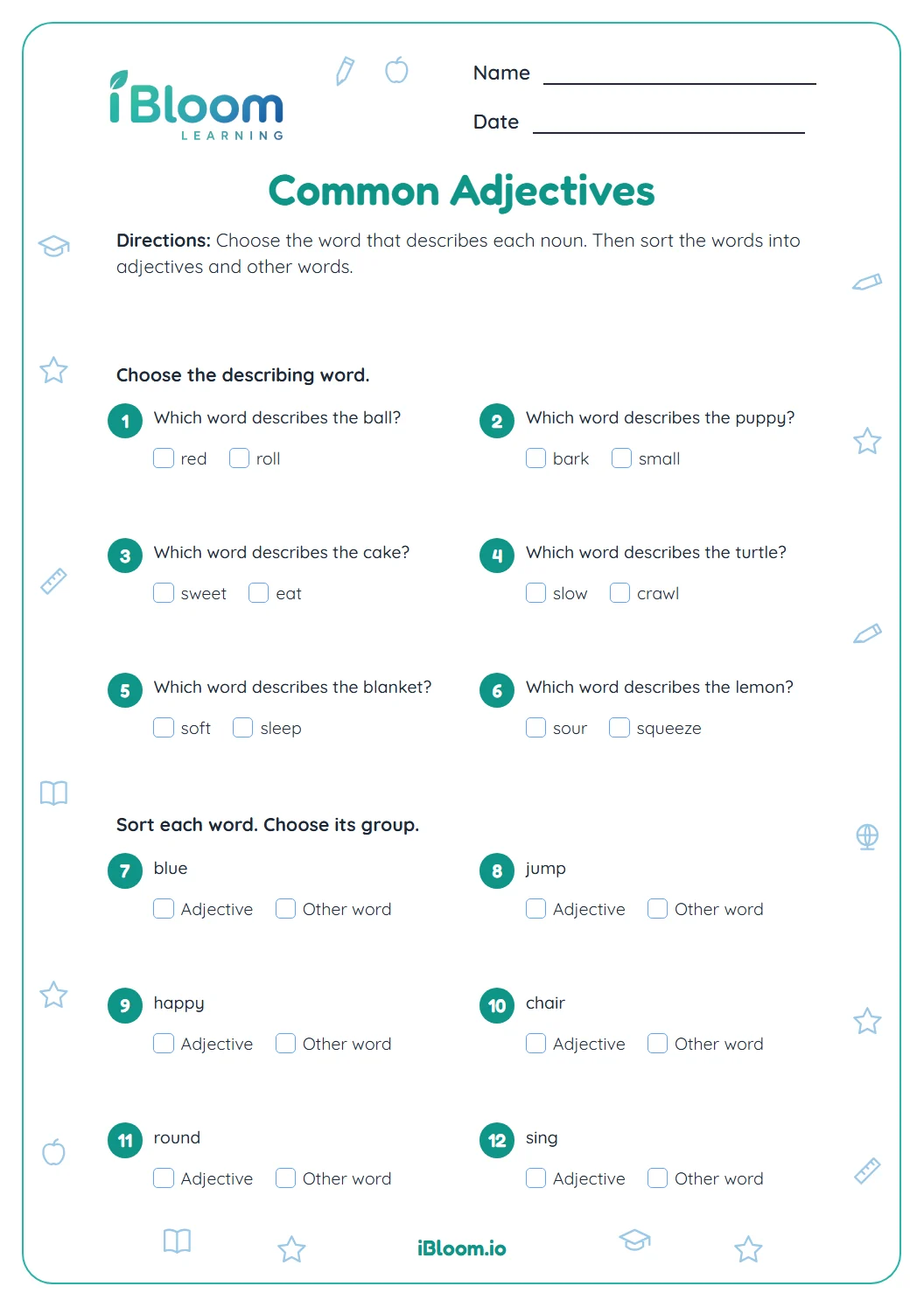
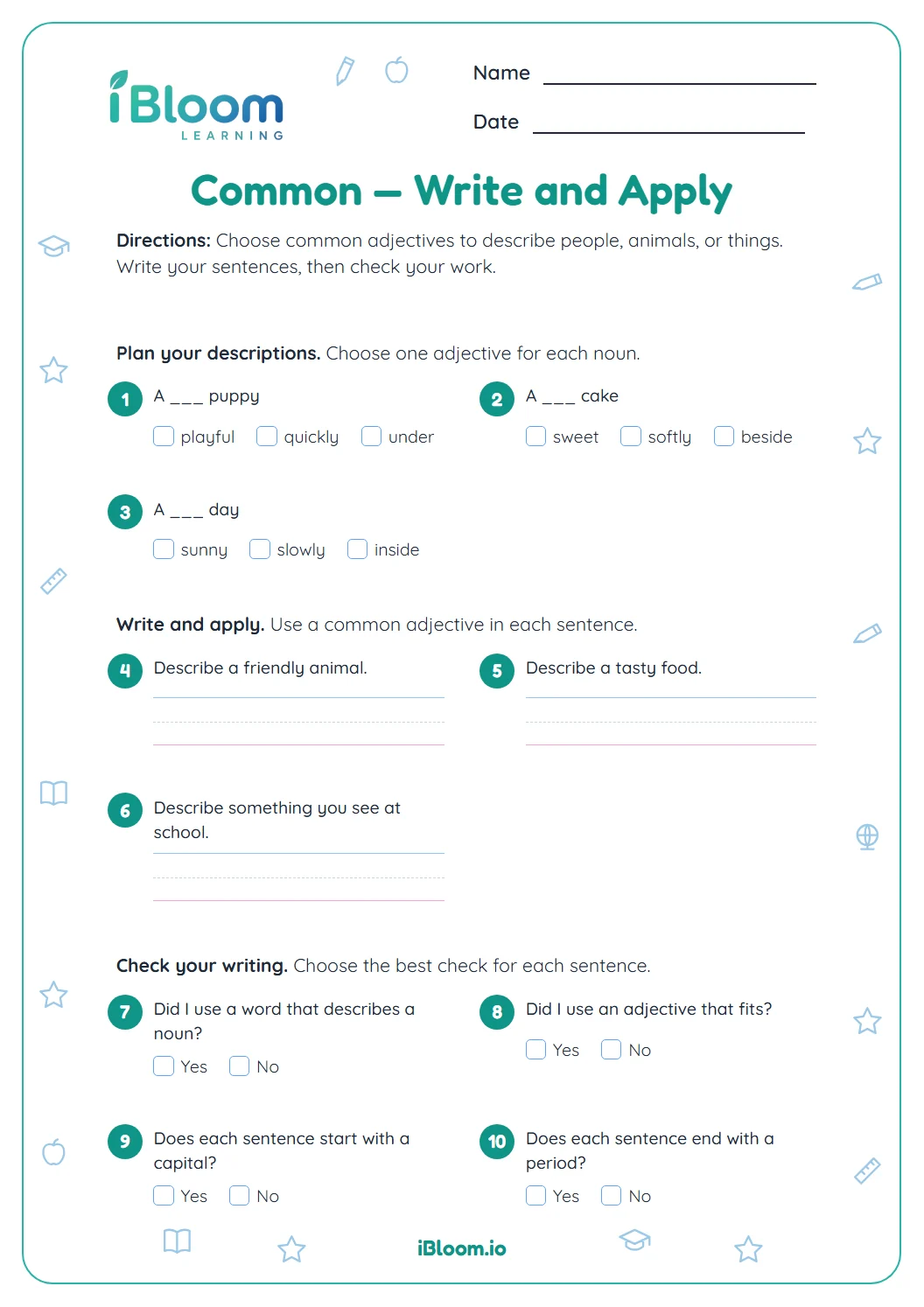
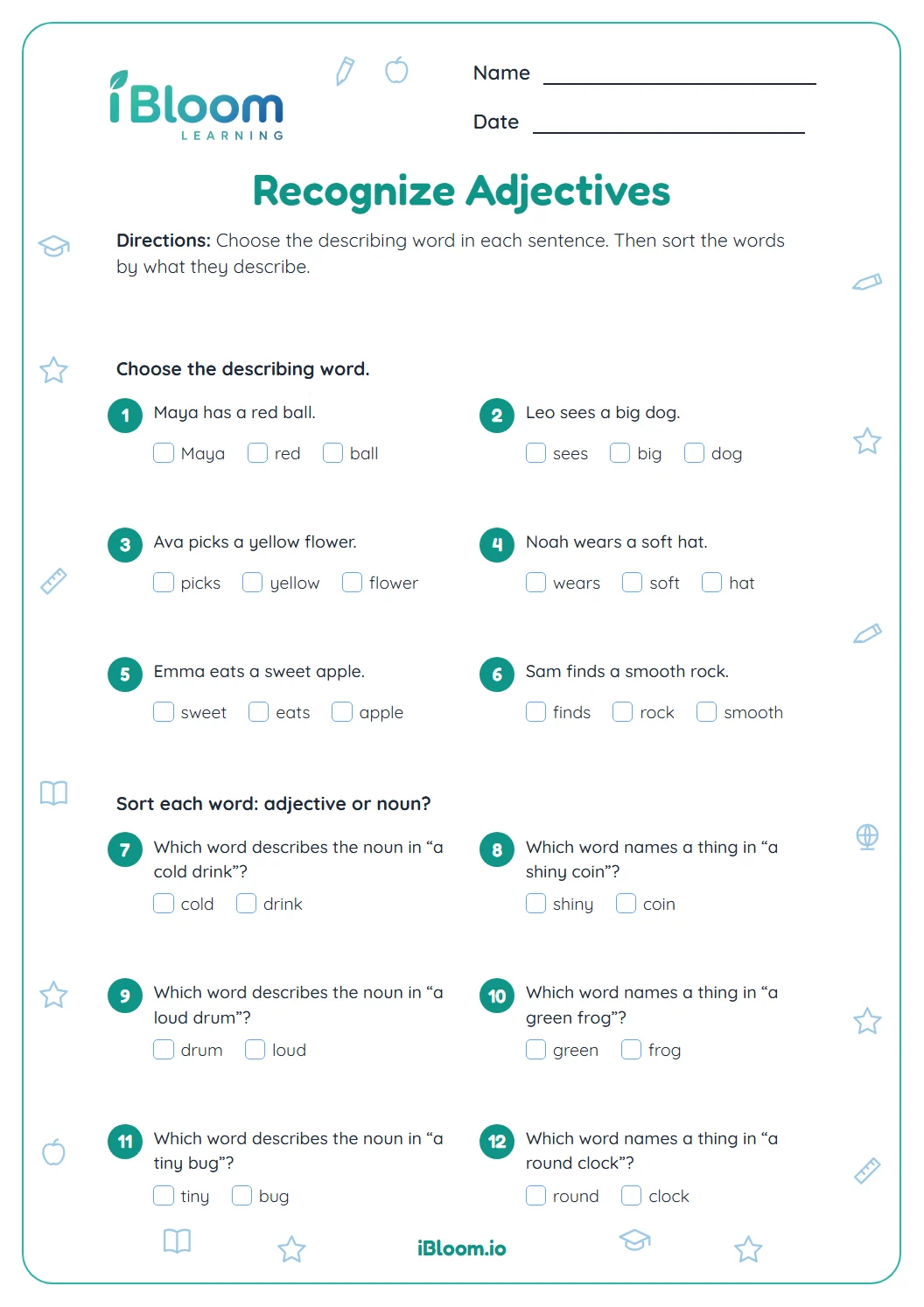
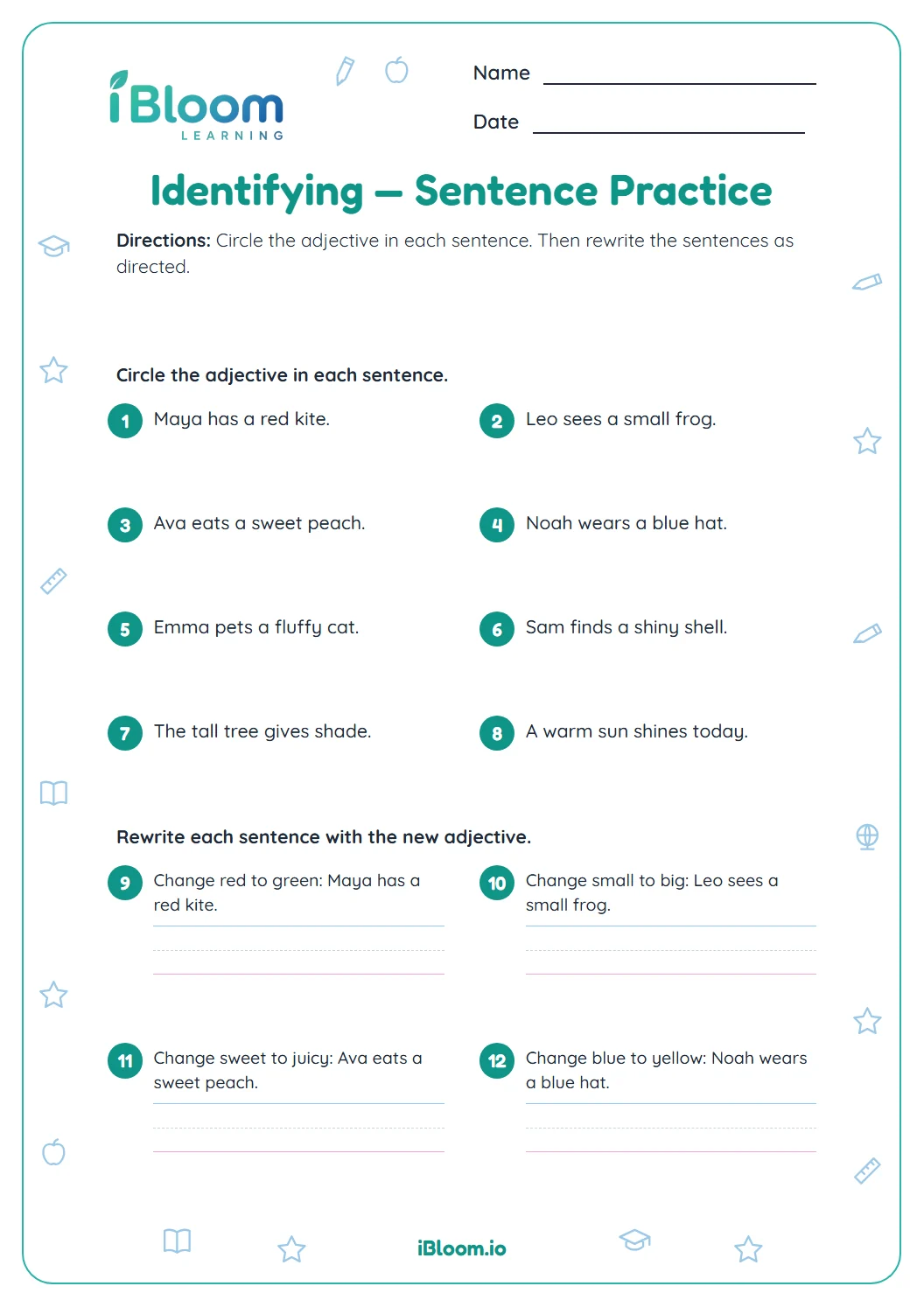


About this worksheet
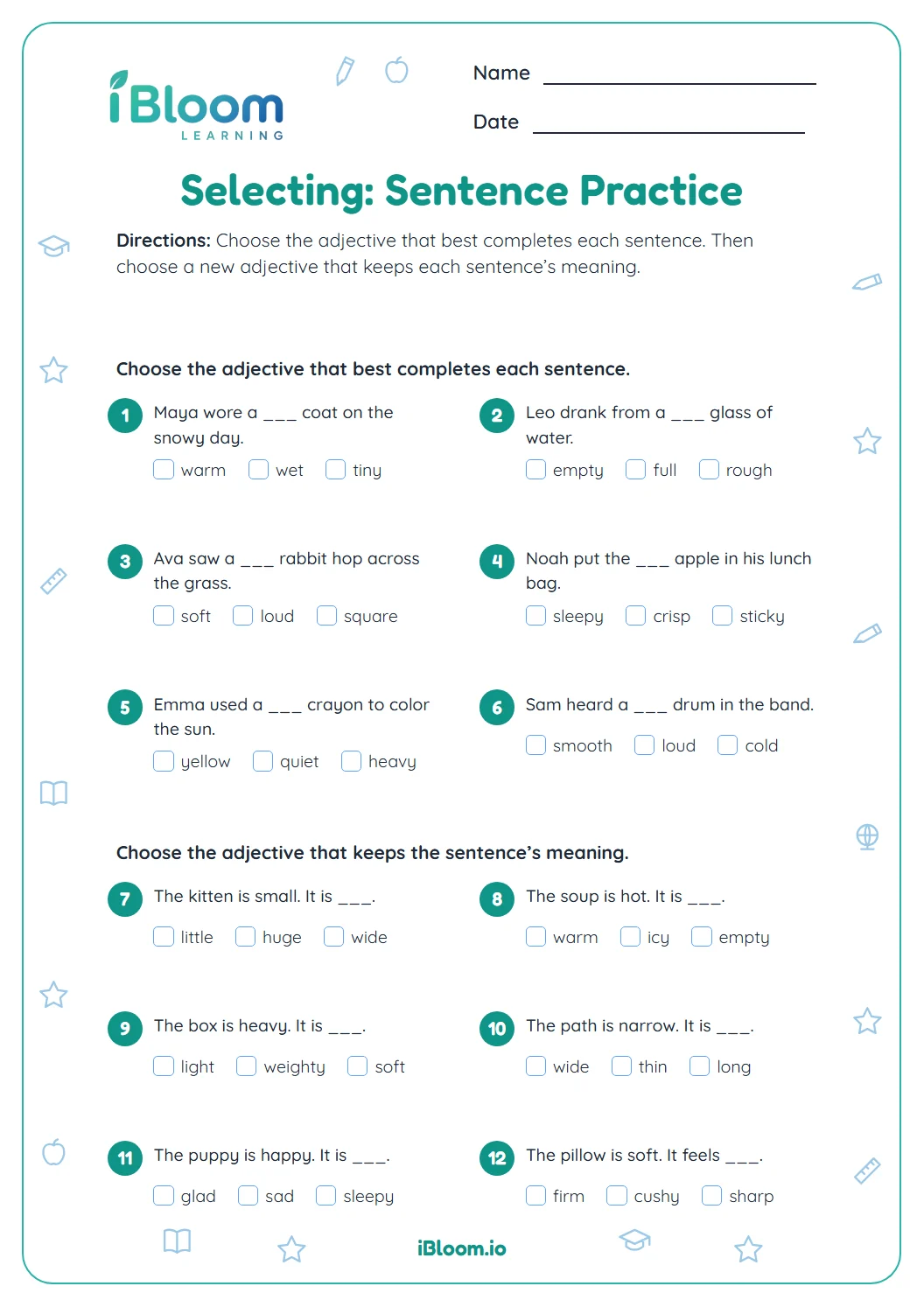
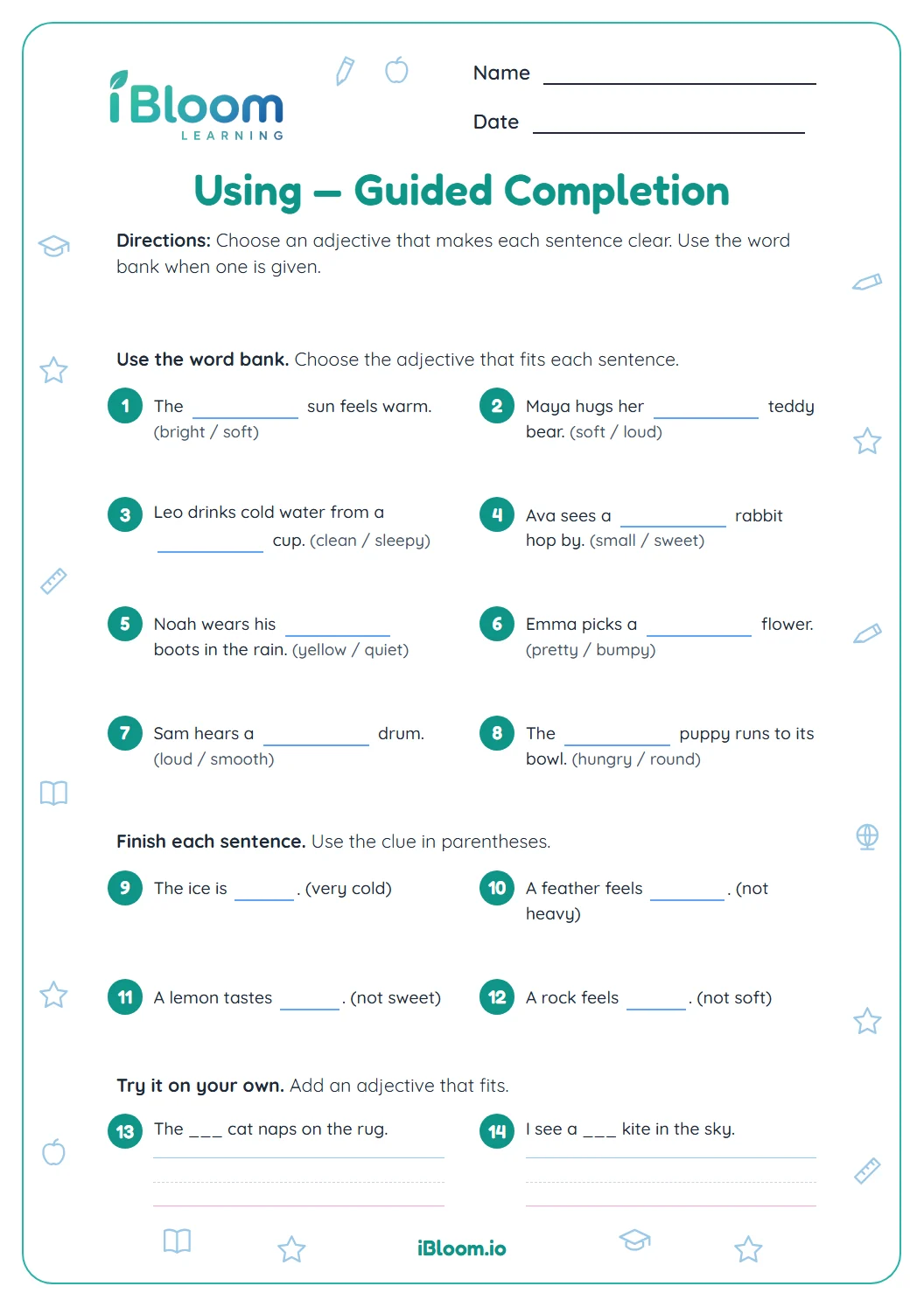
This Grade 1 adjectives worksheet builds from spotting a describing word in a sentence to choosing an adjective that fits a noun and writing an original example. The 14 items practice frequently occurring adjectives in context, including words for animals, foods, and familiar objects. A separate answer key marks the single-word responses and gives examples for the open prompts. It practices Common Core Language standard L.1.1.f.
Aligned to L.1.1.f
How can children spot an adjective?
First find the noun, the person, place, animal, or thing named in the sentence. Then ask “What kind?” In “The fluffy rabbit hops,” rabbit names the animal and fluffy describes it. Part A uses short sentences for this first step.
- 1The fluffy rabbit hops.
- 2What kind of rabbit? A fluffy rabbit. Circle “fluffy.”
How should a child choose an adjective?
Read the whole sentence and look for the noun the blank describes. Try each choice in the sentence, then check whether it tells what that noun is like. Part B includes choices that are verbs or naming words, so the child must choose a describing word.
Why read the whole sentence?
A word’s job depends on how it is used. In “The cold juice tasted good,” cold describes juice. In “Three birds sit on a branch,” colorful describes birds. Part C asks children to circle the describing word in a complete sentence, while Part D invites their own sensible adjectives.
How to use this worksheet at home or in class
- 1Read the first sentence together and find the noun before circling its adjective.
- 2For each choice, reread the complete sentence with the word in the blank.
- 3In Part C, ask “What kind?” about the noun to check the circled word.
- 4For the last two prompts, accept an adjective that sensibly describes the named object.
- 5Use the separate key to check the fixed answers and compare open answers with its examples.
Common mix-ups and a quick fix
The mistake
Circling the naming word, such as rabbit, instead of fluffy.
The fix
Ask “What kind of rabbit?” The word that answers is the adjective.
The mistake
Choosing an answer because it sounds familiar without reading the clue.
The fix
Read the whole sentence with each choice and check that it describes the noun.
The mistake
Treating every word near a noun as an adjective.
The fix
Check the word’s job: in “Colorful birds sit,” colorful describes birds; sit tells what they do.
Common Core alignment
This worksheet gives children sentence practice with frequently occurring adjectives.
Use frequently occurring adjectives to describe nouns in simple sentences.
On this sheet: Children identify and supply adjectives in short sentences.
Show the official wordingHide the official wording
Use frequently occurring adjectives.
What to practice next
Make more practice
Further reading
Questions parents and teachers ask
What is an adjective?
An adjective is a describing word that tells about a noun. In “the fluffy rabbit,” rabbit names an animal and fluffy tells what kind of rabbit it is. This worksheet asks children to find adjectives in sentences, choose one that fits a noun, and supply two describing words of their own.
Which word is the adjective in “Colorful birds sit on a branch”?
Colorful is the adjective because it describes the birds. Birds names the animals, while sit tells what they do. Ask “What kind of birds?” and the answer is colorful. The question uses a clear describing word so children can focus on its job in the sentence.
Can a number word describe a noun?
Yes, a number word can tell how many nouns there are, as in “three birds.” However, this worksheet focuses on descriptive adjectives such as fluffy, shiny, and cold. The revised sentence uses colorful as its answer so learners can practice describing a noun without a grammar-category detour.
Can children give different answers to the last two questions?
Yes. The last prompts ask children to write one adjective for a kite and one for a cake. Answers such as bright kite and soft cake are examples, not the only possibilities. Accept a word that describes the noun and makes sense in the child’s phrase.
How many questions are on the worksheet?
There are 14 questions: eight sentences to scan for an adjective, four multiple-choice sentences, and two short writing prompts. The separate answer key gives the target word for fixed items and sample answers for the two open responses, which can have other sensible answers.