


About this worksheet
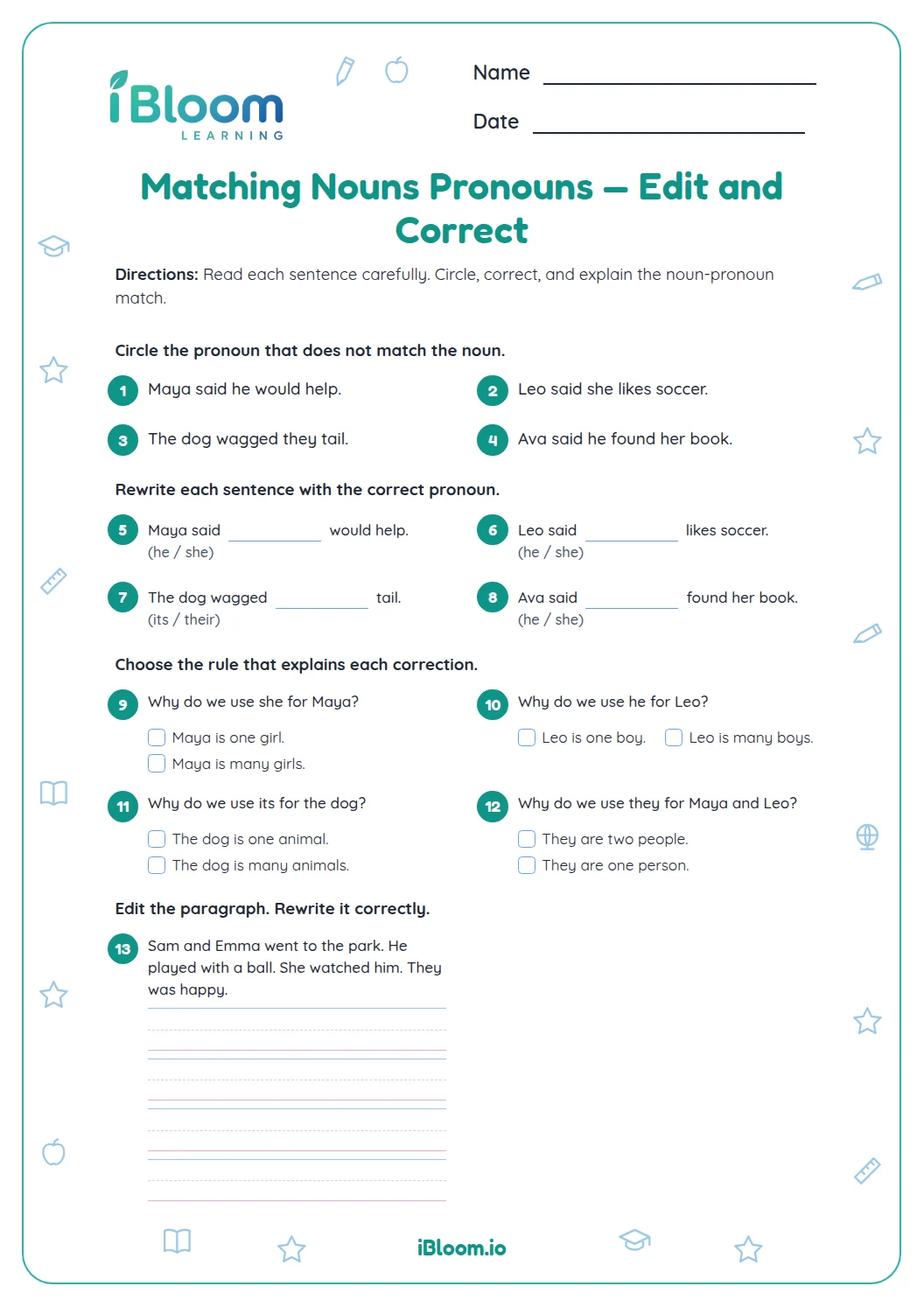
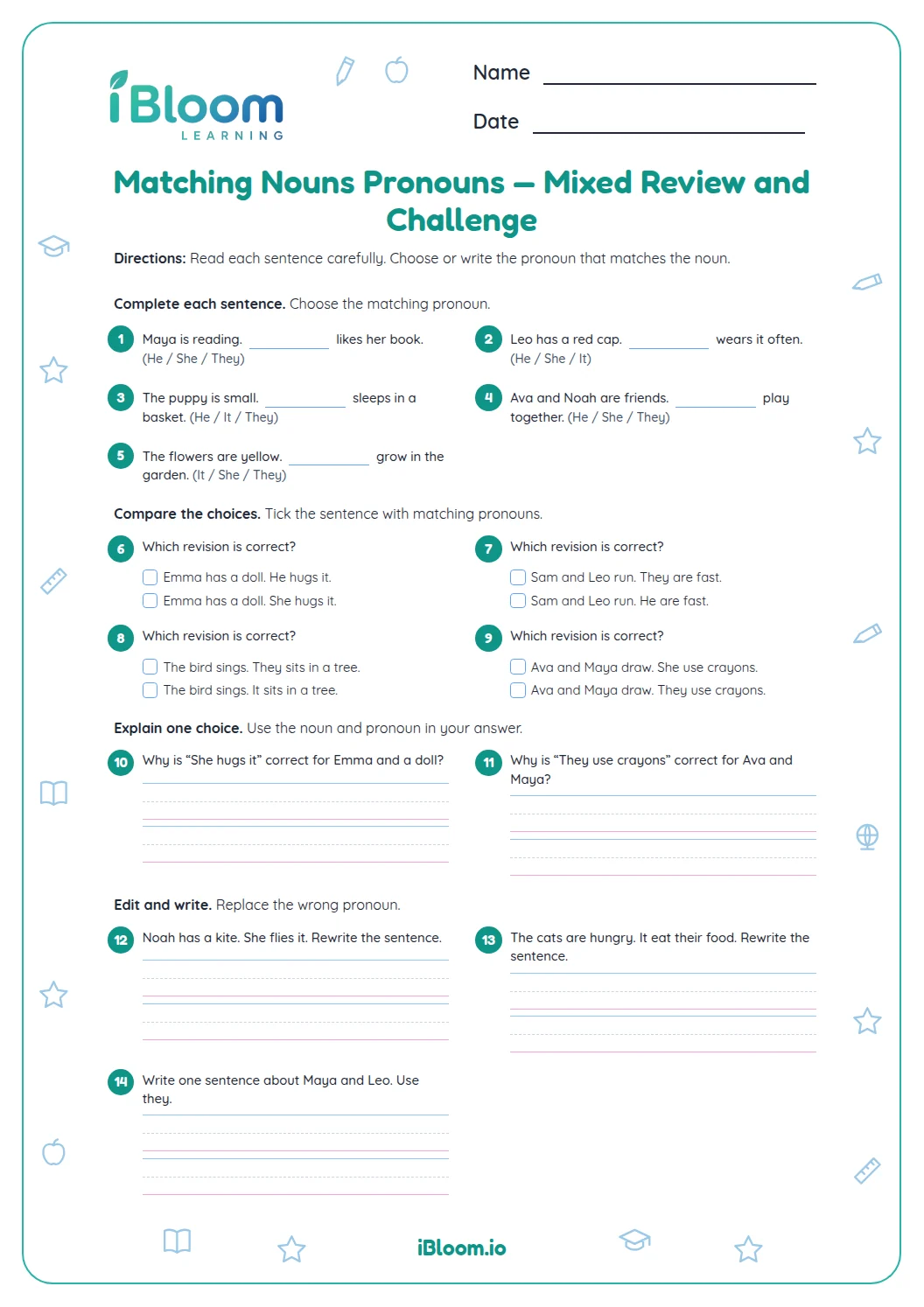
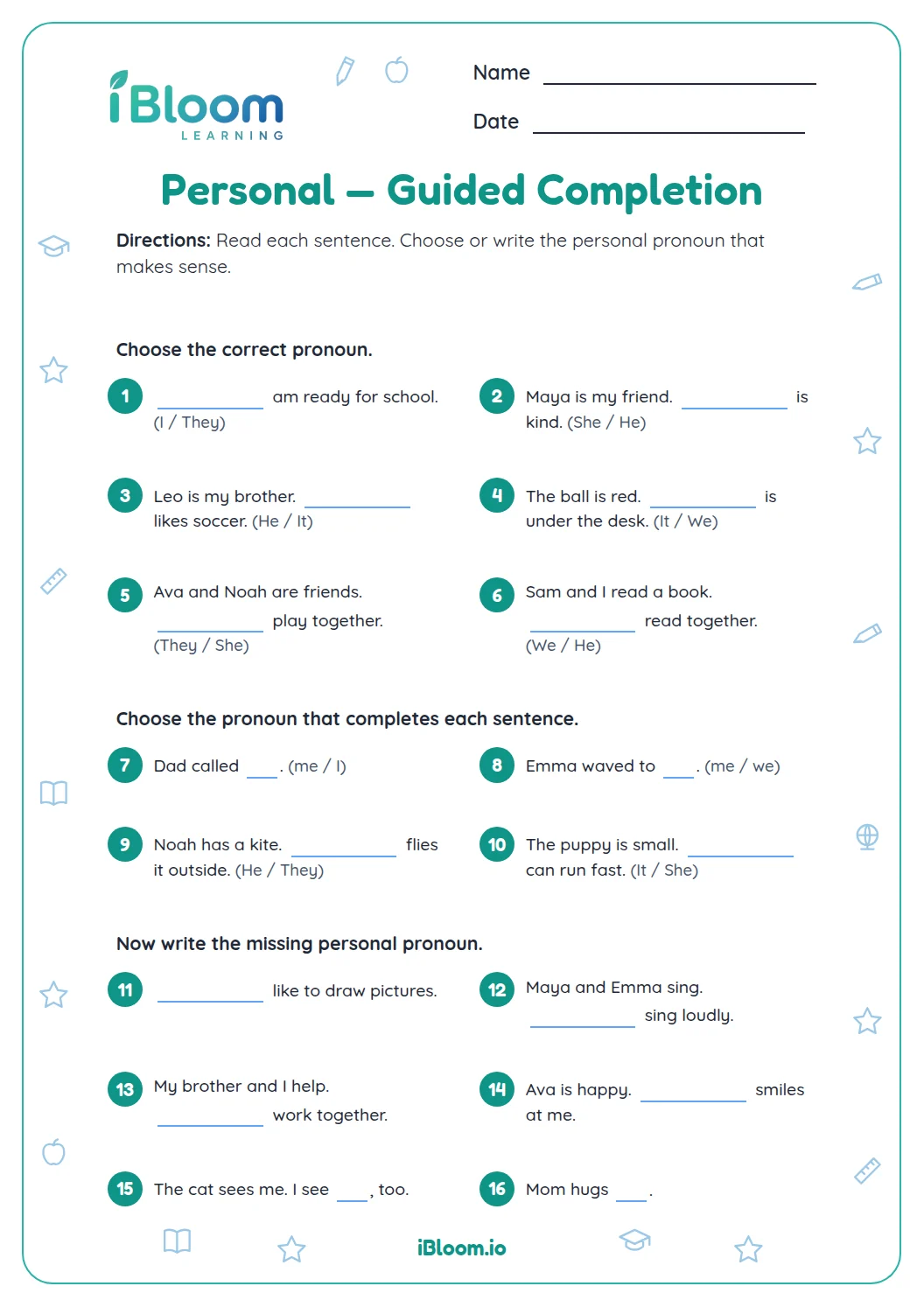
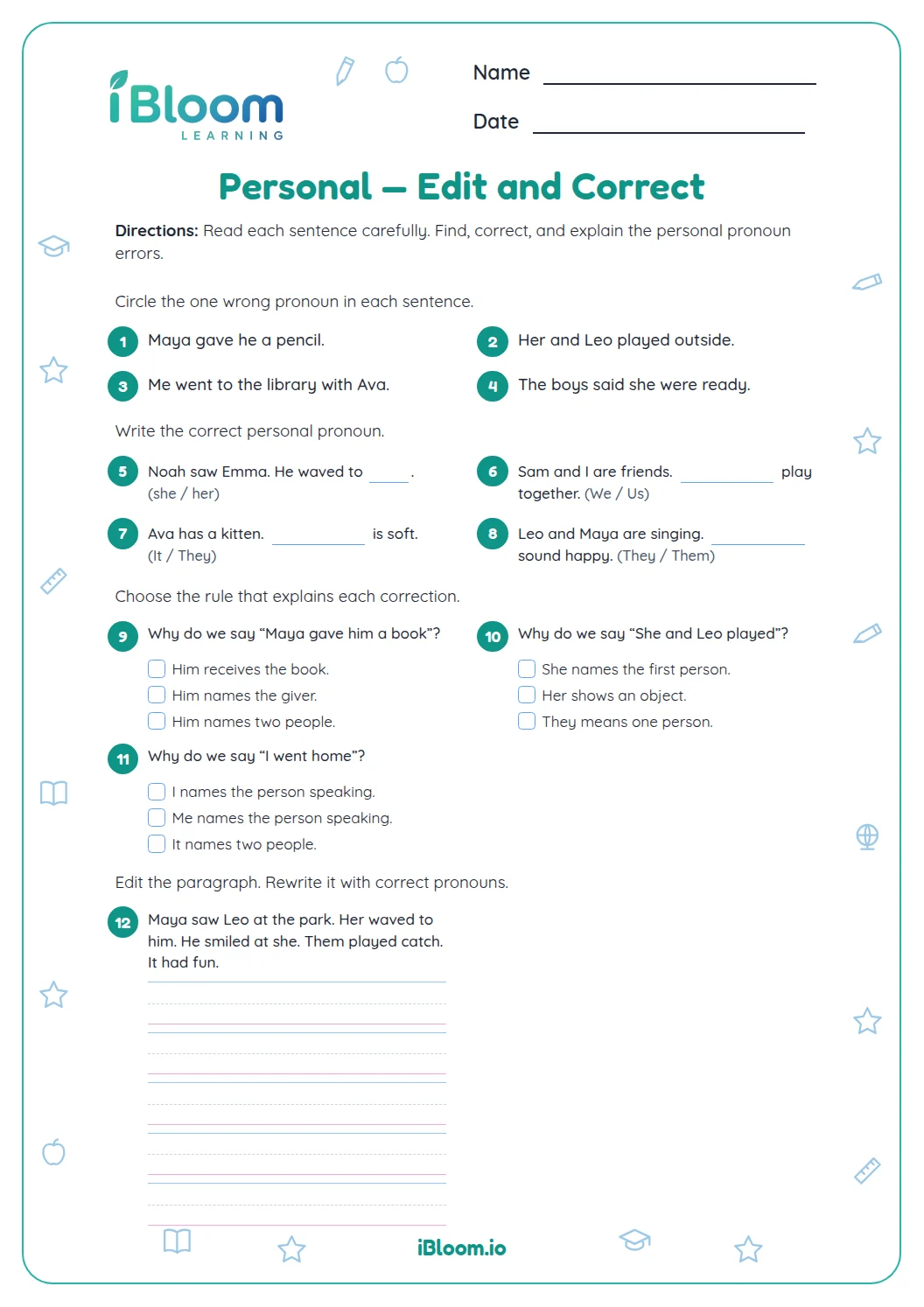
This Grade 1 grammar worksheet gives children practice choosing pronouns that refer clearly to people, animals, and things. Across three parts, students select personal pronouns such as she, we, and them, then use possessive forms such as her, our, and its. The 16 sentence completions move from simple noun matches to pronouns in complete sentence contexts. A printable answer key is included for checking the choices.
Aligned to L.1.1.d
How do students choose a pronoun?
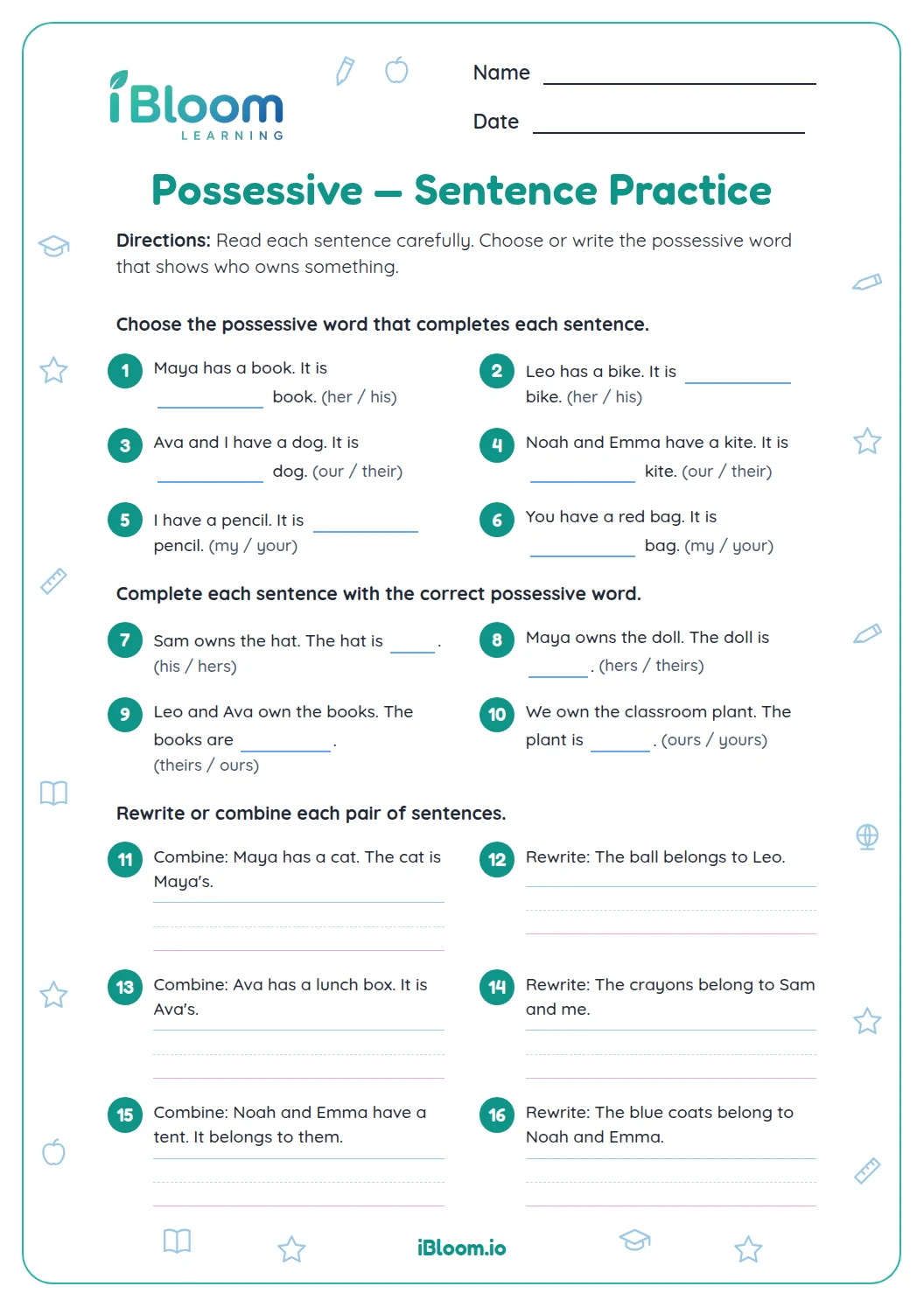
Part A focuses on personal pronouns that stand in for one or more people, animals, or things. For question 1, “Mia” is one girl, so “She flies it” is the matching completion.
How do pronouns show ownership?
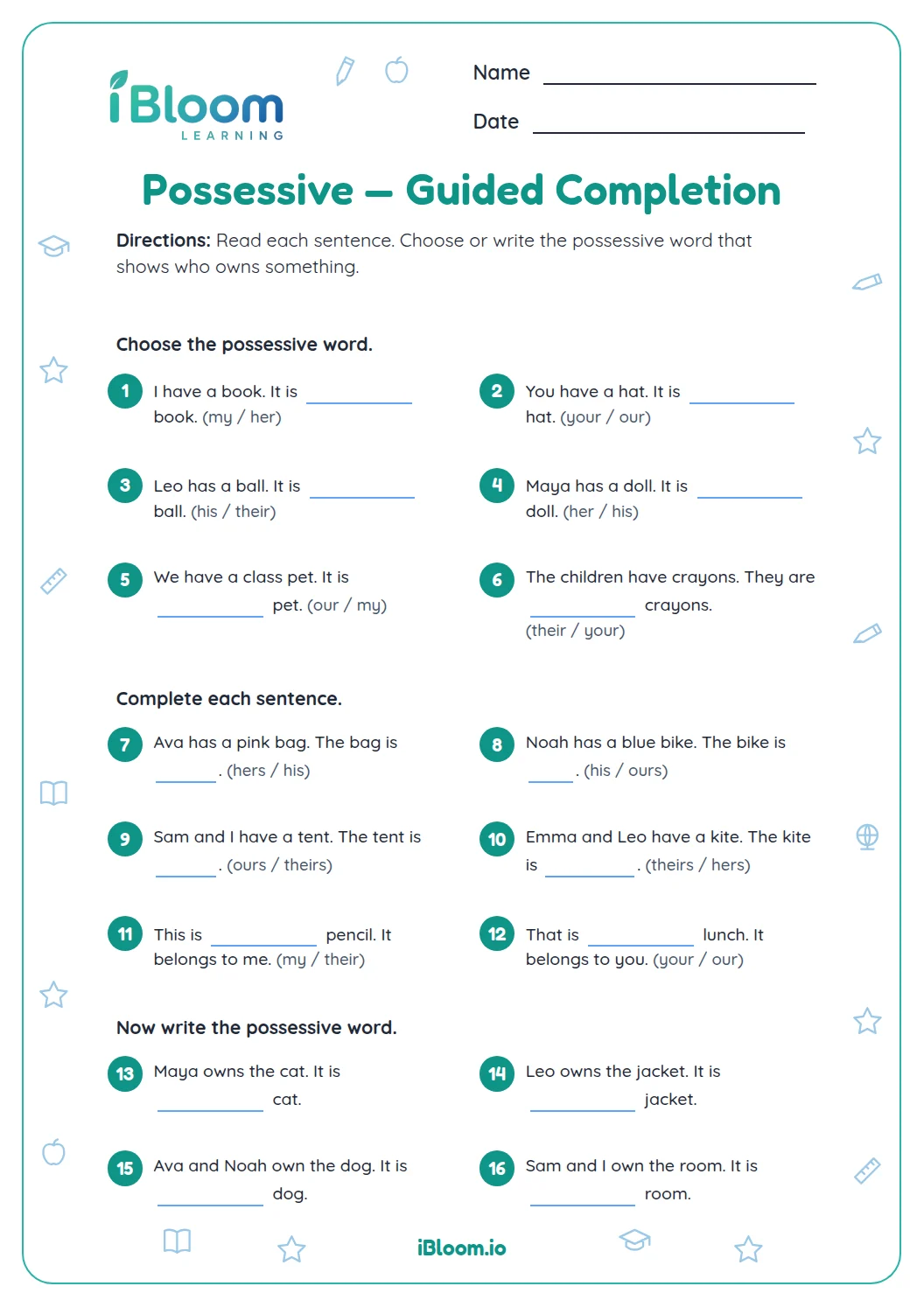
Part B asks students to connect a noun with a possessive pronoun. In question 7, the hat belongs to Lena, so “hers” completes the sentence.
What is in the final part?
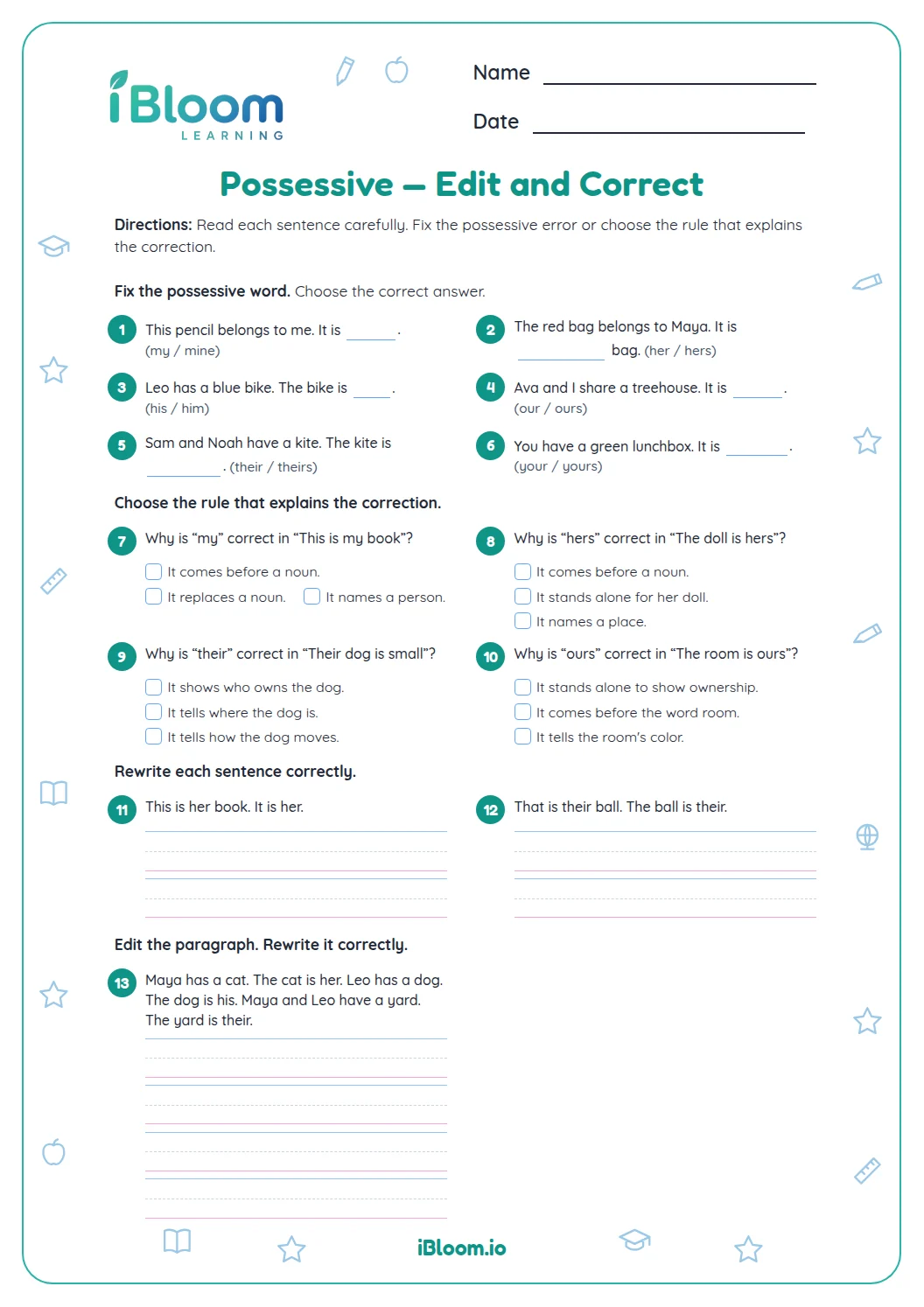
Part C places pronouns in full sentences, including choices such as I or me and its or their. Read the whole sentence to make sure the pronoun fits.
How to use this worksheet
- 1Read the sentence and identify the person, animal, or thing named.
- 2Notice whether the sentence needs a subject, an object, or an ownership word.
- 3Try each answer choice in the blank.
- 4Reread the full sentence aloud to check that it makes sense.
- 5Use the key to talk through any choice that was tricky.
Common mistakes and quick fixes
The mistake
Choosing “me” as the subject in “___ are ready.”
The fix
Use “I” or “they” before the action or linking verb; use “me” after words like to or with.
The mistake
Using “they” for one cat.
The fix
Match the pronoun to the noun: one cat takes “it,” while several cats take “they.”
The mistake
Using “their” for one bird.
The fix
Check whether the owner is one thing or more than one; one bird has “its” wings.
This worksheet practices choosing pronouns that fit sentence meaning and grammar.
Children choose personal and possessive pronouns that agree with the nouns in each sentence.
On this sheet:
Show the official wordingHide the official wording
Use personal, possessive, and indefinite pronouns (e.g., I, me, my; they, them, their, anyone, everything).
What to practice next
Further reading
Questions parents and teachers ask
What pronouns appear on this worksheet?
The page has 16 sentence completions in three parts. Part A offers choices for personal pronouns, Part B asks students to write matching and possessive pronouns, and Part C returns to choices in complete sentences. The key lists a response for each item.
How many questions are included?
“I” names the person doing an action, as in “I made a card.” “Me” follows a preposition or verb, as in “Come with me” or “Dad waved to me.” Students can reread the whole sentence to hear which form fits.
What is the difference between “I” and “me”?
Use “its” to show that one animal or thing owns something, as in “The cat licked its paws.” “It’s” means “it is.” The worksheet practices “its” in a sentence about a cat, and the key gives the expected pronoun. The sentence gives a clue.
When should a child use “its”?
A child who can read short Grade 1 sentences can try the items independently. An adult can read a prompt aloud if needed, then ask which noun the blank refers to. The answer key supports a quick check after the child finishes.
Can students complete this independently?
The answer key gives the intended pronoun for every item. If an answer is missed, reread the full sentence and identify whether the blank needs a subject, an object, or a word that shows ownership. Reading aloud can help. Reread the full prompt before checking the response.
How can I check the answers?
Use the answer key after students finish. For a missed item, reread the sentence and ask which noun the pronoun refers to and whether it shows a subject, object, or ownership. Ask the student to point to the clue that supports the choice, then reread the full example together to confirm its meaning.