
About this worksheet
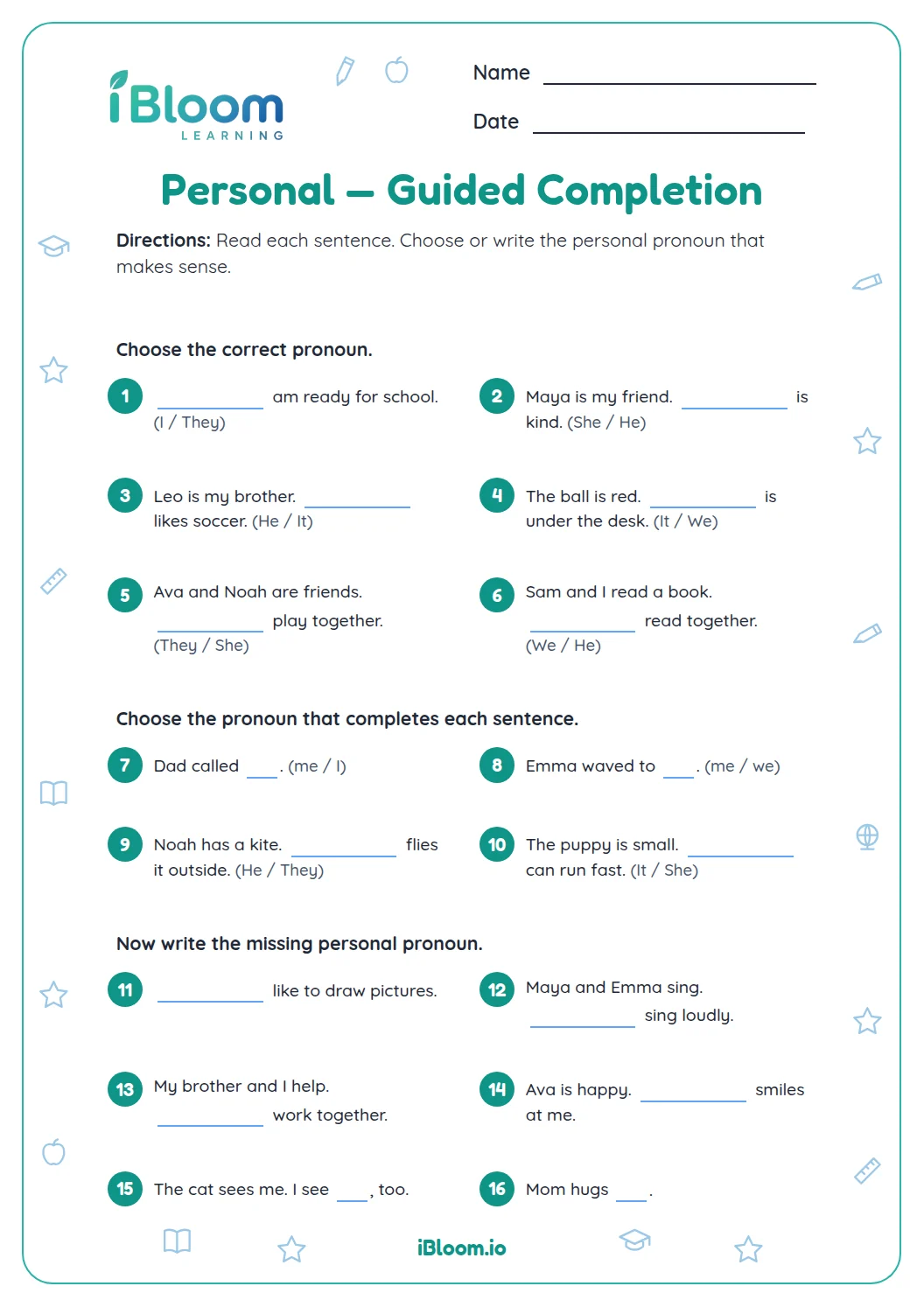
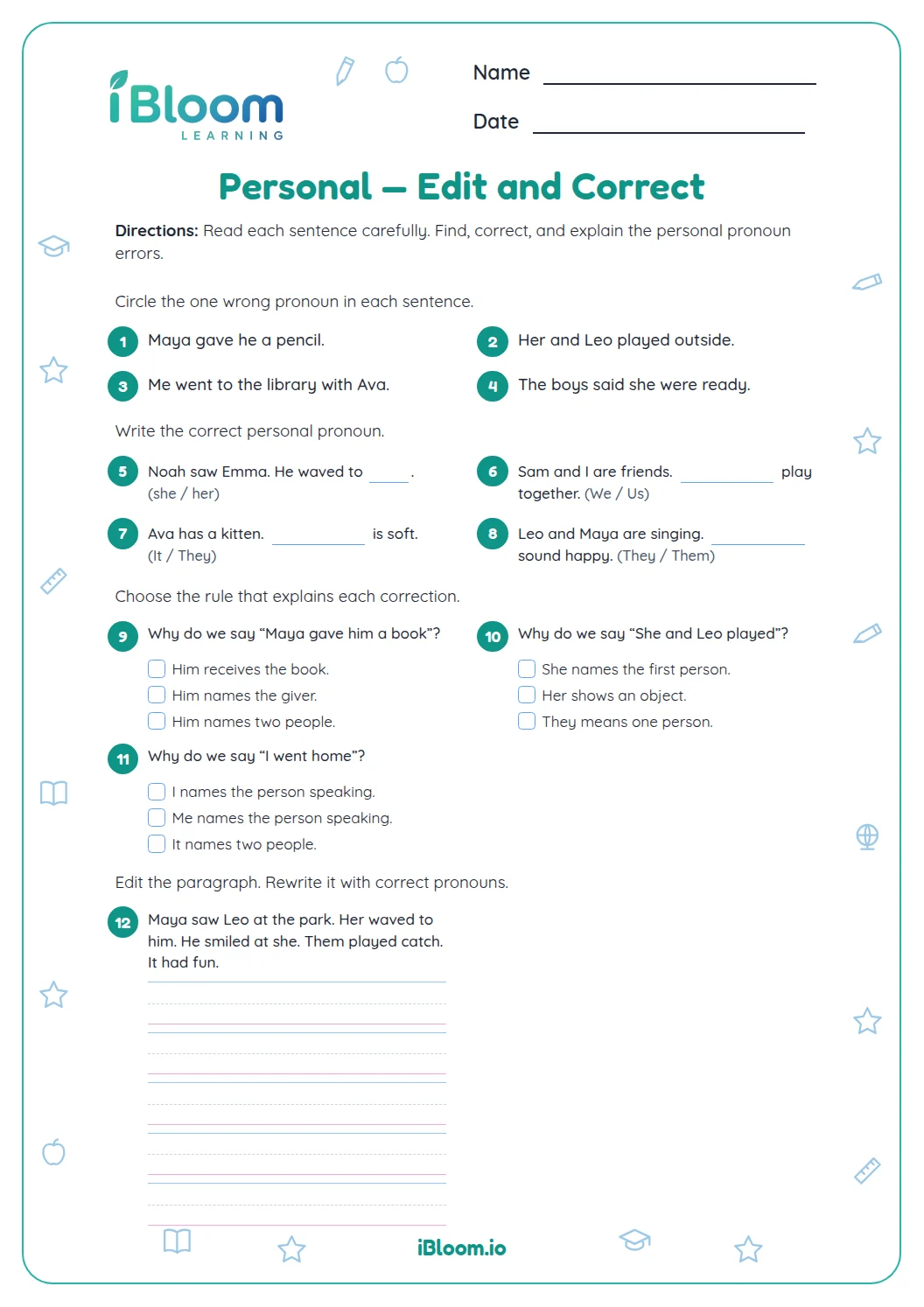
This printable Grade 1 worksheet helps children recognize personal pronouns that refer to a person, animal or thing named in the sentence. Part A asks children to choose a pronoun in a sentence; Part B practices matching pronouns to people, animals and things; Part C asks children to supply a pronoun in a repeated sentence frame. The practice connects to CCSS L.1.1.d, which names personal pronouns. An answer key is included.
Aligned to L.1.1.d
What does this worksheet ask children to do?
The 16 items move from choosing a pronoun to supplying one. Children see singular and plural naming words, including a group that includes the speaker.
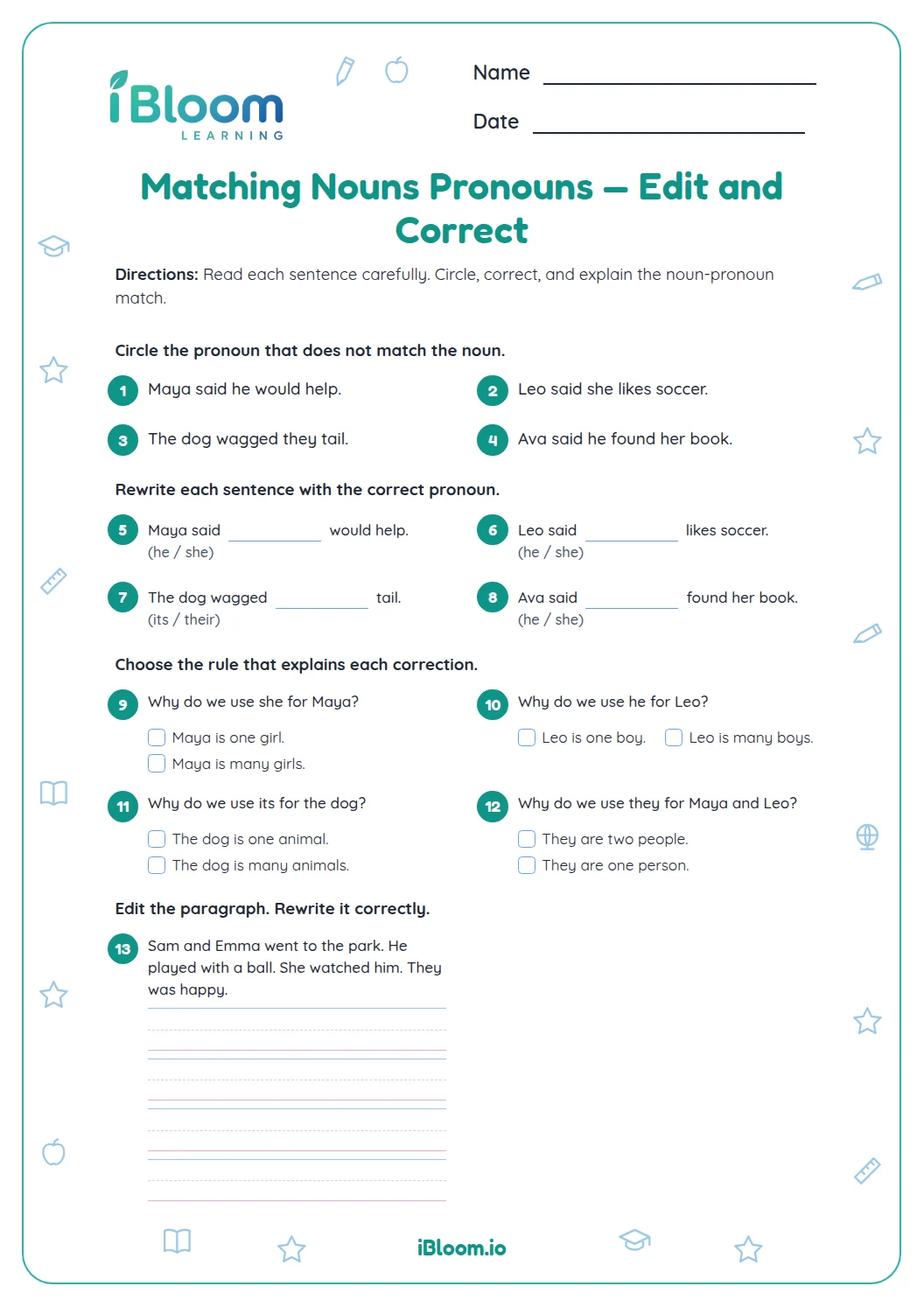
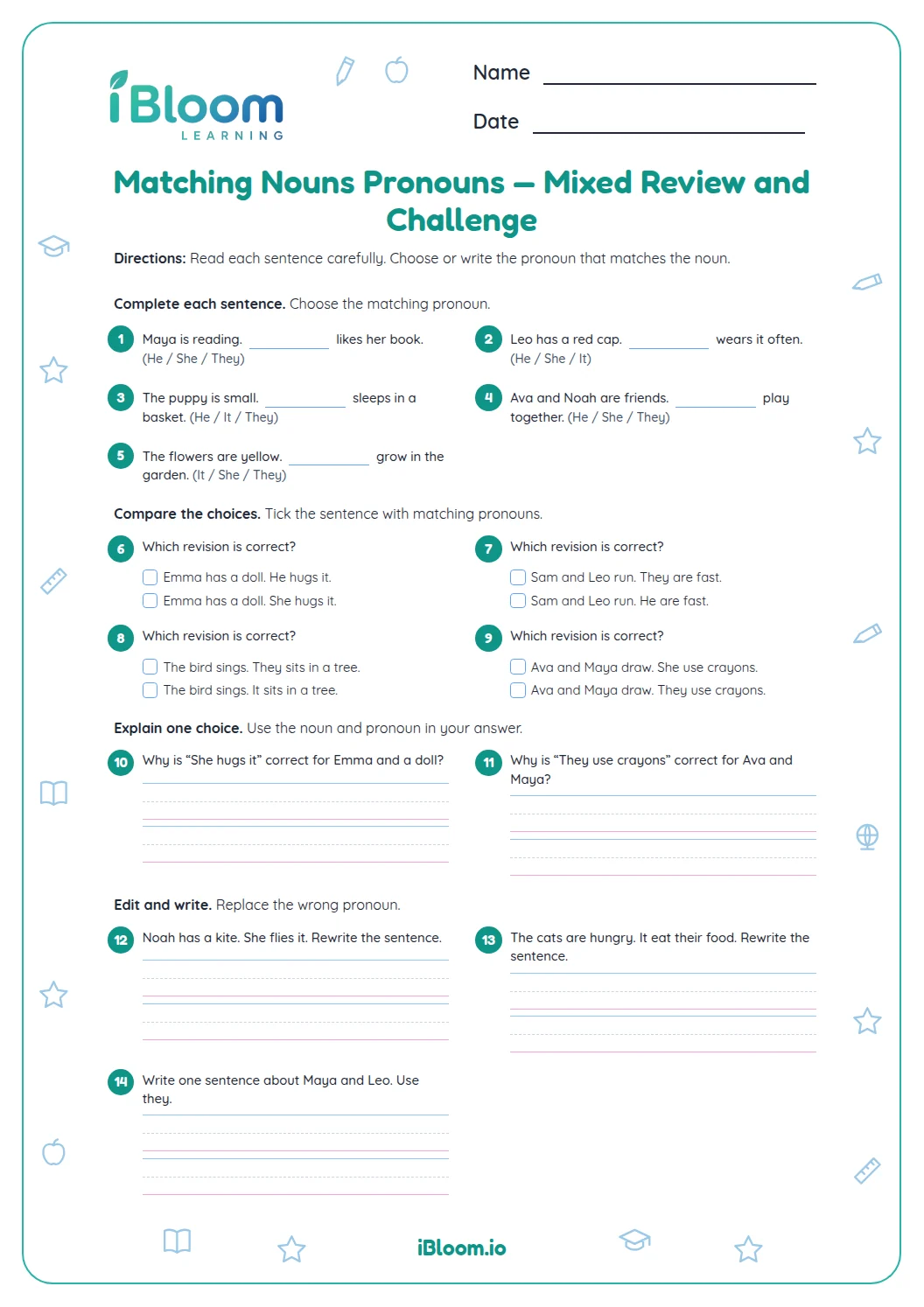
- 1“The puppies nap. They are tired.” → They refers to the plural noun puppies.
How can a child check a pronoun match?
Read the sentence with the noun and pronoun together. Check whether the pronoun means the same person, animal or thing, and whether one or more than one is meant.
When do we use I, we, he, she, it or they?
Use I for the speaker, we for the speaker with others, he or she for one person when the sentence gives that information, it for one thing or animal, and they for a plural group.
How to use this worksheet
- 1Read each complete sentence before choosing.
- 2Find the naming word or naming group.
- 3Ask whether it names one or more than one.
- 4Try each pronoun in the sentence and choose the one that keeps the meaning.
- 5For Part C, write the pronoun that replaces the words in quotation marks.
Common mistakes and quick fixes
The mistake
Using “it” for several puppies.
The fix
Check whether the naming word means one or more than one; use “they” for a plural group.
The mistake
Using “we” when the speaker is not included.
The fix
Use “we” only when the speaker is part of the group.
The mistake
Choosing “he” or “she” without a clue about the person.
The fix
Use the words in the sentence; when no clue is given, a name or neutral plural phrasing may be needed.
Common Core alignment
This Grade 1 grammar practice focuses on choosing personal pronouns that refer to nouns.
Use personal pronouns that match the naming word.
On this sheet: Children select and supply personal pronouns that refer to nouns or noun groups.
Show the official wordingHide the official wording
Use personal, possessive, and indefinite pronouns.
What to practice next
Make more practice
Further reading
Questions parents and teachers ask
What is a pronoun?
A pronoun is a word used in place of a naming word. In “The puppies nap. They are tired,” they replaces the naming words the puppies. Children read complete sentences to hear how each pronoun and noun fit together. The examples use familiar names and groups.
How many questions are on the worksheet?
There are 16 questions in three parts. The first two parts ask children to choose a pronoun, and the final part asks them to write a pronoun in a sentence that repeats the naming words from the question. The questions use short, complete sentences.
Does the worksheet include an answer key?
Yes. A separate answer key page lists the answers for all 16 items. An adult can use it to check the work or help a child talk through a pronoun that does not seem to match the noun. It follows the same item numbers.
What is the difference between “we” and “they”?
We includes the speaker, while they refers to other people, animals or things. If Mom and I cook, we includes the speaker. If the girls laugh, they refers to the girls in the sentence, not the speaker. The pronoun choice depends on who is included in the group.
Why does a pronoun need to match its noun?
A pronoun should point back to the same person, animal or thing named earlier. It should also fit whether the noun means one or more than one. Reading the sentence aloud can help children hear a mismatch. The noun and pronoun should point to the same meaning.