



About this worksheet
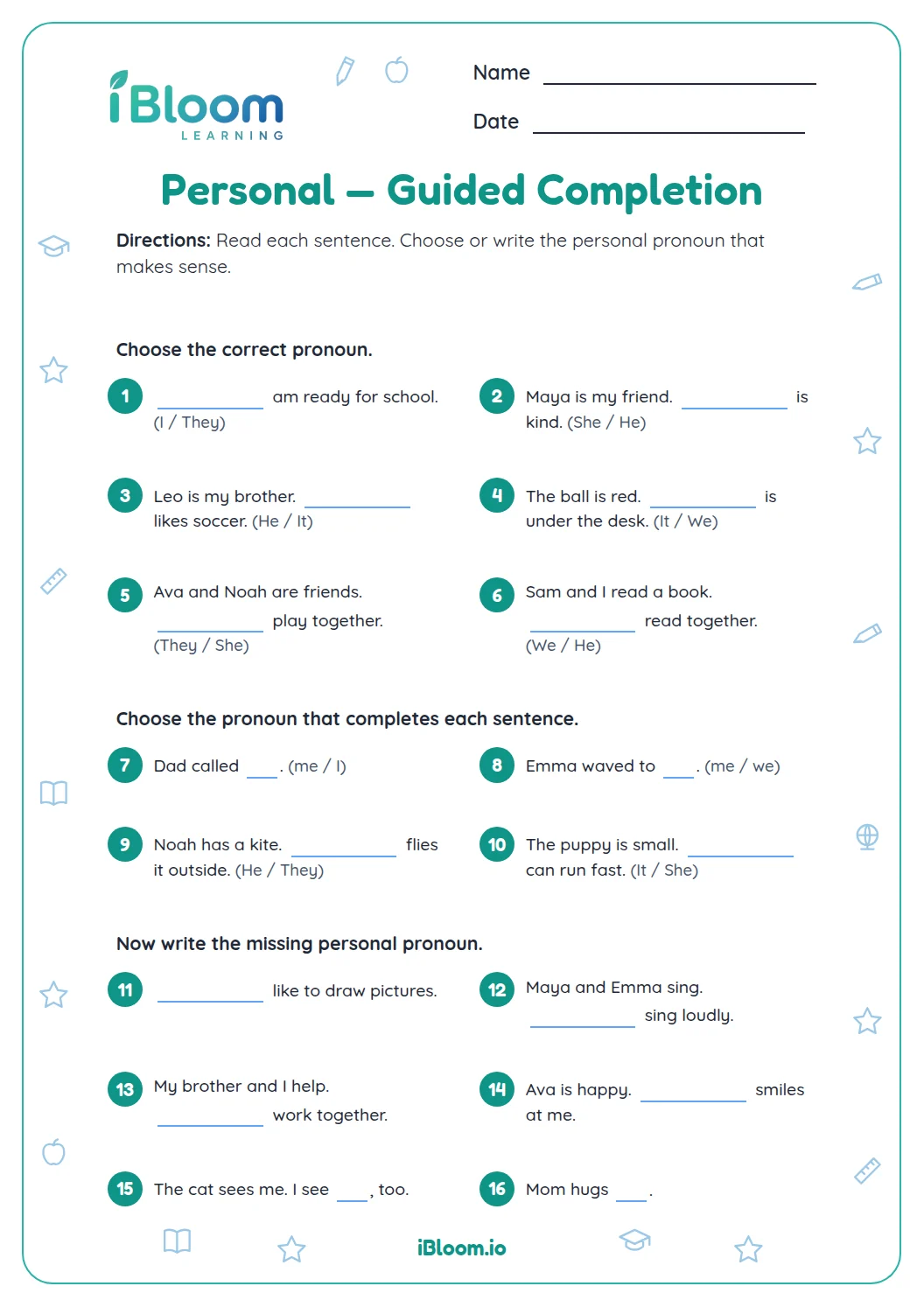
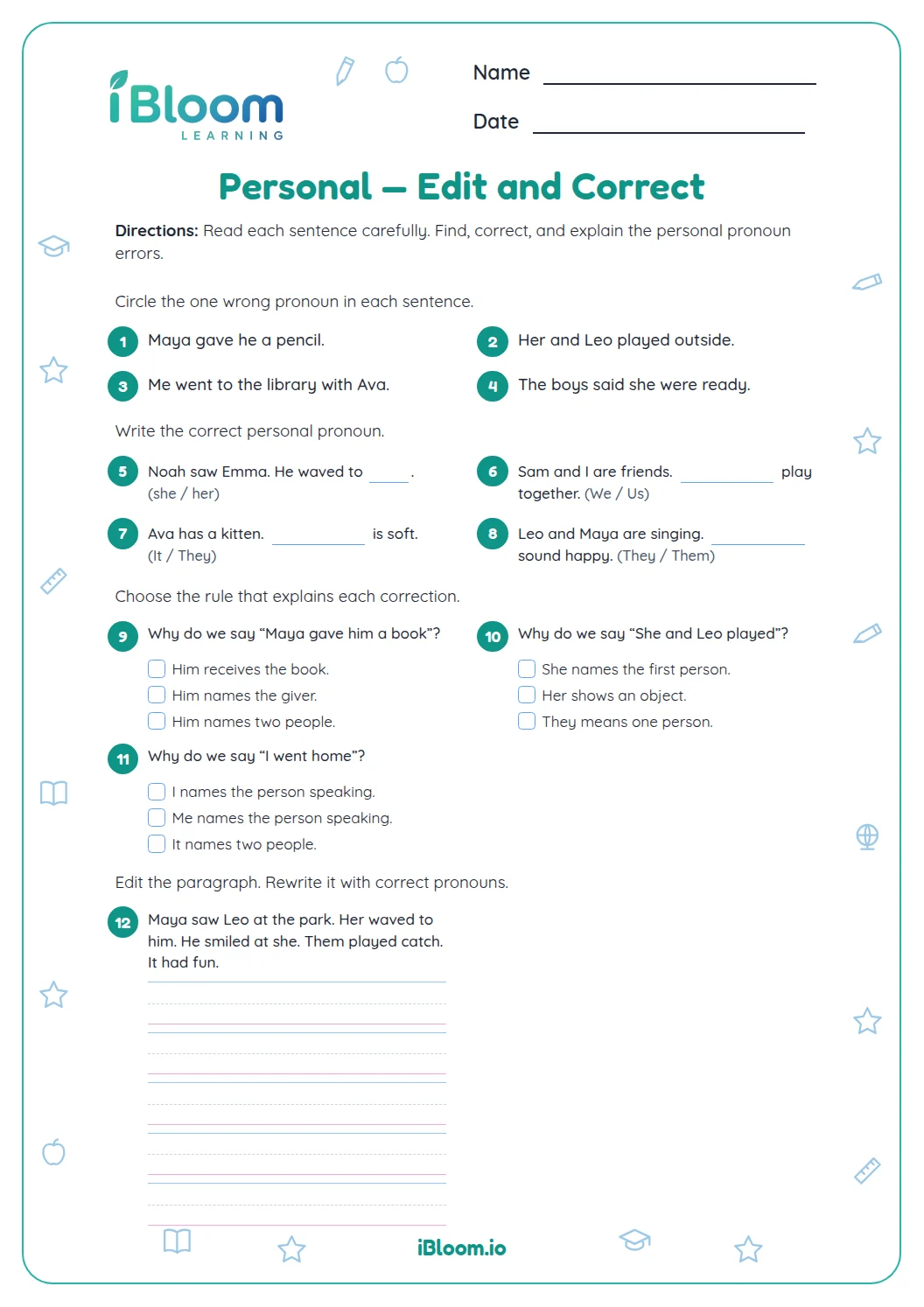
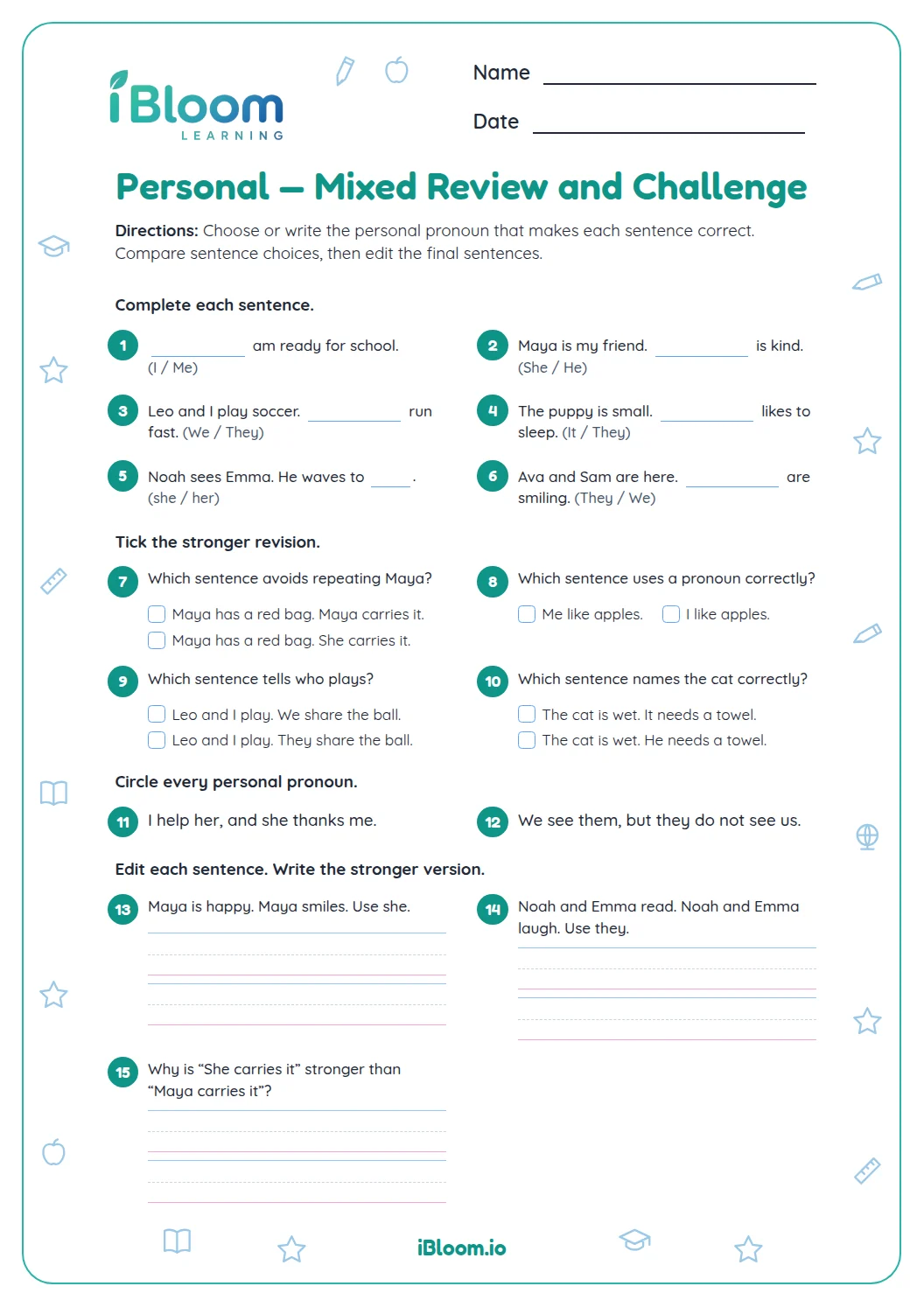
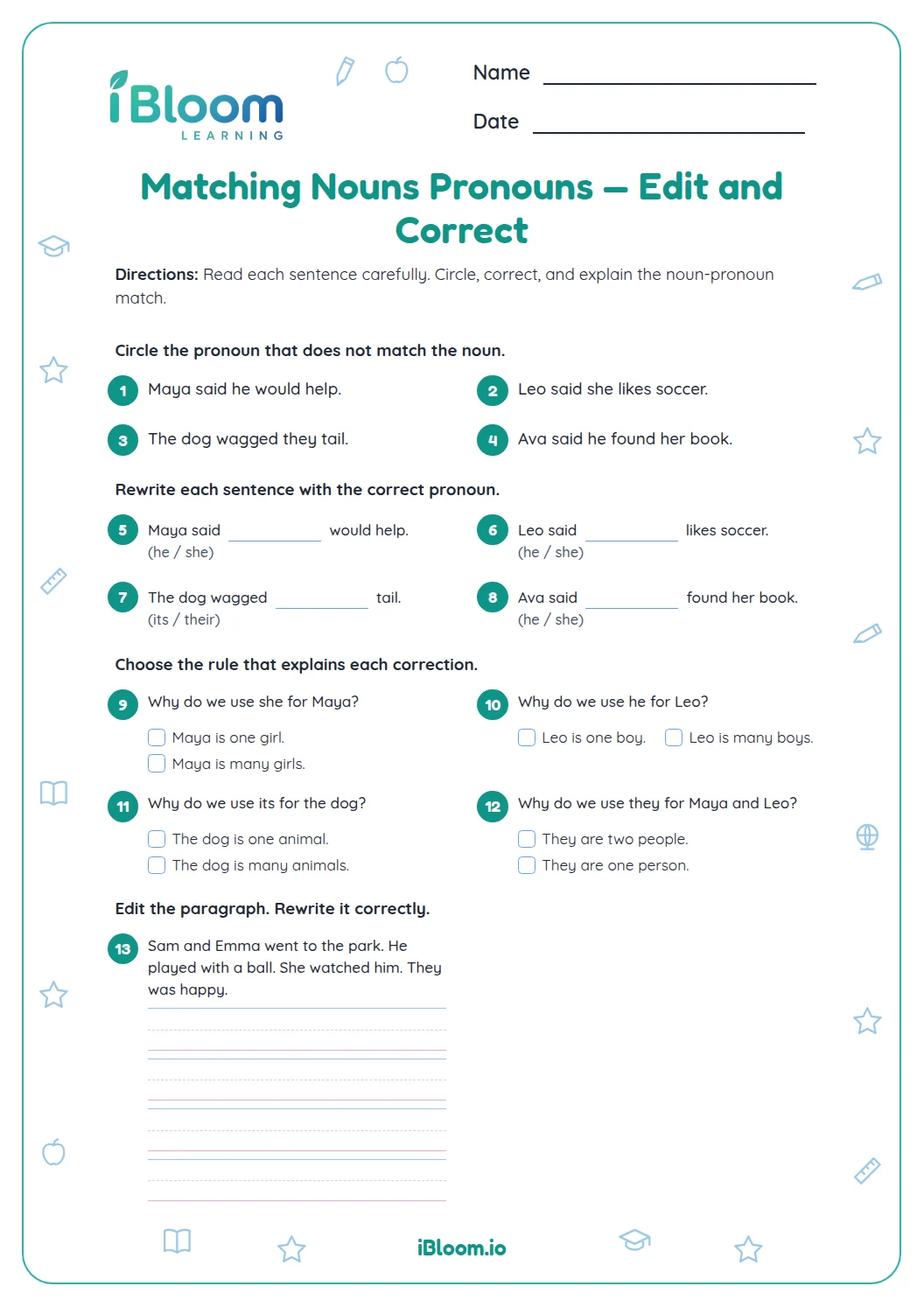
This Grade 1 printable gives students 14 short personal-pronoun questions. They identify pronouns in sentences, complete sentences with a fitting pronoun, distinguish pronouns from other words, and choose forms that refer to people or things. A final prompt invites a sentence using they. The answer key marks the choices and gives a sample sentence. The page practices personal pronouns through recognition and use in simple sentence contexts.
Aligned to 1.L.1.d
How can a child spot a personal pronoun?
Part A asks children to choose the pronoun in a short sentence. A pronoun names who is speaking or refers to someone already mentioned.
- 1She has a red hat.
- 2She is the pronoun.
How can a pronoun replace a name?
In Part B, use the name or group in the first sentence to decide which pronoun completes the next sentence. Check that the sentence still makes sense.
How do readers choose a pronoun that fits?
Part C asks students to distinguish pronouns from other words and match a pronoun to a person, group, or thing. Part D asks for an original sentence using they.
How to use this worksheet
- 1Read the full sentence before choosing a pronoun.
- 2Ask who or what the pronoun names or replaces.
- 3For a blank, reread the sentence with the pronoun in place to check that it fits.
- 4In the final prompt, write a complete sentence using they.
- 5Use the answer key to check choices and compare the sample sentence.
Personal pronoun mistakes and fixes
The mistake
Choosing a noun such as dog instead of the pronoun it.
The fix
Ask which word can stand for the person or thing already named.
The mistake
Using we when the speaker is not part of the group.
The fix
Use we when the speaker is included; use they for other people or things.
The mistake
Choosing a pronoun without checking whether it refers to one person, a group, or a thing.
The fix
Find the name or noun first, then match the pronoun to that referent.
Common Core alignment
This sheet gives focused practice with the skill named in the standard.
Recognize and use personal pronouns to talk about people and things.
On this sheet: Children recognize personal pronouns and choose forms that replace people, groups, and things.
Show the official wordingHide the official wording
Use personal, possessive, and indefinite pronouns (e.g., I, me, my; they, them, their, anyone, everything).
What to practice next
Make more practice
Further reading
Questions parents and teachers ask
What is a personal pronoun?
A personal pronoun is a word such as I, you, he, she, it, we, or they that stands for a person or thing. The worksheet begins by finding pronouns in simple sentences, then uses them in sentence blanks and choices.
When should a child use she or he?
Use the pronoun that the person uses or that the sentence identifies. The worksheet focuses on matching a pronoun to its stated referent, not guessing from a name. Read the surrounding words and check that the pronoun refers to the right person.
When do I use we or they?
We includes the speaker; they refers to other people or things. In the sentence about Mia and Lee as friends, the speaker is not part of that named group, so they fits. Looking for who is included helps children choose.
What pronoun can replace one thing?
It can replace one animal or object when the sentence is about that thing. The worksheet uses a dog as a singular referent. Find the noun first, then check whether the sentence refers to one thing or more than one.
How can I check a pronoun sentence?
Read the sentence and ask who or what the pronoun refers to. Then check that the pronoun matches that person, group, or thing and that the sentence is complete. This rereading step works for both the choices and the blanks.