


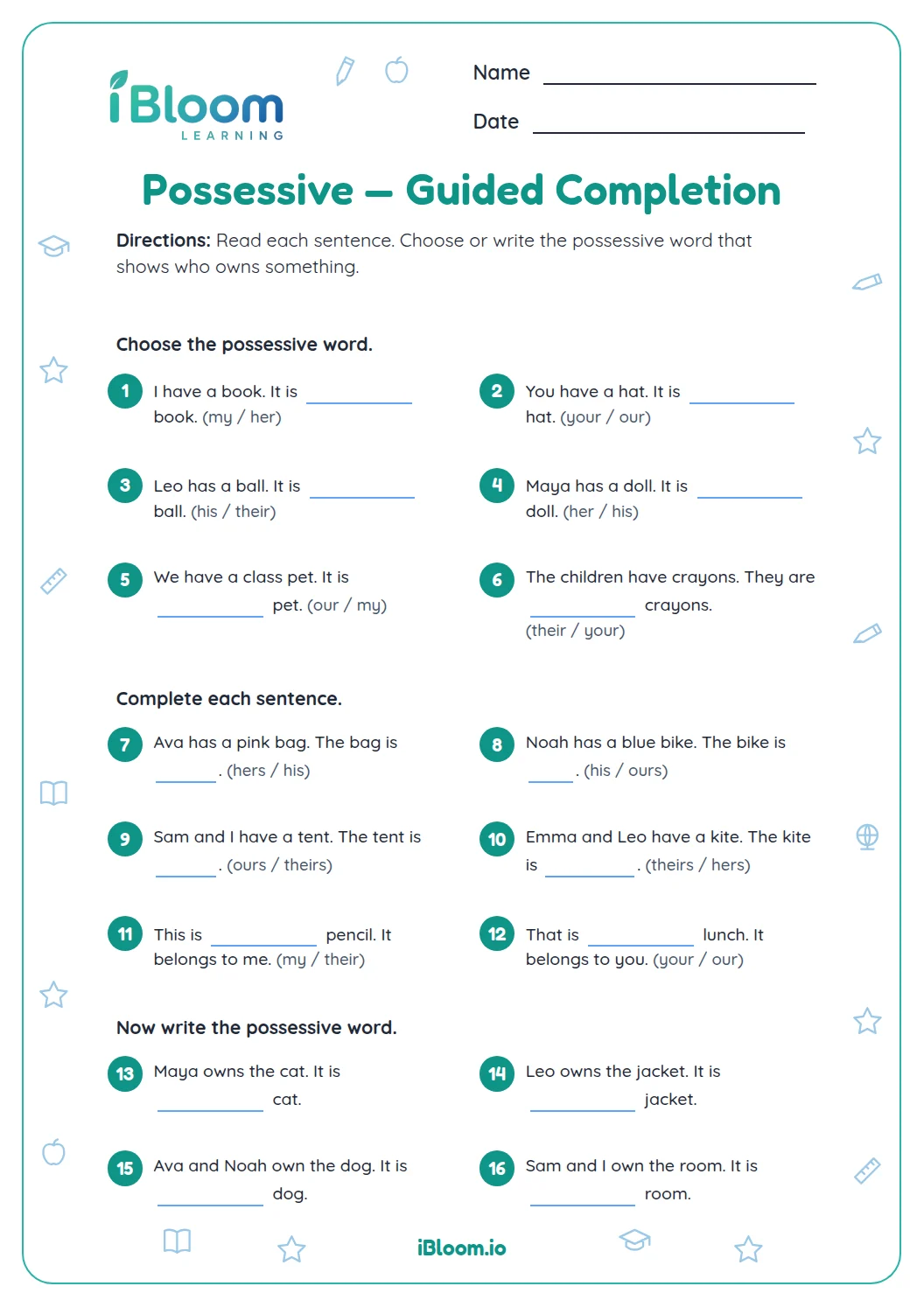
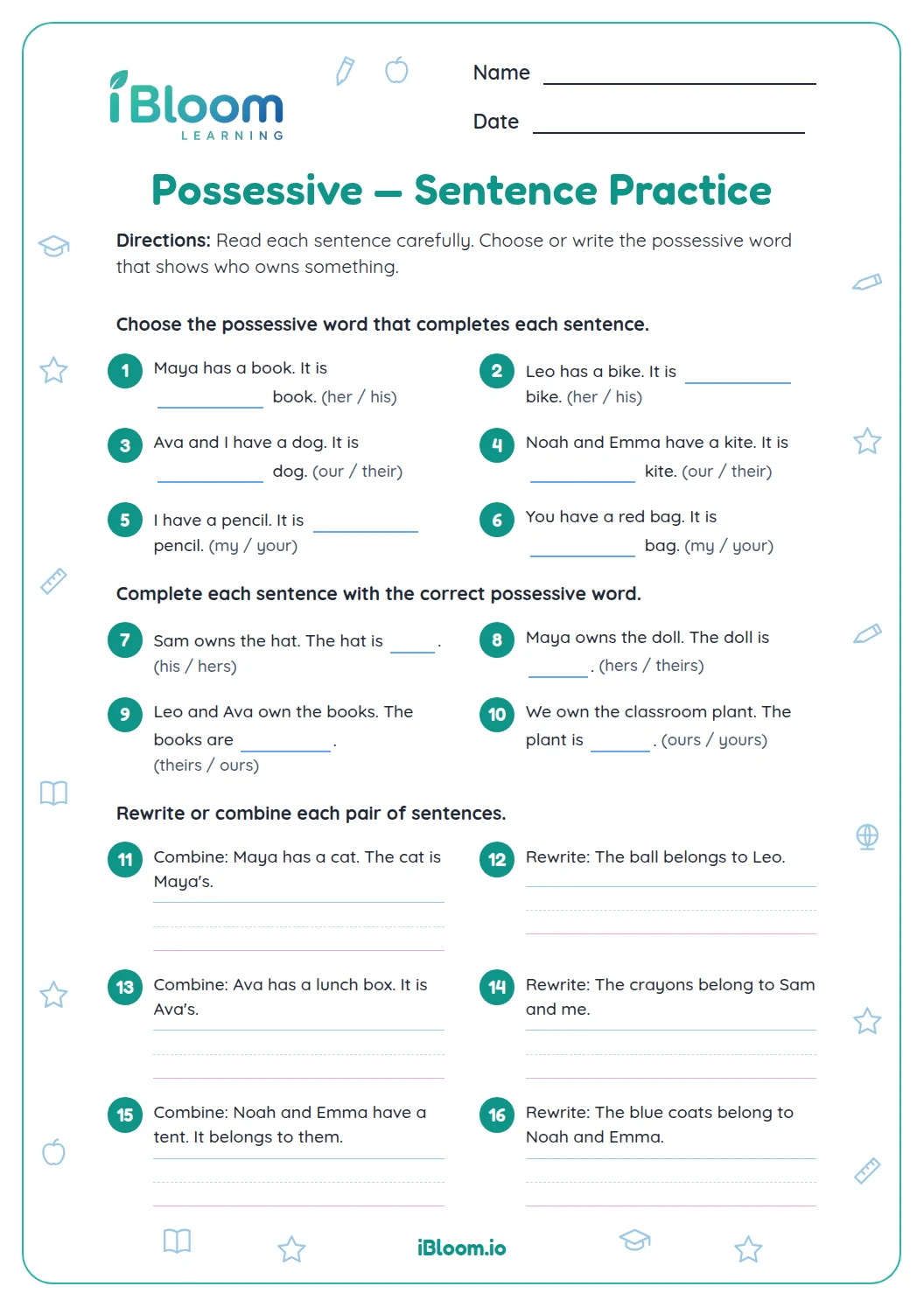
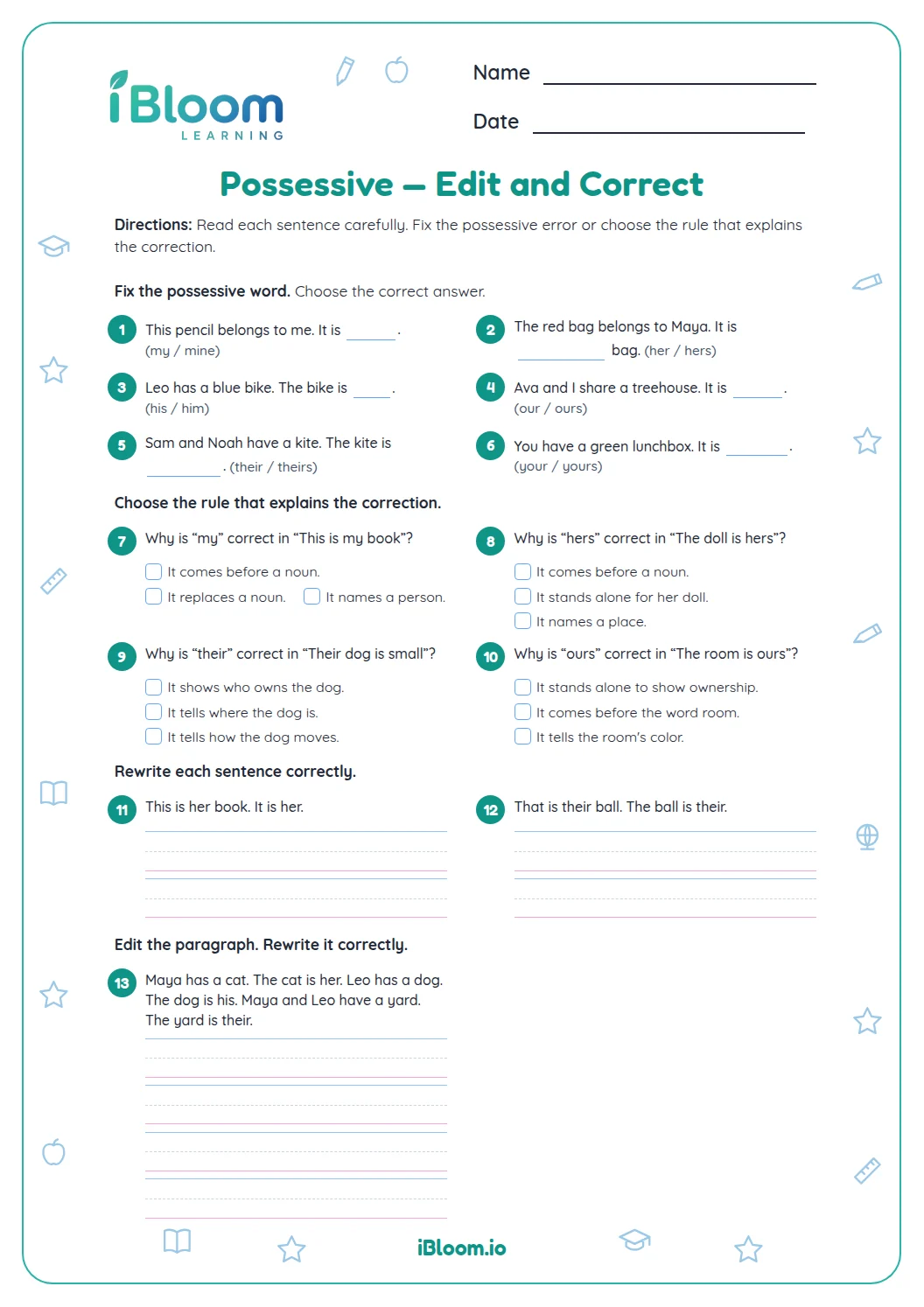
About this worksheet
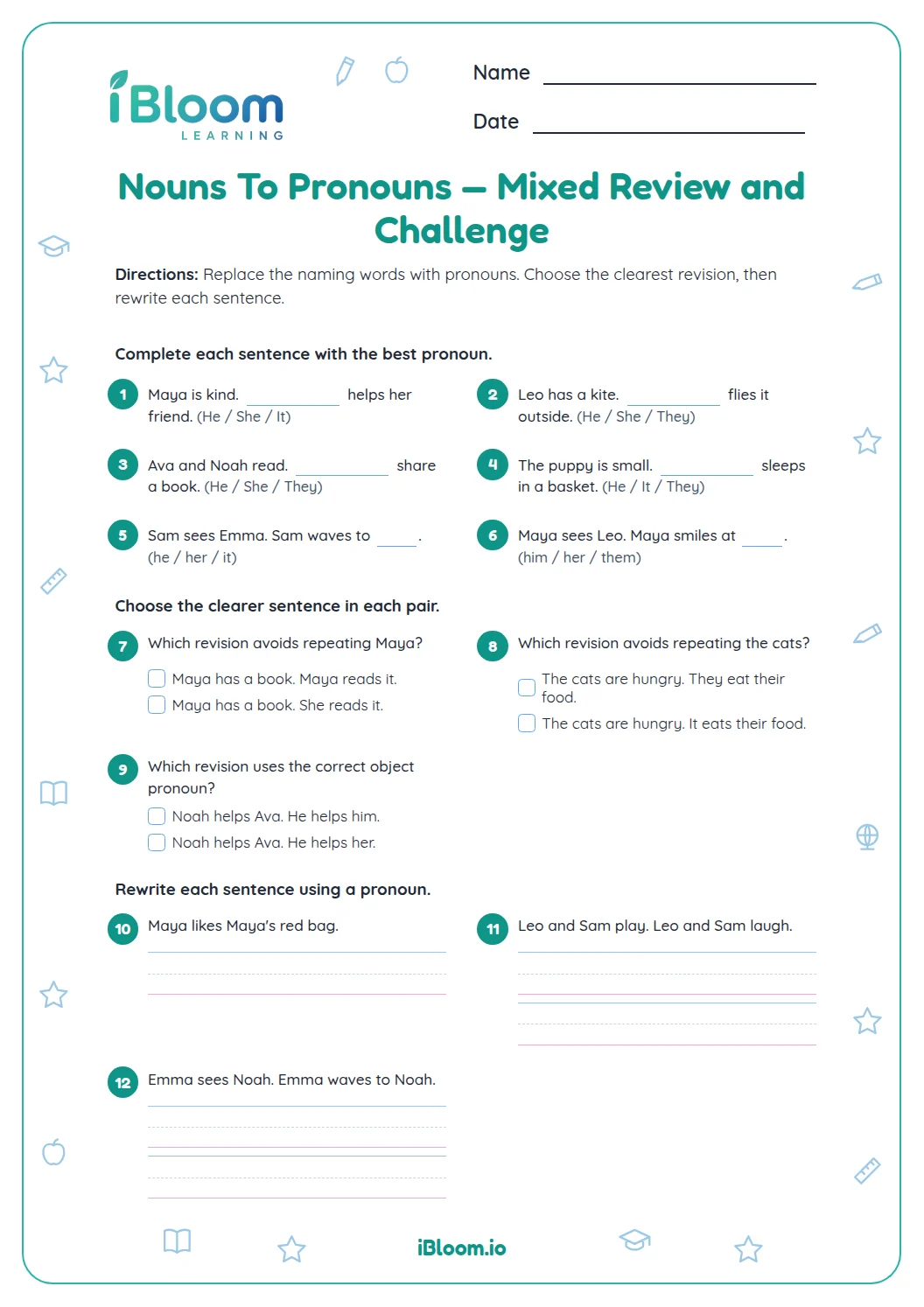
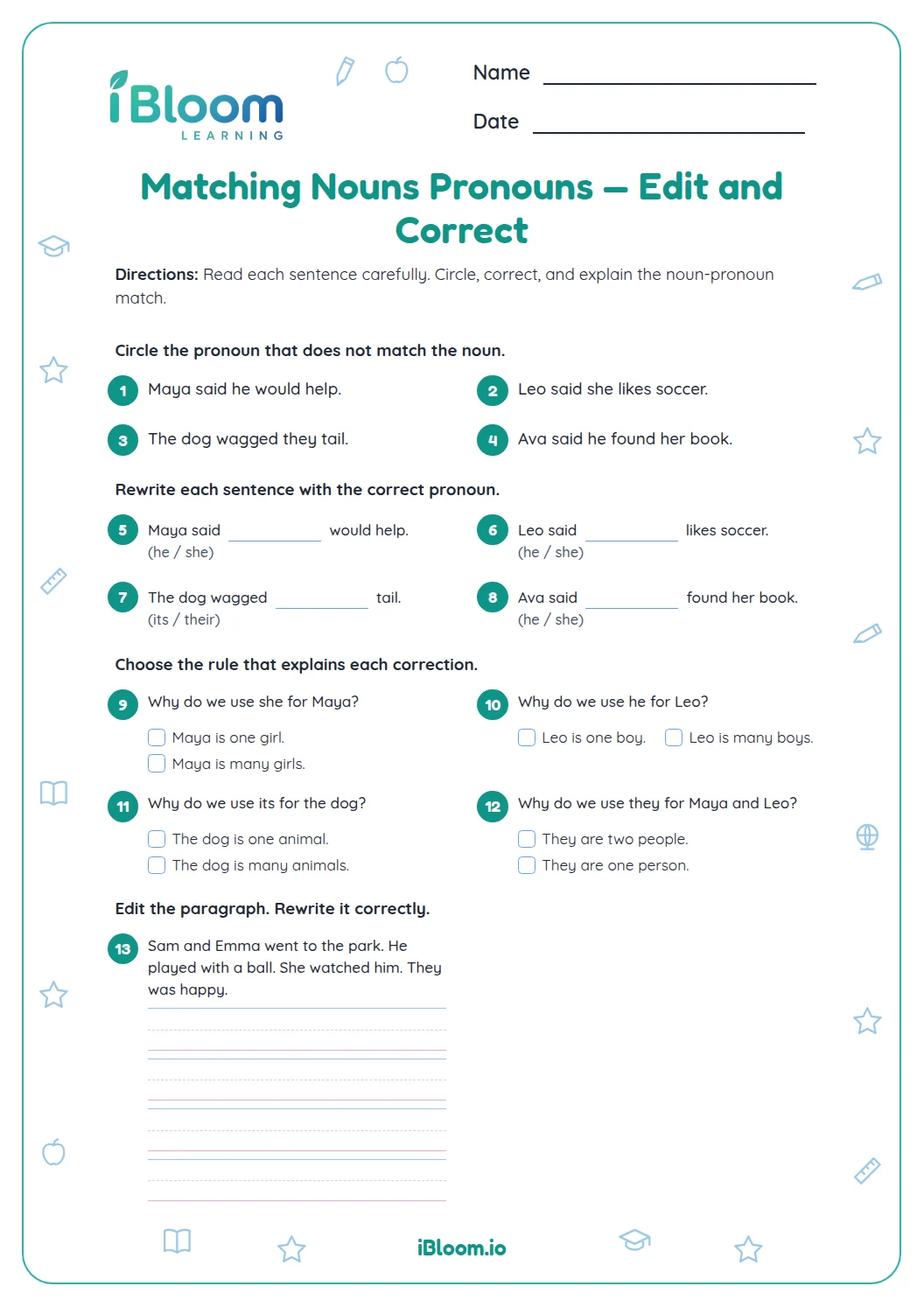
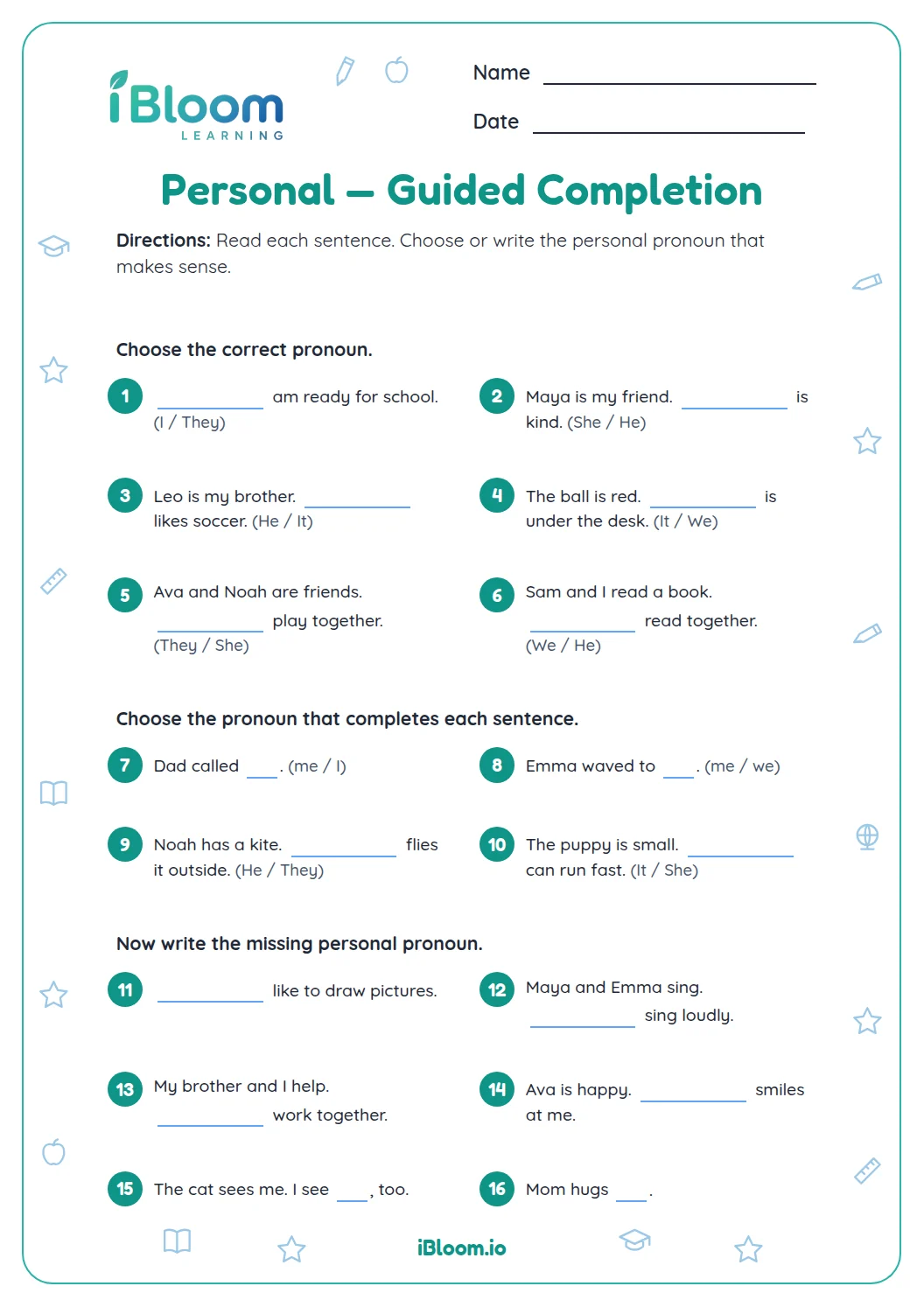
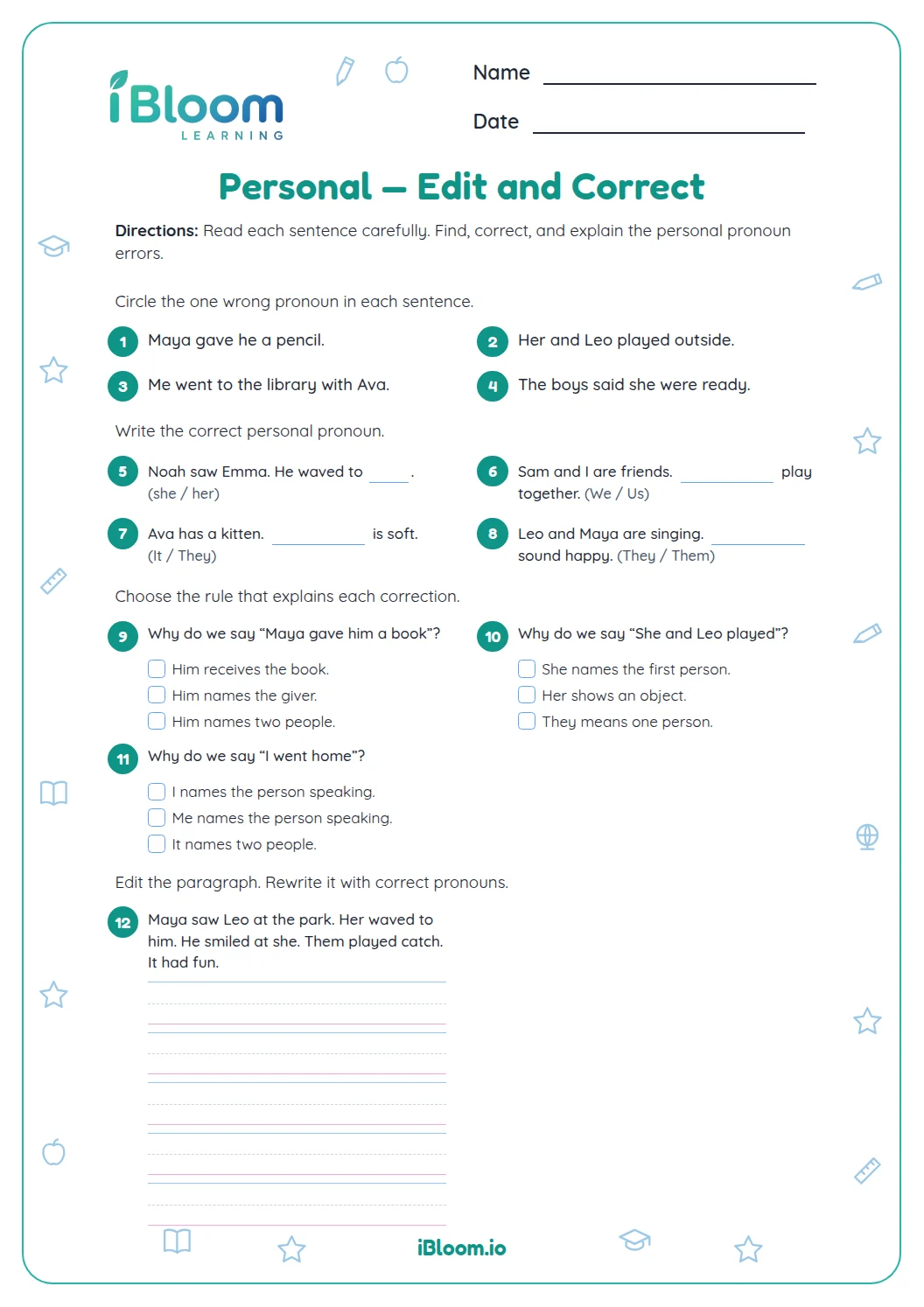
This Grade 1 printable pairs 8 pronoun choices with 6 sentence rewrites. Students match a personal pronoun to a person, animal, thing, or group, then replace repeated nouns while keeping each sentence clear. A separate answer key includes sample rewrites. It practices Common Core L.1.1.d.
Aligned to L.1.1.d
What does this worksheet practice?
Students first choose a pronoun that matches a name or noun. Then they rewrite sentences to replace repeated nouns with personal pronouns such as she, he, it, they, or we.
How can I work through an example?
In Part B, “Maya has a red bag. Maya carries the bag,” replace the repeated name and object noun: “Maya has a red bag. She carries it.”
- 1Maya has a red bag. She carries it. → She replaces Maya; it replaces the bag.
How can students check their work?
In a choice item, point to the name or noun that the pronoun replaces. In a rewrite, check that each pronoun still refers clearly to the same person, thing, or group and that the sentence keeps its meaning.
How to use this worksheet
- 1In Part A, find the name or noun that the blank refers to.
- 2Choose she or he for a person, it for one thing or animal, and they for a group.
- 3Use we when the group includes the speaker, as in “Ava and I.”
- 4In Part B, replace repeated names and nouns while keeping the sentence meaning.
- 5Read each rewrite aloud, then compare it with the sample in the key.
Common mistakes and quick fixes
The mistake
Choosing he or she without checking the name.
The fix
Look back to see who the sentence names.
The mistake
Using it for a group.
The fix
Use they for two or more people or things.
The mistake
Using they when the sentence includes the speaker.
The fix
Use we for the speaker and at least one other person.
Common Core alignment
This page practices the language skill described in L.1.1.d.
Use personal pronouns to replace names and nouns in sentences.
On this sheet: Students select personal pronouns and use them in sentence rewrites.
Show the official wordingHide the official wording
Use personal, possessive, and indefinite pronouns (e.g., I, me, my; they, them, their, anyone, everything).
What to practice next
Make more practice
Further reading
Questions parents and teachers ask
What does replacing nouns with personal pronouns in sentences mean?
A personal pronoun takes the place of a name or noun. In “Maya has a red bag. Maya carries the bag,” she can replace Maya and it can replace the bag. The worksheet practices choosing pronouns and rewriting sentences. Both choices and rewrites use this idea.
What is the difference between they and we?
Use they for a group that does not include the speaker, as in “The girls sing. They know the song.” Use we when the speaker is part of the group, as in “Ava and I read. We share a book.”
How many questions are on this worksheet?
There are 14 questions: eight pronoun choices in Part A and six sentence rewrites in Part B. Writing space makes the printable three worksheet pages, with a three-page answer key that gives sample rewrites. The separate key gives sample sentences for every rewrite.
What should students do in the sentence rewrite part?
Rewrite each pair of sentences so a pronoun replaces a repeated name or noun. For example, “Leo sees Ava. Leo waves to Ava” can become “Leo sees Ava. He waves to her.” The key shows a sample response for each item.
Can more than one rewrite be correct?
Yes. A sentence can sometimes be rewritten with different wording while still using pronouns clearly. The answer key gives one sample for each item. Check that the pronoun matches the person, thing, or group and that the new sentence keeps the original meaning.