


About this worksheet
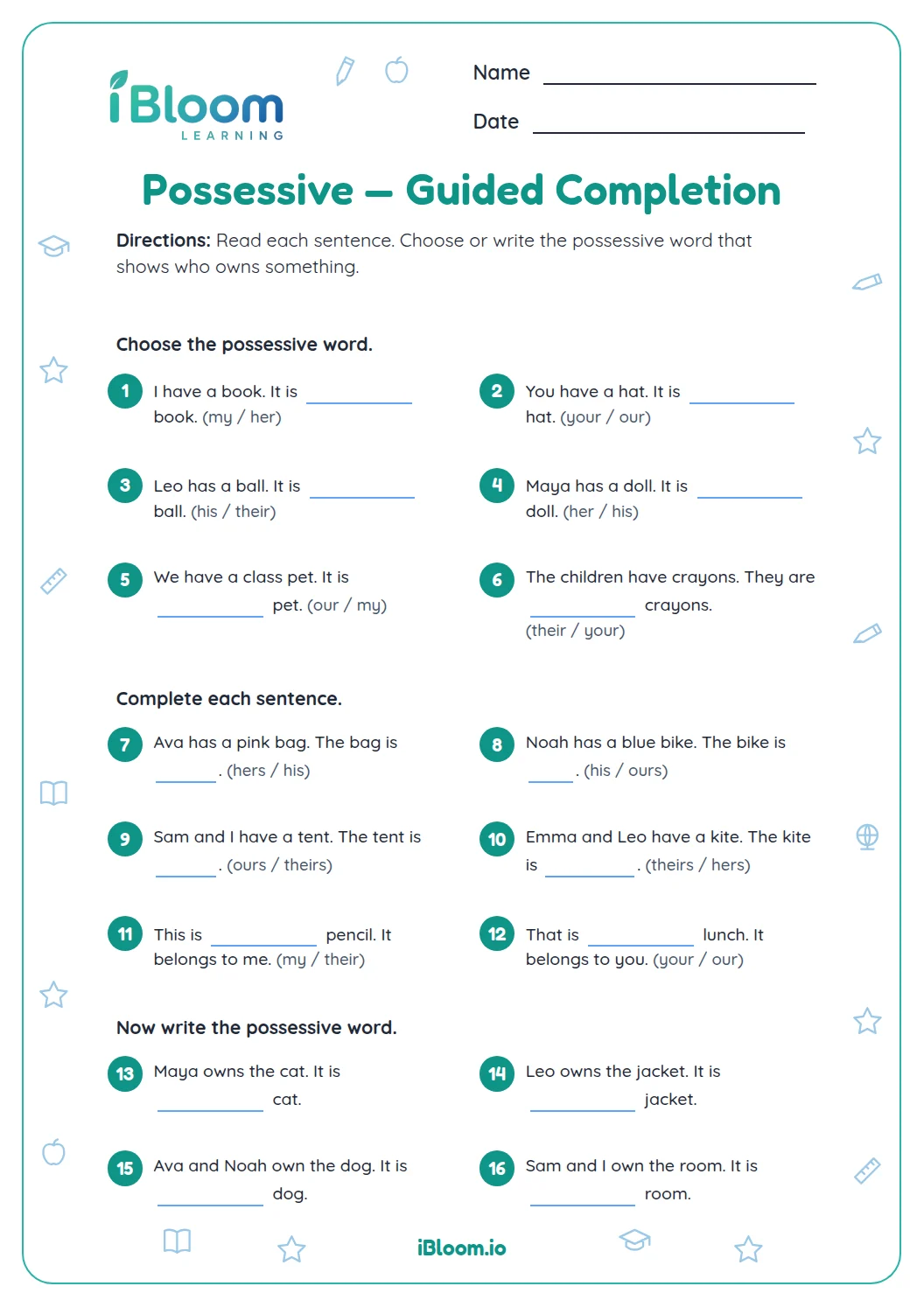
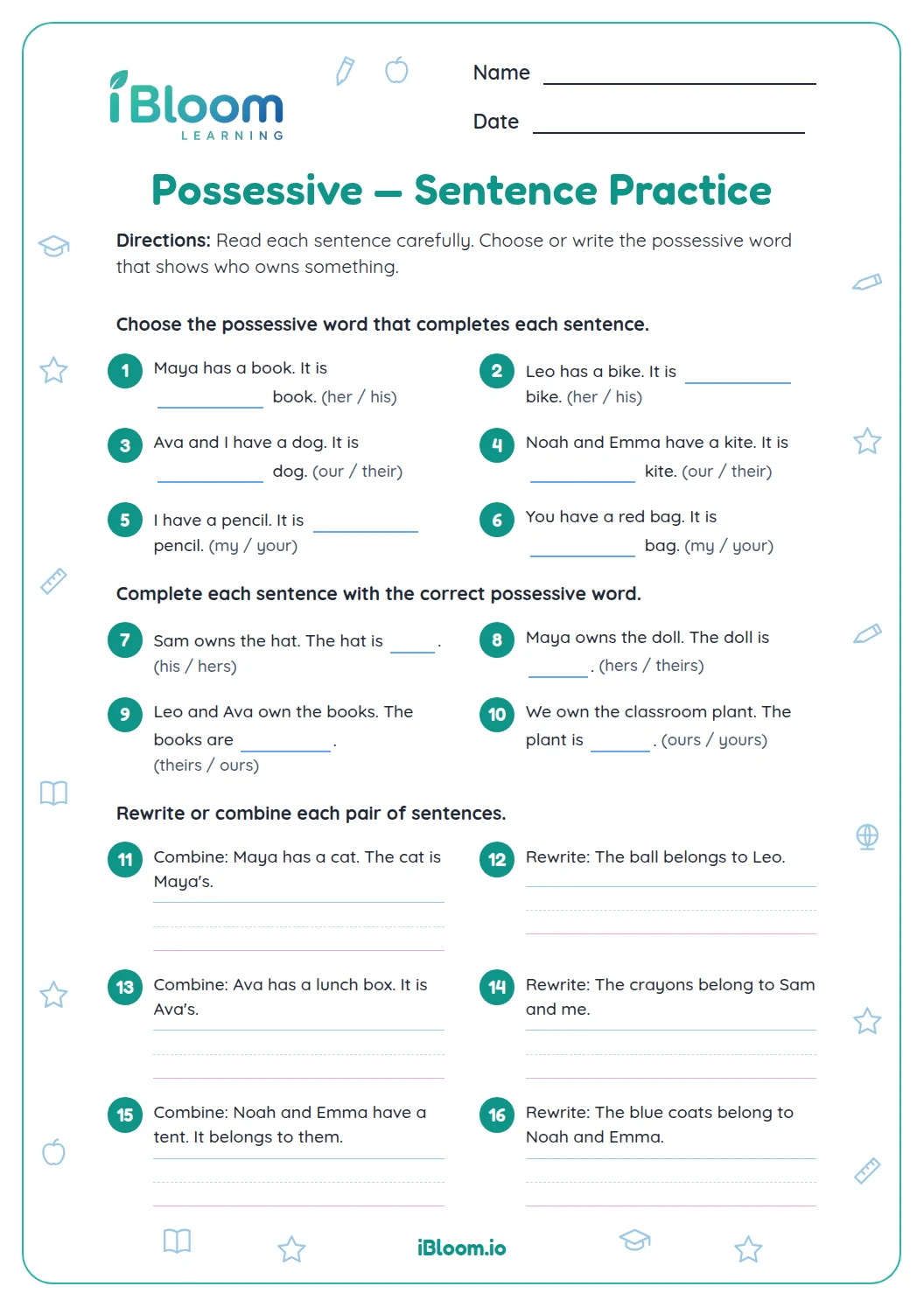
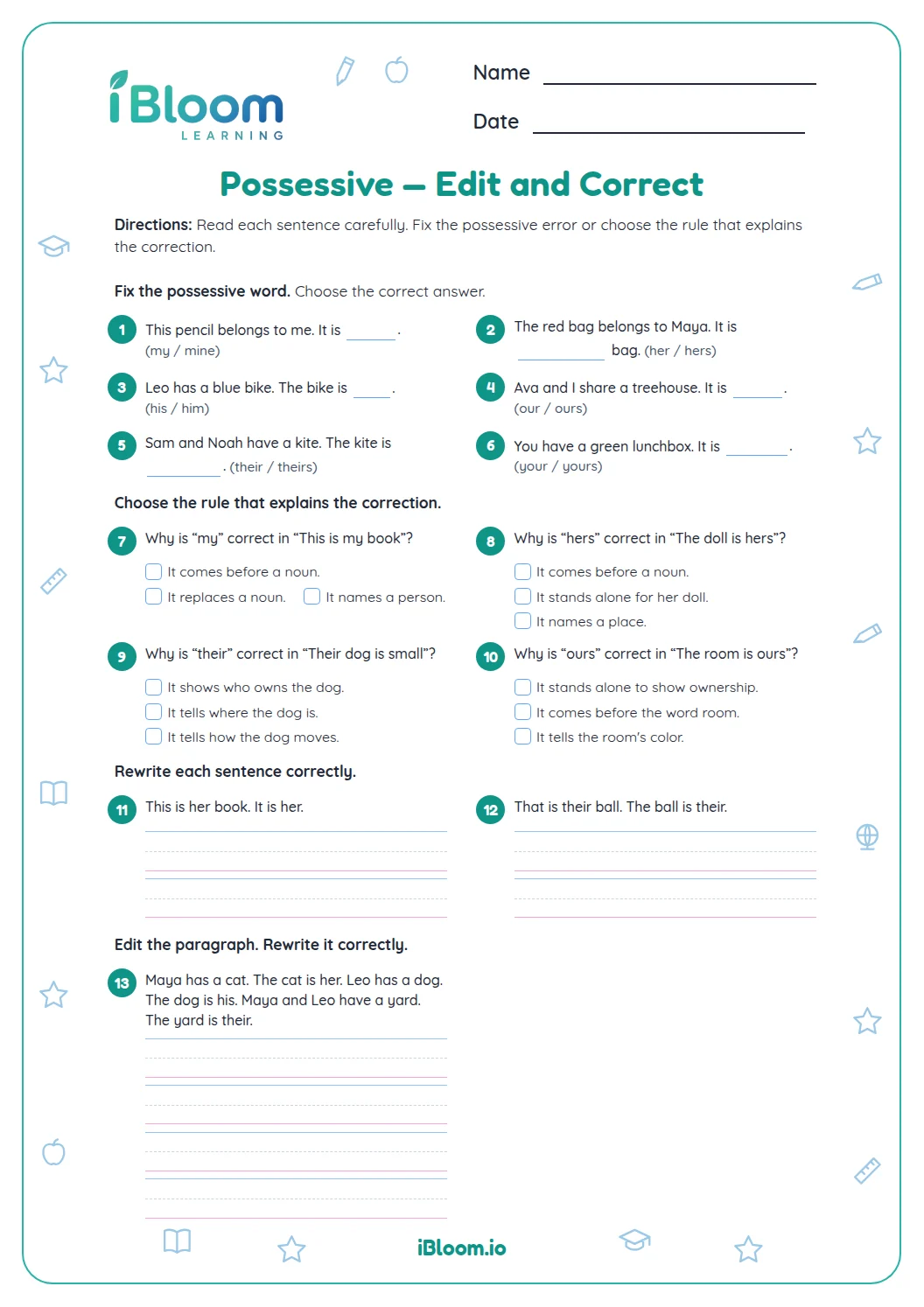
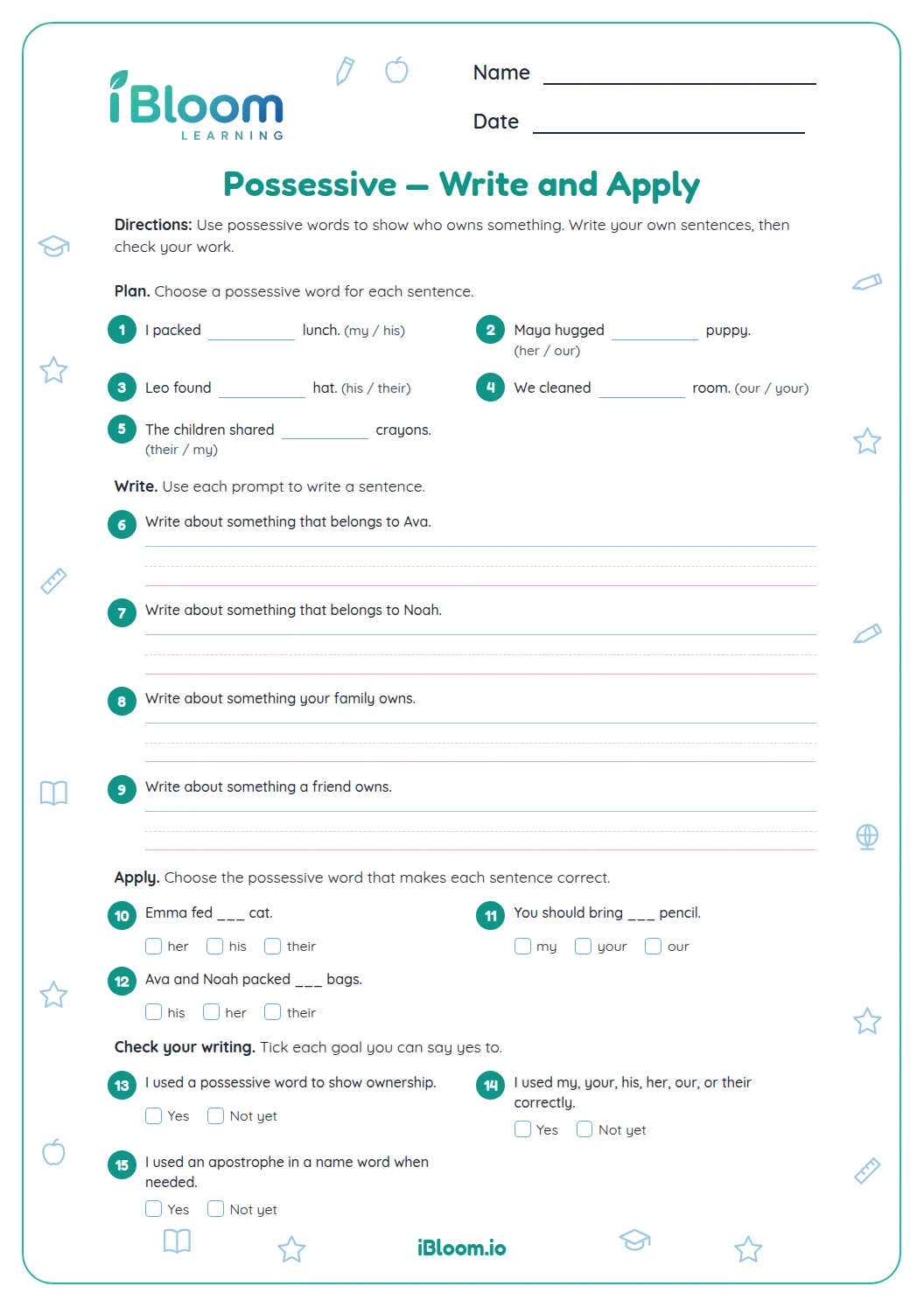
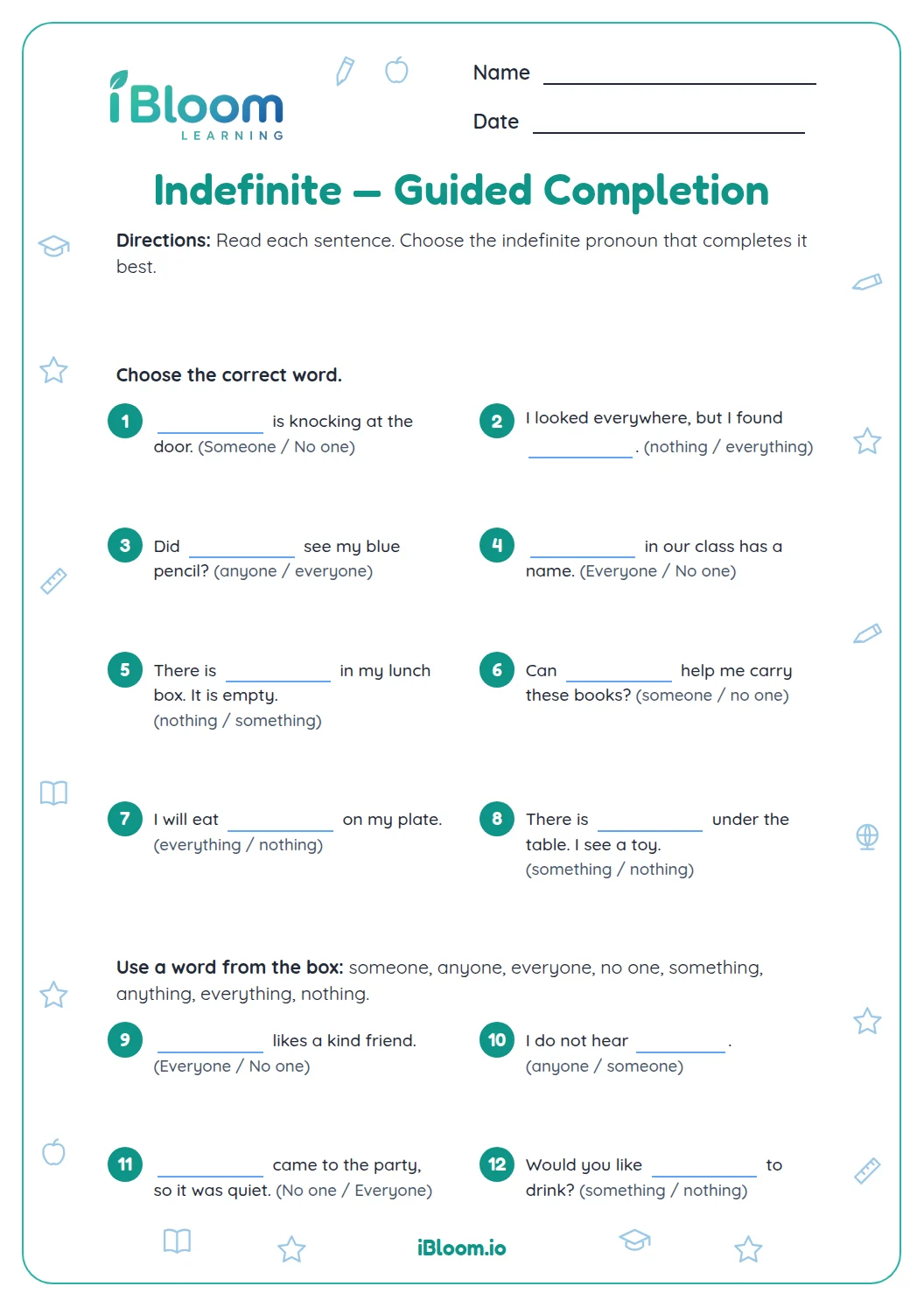
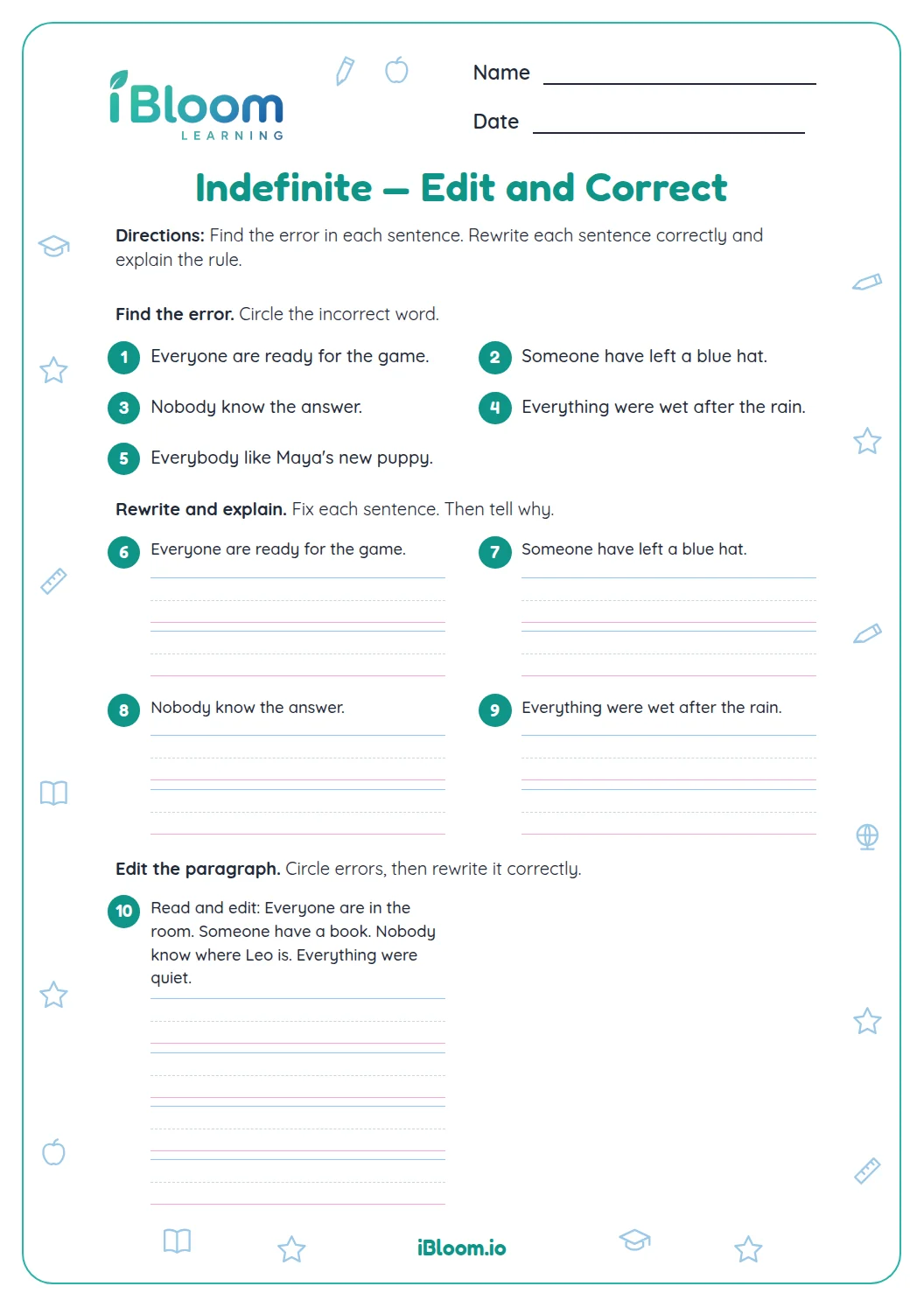
This free Grade 1 worksheet helps children recognize possessive words in familiar sentences. Students choose an ownership word, complete a sentence, and decide whether a sentence shows ownership. Examples include my, his, her, its, your, our, and their. The activity aligns with Common Core L.1.1.d, which asks students to use possessive pronouns. A separate answer key supports quick checking.
Aligned to L.1.1.d
How does a possessive pronoun show ownership?
A possessive pronoun points to the person or group that owns an object. Words such as my, his, her, its, your, our, and their can appear before a noun.
In question 2, the hat belongs to Luis, so “his hat” tells the reader who owns it.
- 1The hat belongs to Luis. It is his hat.
- 2“His” names Luis as the owner.
When should a sentence use my, mine, or our?
This page practices possessive words before a noun: my pencil, your ball, our toys. Some possessive forms can stand alone, such as mine or ours, but the sentence frame matters.
Read the whole sentence and notice whether a noun follows the blank. “It is ___ pencil” needs “my,” while “The pencil is ___” could take “mine.”
How can a child check a possessive word?
Ask, “Who owns the thing?” Then match the owner to the word: I → my, you → your, he → his, she → her, we → our, they → their. For an animal or object, “its” can show ownership.
The final part asks children to decide whether a full sentence shows ownership, including sentences that use a possessive word and sentences that do not.
How to use this worksheet
- 1Read the whole sentence before choosing a word.
- 2Name who owns the item or items.
- 3Match the owner to my, your, his, her, its, our, or their.
- 4Check whether the blank comes before a noun.
- 5For circle items, say the owner word aloud and circle it.
Common mistakes and quick fixes
The mistake
Using “they” instead of “their” before a noun.
The fix
Use “their” to show ownership: their dog. “They” is the owner doing an action.
The mistake
Writing “her” when the sentence needs “hers.”
The fix
Check whether a noun follows. Use “her scarf,” but “The scarf is hers.”
The mistake
Using “it’s” to show ownership.
The fix
“It’s” means “it is.” The possessive form is “its,” as in “its bed.”
Common Core alignment
This worksheet helps first graders recognize possessive words in short sentences.
Recognize and use possessive pronouns such as my, her, our, and their.
On this sheet: Each item asks students to identify or supply a possessive pronoun in a sentence.
Show the official wordingHide the official wording
Use personal, possessive, and indefinite pronouns (e.g., I, me, my; they, them, their, anyone, everything).
What to practice next
Make more practice
Further reading
Questions parents and teachers ask
What is a possessive pronoun?
A possessive pronoun shows who owns something. On this worksheet, words such as my, his, her, its, your, our, and their appear in sentences about familiar objects and animals. Children first choose a word, then use it in context.
What is the difference between “her” and “hers”?
“Her” usually comes before a noun, as in “her scarf.” “Hers” stands alone, as in “The scarf is hers.” This page focuses on possessive words that fit directly into the sentence frames provided, so students can attend to the owner and the noun.
Why is “its” different from “it’s”?
“Its” shows that something belongs to an animal or object, as in “its bed.” “It’s” is a contraction meaning “it is.” Question 6 uses “its” because a bed belongs to the kitten, so the sentence needs the ownership form.
How many questions are included?
There are 16 items in three parts. Students choose possessive words, complete sentence blanks, and decide whether a sentence shows ownership. The separate answer key lists each correct response. These formats help children connect the word form with its job in a sentence.
How can I help if my child is unsure?
Ask who owns the object in the sentence, then help match that owner to a word. For instance, if the object belongs to “we,” the sentence can say “our poster.” Read the whole sentence aloud to check that the word fits.