


About this worksheet
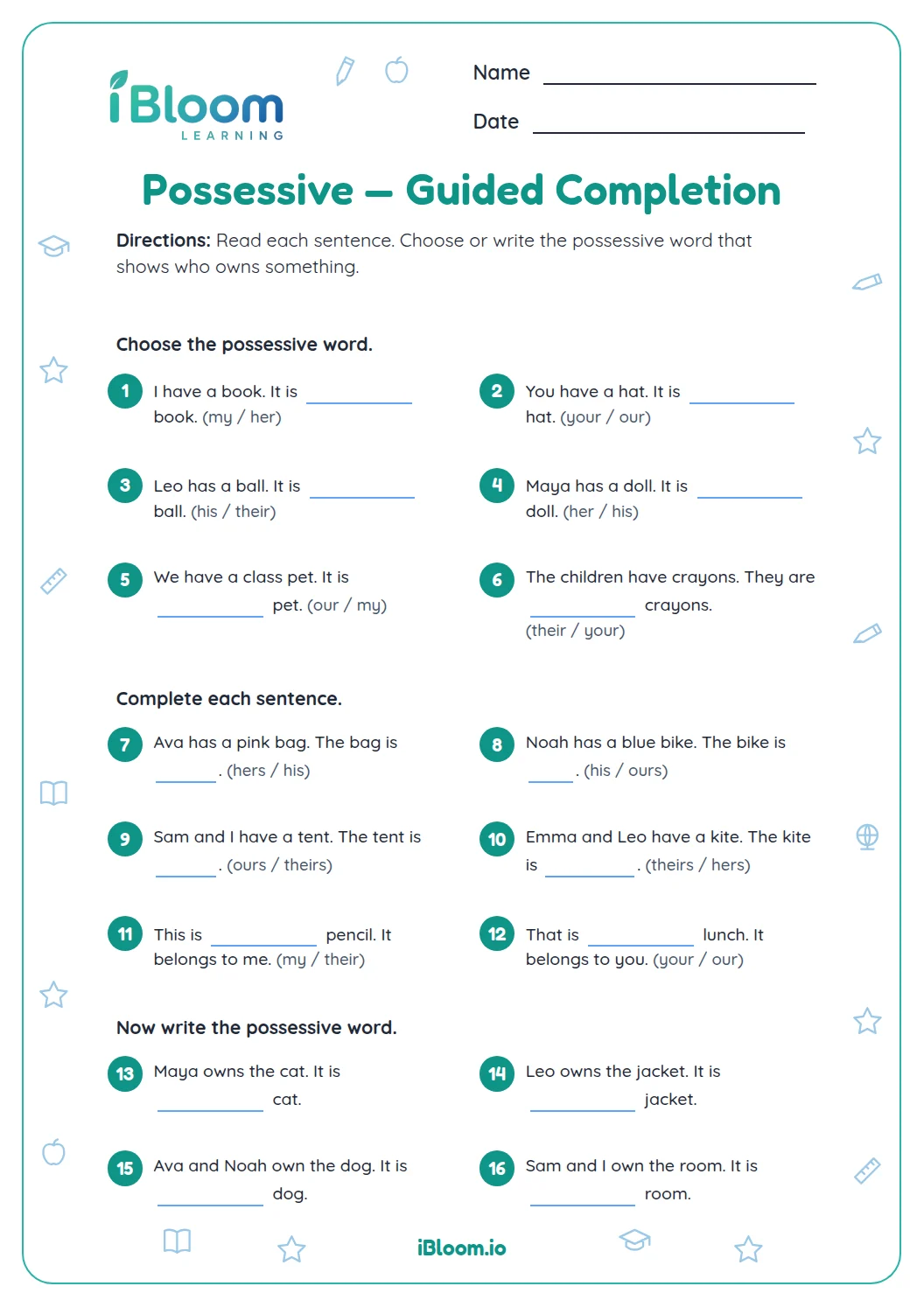
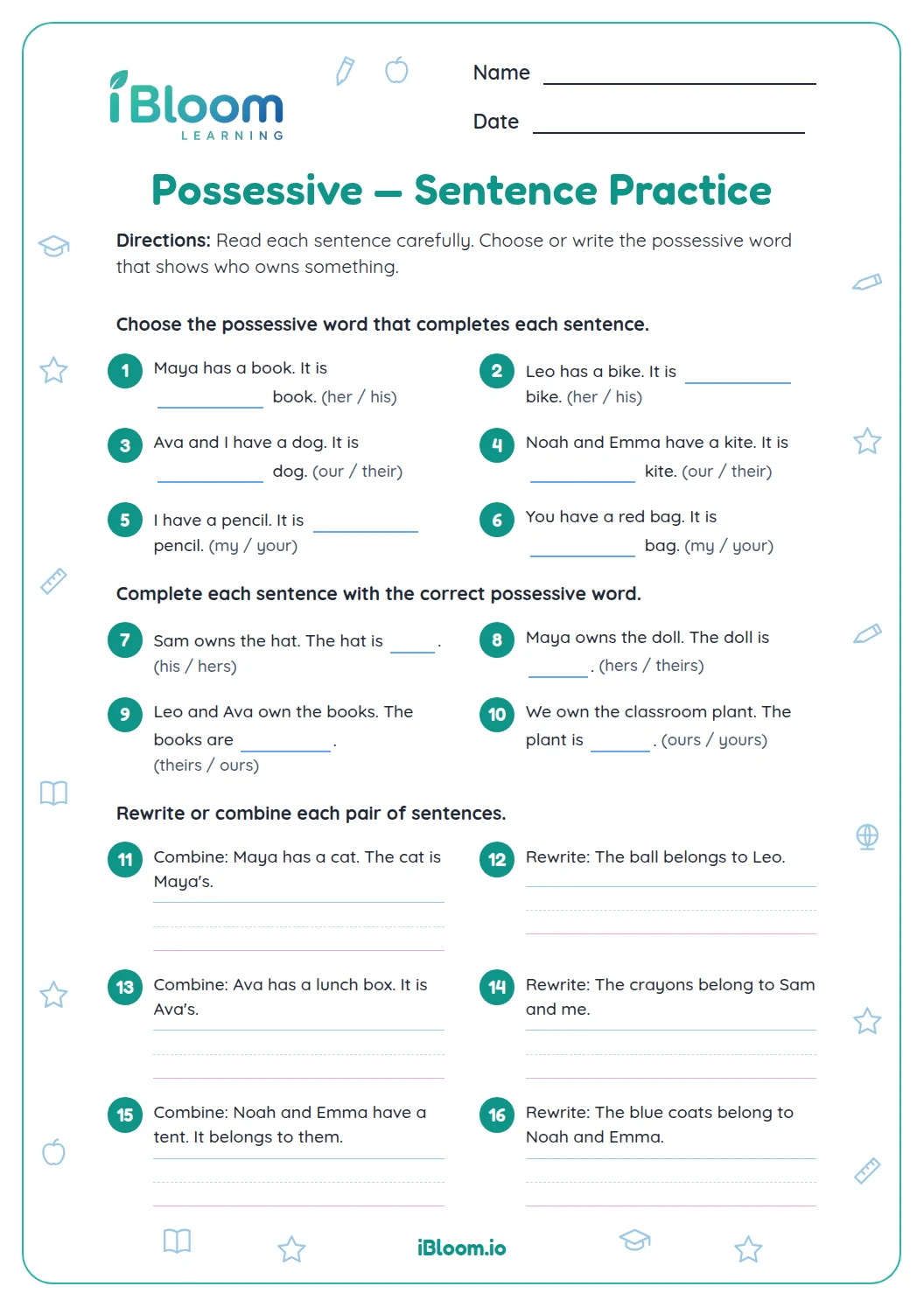
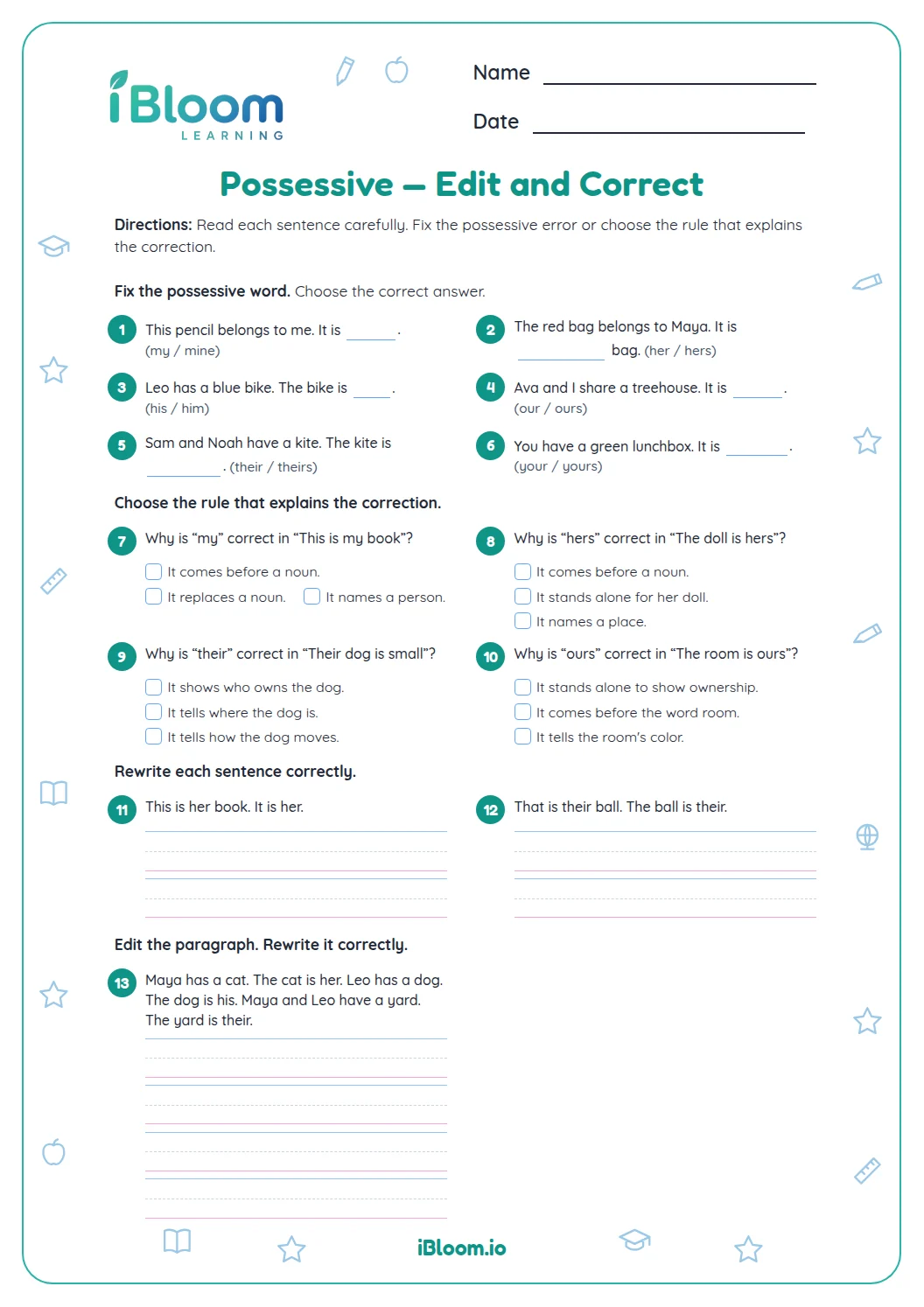
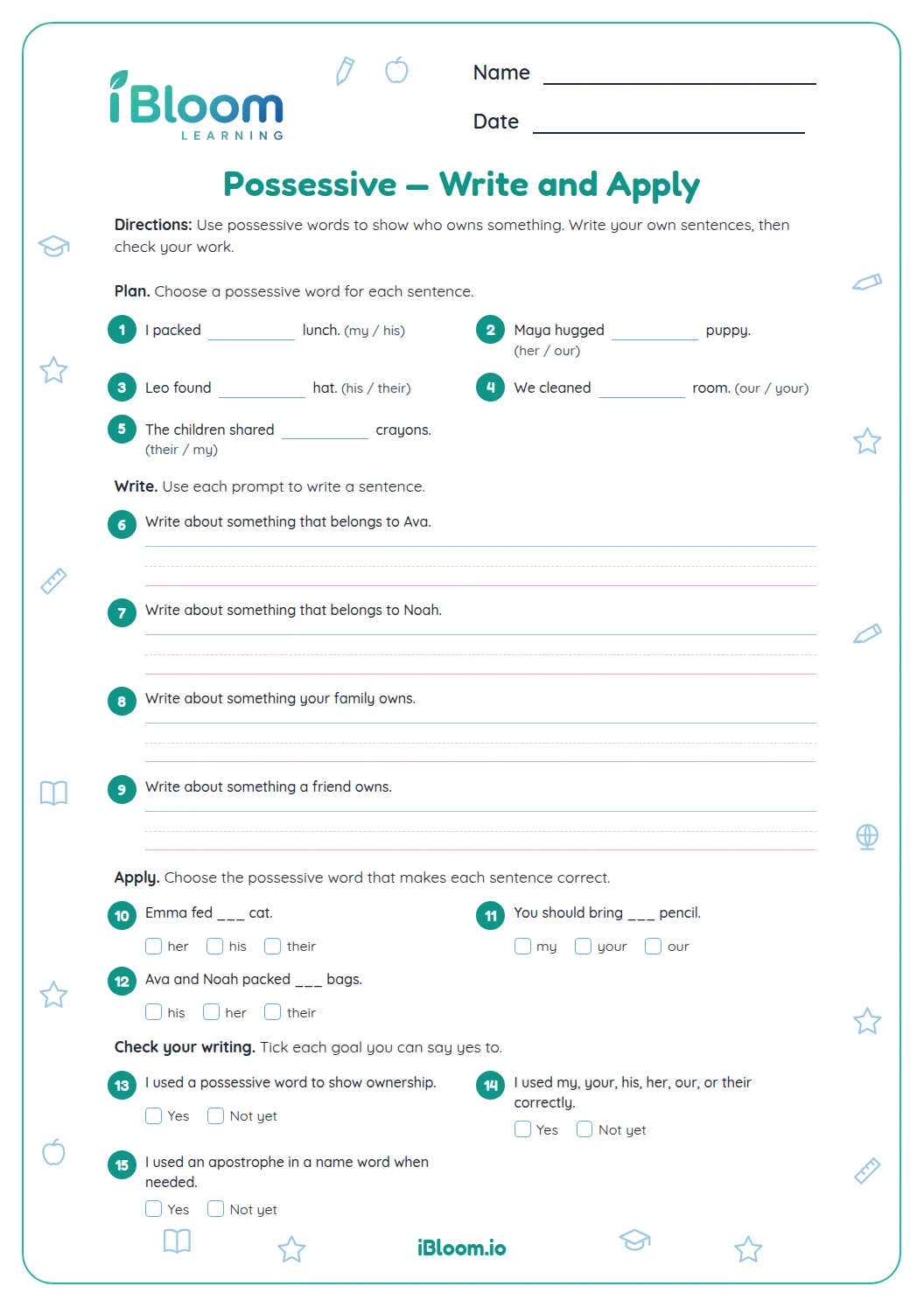
This free Grade 1 worksheet gives children fourteen ways to practice words that tell who owns something. Part A offers six choices between forms such as my and mine. Part B has four sentence blanks with the owner stated clearly. Part C asks children to correct four sentences while keeping the same owner. The practice supports CCSS L.1.1d, using possessive pronouns. Familiar objects such as hats, balls, books, and bags keep attention on the wording. A separate answer key supplies the missing words and the full corrected sentences.
Aligned to L.1.1d
How do ownership words fit into a sentence?
My, your, her, our, and their go before a noun: my hat, your book, her bag. Mine, yours, hers, ours, and theirs can stand without that noun: the hat is mine. His works in either place, as in his cup and the cup is his.
Use a real object to demonstrate. Hold a pencil and say, “This is my pencil. This pencil is mine.” The owner stays the same while the sentence changes.
How can a child repair “This ball is my”?
Ask whether the word after my names an object. Here the sentence stops at my, so it needs mine. The child should keep the words This ball is and change only the ownership word.
- 1Sentence to fix: This ball is my.
- 2The owner is the speaker. No noun follows my.
- 3Correct sentence: This ball is mine.
What makes the last part a challenge?
Part A offers six choices between forms such as my and mine. Part B has four sentence blanks with the owner stated clearly. Part C asks children to correct four sentences while keeping the same owner.
The old sheet used ownership choices, short explanations, and sentence rewrites. This version keeps choice and correction practice, with clearer sentence contexts and a pair of final review items.
Practice ownership in three ways
- 1Use a pencil to say “my pencil” and “The pencil is mine.”
- 2Have children name the owner in each Part A prompt before choosing.
- 3Read each Part B sentence with both words in parentheses and choose the form that fits.
- 4For Part C, identify the one ownership word to change and rewrite the sentence.
- 5Compare with the key and reread each corrected sentence aloud.
Mistakes to notice and how to help
The mistake
Writing “This is mine hat.”
The fix
Hat is a noun right after the ownership word. Use my hat.
The mistake
Writing “That book is her.”
The fix
When the word stands alone to show ownership, use hers: “That book is hers.”
The mistake
Changing “We own it” into “It is theirs.”
The fix
Keep the owner the same. We points to our or ours; they points to their or theirs.
Common Core alignment
Choose and write possessive pronouns that match the owner.
On this sheet: All three parts ask children to use ownership words in sentences.
Show the official wordingHide the official wording
Use personal, possessive, and indefinite pronouns (e.g., I, me, my; they, them, their, anyone, everything).
What to practice next
Make more practice
Further reading
Questions parents and teachers ask
Which possessive forms are on the sheet?
The questions use my and mine, your and yours, her and hers, our and ours, their and theirs, and his. Parts A and B give an owner or a pair of forms. Part A and Part B give an owner or a pair of forms. In Part C, children repair the ownership word while keeping the same owner.
Why does his stay the same?
His can appear before a noun or stand alone to show ownership. Say “This is his cup” and “The cup is his” together. In question 5, the cup belongs to a boy, and his completes the sentence. Children can compare that example with my and mine.
Does my child need to copy every sentence?
Only Part C asks children to rewrite whole sentences. Part A uses choices, and Part B asks for the missing word. This gives first graders several ways to practice ownership while saving the longer writing for the four corrections at the end of the worksheet.
How can I help with the challenge questions?
Ask two questions: “Who owns it?” and “Does a noun come next?” For “This ball is my,” the speaker owns the ball and no noun comes after my, so mine fits. Let your child say the corrected sentence before writing it on the lines.
What does the answer key show?
The key shows the selected choices, the missing ownership words, and all four corrected sentences. For the last part, compare the ownership word and the rest of the sentence with the model. If a child changes the owner, return to the original sentence and identify whose object it is.