



About this worksheet
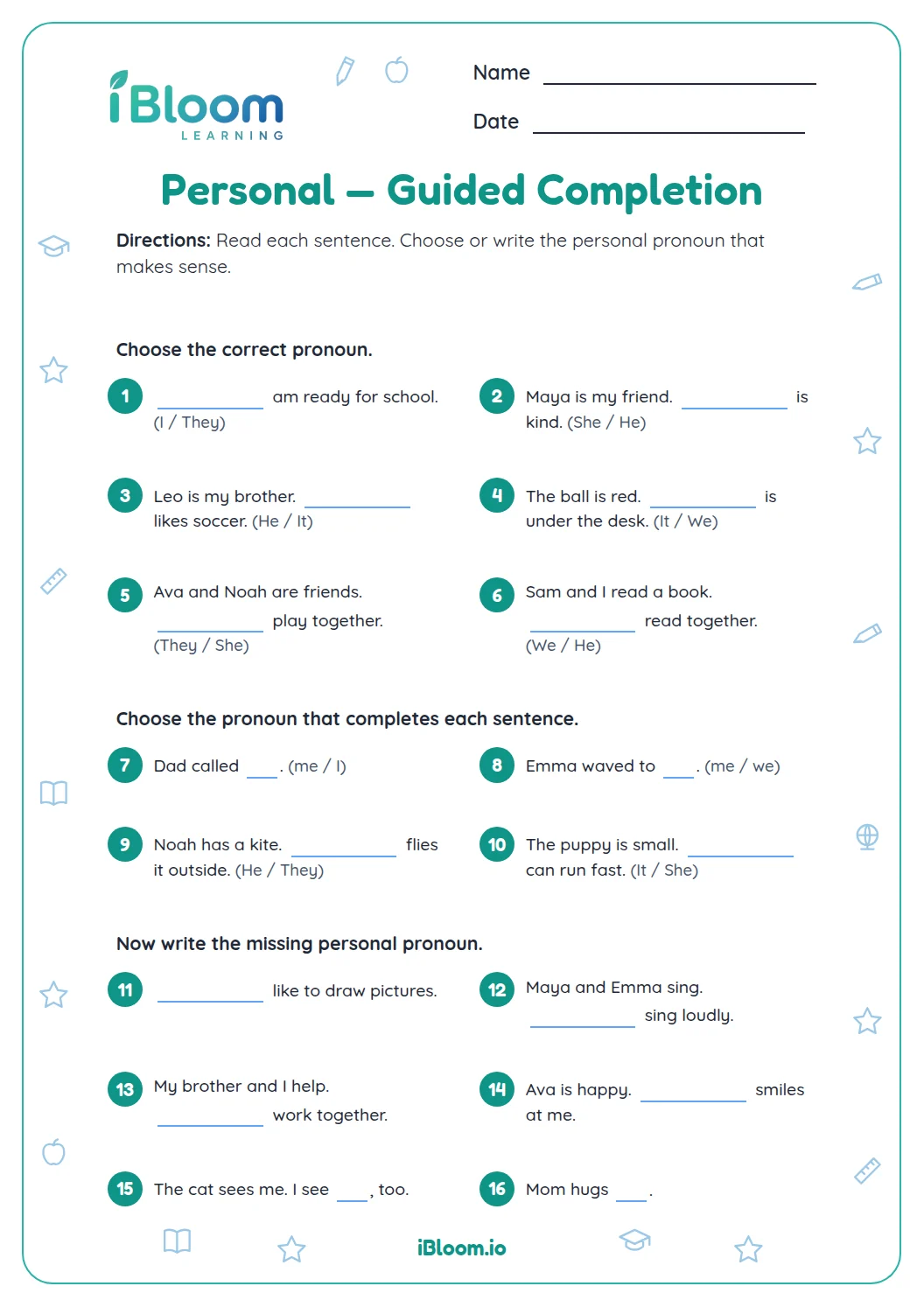
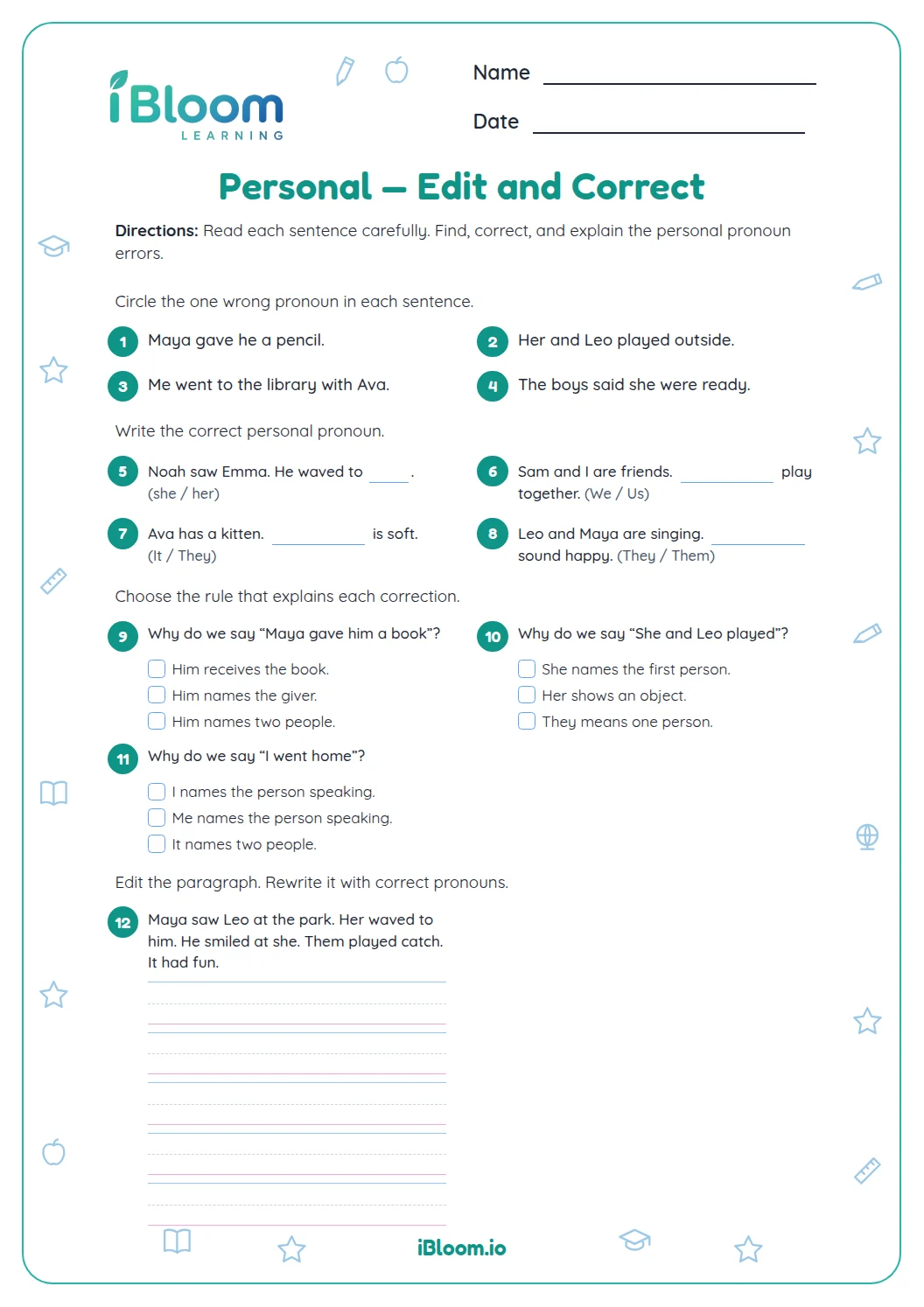
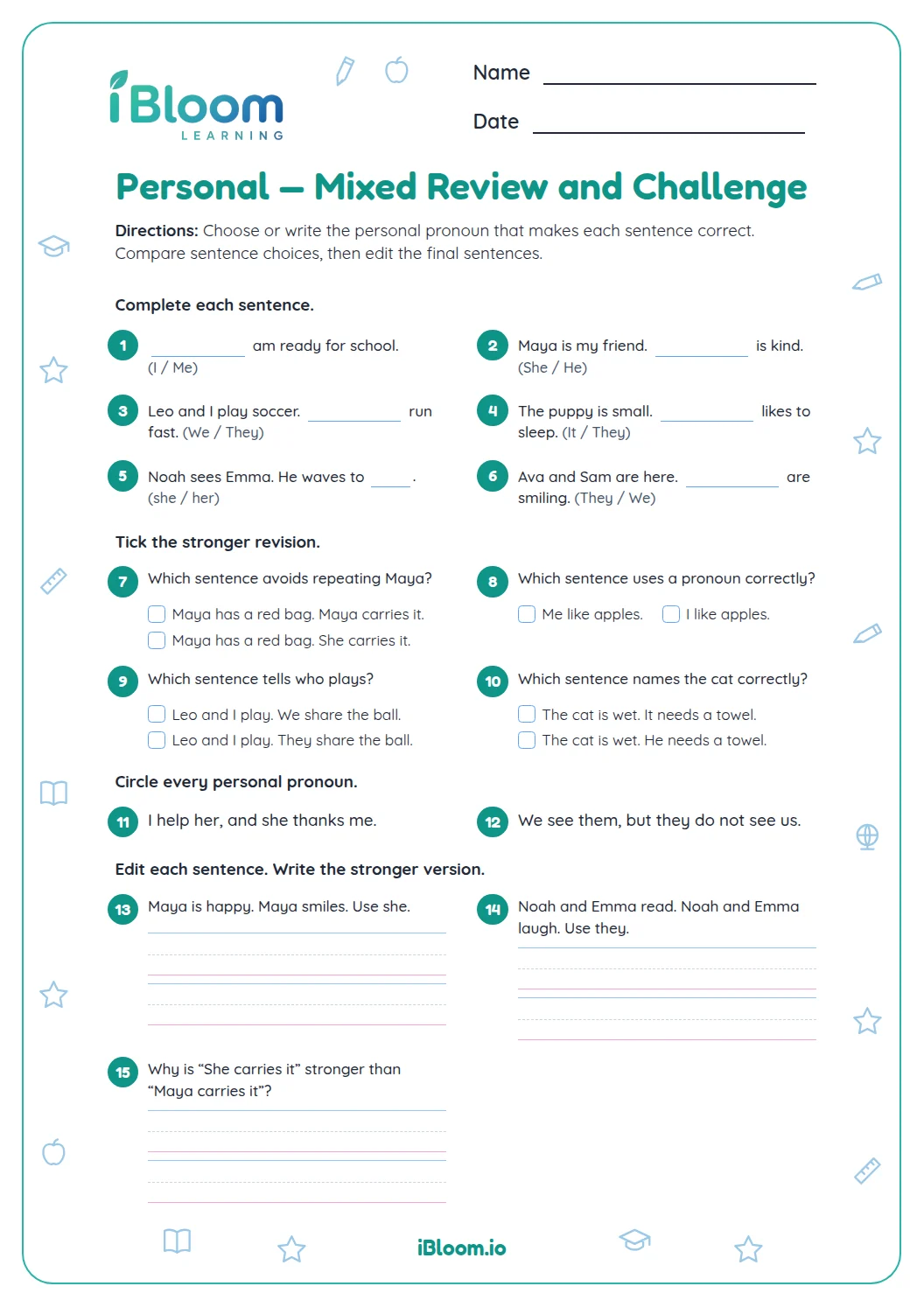
This free printable worksheet gives Grade 1 children sixteen sentence questions on the personal pronouns I, me, we, she, he, it and they. They pick the right pronoun in six short sentences, such as “Maya is my friend. She likes to draw,” then choose between I and me, write a pronoun on the line, and finally rewrite two sentences so the repeated name becomes a pronoun. It practices Common Core L.1.1.d, using personal pronouns, and comes with a separate answer key.
Aligned to L.1.1.d
What is on this worksheet?
The sheet has four short parts, and each one asks a little more of the writer. Parts A and B are bubbles, so a child who is still building stamina can show the thinking without writing much. Part C is a single word on a line, and Part D asks for two full sentences.
Every sentence gives enough clues to pick one pronoun. The sentence before the blank tells who or what is being talked about, so the child never has to guess what the answer key wanted.
- Part A, Pick the pronoun: 6 sentences with 3 choices each (I, She, He, We, They, It)
- Part B, I or me: 4 sentences with 2 choices each
- Part C, Write the pronoun: 4 sentences with a blank to fill in (They, It, We, He)
- Part D, Rewrite with pronouns: 2 pairs of sentences to write again using she, it or they
How do you choose the right pronoun?
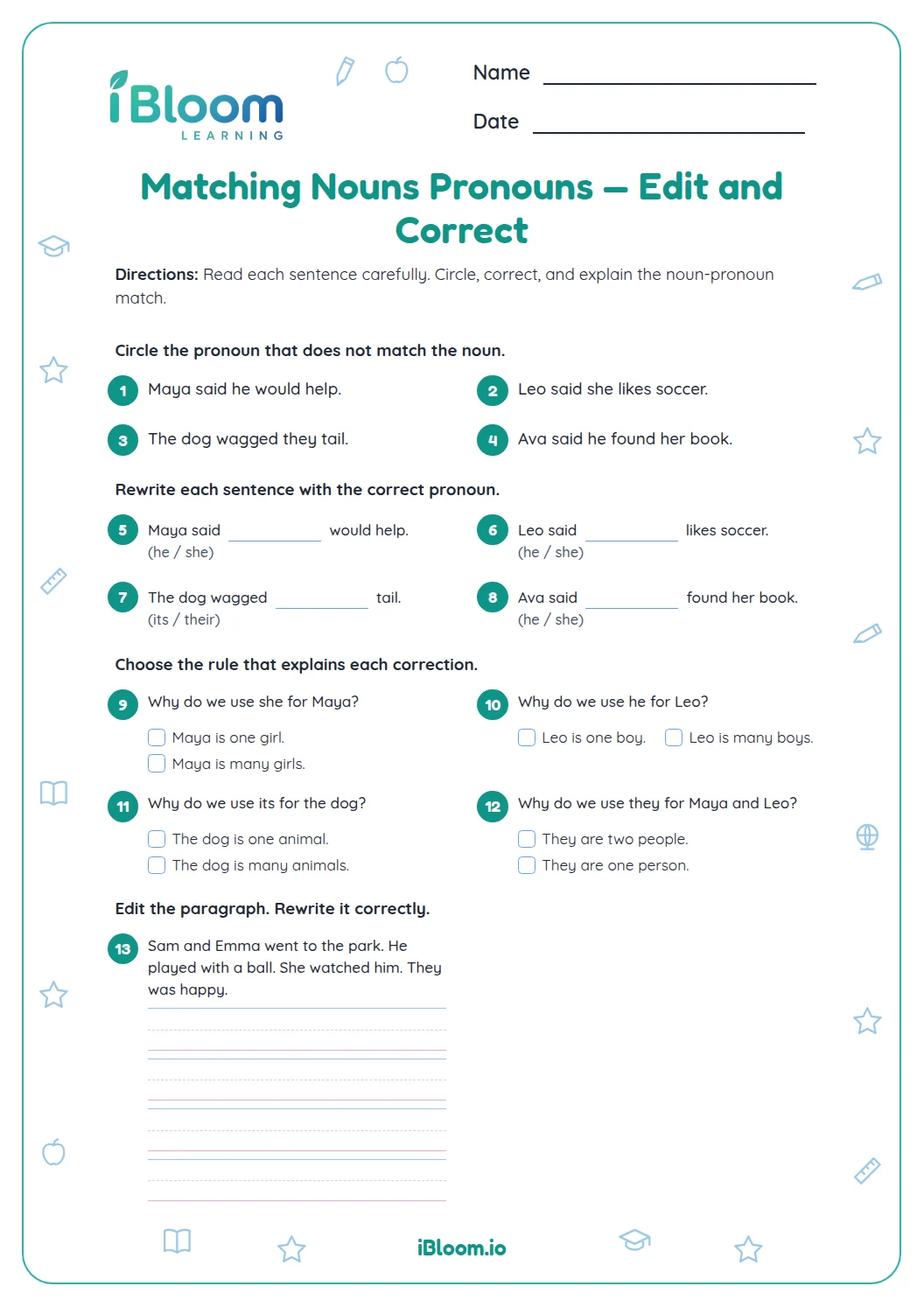
Look back at the first sentence and find who or what it is about. Then think how many there are. Maya is one girl, so she takes her place. A puppy is one animal, so it takes its place. Noah and Emma are two people, so they does the job.
The sentences with I and we have a clue too. If the writer is one of the people doing the action, the pronoun is I (one person) or we (a group that includes the writer).
- 1Maya is my friend. ___ likes to draw.
- 2Who is the sentence about? Maya.
- 3Is Maya one person? Yes, and she is a girl.
- 4She likes to draw. ✓
When do children use I and when do they use me?
I goes before the action word, as in “I help my teacher.” Me comes after it, as in “Mom hugs me.” A quick test is to say the sentence with only the pronoun, leaving the other person out.
That test is what Part B practices. In “Leo and ___ play at recess,” cover Leo and read “___ play at recess.” I play sounds right and me play does not, so the answer is I.
Why does the sheet end with rewriting?
Writers use pronouns to stop repeating a name. Reading “Maya has a book. Maya reads the book.” aloud shows why. Rewriting it as “Maya has a book. She reads it.” turns the skill from choosing into using.
Accept any correct version. For “Noah and Sam run. Noah and Sam are fast,” “Noah and Sam run. They are fast” works, and so does “They run. They are fast.”
How to use this worksheet at home or in class
- 1Warm up out loud: point at family members and say who they are in one word (she, he, they). Then point at yourselves for I and we.
- 2Do question 1 together. Read both sentences, ask who or what the blank stands for, then fill in the bubble.
- 3Let your child finish Part A alone, then do Part B with the cover-the-name trick from the I-or-me section.
- 4In Part C, ask your child to read each completed sentence aloud so they can hear whether it sounds right.
- 5For Part D, have your child say the new sentences before writing them, and check that every sentence starts with a capital letter and ends with a period.
- 6Mark with the answer key and ask your child to explain one answer they were unsure about.
Common mistakes and quick fixes
The mistake
Writing me at the front of a sentence, as in “Me am ready for school.”
The fix
Say the sentence aloud both ways. I goes before the action word. Me comes after it, as in “Mom hugs me.”
The mistake
Choosing They for “Ava and I read. ___ read every day,” because two people are reading.
The fix
Ask whether the writer is in the group. Ava and I includes the writer, so the pronoun is we. They is for a group the writer is not part of.
The mistake
Using she or he for two people, as in “Noah and Emma are happy. He are smiling.”
The fix
Count the people. When there are two or more, use they, and notice that the verb are matches.
Common Core alignment
Most US states use the Common Core language standards or a close state version.
Use personal pronouns such as I, me, we, she, he, it and they in sentences.
On this sheet: Every question asks children to choose, write or use a personal pronoun in a complete sentence.
Show the official wordingHide the official wording
Use personal, possessive, and indefinite pronouns (e.g., I, me, my; they, them, their, anyone, everything).
What to practice next
Make more practice
Further reading
Questions parents and teachers ask
What is a personal pronoun?
A personal pronoun is a short word that takes the place of a person, animal or thing, such as I, me, we, she, he, it and they. On this sheet, children choose or write one in a sentence instead of repeating a name, like turning “Maya reads” into “She reads.”
What grade is this pronoun worksheet for?
It is written for Grade 1, where Common Core L.1.1.d asks children to use personal pronouns. Part A suits children who are just starting, and Parts C and D give stronger writers a chance to produce the pronoun and whole sentences on their own.
When should my child use I and when should they use me?
Use I before the action word and me after it. “I help my teacher” and “Mom hugs me” are both right. For sentences like “Leo and ___ play,” cover the other name and read the sentence again. If I play sounds right, the answer is I.
Why is the answer “We” and not “They” for Ava and I?
They is for a group the writer is not part of, and we is for a group that includes the writer. “Ava and I” has the writer in it, so questions 4 and 13 both take we. A quick check is to point to yourself: if you are in the group, use we.
How long does the worksheet take, and is there an answer key?
Most Grade 1 children need about 15 minutes. The two-page answer key matches the worksheet page for page, showing every correct choice and a sample for the two rewrite lines, so you can print the sheet alone and check the answers together afterward.
How can my child practice pronouns after this page?
Tell a short story together and ban names after the first sentence: “Mia has a kite. She runs. It flies.” Take turns and see who can use the most pronouns. A few minutes at dinner works well and helps the habit stick.