

About this worksheet
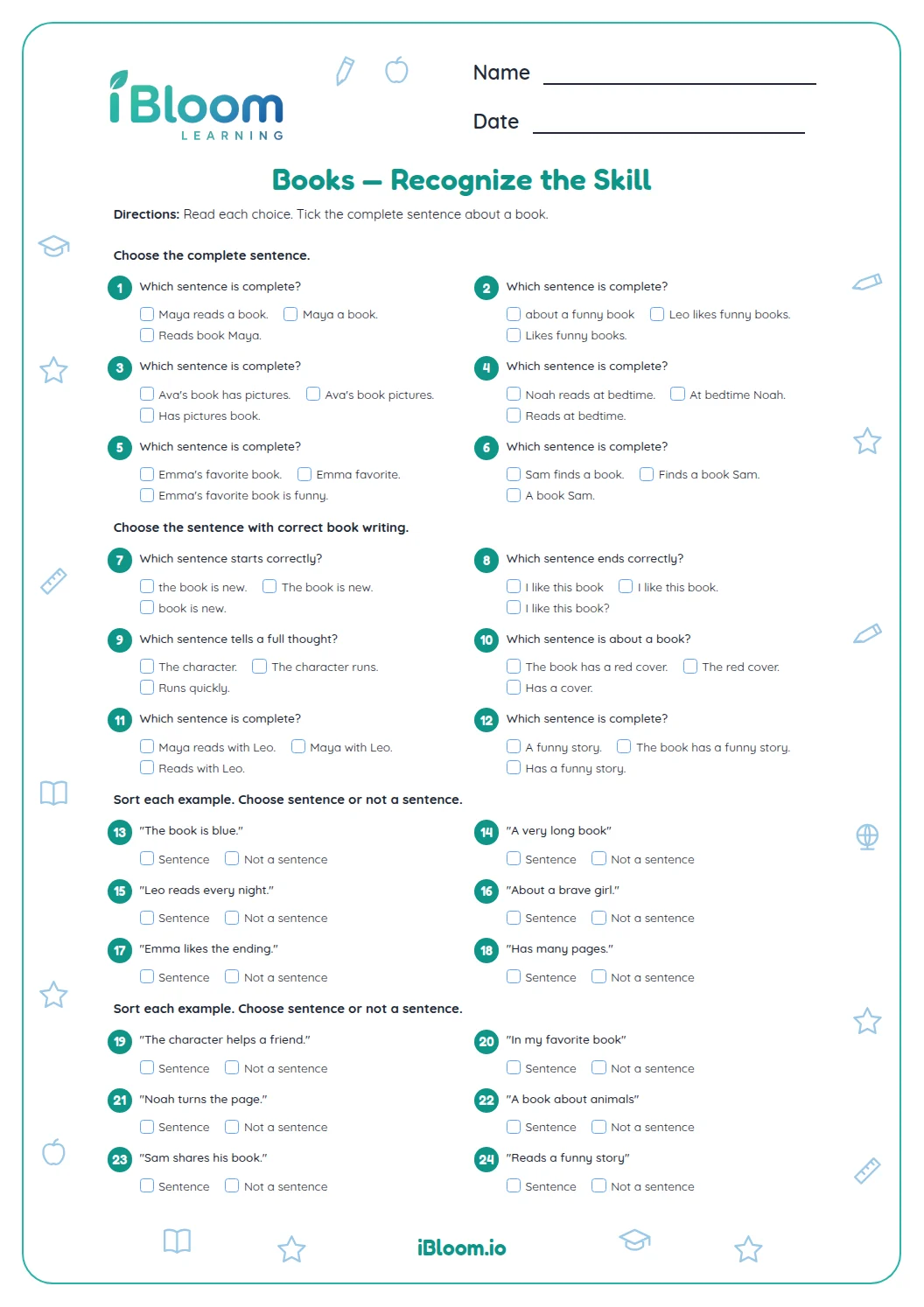
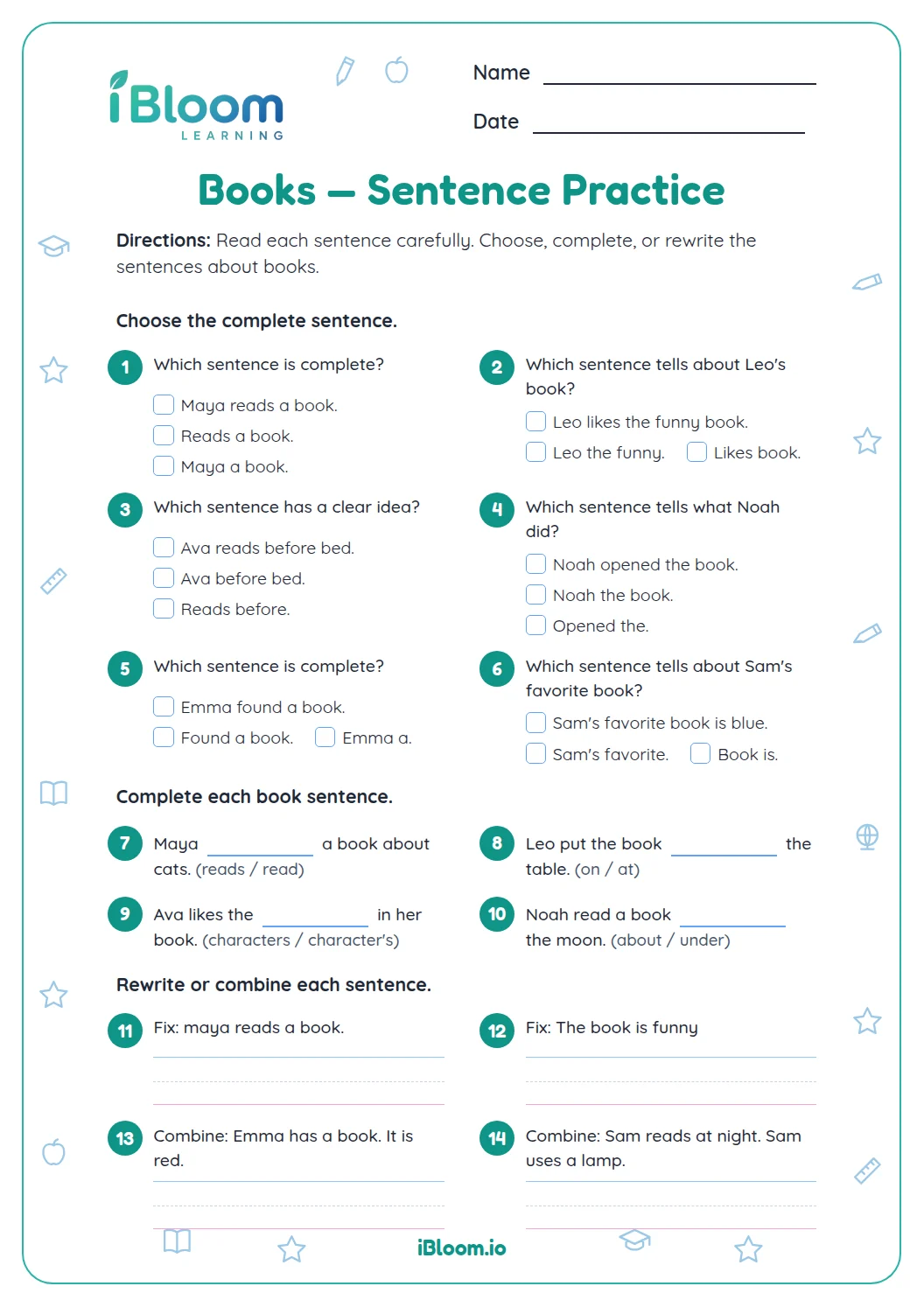
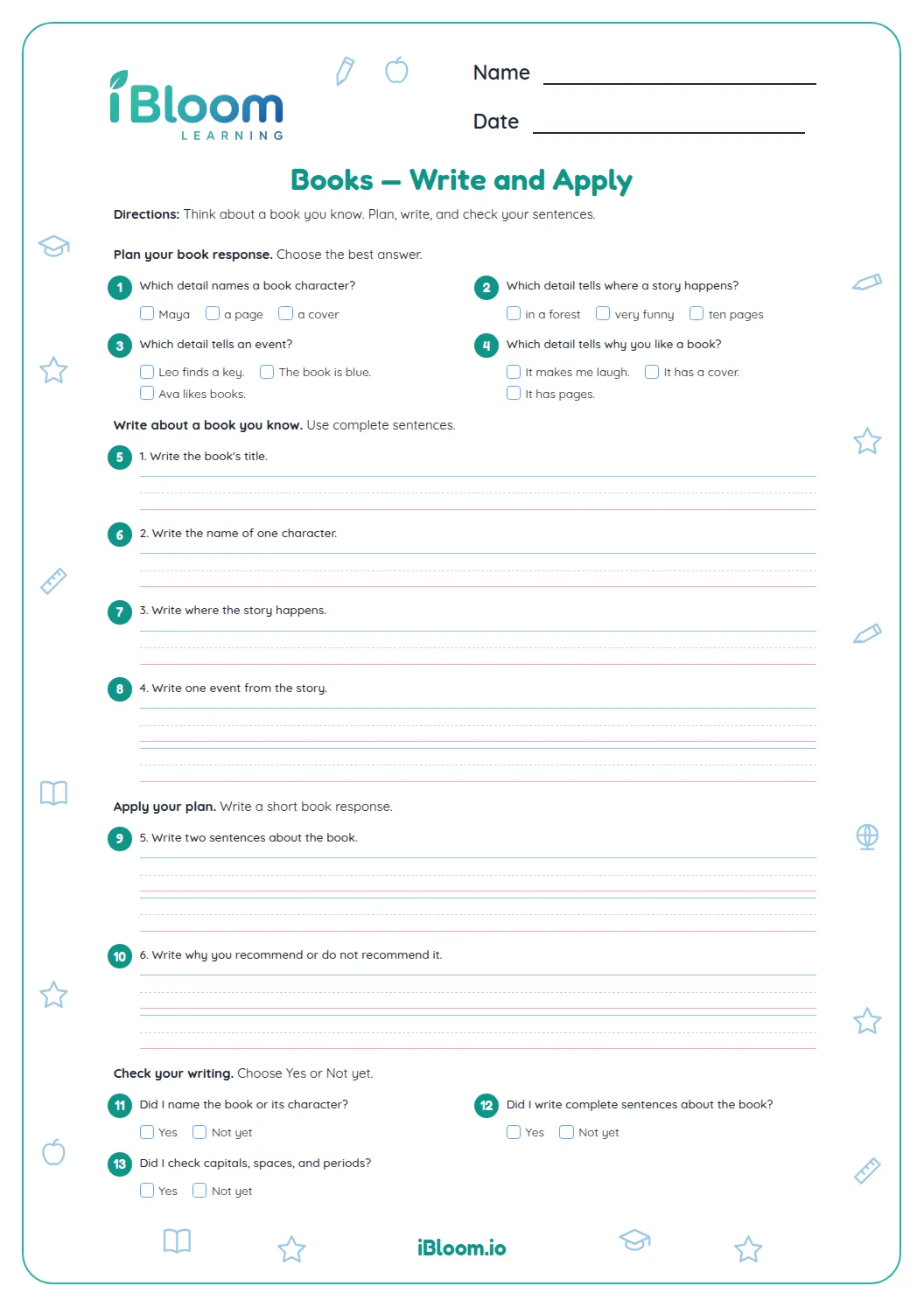
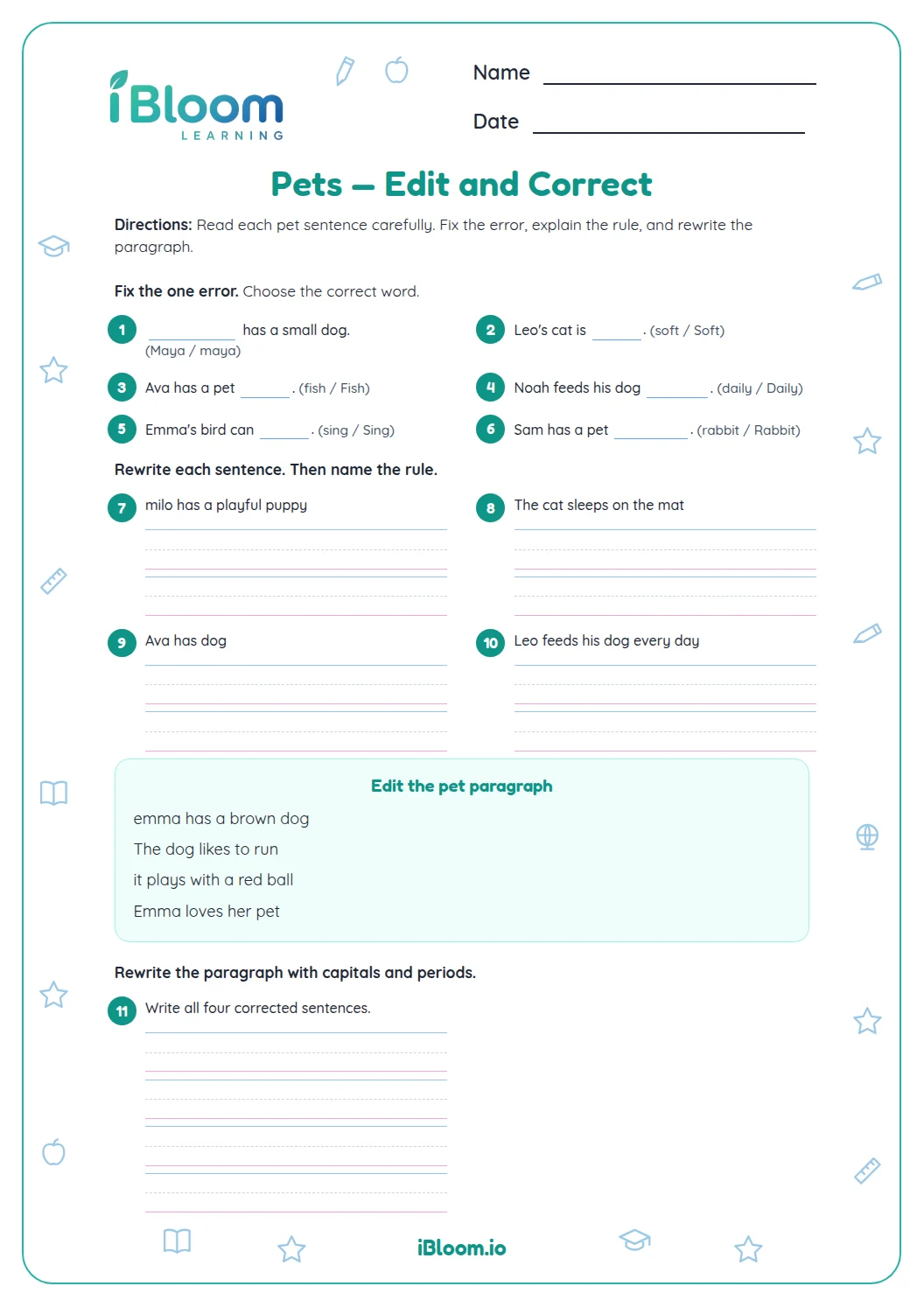
This printable Grade 1 worksheet gives children book-themed practice editing sentences. They choose a sentence written correctly, fix short examples, capitalize a book title, and write a complete sentence of their own. The work practices capitalization and punctuation under Common Core L.1.2 and subject-verb agreement under L.1.1.c. The answer key gives expected corrections and a sample response for the open prompt.
Aligned to L.1.2 and L.1.1.c
What should children check first?
Start with the first word. A sentence begins with a capital letter, including the pronoun I and a person’s name. The book theme keeps the practice focused on short, familiar sentences.
How do end marks change a sentence?
A statement usually ends with a period. A question asks something and ends with a question mark. An exclamation mark shows strong feeling. Children should read the whole sentence to decide which mark fits.
- 1Can we read this book.
- 2It asks something, so it needs a question mark.
- 3Corrected: Can we read this book?
What does the answer key include?
The key lists the corrected choices and sample answers for the open writing prompts. A child’s own sentence can be different and still be correct if it is complete and follows the prompt.
How to use this worksheet
- 1Read each item aloud once before choosing a correction.
- 2Check the first word for a capital letter.
- 3Read the sentence to decide whether it states, asks, or exclaims.
- 4Rewrite every word that needs a capital, then add the end mark.
- 5For open responses, check that the sentence expresses a complete idea.
Common mistakes and quick fixes
The mistake
Adding a question mark to every sentence.
The fix
Ask whether the sentence asks something; statements need a period.
The mistake
Forgetting to capitalize I or a name.
The fix
Scan the sentence for I and people’s names after checking its first word.
The mistake
Changing the meaning while editing.
The fix
Keep the original idea and fix only the writing conventions requested.
Common Core alignment
This page connects the worksheet practice to a specific Common Core skill.
Capitalize sentence beginnings and use correct end marks.
On this sheet: Children correct sentence capitals and end punctuation, then apply both when rewriting.
Show the official wordingHide the official wording
Demonstrate command of the conventions of standard English capitalization, punctuation, and spelling when writing.
Use singular and plural nouns with matching verbs.
On this sheet: Several editing choices ask children to notice whether the subject and verb agree.
Show the official wordingHide the official wording
Use singular and plural nouns with matching verbs in basic sentences (e.g., He hops; We hop).
What to practice next
Make more practice
Further reading
Questions parents and teachers ask
What does “edit and correct” mean on this page?
It means noticing a writing error and fixing it while keeping the sentence’s meaning. Children choose corrected book-themed sentences, repair sentence endings, capitalize a title, and write a few complete sentences. The answer key provides the expected corrections and sample answers for the open prompts.
How many questions are on the worksheet?
There are 14 questions in the worksheet. Ten ask children to choose a corrected sentence, and four ask them to make short edits or write a sentence. The separate answer key lists the choices and sample written responses. This quick rereading helps connect the writing rule to the whole sentence.
Should every sentence end with a period?
No. A statement usually ends with a period, a question ends with a question mark, and an exclamation mark can show strong feeling. Children should read the sentence and decide what it is doing before choosing an end mark. The examples stay with familiar books, readers, and classroom language.
Can a child give a different answer to the writing prompts?
Yes. The final prompts ask for a sentence about a book and about someone who reads with the child. The key gives sample responses; another complete sentence that answers the prompt and uses a capital and ending mark can also work.
How can I help a child who is unsure about capitals?
Have the child point to the first word and reread the sentence while checking for names and the word I. Then read the sentence once more to check its ending mark. This small routine makes proofreading more manageable. Ask the child to read the corrected version aloud and point to the change.
Is this a spelling worksheet?
The page focuses on sentence capitals and punctuation, with a little title capitalization. It does not ask children to memorize a spelling list. The goal is to read each short sentence carefully and make a clear correction. This quick rereading helps connect the writing rule to the whole sentence.