

About this worksheet
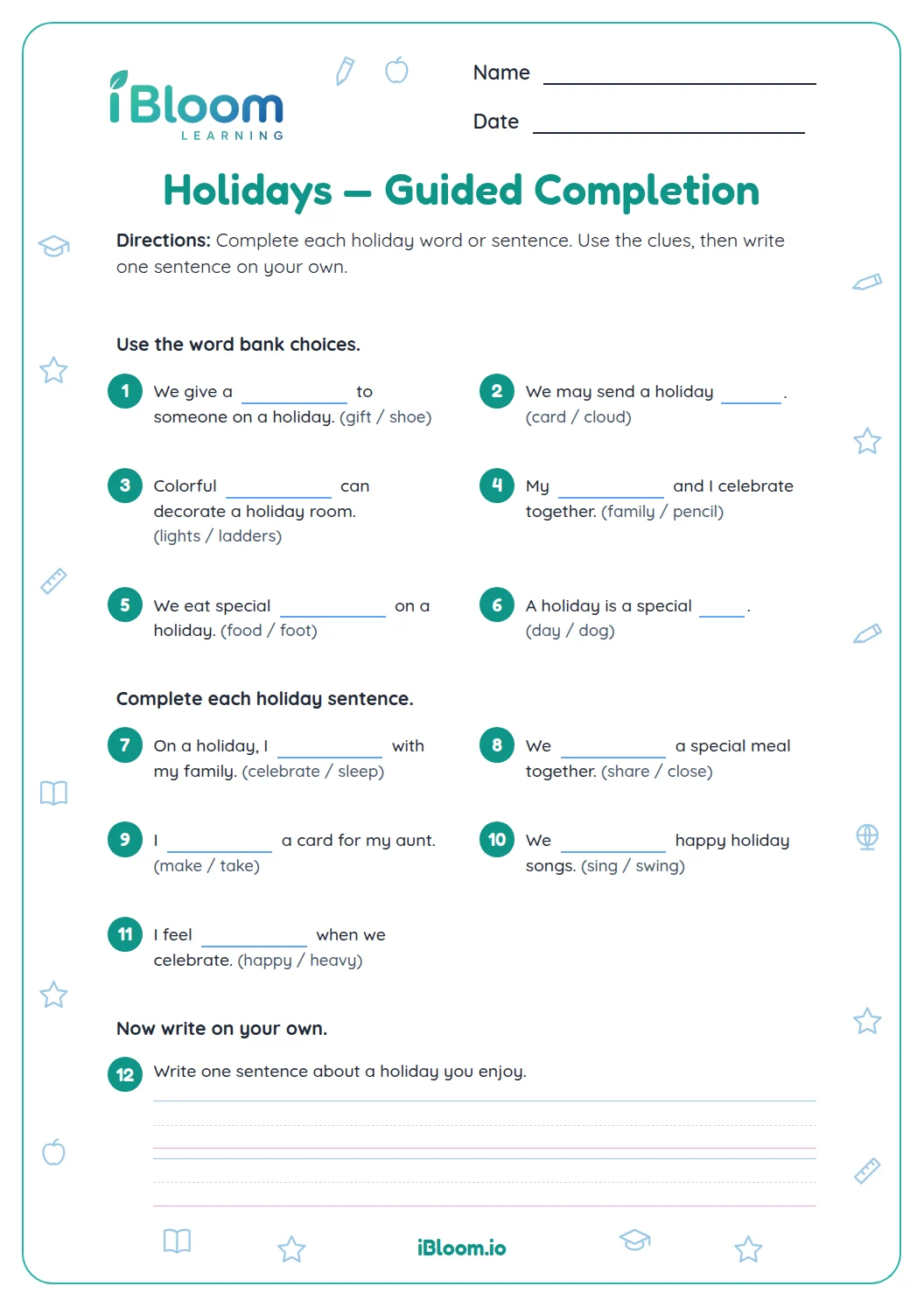
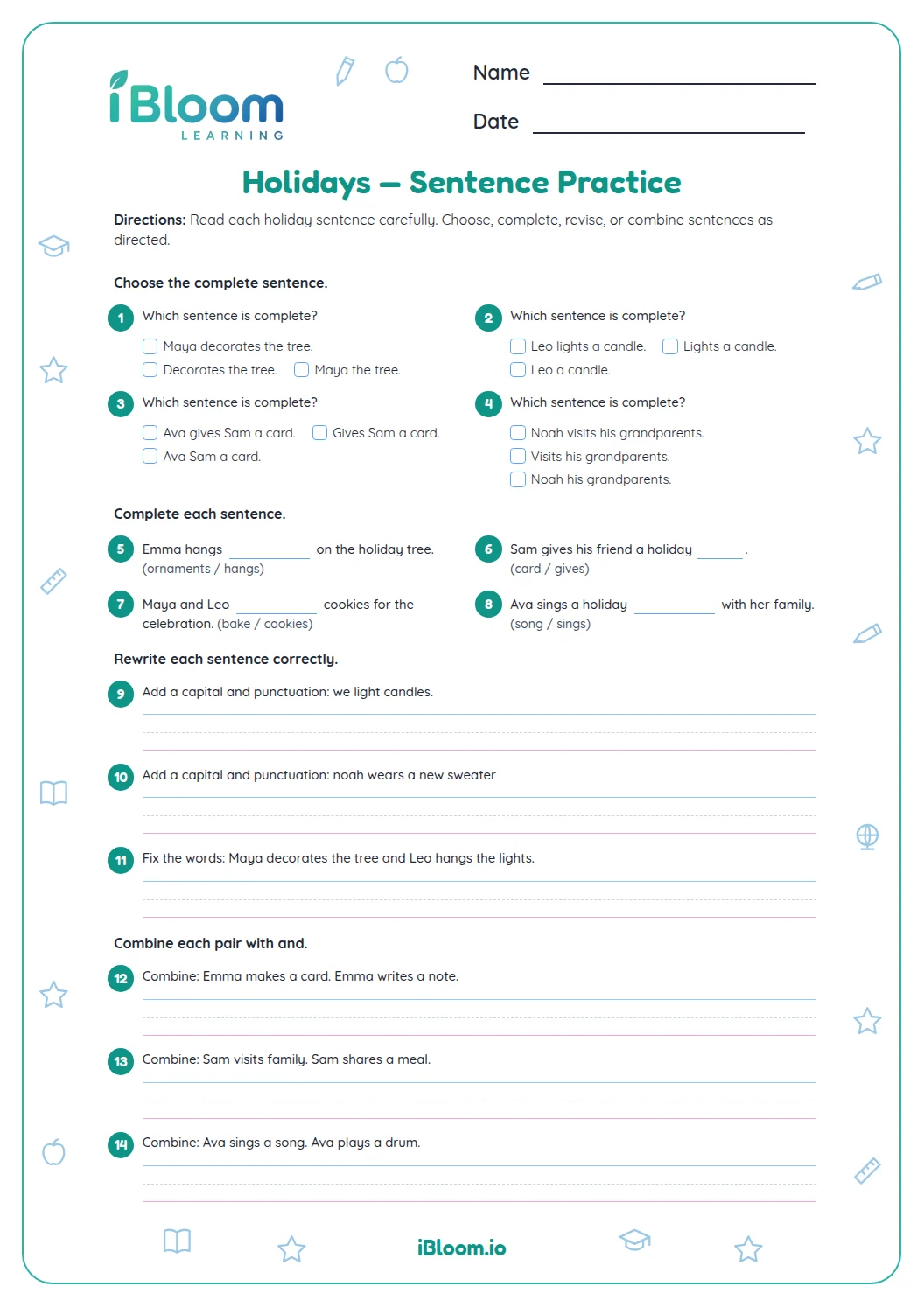
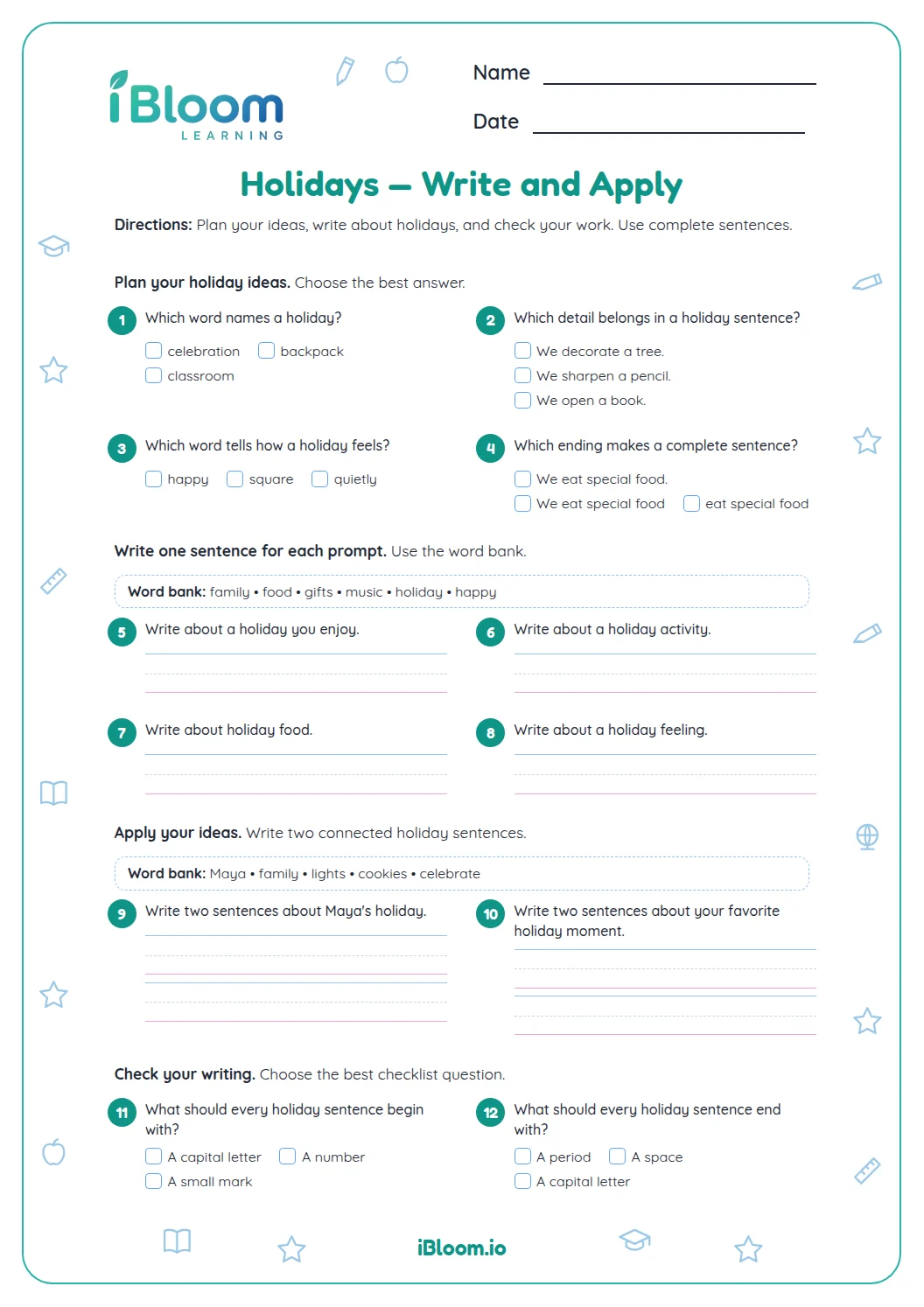
This Grade 1 holiday worksheet helps children recognize how a celebration appears in a sentence. Students name holidays from familiar clues, complete sentences with celebration words such as gifts and parade, sort holiday events from everyday routines, and choose details that fit a holiday moment. The 14 questions move from recognition to applying a fitting detail, and the printable answer key supports quick checking.
What clues point to a holiday?
Part A gives familiar celebration details, such as a November meal or costumes and candy in October. Students name the holiday that fits each clue.
- 1Families hang lights and exchange gifts in December.
- 2The clue points to Christmas.
Which words name a holiday detail?
Part B asks students to complete short sentences with a holiday item or event. Read the entire sentence to check that the word fits.
How can you sort a celebration from a routine?
Part C distinguishes holiday events from everyday routines. Part D asks students to choose a detail that helps a reader picture a holiday moment.
How to use this worksheet
- 1Read each sentence aloud and ask what clues suggest a holiday.
- 2For the word search items, reread the whole sentence after circling a word.
- 3Compare holiday events with everyday routines in Part C.
- 4Use the final prompts to add a specific detail or an event that follows.
Common mistakes and quick fixes
The mistake
Do not label every special activity as a holiday.
The fix
Check for a named celebration.
The mistake
Circle a holiday word that appears in the sentence, not a nearby noun.
The fix
The mistake
Keep an event sequence in order by using a first, next, or then idea.
The fix
What to practice next
Make more practice
Questions parents and teachers ask
What does this worksheet ask children to do?
Children choose sentences connected to holidays, circle holiday words in short sentences, and decide whether a sentence describes a holiday or an everyday activity. Four final prompts ask them to add a holiday detail or continue an event. The answer key includes sample responses for the open-ended items.
Which holiday words appear?
The practice includes Christmas, Thanksgiving, New Year’s Eve, Halloween, Diwali, Independence Day, a menorah, gifts, and a parade. The examples represent different traditions and celebrations. Families can use the sentences to talk about holidays they celebrate or learn about. The key identifies the expected word for every sentence.
Are there writing questions?
Yes. The last four questions ask children to imagine a next event, describe a family holiday moment, finish a short sequence, or name a detail that helps a reader picture a celebration. The key shows one possible response; other clear, on-topic sentences are acceptable.
How should my child decide whether a sentence is about a holiday?
Look for a named holiday, a familiar holiday event, or a celebration activity. A sentence about homework or packing a backpack is an everyday routine here. A parade is counted as a holiday event only when the sentence connects it to a holiday.
How can I extend the practice?
Ask your child to tell two things that happened at a celebration in the order they happened. Encourage a time word such as “first” or “next,” plus one concrete detail. Then have your child add a final sentence that sounds like an ending.