

About this worksheet
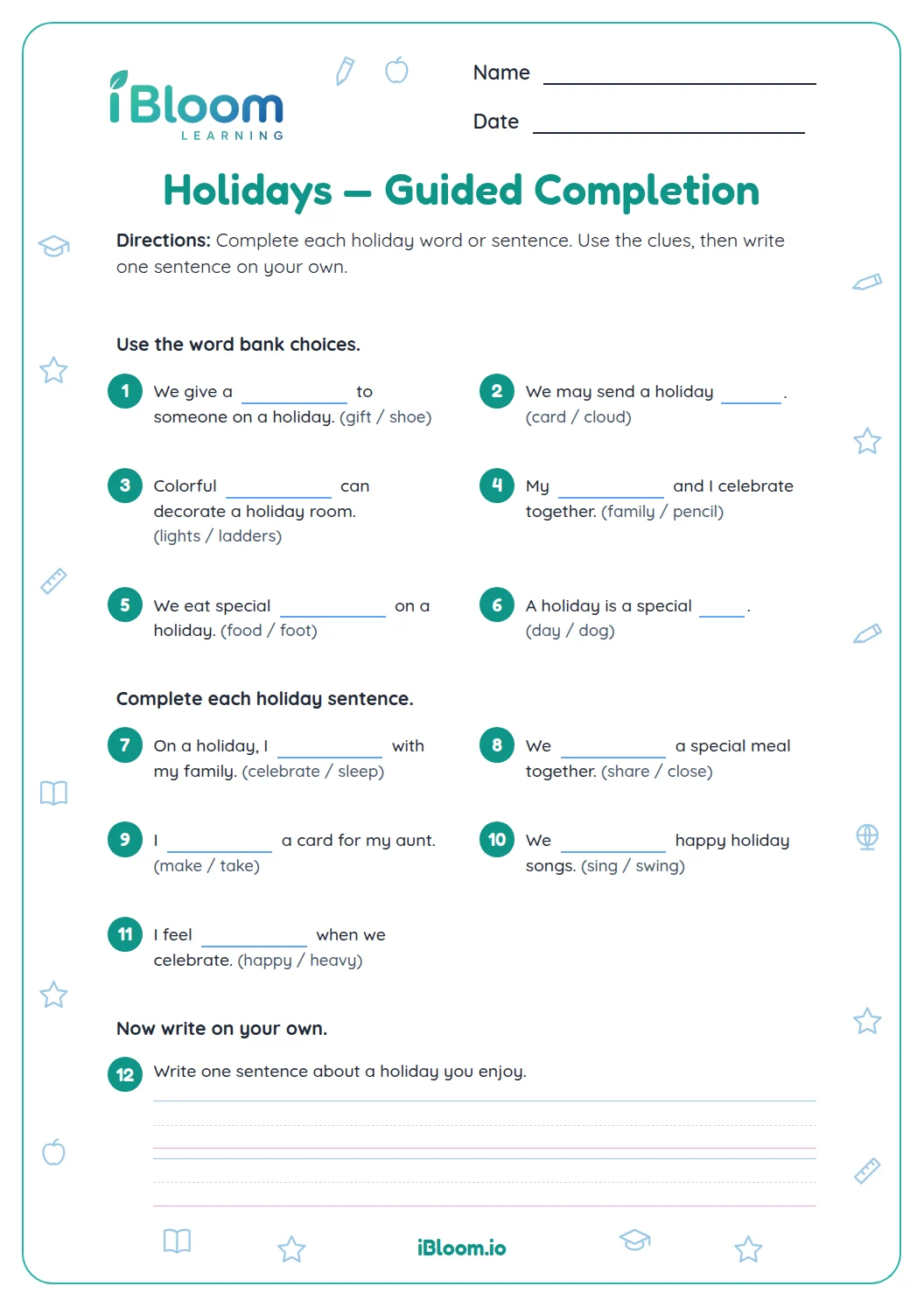
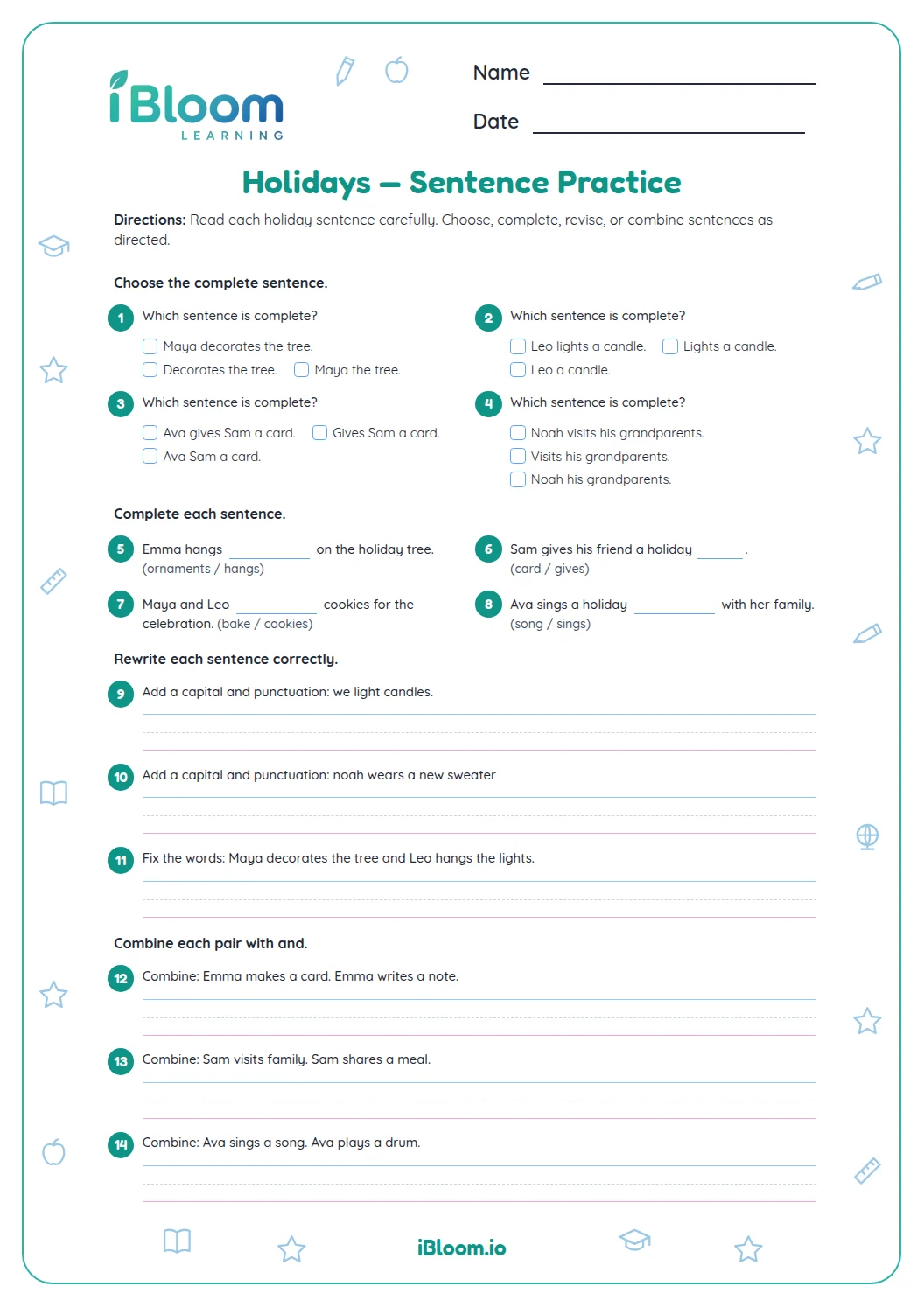
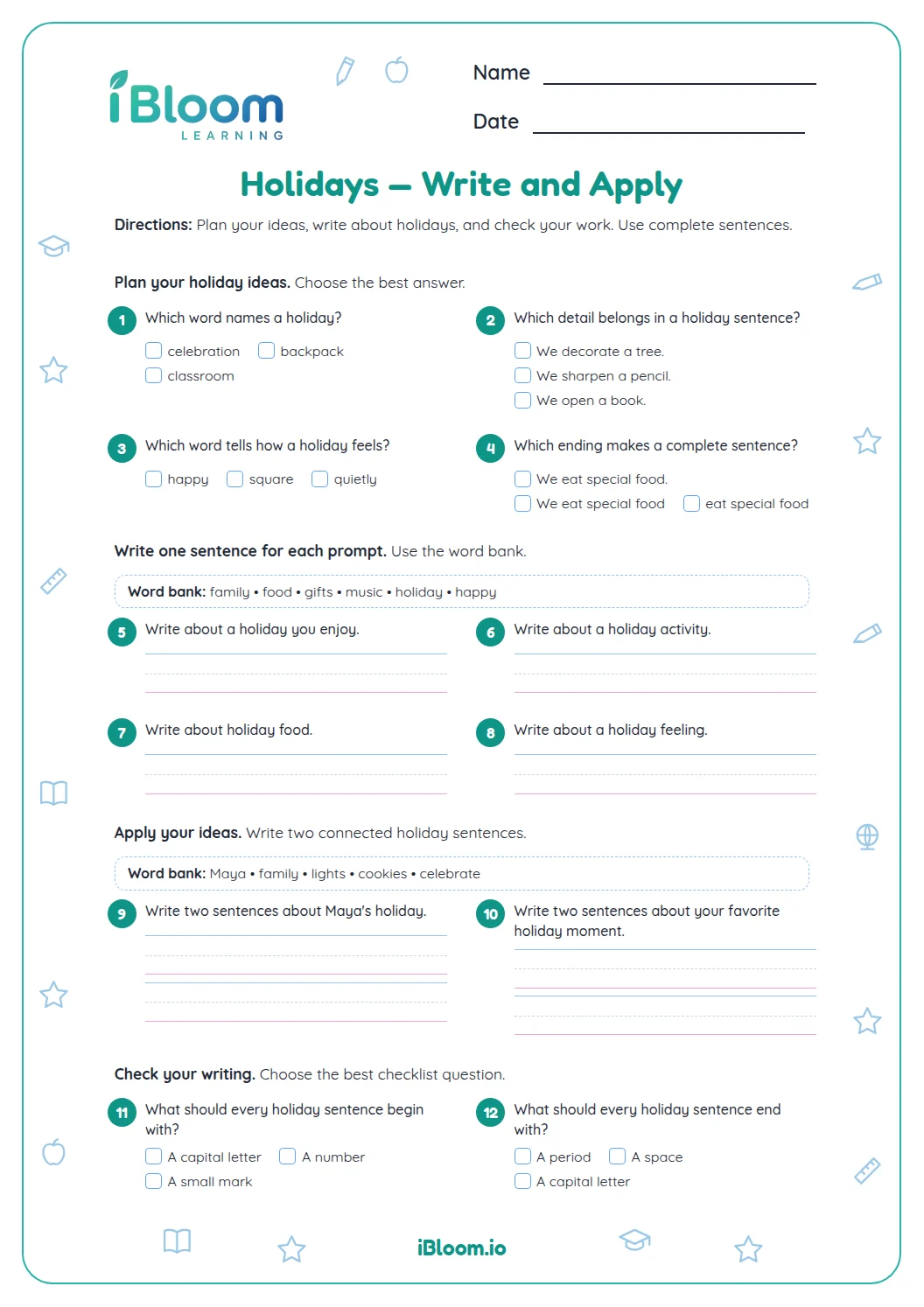
This Grade 1 holiday writing worksheet moves from choosing complete sentences to editing capitals and end marks, then writing short responses about holiday events. Students practice sentence conventions and put events in order with words such as first and then. The 16 questions include answer choices, sentence edits and original writing prompts, with sample answers in a separate key. It practices CCSS W.1.3 and L.1.2.
Aligned to W.1.3 and L.1.2
How can a child spot a complete sentence?
A complete sentence tells a whole idea. It begins with a capital letter and ends with punctuation. In question 1, “We hang lights.” has a subject, an action, a capital letter, and a period. The other choices leave out an ending mark or put the words in an unclear order.
- 1We hang lights.
- 2It tells a complete thought.
- 3It begins with a capital and ends with a period.
What should children check when editing?
Look at the first letter and the end of the sentence. Names and holiday names also begin with capital letters. Questions 5–8 give short lines to rewrite or finish, so children can practice these details in context.
- Part A: choose a complete or correctly written sentence
- Part B: fix or complete short holiday sentences
- Part C: write brief stories with events in order
How can a short holiday story stay in order?
The last six questions ask students to write about holiday events, decorations, meals, and celebrations. Some ask for events in order; others focus on one sentence or an ending. The key gives examples, but a child’s wording can differ if it answers the prompt and forms a complete sentence.
How to use this worksheet
- 1Read every choice aloud and listen for a complete idea.
- 2Check the first word for a capital letter.
- 3Add a period at the end of a telling sentence.
- 4For each story, choose two events and put them in order.
- 5Reread to make sure the story has an ending.
Common mistakes and quick fixes
The mistake
Writing a phrase instead of a complete thought.
The fix
Say who or what the sentence is about and what happens.
The mistake
Forgetting the capital at the beginning or for a holiday name.
The fix
Check the first letter and capitalize names such as New Year’s Day.
The mistake
Listing events without showing their order.
The fix
Use first, next, or then to guide the reader.
Common Core alignment
Students practice writing clear sentences and short narratives.
Write ordered events with details, time words, and an ending.
On this sheet: The final prompts ask children to narrate two holiday events in sequence with time words and an ending.
Show the official wordingHide the official wording
Write narratives in which they recount two or more appropriately sequenced events, include some details regarding what happened, use temporal words to signal event order, and provide some sense of closure.
Use capitalization and end punctuation in sentences.
On this sheet: The editing questions practice initial capitals and sentence-ending periods.
Show the official wordingHide the official wording
Demonstrate command of the conventions of standard English capitalization, punctuation, and spelling when writing.
What to practice next
Make more practice
Further reading
Questions parents and teachers ask
What makes a sentence complete?
A complete sentence tells a whole idea. It usually names who or what and tells what happens, begins with a capital letter, and ends with punctuation. On question 1, “We hang lights.” is complete; the other options leave something unfinished.
What should children include in the story prompts?
The final six questions ask children to tell at least two events in order, add a detail, and give the story an ending. Time words such as first, next, and then help show what happened when. The key offers sample responses, but other clear stories can work.
Can a child write about a holiday their family does not celebrate?
Yes. Children can choose a winter celebration, a family gathering, or another holiday that is meaningful to them. They can also describe a classroom celebration. The prompts focus on writing clear sentences and ordered events, so the details can be personal.
How can I help with capitals and periods?
Ask the child to point to the first word and the final mark in each sentence. The first letter should be capitalized, and a telling sentence ends with a period. Questions 5–8 provide short editing practice before the longer story prompts.
Does the answer key give exact stories?
The key gives sample responses for open writing prompts. A child’s own answer can be different and still be successful if it follows the prompt, uses complete sentences, puts events in order, and includes an ending. Multiple-choice and editing items have specific answers.