

About this worksheet
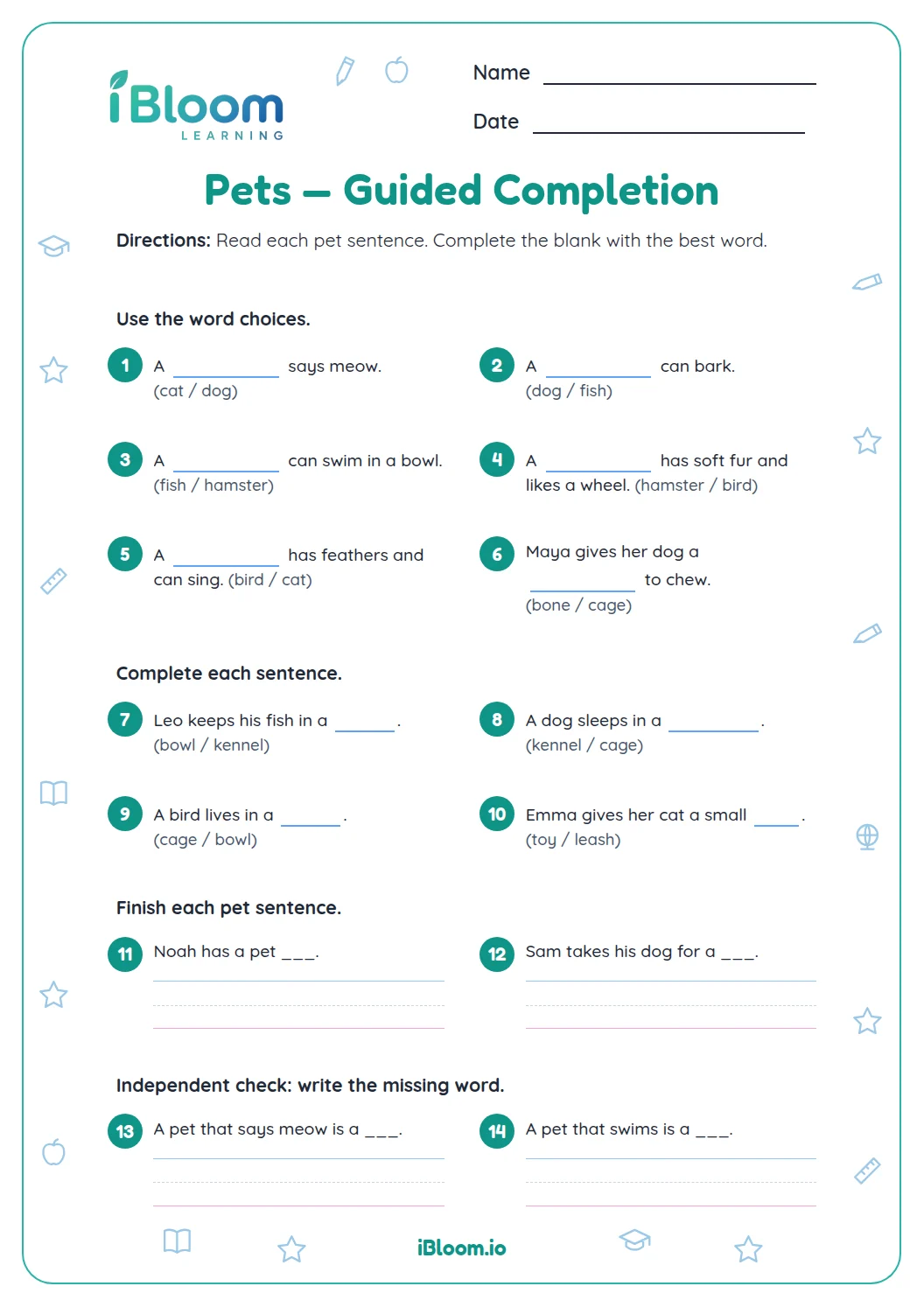
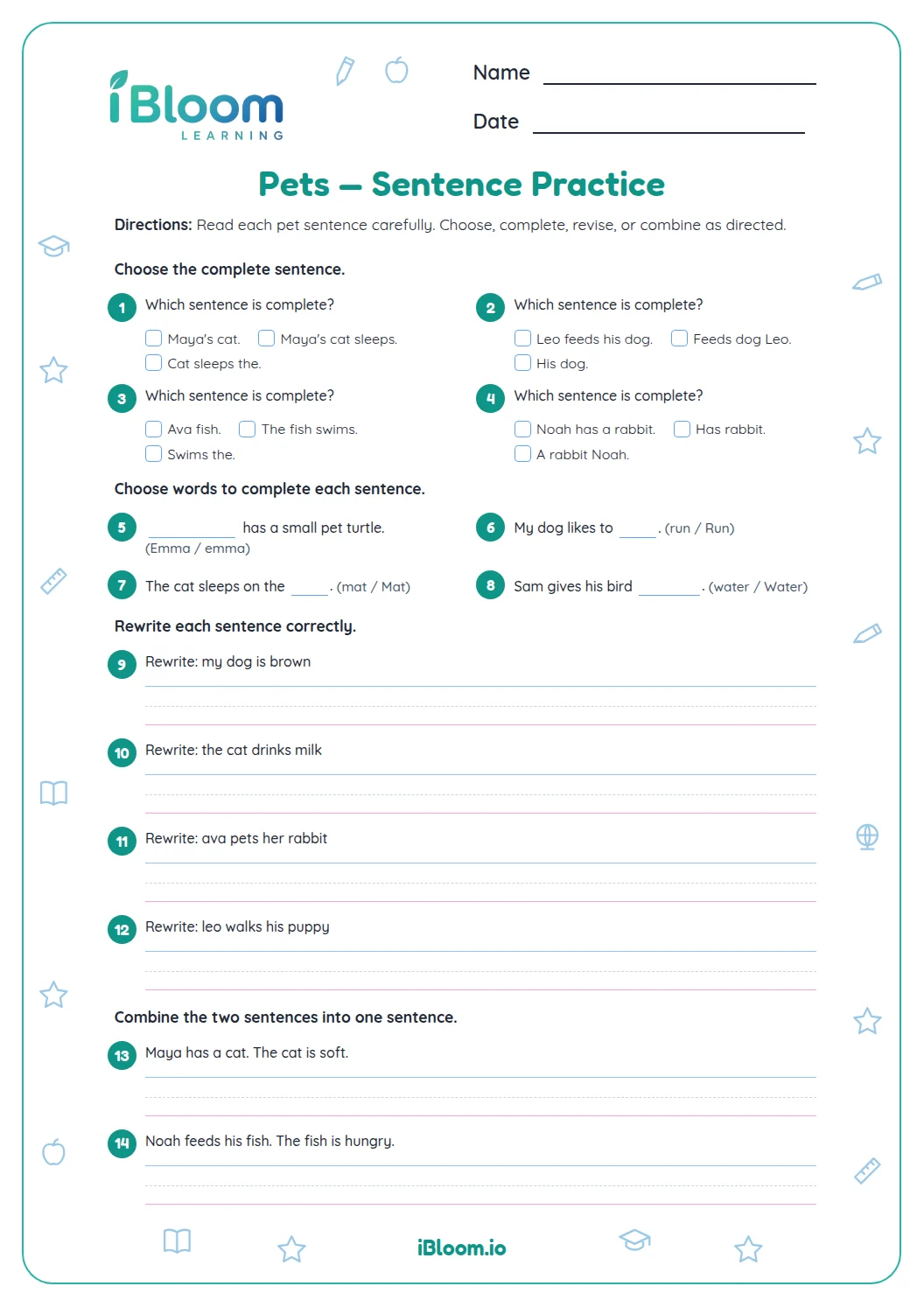
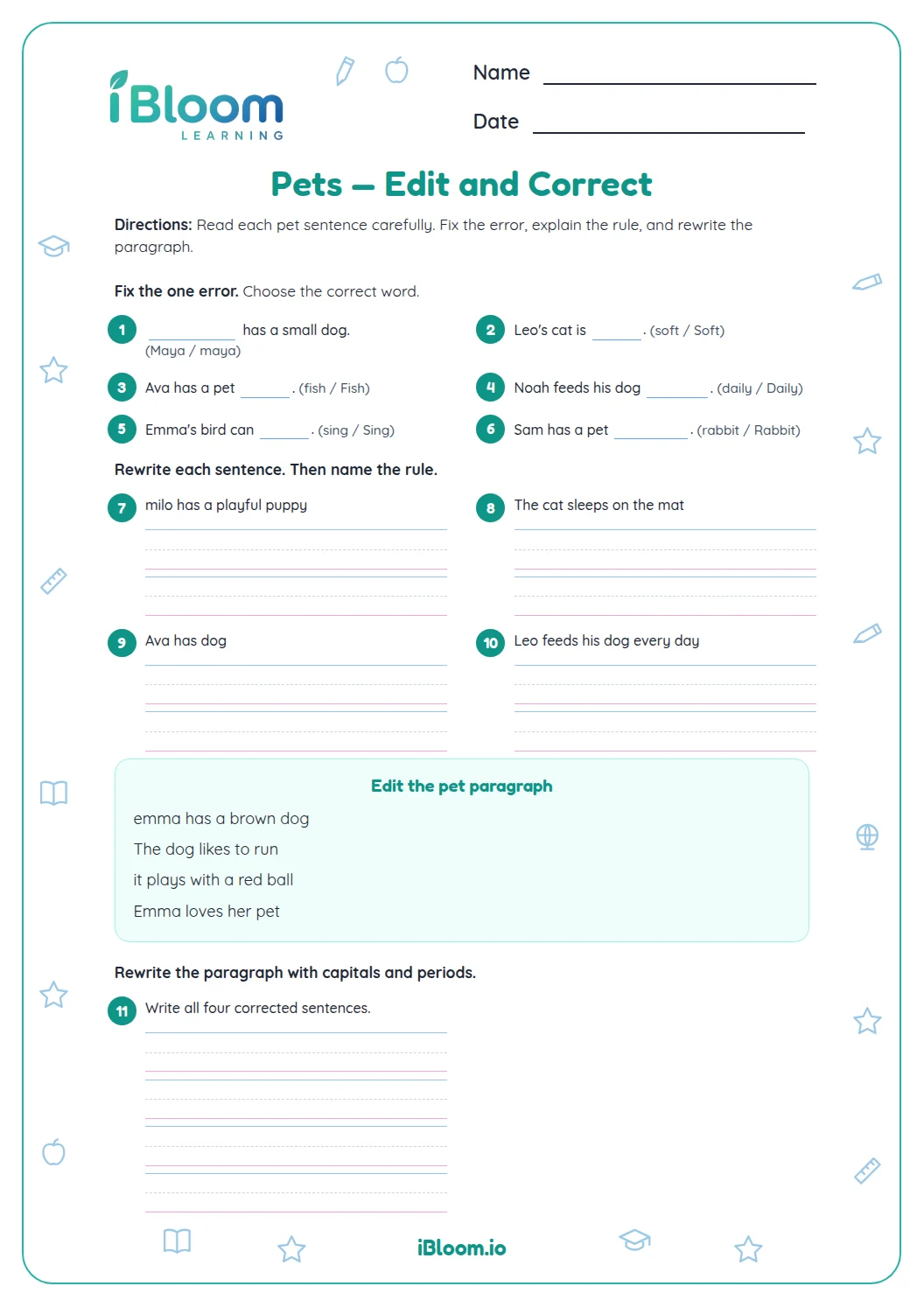
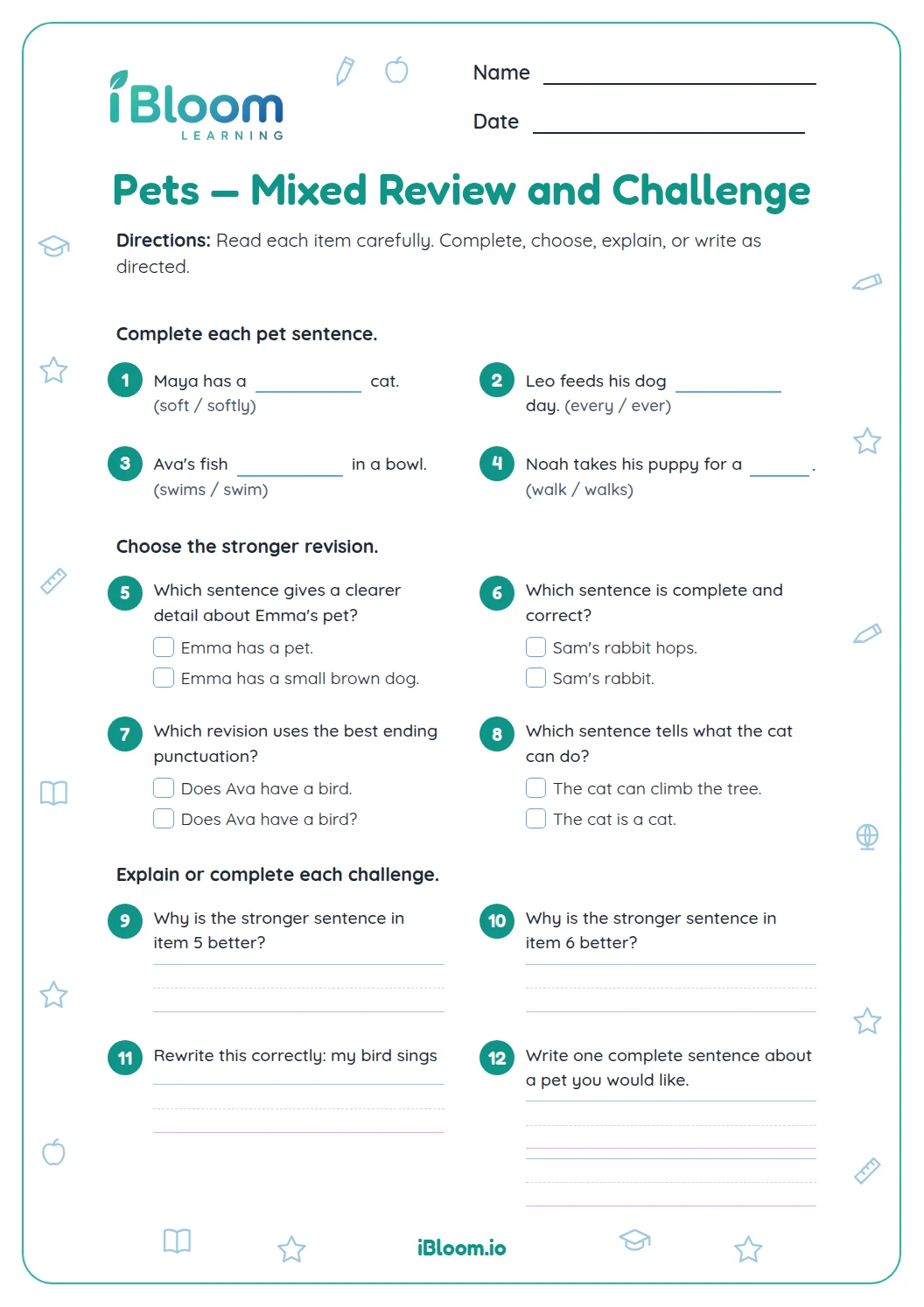
This free printable Grade 1 worksheet turns a familiar topic, pets, into complete-sentence practice. Children first finish four sentences using a choice of action words. They then write four sentences of their own, including a question, about a pet they have or would like. The final two tasks expand short sentences with a describing word and a place. These ten prompts practice Common Core L.1.1.j, producing and expanding sentences in response to prompts. The separate answer key includes sample responses for the six open writing tasks.
Aligned to L.1.1.j
How do the first four prompts help children begin?
Each Part A sentence already has a subject and needs one action word. Children choose between two supplied words, such as bark and read for dogs. Reading the completed sentence aloud checks that it makes sense.
Part B gives more responsibility to the writer: children supply the whole sentence instead of a single missing word.
How do children add a detail without losing the sentence?
Keep the original subject and action, then add the requested information. Question 9 asks for a describing word about the dog. Question 10 asks where the cat naps.
- 1Question 9: The dog runs.
- 2Add a describing word: little.
- 3Expanded sentence: The little dog runs.
What should I look for in the original sentences?
Look for a complete thought that answers the prompt. A child can name a real pet or an imagined one. The need sentence should name something that animal needs, and the question should ask for information.
Read each sentence aloud together. Check the beginning capital, spaces, and ending mark after checking the idea. The key’s rabbit examples show possible answers; children may choose a different pet.
How to use this worksheet
- 1Say a complete pet sentence aloud and have the child repeat it.
- 2Read both word choices in each Part A prompt before writing.
- 3Let the child choose a real or imagined pet for Part B.
- 4Ask the child to say each original sentence before writing it.
- 5For Part C, keep the original sentence and add the requested detail.
- 6Review complete thoughts first, then capitals, spaces, and ending marks.
Mistakes to check and ways to help
The mistake
Writing “A rabbit” instead of a complete sentence.
The fix
Ask the child to tell a whole thought, such as “I would like a rabbit.”
The mistake
Answering the question prompt with a statement.
The fix
Begin with a question word such as what or where and read it as something you want to find out.
The mistake
Adding “little” but leaving out “runs” in question 9.
The fix
Keep the original subject and action: “The little dog runs.” The new word adds detail to the complete thought.
Common Core alignment
Write complete pet sentences and expand them with a describing word or a place.
On this sheet: Students complete sentences, write their own pet sentences, and expand two short sentences.
Show the official wordingHide the official wording
Produce and expand complete simple and compound declarative, interrogative, imperative, and exclamatory sentences in response to prompts.
What to practice next
Make more practice
Further reading
Questions parents and teachers ask
Does my child need to own a pet?
No, children can write about a pet they would like to have. The first original prompt explicitly offers that choice. Use the same imagined pet for the action and need sentences if that helps your child keep ideas connected and focus on writing complete thoughts.
Are all ten answers fixed?
No, the first four sentence completions have fixed answers, while the remaining six writing tasks allow different responses. The key labels those responses as samples. Accept any complete sentence that answers its prompt, including a sensible action, an animal need, or the requested added detail.
How much should children write for each prompt?
One complete sentence is enough for each writing prompt. Question 8 asks for one question, and the last two tasks each ask for one expanded sentence. Encourage a clear idea and the requested detail before asking for extra length or more complicated vocabulary from your child.
How can I help with spelling during the writing tasks?
Let your child say the sentence first, then help with a pet name or another needed word on separate paper. Keep the child responsible for choosing the idea and writing the sentence. Afterward, reread together and correct a small number of spellings that affect meaning.
What is the difference between the last two tasks?
Question 9 adds a describing word to “The dog runs,” while question 10 adds a place to “The cat naps.” Both keep the original complete thought and make it more specific. A little dog and a cat napping on a rug are the key’s examples.