






About this worksheet
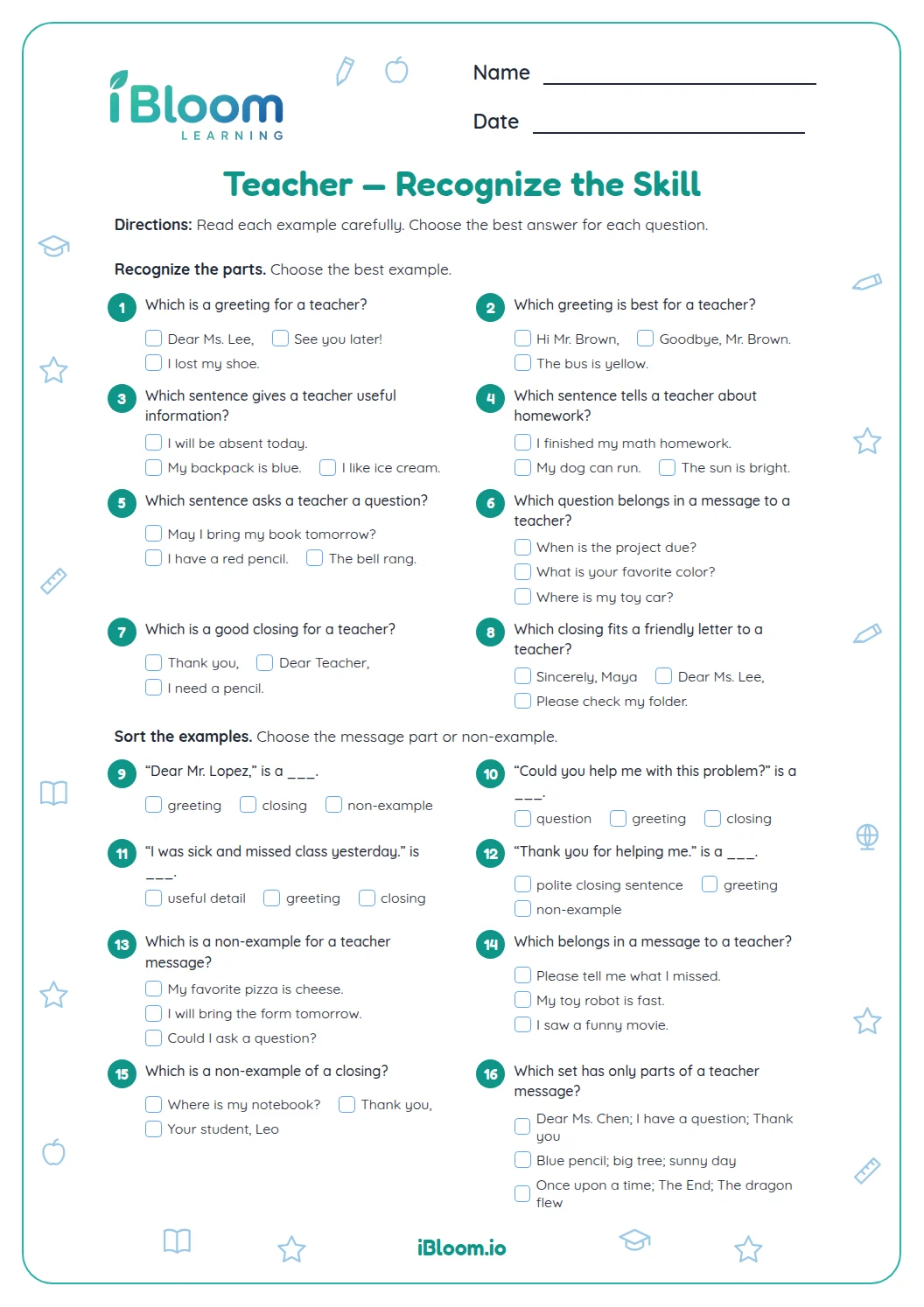
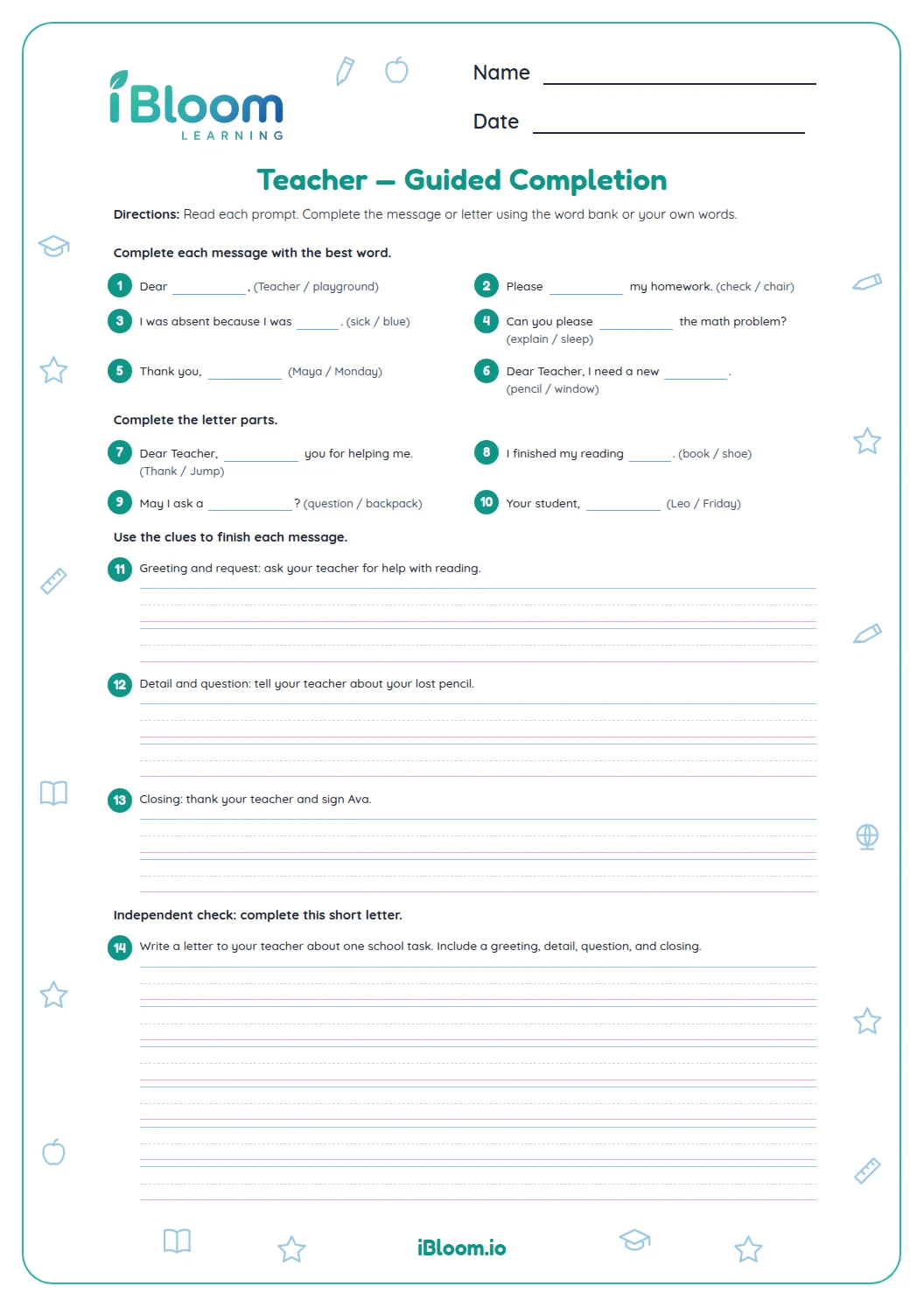
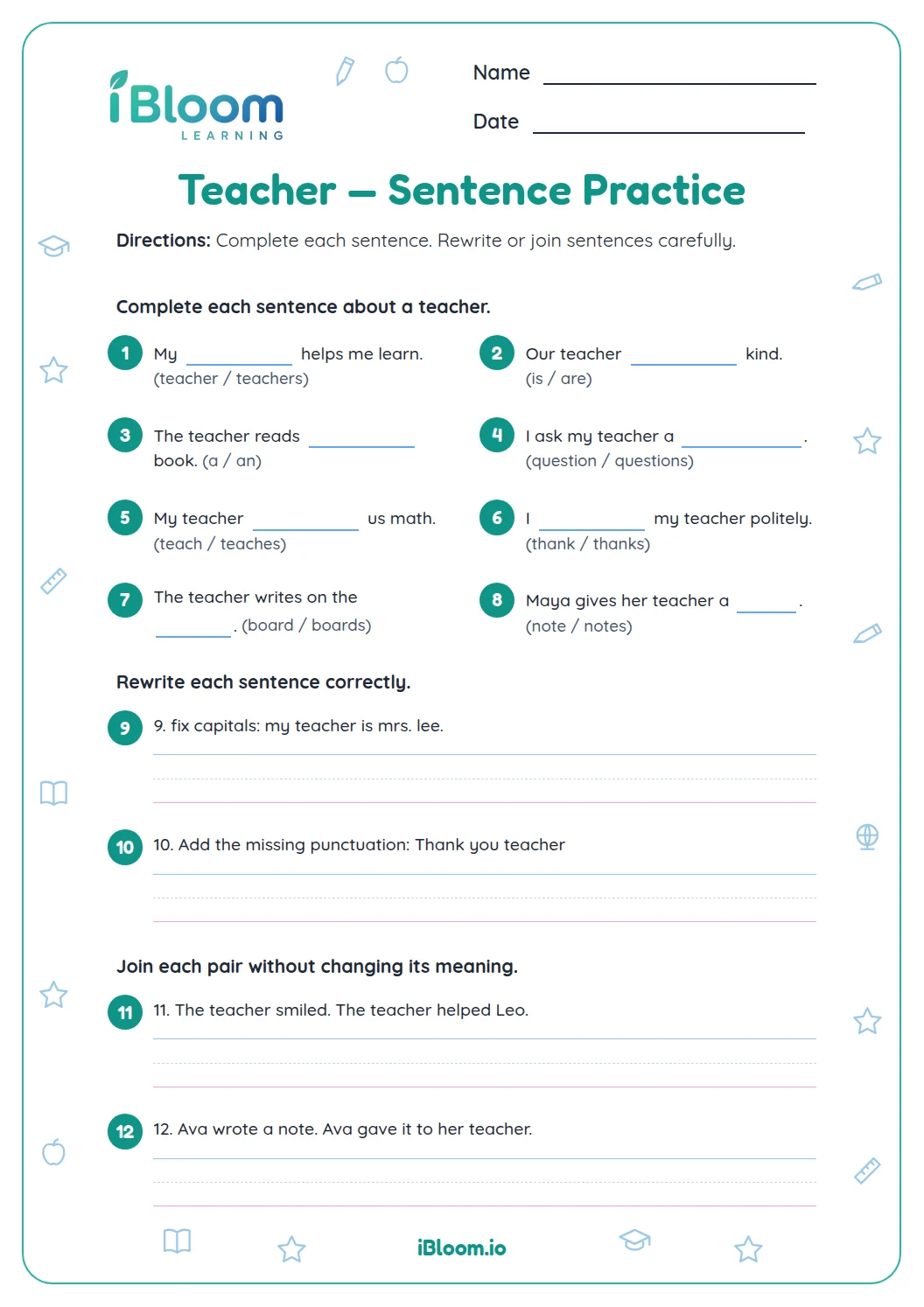
This free Grade 2 writing worksheet helps children turn a classroom memory into a short letter to their teacher. Part A asks two planning questions about a lesson and the teacher’s help. Part B gives two letter parts to punctuate. Part C guides children through six writing tasks: a greeting, three body sentences including a question, a closing, and a signature. The worksheet practices Common Core W.2.8 through recalling experience and L.2.2b through greeting and closing commas. The 10 tasks include a sample answer key so adults can check the letter’s meaning, detail, and punctuation.
Aligned to L.2.2b and W.2.8
What should a child tell their teacher?
Start with a small memory the child can explain clearly: reading a book, solving a math problem, making something, or trying a new skill. Part A asks what the child learned and how the teacher helped.
These notes supply the letter’s details. A sentence such as “You showed me how deep to plant the seed” gives the teacher a specific moment to recognize.
Where do commas go in a friendly letter?
A comma follows the greeting and another follows the closing. In Part B, children practice with Dear Ms. Lee and Yours truly. In Part C, they transfer the same pattern to a letter addressed to their own teacher.
- 1Question 3: Dear Ms. Lee
- 2Correct greeting: Dear Ms. Lee,
- 3Keep the period in Ms. and add the comma after Lee.
How do the six letter tasks fit together?
Read questions 5 through 10 in order as one letter. The greeting names the reader. Three body sentences tell what the child learned, explain the teacher’s help, and ask a related question. The closing ends the letter politely, and the signature identifies the writer.
The spaces keep each part manageable for Grade 2 writers. After checking the draft, a child can copy the parts onto a separate page to make a continuous letter, keeping the greeting, body, closing, and signature in that order.
How to use this worksheet
- 1Talk about one classroom moment the child remembers.
- 2Record short notes in Part A about the learning and the teacher’s help.
- 3Practice adding commas to the greeting and closing in Part B.
- 4Write the letter in Part C using the same classroom memory throughout.
- 5Read all six letter parts aloud in order.
- 6Check the two commas, question mark, sentence endings, and signature against the sample key.
Mistakes to notice and fix
The mistake
Writing only “You are nice” without a classroom detail.
The fix
Use the planning notes to name one thing the teacher did to help.
The mistake
Putting the greeting comma after Dear.
The fix
Read the whole greeting as one unit and place the comma after the teacher’s name.
The mistake
Putting the closing comma after the signature.
The fix
Write the comma after From or Your student; put the child’s name on the next line.
Common Core alignment
Place commas after a letter greeting and closing.
On this sheet: Children correct two letter parts and use commas in their own letter to a teacher.
Show the official wordingHide the official wording
Use commas in greetings and closings of letters.
Recall a classroom experience to supply details for a letter to a teacher.
On this sheet: Planning questions ask children to recall a lesson and something their teacher did to help.
Show the official wordingHide the official wording
Recall information from experiences or gather information from provided sources to answer a question.
What to practice next
Make more practice
Further reading
Questions parents and teachers ask
Does my child need to use the teacher’s real name?
The child can use the name they normally use for the teacher. Part B uses Ms. Lee only for punctuation practice; Part C invites a personal greeting. Help with spelling the name if needed, then let the child place the comma at the end of the greeting.
What if my child cannot think of a class memory?
Offer a few concrete reminders without choosing the message for them. Ask about a recent book, a math lesson, an art activity, or a time they asked for help. Let the child select one experience and describe what the teacher did before filling in the planning notes.
How long should the letter be?
The letter body is three sentences, with a greeting, closing, and signature added around it. Each sentence has a specific job: name the learning, explain the help, and ask a question. This keeps the message focused while giving a second grader enough room to include a meaningful classroom detail.
How should I use the sample answer key?
Use the sample key to check the structure and purpose of each response. The child’s memory, teacher’s name, and signature will naturally differ. Check that the message stays connected to one experience, includes specific help and a related question, and places commas after the greeting and closing. Accept different appropriate wording.
Can the worksheet become a letter to give to the teacher?
Yes, the child can copy the completed Part C responses into a continuous letter after checking them. Keep the greeting first, combine the three body sentences, and finish with the closing and name on separate lines. Let the child decide whether to share the finished letter with the teacher.