

About this worksheet
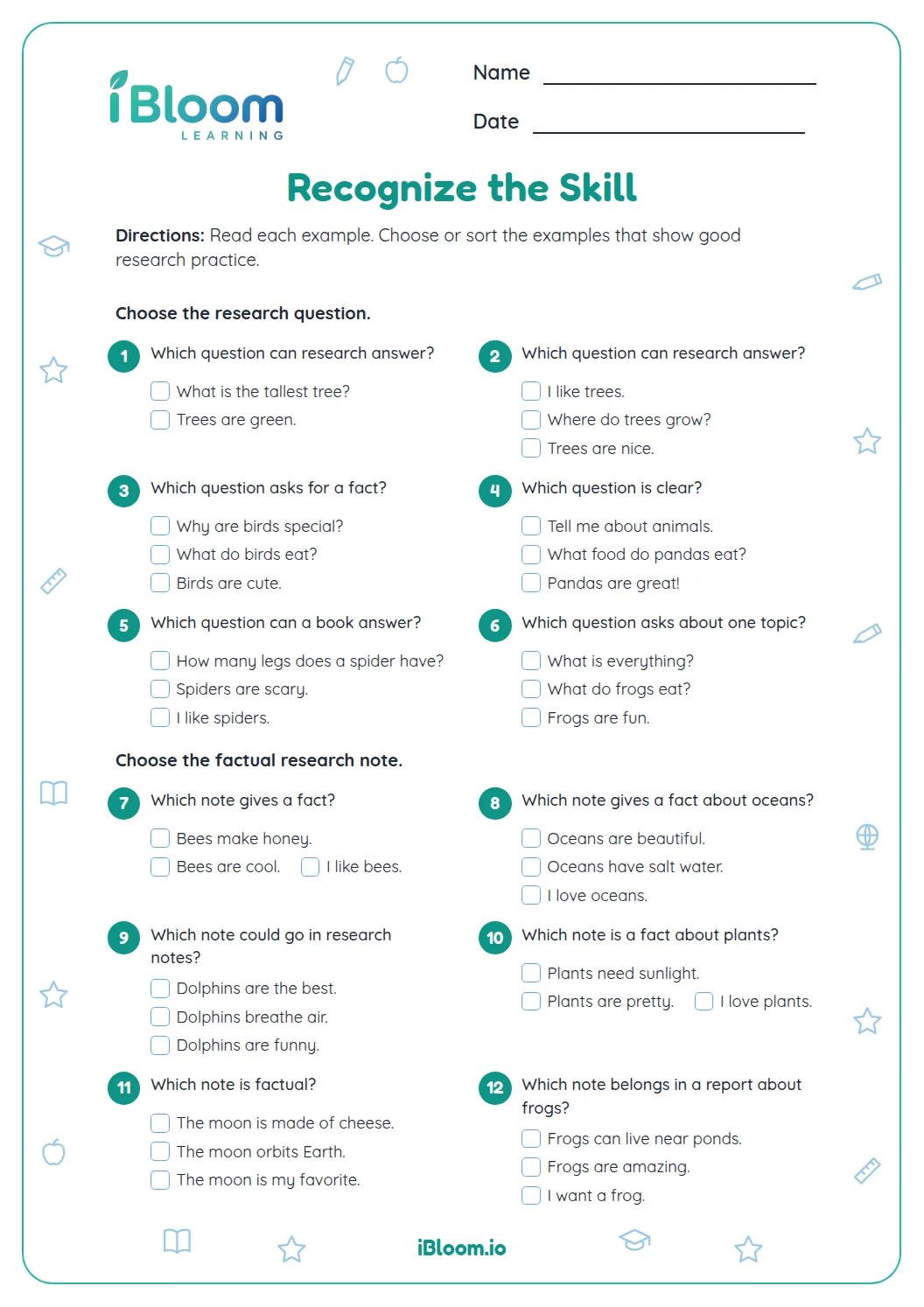
This Grade 2 printable reviews useful steps for a small research task. Children choose focused questions and sources, distinguish fact from opinion, and complete sentences about notes, headings, and report parts. Six multiple-choice items lead into eight fill-in-the-blank items. The separate answer key gives the correct choices and words.
How does a focused question guide research?
A focused question names a topic and asks for information that can be checked. “What do bees eat?” points toward sources and facts; “What is everything about nature?” is too wide for a short report.
- 1Which is a focused research question?
- 2What do bees eat?
- 3It asks about one topic and can be answered with facts.
How can a writer choose and record facts?
Match the source to the topic, then write a useful fact in your own words. A fact note belongs to the question and can be checked in the source.
What does the mixed review ask children to write?
The final part asks for report details: a focused question, a title, a fact sentence and a closing line. The key gives samples; responses may vary if they meet the prompt.
How to use this worksheet
- 1Read each choice and name the research step it represents.
- 2For open responses, pick one small topic before writing.
- 3Use a book or another provided source to check factual notes.
- 4Write notes in your own words instead of copying full sentences.
- 5Reread the report parts to make sure they stay on one topic.
Common mix-ups
The mistake
Starting with a question that is too broad.
The fix
Name one topic and ask one answerable question about it.
The mistake
Writing an opinion as if it were a fact.
The fix
Check whether a source could confirm the sentence.
The mistake
Copying a source sentence word for word.
The fix
Read, look away, and restate the idea in child-friendly words.
What to practice next
Make more practice
Further reading
Questions parents and teachers ask
What does research practice mean on this page?
Here, research practice means choosing a focused question, matching it with a source, and recording information that answers it. The worksheet checks each move with short choices and sentence completions before children put report parts together. Children can try the method with any familiar topic.
Does a child need books to complete this page?
The worksheet can be completed as a planning and review activity, but a real source helps children verify fact notes. Use a short nonfiction book or a teacher-provided text about bees, turtles, or plants to find and check information.
How should I score the open responses?
Use the answer key to check each choice or blank. A child may use a different word when it clearly completes the sentence and fits the research idea. For fact questions, the response should be something a source could confirm.
What is the difference between a fact and an opinion?
A fact can be checked in a source, such as “Bees visit flowers.” An opinion shares a preference or judgment, such as “Bees are the best.” Questions 4 and 13 practice recognizing this difference, and children can explain how they decided.
Is this an essay worksheet?
It is a mixed review of steps that support a short research report. Children practice forming questions, choosing sources, writing fact notes, adding a heading, and completing report sentences rather than composing a long essay. Children can see how each part helps a reader follow the topic.
Is an answer key included?
Yes. The separate answer key lists the correct choices and words for each blank. It helps an adult check the research vocabulary and discuss why a focused question or a checkable fact is useful. The samples make it easy to review the vocabulary together.