
About this worksheet
This Grade 2 writing worksheet uses space topics to practice asking researchable questions, recording relevant facts, and sharing information in clear sentences. Children choose focused questions, sort details, write notes, and build a short factual report. The 16 prompts include a separate answer key with sample responses for open-ended writing.
What makes a useful research question?
A research question can be answered with information and stays focused on a topic. Question 3 asks about how the Moon looks different each night; that is more focused than asking what everything in space is like.
How can notes help organize facts?
Notes keep useful facts close to the question being researched. In question 7, “Earth travels around the Sun” is a relevant note about Earth; “The Sun is bright and nice” is an opinion, not a precise fact from the source sentence.
- 1Prompt: Write a short fact note about Earth.
- 2Sample: Earth is a planet.
What will students write?
The sheet has 16 prompts in three parts: choosing or writing questions, gathering and sorting facts, and sharing findings. Students also correct a sentence and write connected sentences about a space topic.
How can students check a report?
For a report, check that each sentence stays on the chosen topic and gives information rather than a preference. A source name should help someone locate where a fact came from.
How to use this worksheet
- 1Read the directions together and notice what each part asks.
- 2Complete one question at a time, pointing to the key information.
- 3For written responses, use a complete thought that answers the prompt.
- 4Pause after each part and check that every item has a response.
- 5Use the answer key to identify a step to practice again.
Common mistakes and quick fixes
The mistake
Answering before reading the full prompt.
The fix
Read every word and identify exactly what the question asks.
The mistake
Mixing up the information in the prompt.
The fix
Point to the numbers, clues, or words used to decide.
The mistake
Stopping after choosing an answer.
The fix
Check that the response answers the question and fits the example.
What to practice next
Make more practice
Questions parents and teachers ask
How many questions are included?
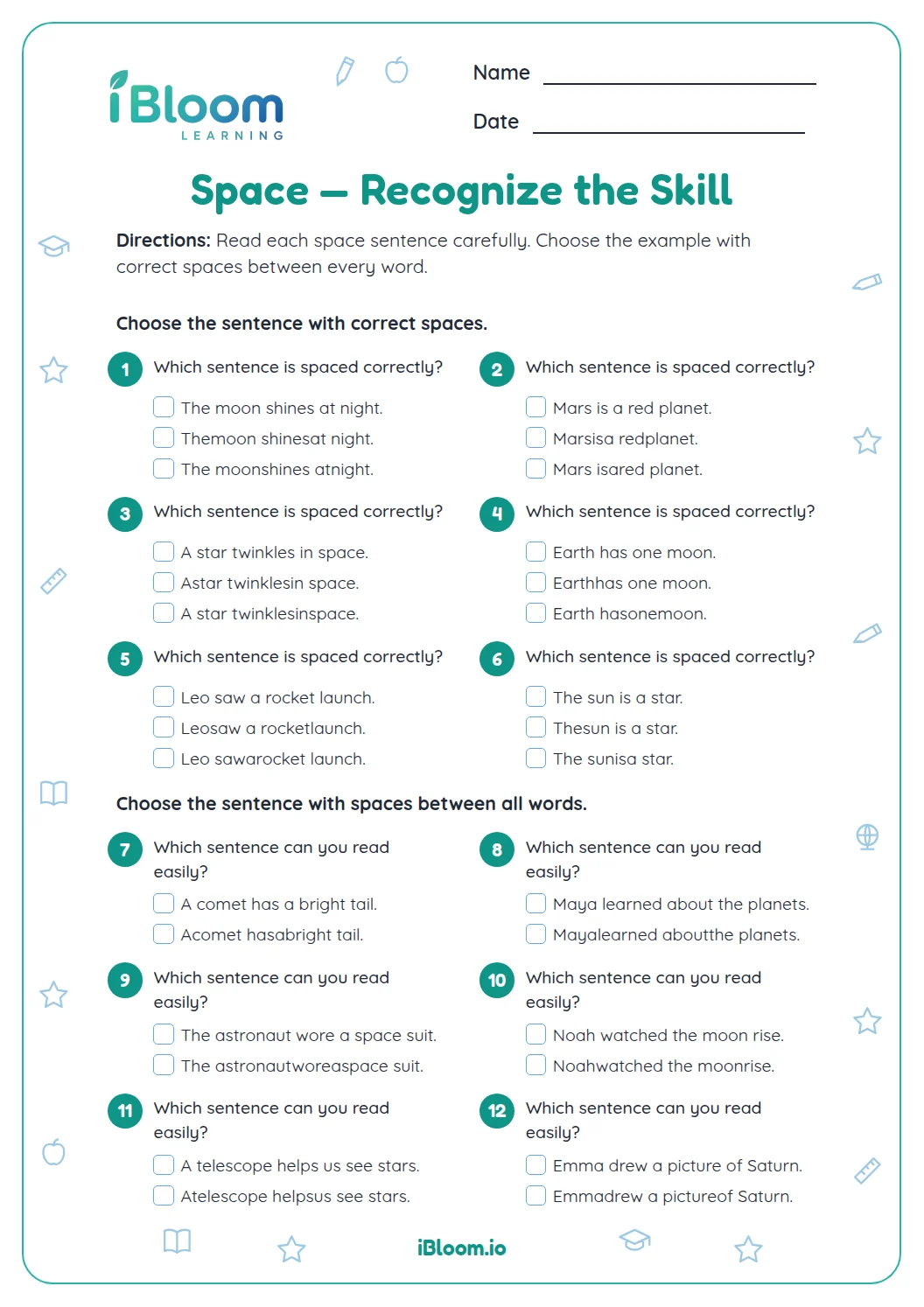
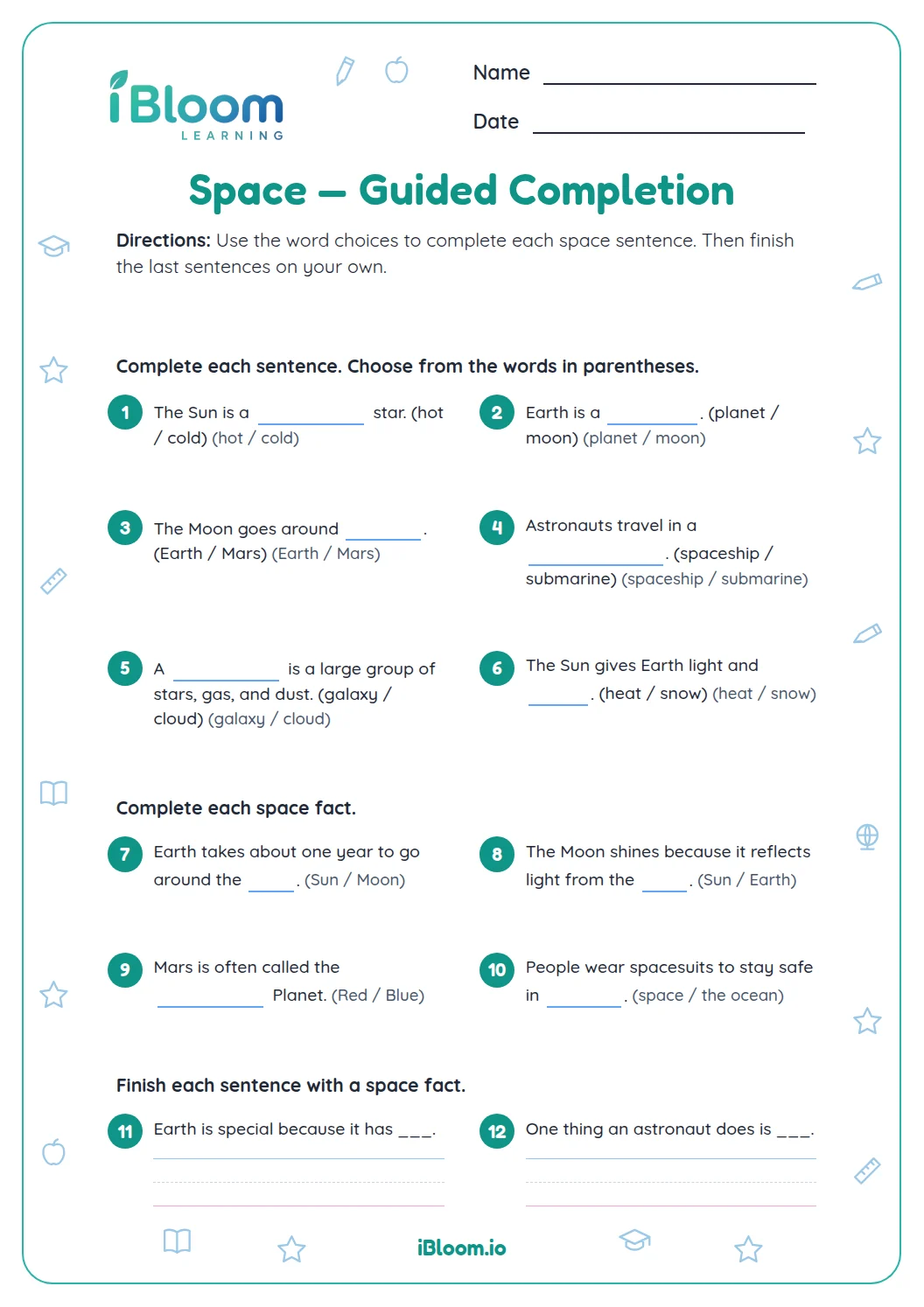
There are 16 prompts in three parts. Students choose or write research questions, gather and sort space facts, and share what they learned in short writing tasks. The separate answer key includes examples for open responses, which may be phrased in other accurate ways.
Does the worksheet include a reading passage?
No passage is needed for these tasks. The worksheet supplies short source statements and question contexts, such as “Earth travels around the Sun,” for students to use when selecting relevant notes and writing about space. Children can focus on using the supplied details rather than finding outside material.
What makes a research question useful?
A useful question asks for information that a source could answer and focuses on one topic. “How do astronauts eat in space?” is focused and researchable. “Is space very big?” is broad, while asking which planet is prettiest depends on personal opinion.
How long should children write?
Most answers can be one clear question, fact note, or sentence. Question 14 asks for two connected factual sentences about one topic. The sample key response links Earth being a planet with its orbit around the Sun. Encourage complete sentences and a clear connection between the two ideas.
How can an adult support the research practice?
Ask the child to name the topic, then check whether a question can be answered with facts. For notes and report sentences, ask whether each detail belongs to that topic and can be supported by a source. The key offers sample responses to compare.