
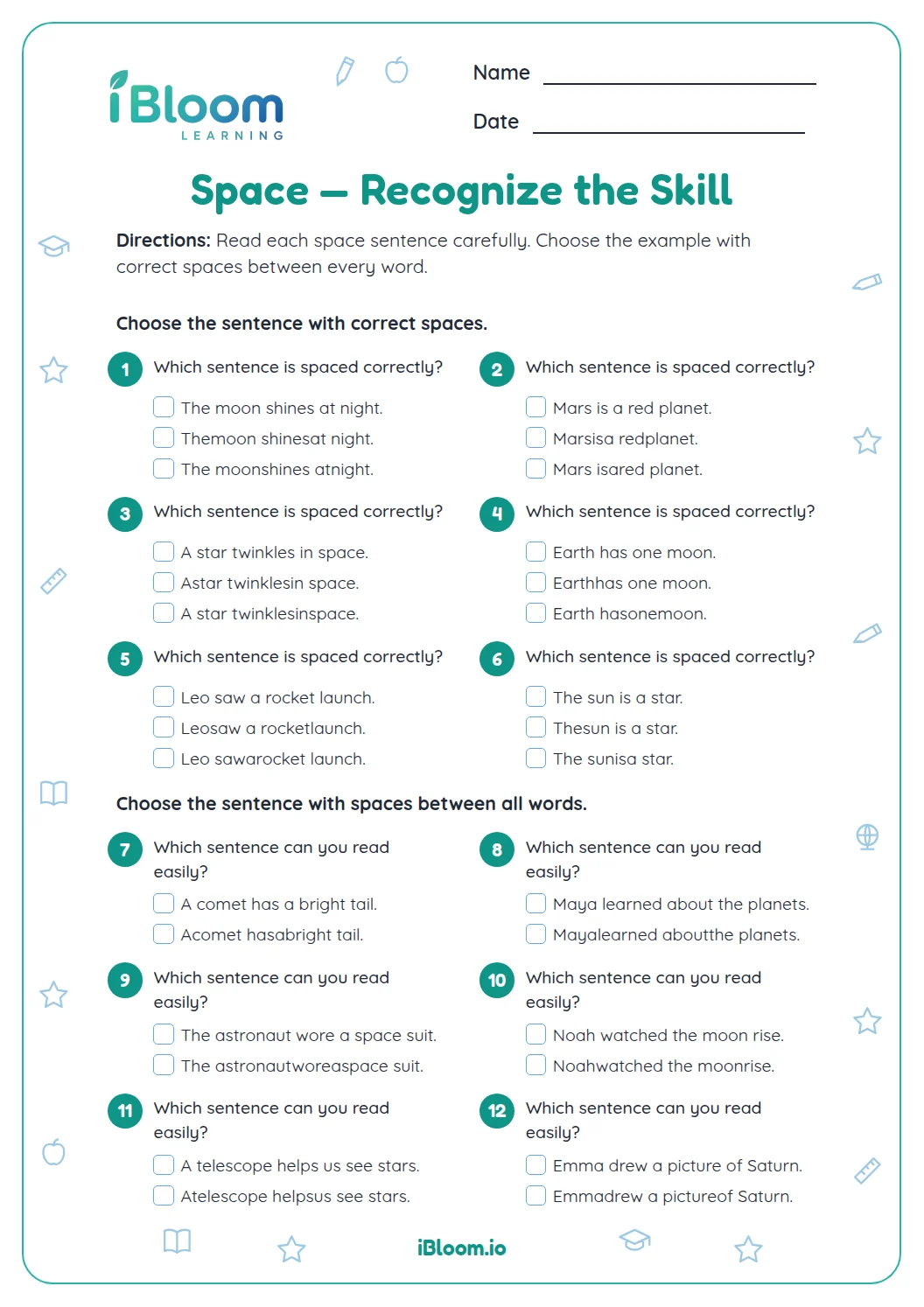
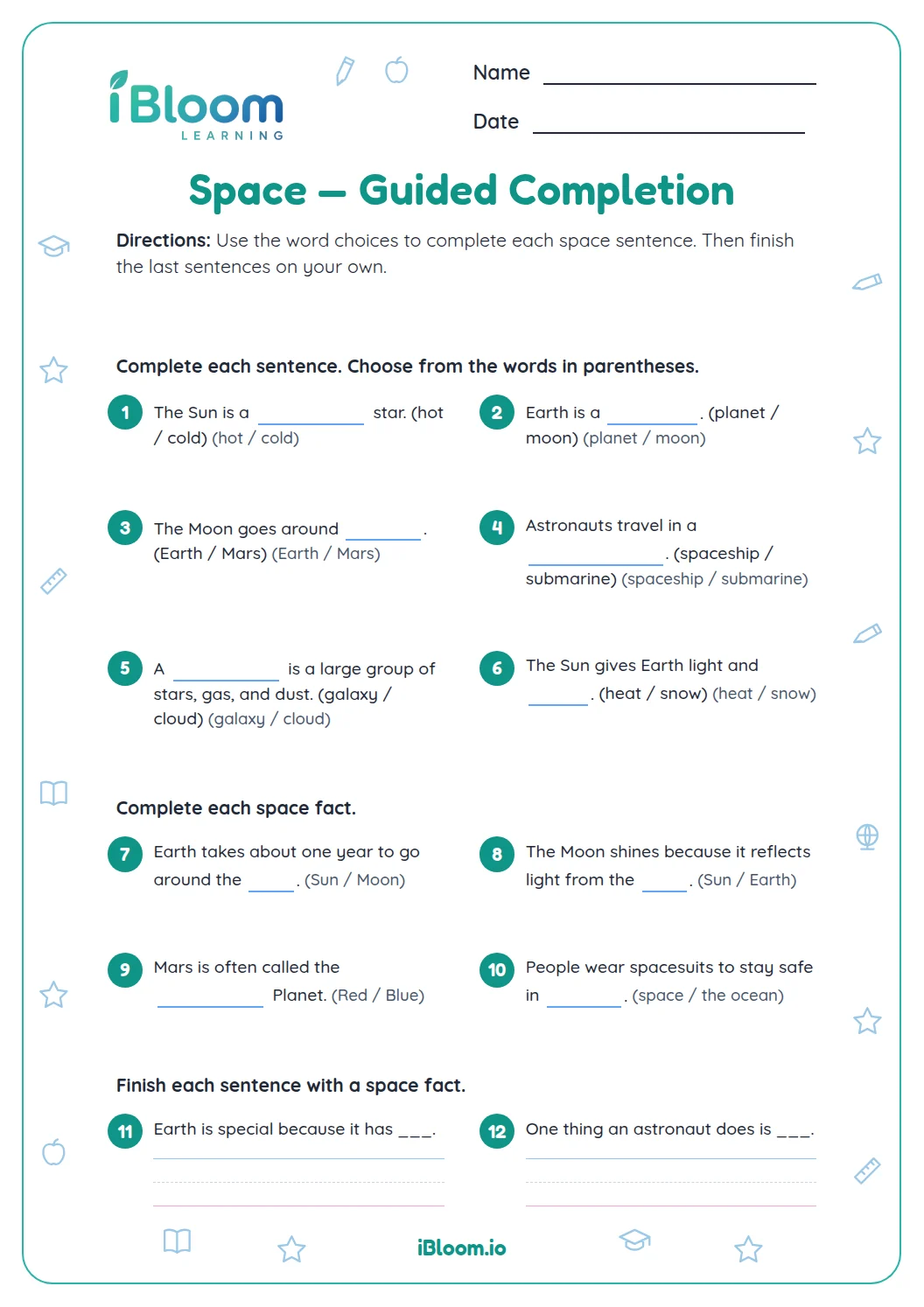
About this worksheet
This free printable Grade 2 writing worksheet turns a short passage about space into research practice. Children read "Our Home in Space", answer four multiple-choice questions to find facts, fill four blanks with the right word, and then write in their own words: two facts they learned and a question they would ask an astronaut. It is for second graders who are learning to gather facts from a text and put them into complete sentences, and it practices CCSS W.2.8. The answer key gives every answer and a sample of both written responses.
Aligned to W.2.8
What does research practice look like in Grade 2?
Second graders do not need a library visit to start. Research at this age means reading one short text, finding the facts in it, and writing those facts as complete sentences. The skill is the move from "it says it right there" to "here is what I learned, in my own words."
A short passage keeps that move small enough to practice. Every question on this sheet can be answered from the passage, so children learn that a good answer comes from the text, not from a guess.
- 1Why do astronauts tie their sleeping bags to the wall?
- 2Find the sentence: "Inside, everything floats, so astronauts tie their sleeping bags to the wall."
- 3The words before "so" give the reason: everything floats.
- 4Answer: Everything floats.
What is on this space worksheet?
Part A is the passage, "Our Home in Space": three short paragraphs about Earth, the Moon and astronauts on a space station. Parts B to D work through it in three steps, from finding facts to using them.
- Part B, Find the facts: four multiple-choice questions on the Sun, Earth's orbit, life on a space station and moonlight (questions 1 to 4)
- Part C, Finish the facts: four sentences with a blank for a word from the passage (questions 5 to 8)
- Part D, Write about space: two facts in your own words, then one question for an astronaut (questions 9 and 10)
- A matching answer key with sample sentences for Part D
How do I help my child write facts in their own words?
Ask your child to read a sentence, cover it with a hand, and say the fact out loud. Then they write what they said. This keeps them from copying the passage word for word, and it works for any text.
For the question in Part D, start with a question word: What, Why or How. A question about how astronauts eat, sleep or wash is a real research question, because it is something to look up next.
Why does the Moon shine if it makes no light?
Question 4 checks this idea. The Moon does not make its own light. It reflects light from the Sun, a bit like a mirror. The passage says plainly that the Sun is a star and that the Moon only shines with the Sun's light, so the answer is there to find.
How to use this worksheet at home or in class
- 1Read the passage aloud once while your child follows with a finger.
- 2Let your child read it again alone and underline one fact they like.
- 3Do Part B together. For each question, ask your child to point to the sentence that answers it.
- 4Have your child complete Part C by themselves, using words from the passage.
- 5For Part D, ask them to say each fact aloud first, then write it with a capital letter at the start and a period at the end.
- 6Check with the answer key, and ask your child to read their question to you as if you were the astronaut.
Common mistakes and quick fixes
The mistake
Choosing "It makes its own light" in question 4, because the Moon looks bright.
The fix
Reread paragraph 2 together. The passage says the Moon does not make its own light and shines because it reflects the Sun.
The mistake
Copying a whole sentence from the passage for Part D.
The fix
Cover the passage, say the fact aloud, then write it. A short sentence such as "The Sun is a star." is enough.
The mistake
Writing a statement instead of a question in question 10, or leaving off the question mark.
The fix
Begin with What, Why or How, and end with a question mark. For example: "How do astronauts sleep?"
Common Core alignment
The sheet practices the writing standard below, gathering information from a text to answer questions.
Find facts in a text you are given and use them to answer questions.
On this sheet: Parts B and C have children find facts in the passage; Part D has them write those facts in their own sentences.
Show the official wordingHide the official wording
Recall information from experiences or gather information from provided sources to answer a question.
What to practice next
Make more practice
Further reading
Questions parents and teachers ask
What is this Grade 2 space worksheet for?
It practices finding facts in a short text and writing them in complete sentences. Children read "Our Home in Space", answer questions from it, and then write two facts and a question of their own. It is a first step toward research writing.
Do children need to know about space already?
No. The passage gives every fact the questions ask for, so a child who knows nothing about space can still answer. A child who loves space will have more to say in Part D, where answers come from their own ideas as well.
What if my child cannot read the passage alone?
Read it aloud first, then let your child read it again with you. Reading the questions to them is fine, too. The goal is to find and use facts, so support with the reading and let them do the choosing and writing.
What should my child write in Part D?
Two true space facts in complete sentences, such as "The Sun is a star." and "The Moon reflects light from the Sun." Then one question, such as "How do astronauts eat in space?" The answer key gives samples, but any fact from the passage or sensible question counts.
Is the spelling of space words important here?
Spelling matters less than getting the idea down. Words such as astronaut, spacesuit and station are in the passage, so children can copy the spelling from it. After they finish writing, ask them to check for a capital letter at the start and a period or question mark at the end.
How long does it take, and is there an answer key?
Most children finish in about 20 minutes. Part D takes the longest. There is an answer key after the worksheet that lists every answer and gives sample sentences for the two written responses, so you can print the key with the sheet or on its own.