





About this worksheet
This Grade 3 printable practices countable nouns through plural forms and sentence editing. Students form regular plurals, recognize irregular forms such as mice and people, and correct sentences so the noun and verb agree. The three parts move from plural spelling to choosing and editing complete sentences. A separate answer key lists the correct forms.
Aligned to L.3.1.b
How do you edit a countable noun?
Countable nouns name things you can count: one bird, two birds. This page starts with regular singular and plural forms, then asks students to edit complete sentences. Watch for nouns ending in s, sh, ch, x, or z, which often add -es.
- 11) Mia packed three ___ for lunch. → sandwiches
- 2Sandwich ends in ch, so add -es.
What if the plural noun changes its spelling?
Some common nouns use an irregular plural. Child becomes children, mouse becomes mice, and person becomes people. Read the whole sentence after editing so the noun and verb still agree.
How can a plural noun change the rest of a sentence?
A plural noun usually takes a plural verb: “The babies play.” The final questions ask students to correct complete sentences, checking both the noun form and the verb that goes with it.
How to use this worksheet
- 1Read the whole sentence before changing a noun.
- 2Check whether it names one or more than one.
- 3Use the regular or irregular plural form that fits.
- 4Reread each corrected sentence to check noun and verb agreement.
- 5Use the answer key to compare each selected form and correction.
Common mistakes and quick fixes
The mistake
Adding only -s to a noun ending in ch.
The fix
Say the word aloud and check whether it needs -es, as in dishes.
The mistake
Writing a plural noun with a singular verb.
The fix
Find the subject first, then make the verb agree: babies play.
The mistake
Adding -s to an irregular plural.
The fix
Learn common forms as whole words, such as mouse/mice and person/people.
Curriculum alignment
This practice connects the page activities with the listed learning standard.
Form and use regular and irregular plural nouns in sentences.
On this sheet: Questions practice regular plurals, irregular plurals, and their use in complete sentences.
Show the official wordingHide the official wording
Form and use regular and irregular plural nouns.
What to practice next
Make more practice
Further reading
Questions parents and teachers ask
What is a countable noun?
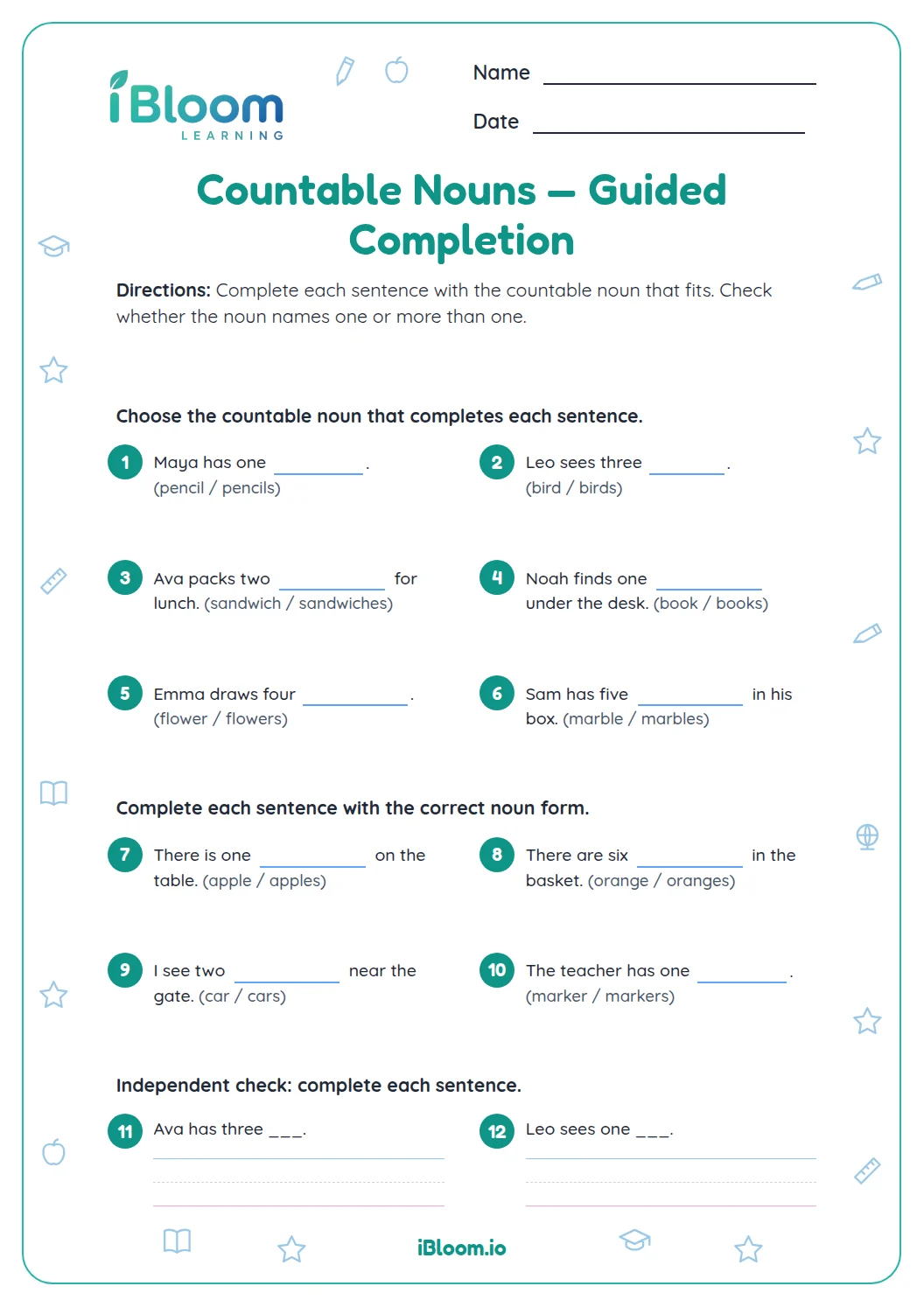
A countable noun names something that can be counted as one or more items, such as one pencil or four pencils. The worksheet asks students to use both singular and plural forms in sentences, then revise sentences where the noun or verb form does not fit.
When does a noun take -es instead of -s?
Many nouns ending in s, sh, ch, x, or z add -es to form the plural. For example, one dish becomes two dishes. Question 10 asks students to apply that spelling pattern while correcting a sentence about dishes on a table.
Are all plural nouns made by adding -s?
Some common nouns change spelling, such as mouse to mice and child to children. The worksheet includes a mouse example and an irregular plural choice so students read the noun itself instead of adding -s automatically. Ask your child to reread the full sentence after choosing.
Why does the verb change with a plural noun?
A sentence should make its subject and verb agree. “The babies play” uses a plural subject and verb, while “The baby plays” uses singular forms. The final part asks students to choose corrections such as “The leaves fall in autumn” and “The men carry bags.”
How many questions are on the worksheet?
There are 14 questions in three parts: four regular plural forms, four sentence choices using plural nouns, and six sentence edits. The answer key gives the intended form or corrected sentence for each item. Ask the learner to point out the noun that changes.
How can I check the corrections?
Compare each selected sentence with the answer key, then reread it aloud. In question 10, dish becomes dishes; in question 11, leaves goes with fall. The corrected sentences should keep the noun form and verb consistent with the number of people or things described.