





About this worksheet
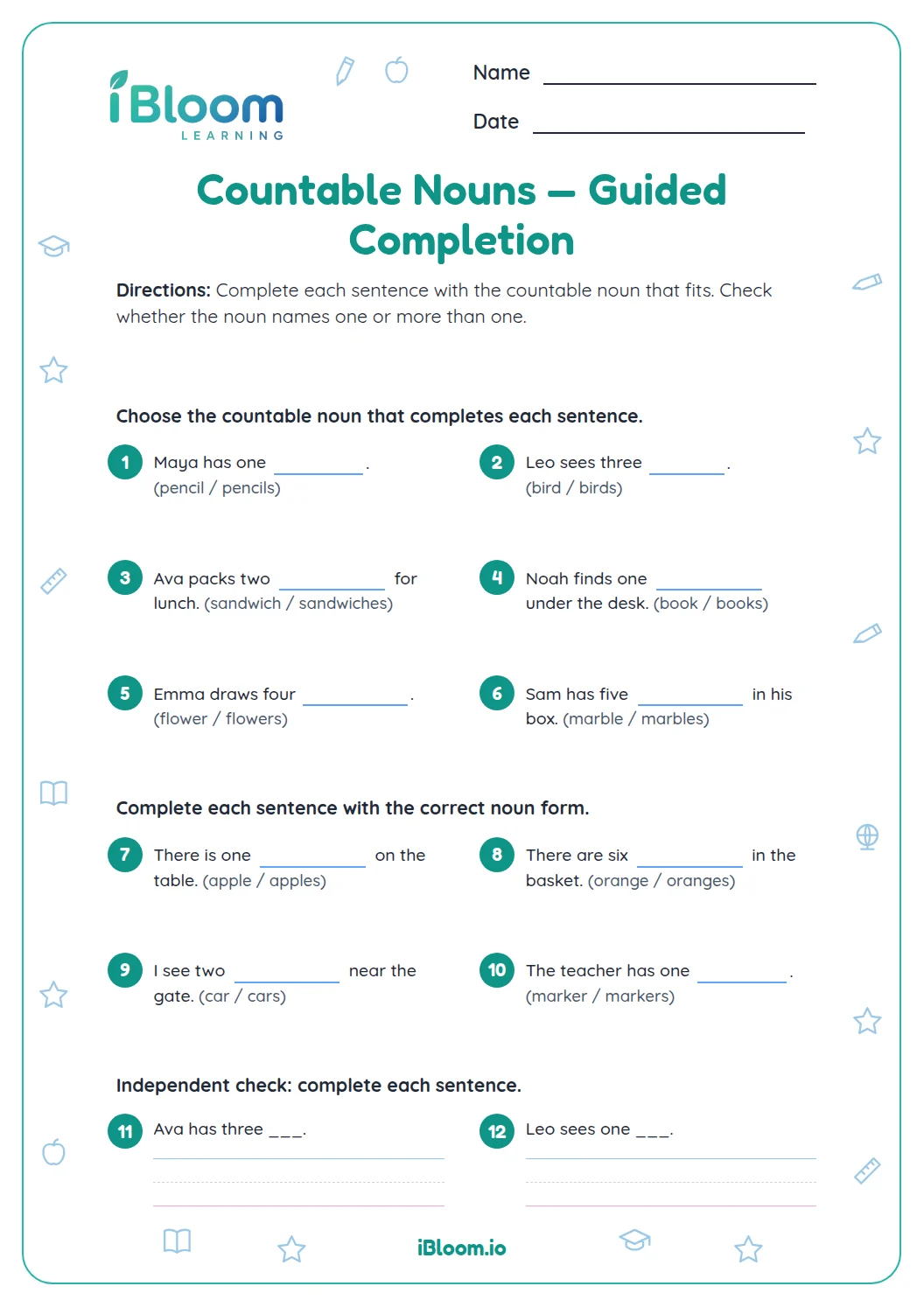
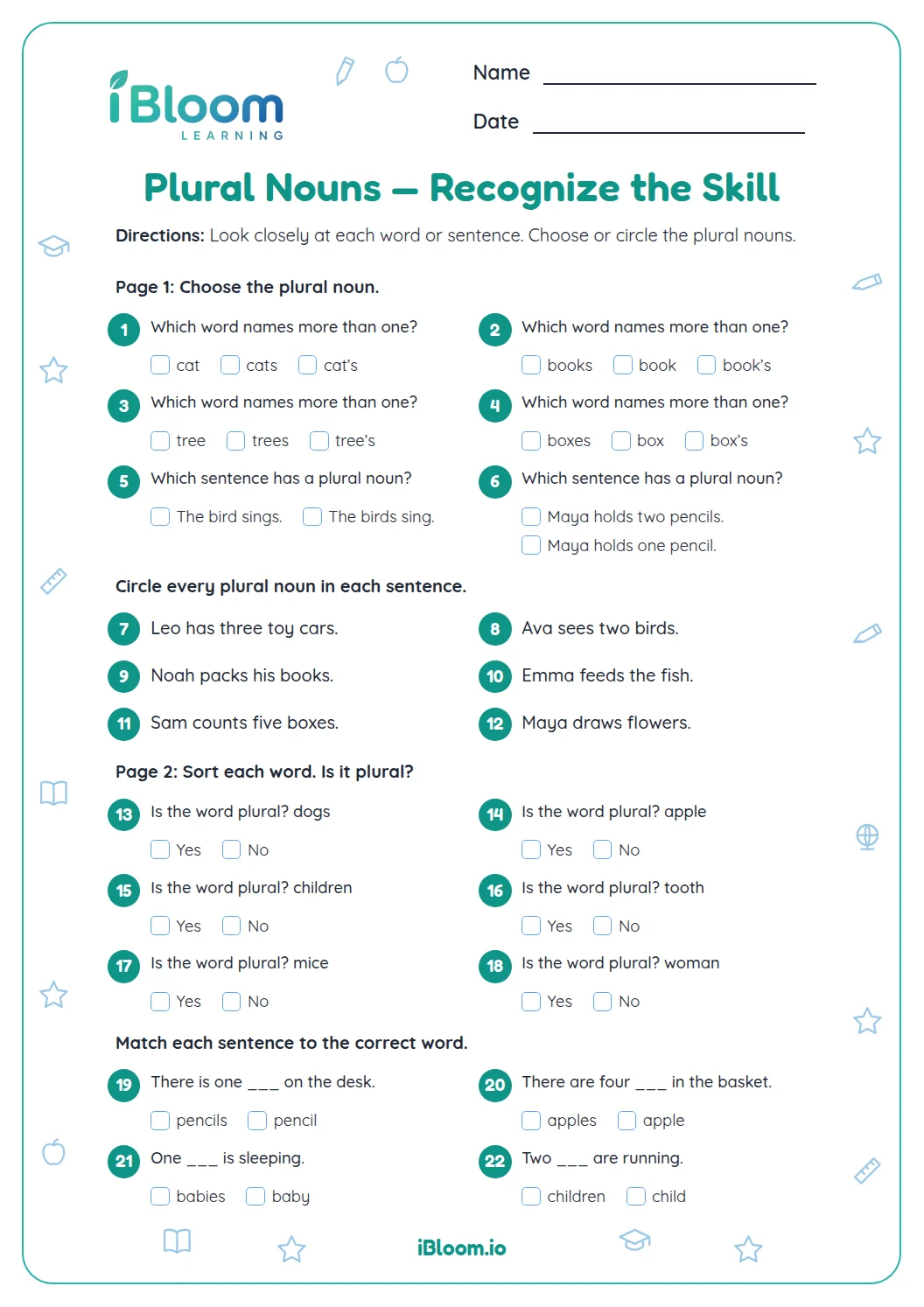
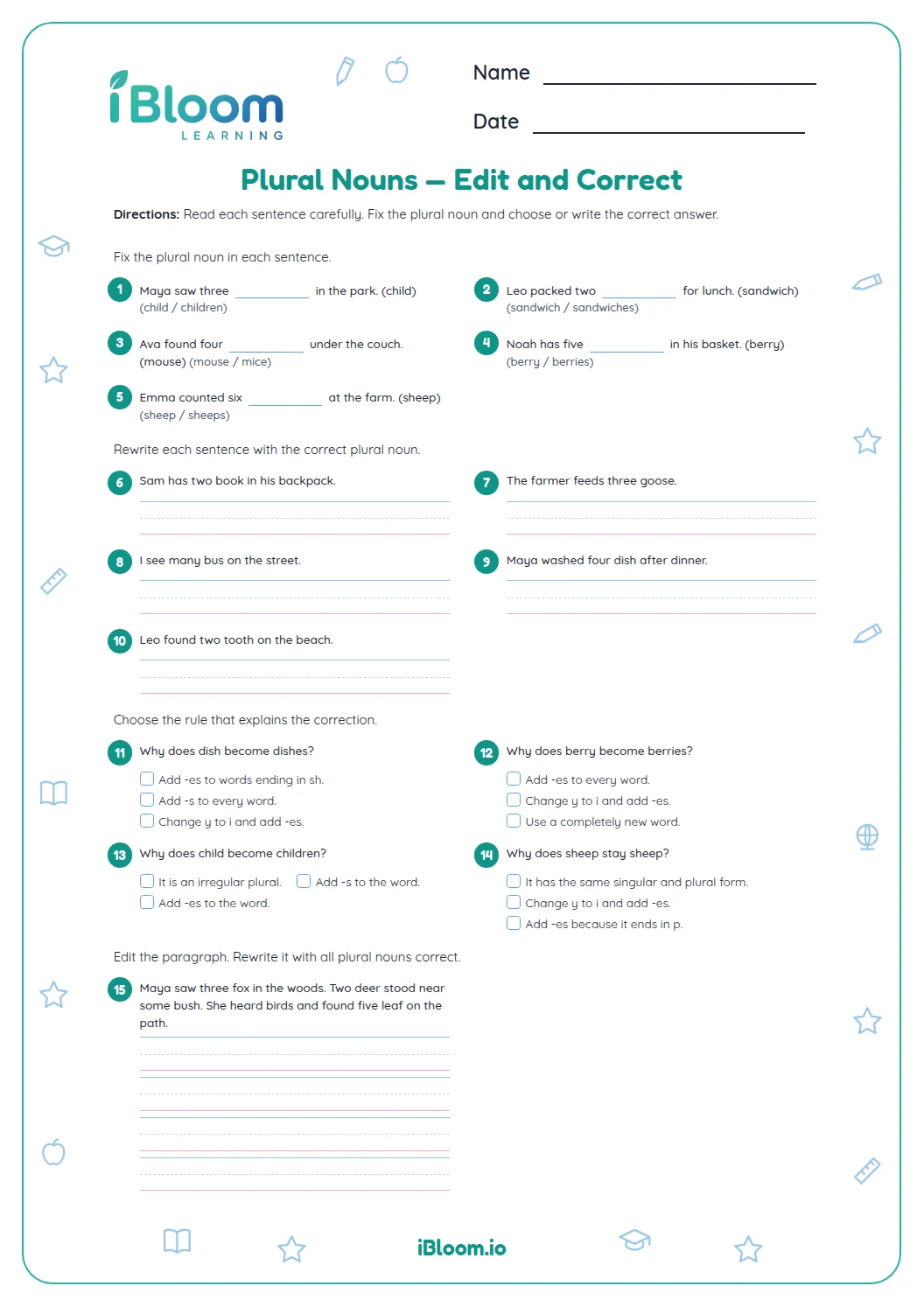
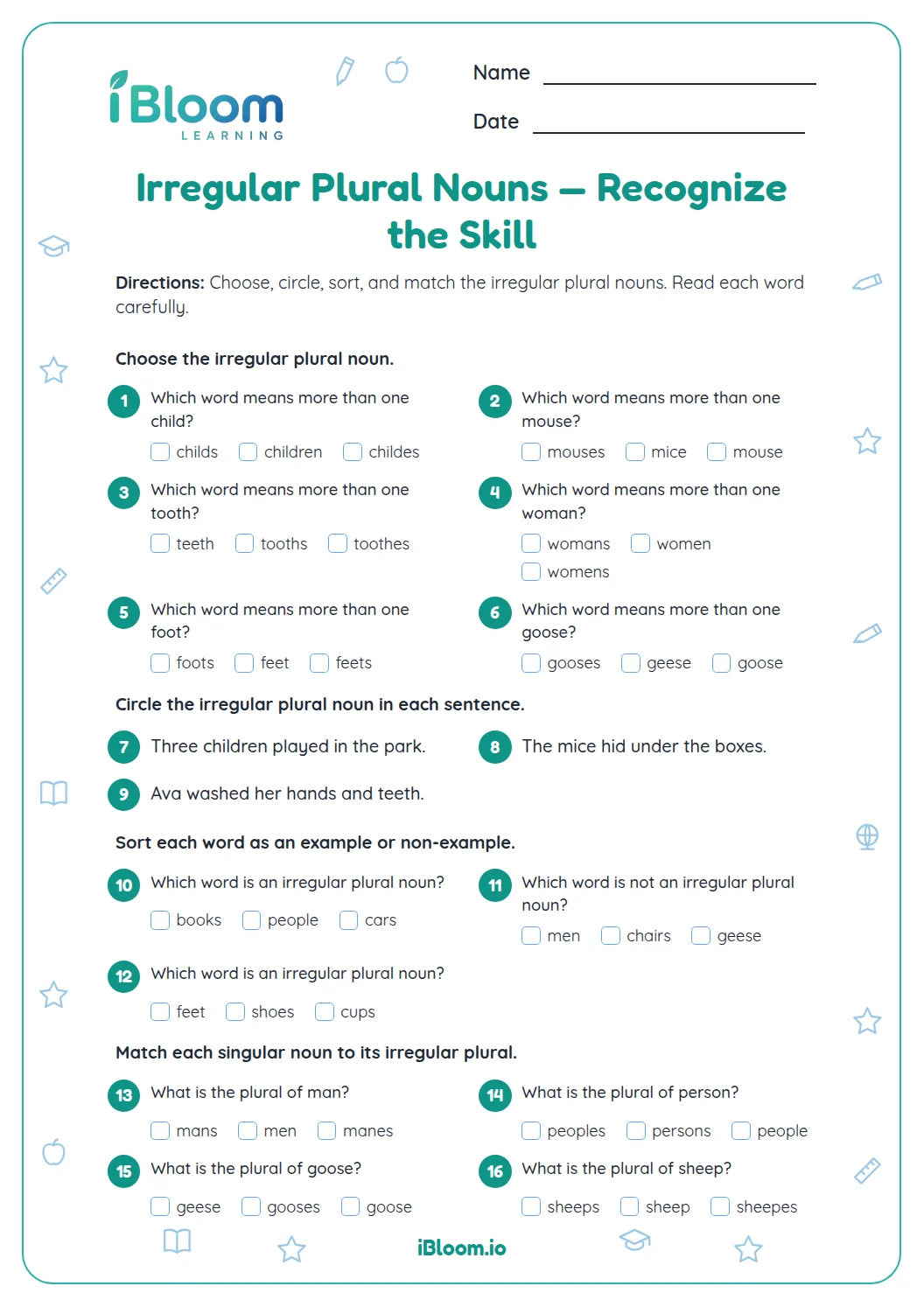
This Grade 3 countable-nouns worksheet mixes recognition, plural forms, and sentence use. Students distinguish separate items such as chairs and coins from mass nouns such as sand and milk, then apply the distinction in phrases and sentences. The 14 questions include a few explain-and-rewrite challenges. An answer key gives direct answers plus models for open responses.
Aligned to CCSS.ELA-Literacy.L.3.1
How can you spot a count noun?
Ask whether the noun names separate things you can count one by one. Chairs can be counted as one chair, two chairs. Sand is usually treated as a mass rather than separate grains.
- 1chairs: one chair, two chairs
- 2sand: usually a mass
- 3Countable choice: chairs
How do count nouns change in a sentence?
Count nouns can use a number and a plural form when there is more than one. Many nouns add -s; nouns ending in sounds like ch or sh often add -es.
How can you count a mass noun?
A mass noun may be counted by naming a container or unit. Instead of “two juice,” say “two cups of juice.” Cups are countable; juice is the mass noun.
How to use this worksheet
- 1Ask if the noun names separate items.
- 2Try one, two, three before the noun.
- 3Use a plural form for more than one count noun.
- 4For mass nouns, count a container or unit.
- 5Reread the whole phrase for sense.
Common mistakes and quick fixes
The mistake
Writing “two sand.”
The fix
Name a unit such as two buckets of sand.
The mistake
Forgetting -es in dishes.
The fix
Listen for the ending and use the common -es plural pattern.
The mistake
Calling every noun countable.
The fix
Check whether it is treated as separate items in the sentence.
This practice builds the language and writing skills named below.
Students identify and use count nouns in clear sentences.
On this sheet:
Show the official wordingHide the official wording
Demonstrate command of the conventions of standard English grammar and usage when writing or speaking.
What to practice next
Make more practice
Further reading
Questions parents and teachers ask
What is a countable noun?
A countable noun names separate items that can be counted one by one, such as chairs or shells. It can usually follow a number and has a plural form. The worksheet contrasts count nouns with mass nouns such as sand and rice.
Are rice and sand countable nouns?
In phrases such as “some rice” or “sand,” these words are treated as mass nouns. To count an amount, name a unit or container, such as cups of rice or buckets of sand. The unit word is countable even when the material is not.
How many questions does the sheet include?
There are 14 questions in two parts. Students identify count nouns, form regular plurals, choose nouns that fit number phrases, and distinguish count nouns from mass nouns. The answer key gives the matching choices for review and discussion together.
Why do some plurals end in -es?
Many nouns add -s, but words ending in sounds such as sh often add -es to make the plural easier to say. Dish becomes dishes and wish becomes wishes. The worksheet practices these familiar patterns alongside pencil, box, and other examples.
Can the same noun be countable or a mass noun?
Some nouns can work differently depending on what they mean in a sentence. “Chicken” can name an animal or food, for example. This page uses familiar examples in a clear sense, such as coins as separate objects and milk as a mass.