




About this worksheet
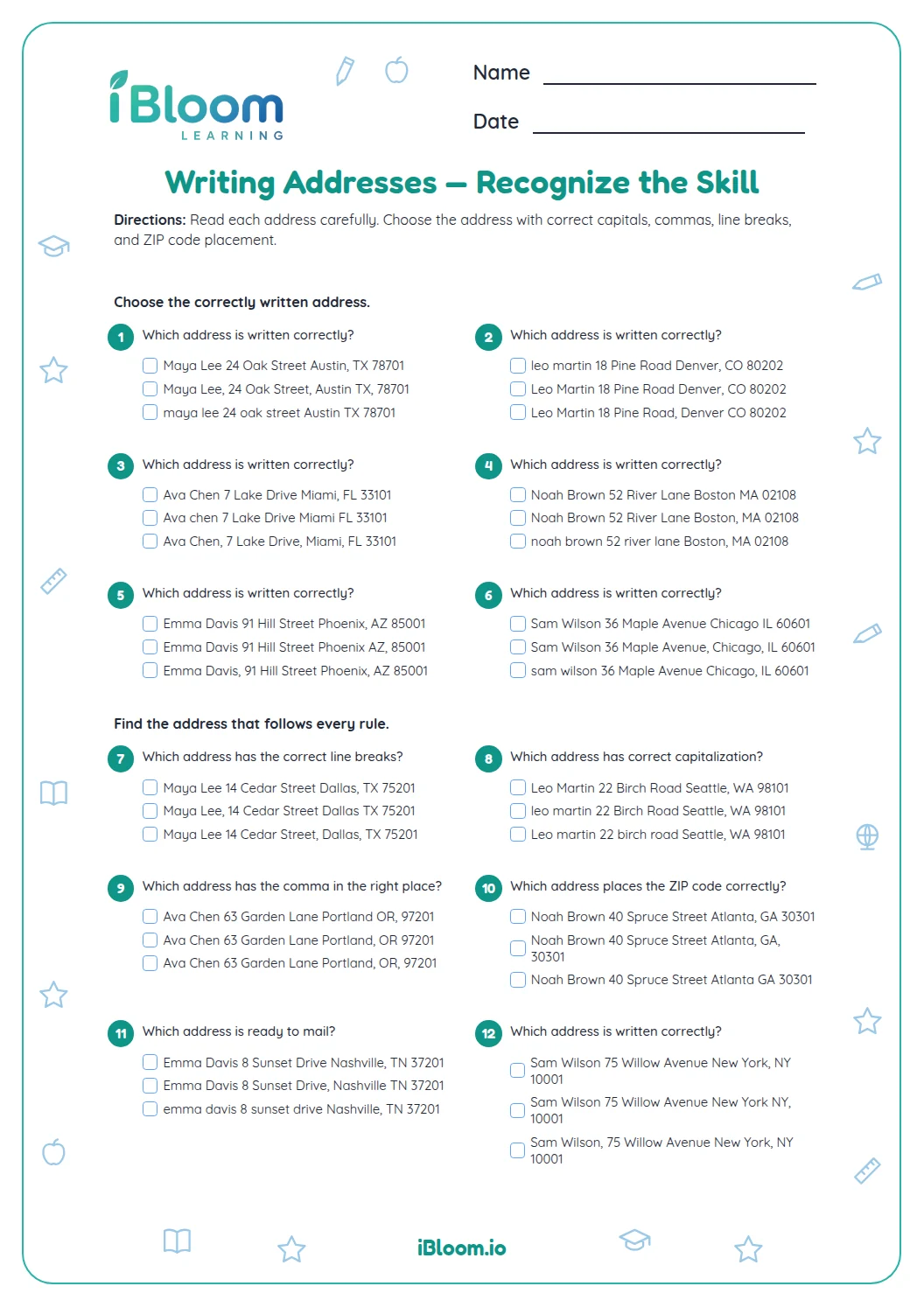
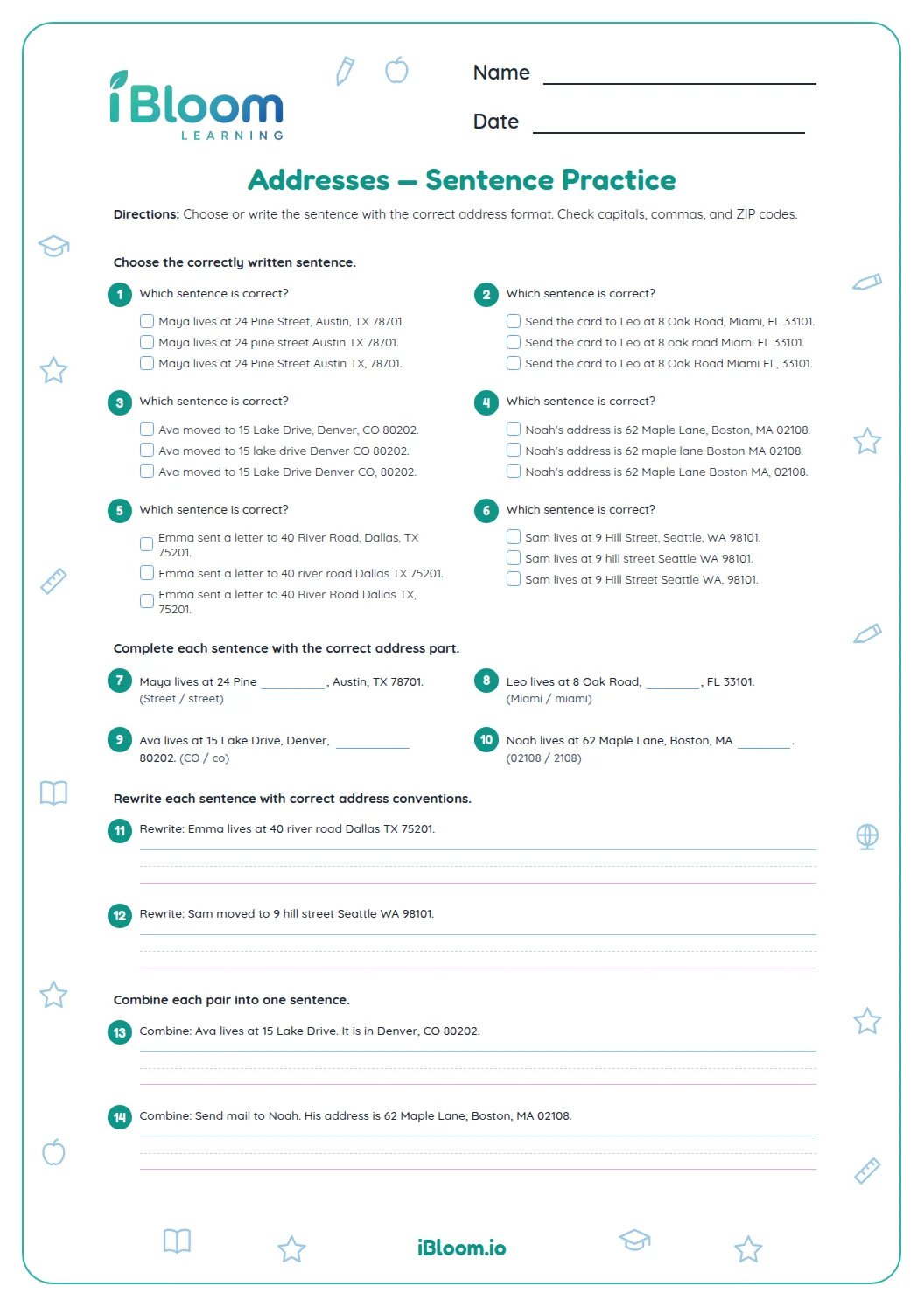
This Grade 3 worksheet focuses on commas in mailing addresses. Twelve items ask children to copy or edit address lines, and eight are punctuation choices. The examples include city, state abbreviation, ZIP code, and street details, with both line-by-line and single-line formatting. The answer key provides model address lines and the correct choice for every item. This supports command of punctuation when writing (CCSS L.3.2).
Aligned to L.3.2
Where do commas go in an address?
A mailing address puts a comma between the city and state abbreviation. In a single-line address, a comma may also separate the street address from the city line. The ZIP code follows the state abbreviation.
How can you check an address line?
Read the line in chunks: street, city, state, ZIP. Add the city-state comma, keep the ZIP after the state, and avoid placing punctuation between the state and ZIP.
- 1Unpunctuated: Salem OR 97301
- 2City: Salem; state: OR; ZIP: 97301
- 3Correct: Salem, OR 97301
When do line breaks change the punctuation?
Line breaks separate parts of a mailing address, but they do not remove the comma between city and state. When a street and city are combined on one line, a comma separates them too. Keep the ZIP code after the state abbreviation.
How to use this worksheet
- 1Read the whole address before editing it.
- 2Mark the boundary between the city and state.
- 3Rewrite the requested line with commas in place.
- 4For choice questions, check every chunk of the address.
Common mistakes and quick fixes
The mistake
Leaving out the comma between city and state.
The fix
Add the comma after the city, then write the two-letter state abbreviation.
The mistake
Putting a comma between the state abbreviation and ZIP code.
The fix
Keep the ZIP code after the state with a space; do not insert a comma between them.
The mistake
Adding a comma after a street line when the address is already split across lines.
The fix
Use the street-to-city comma only when those parts share one line; separate address lines do not need it.
Common Core alignment
Use standard punctuation conventions when writing and editing address lines.
On this sheet: Use commas and quotation marks in addresses.
Show the official wordingHide the official wording
Demonstrate command of the conventions of standard English capitalization, punctuation, and spelling when writing.
What to practice next
Make more practice
Further reading
Questions parents and teachers ask
How many address questions are included?
There are 20 items: 12 address-copying or editing responses and eight multiple-choice punctuation checks. They practice city and state punctuation, ZIP placement, and commas between address parts when they appear on one line. The sheet includes both city-state-ZIP lines and full addresses with a street line.
What punctuation does the worksheet focus on?
The practice focuses on a comma between the city and state abbreviation. When the street, city, state, and ZIP appear together on one line, commas also separate the street and city. The ZIP code follows the state abbreviation without a comma. Look at whether the street and city share a line before deciding if that comma is needed.
Why are some address parts on separate lines?
A mailing address is commonly arranged on separate lines, with the street on one line and the city, state, and ZIP on the next. The worksheet also includes single-line examples so learners can practice punctuation when address parts are joined. These formats help children see that line breaks organize the address while commas mark parts within a line.
How can a student check a rewritten address?
Read the parts in order: street, city, state abbreviation, ZIP code. Check for a comma after the city and, when the street and city share a line, after the street. Do not add a comma between the state and ZIP code. Reading each part aloud can help a student notice where the city ends and the state begins.
What does the answer key provide?
The key gives model punctuation for the copy and editing items and identifies the correct address in each choice question. Equivalent spacing or line breaks may vary while the punctuation pattern stays correct. The model answers show standard punctuation while allowing the address to remain on separate lines.
Can children write the address on separate lines?
Yes. A traditional mailing address can keep the street and city-state-ZIP on separate lines. The questions that ask for a particular line should be answered with that line; the editing prompts show when the address is presented together. The worksheet distinguishes a punctuation choice from a rewrite, so learners practice both recognizing and producing the pattern.