




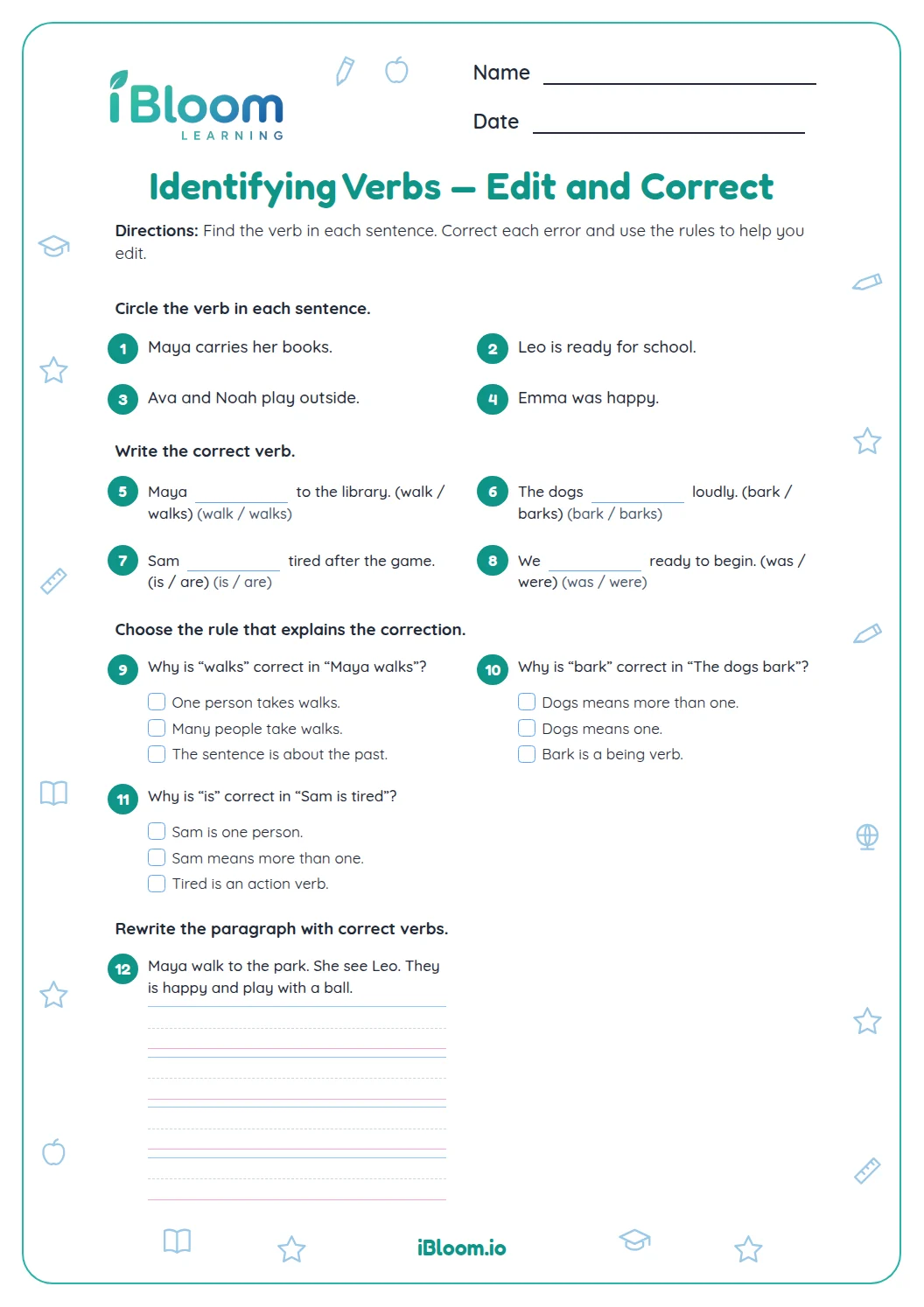
About this worksheet
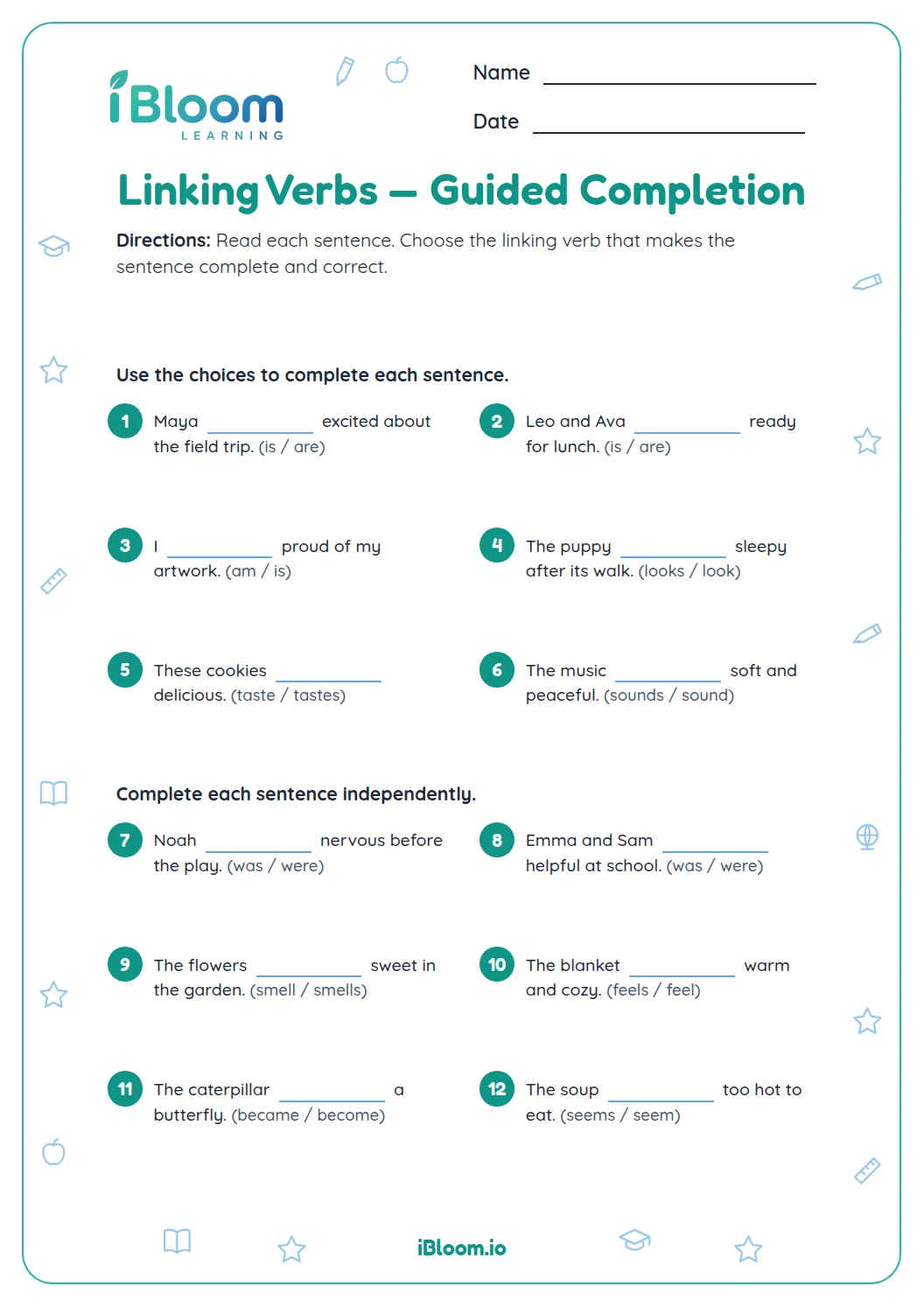
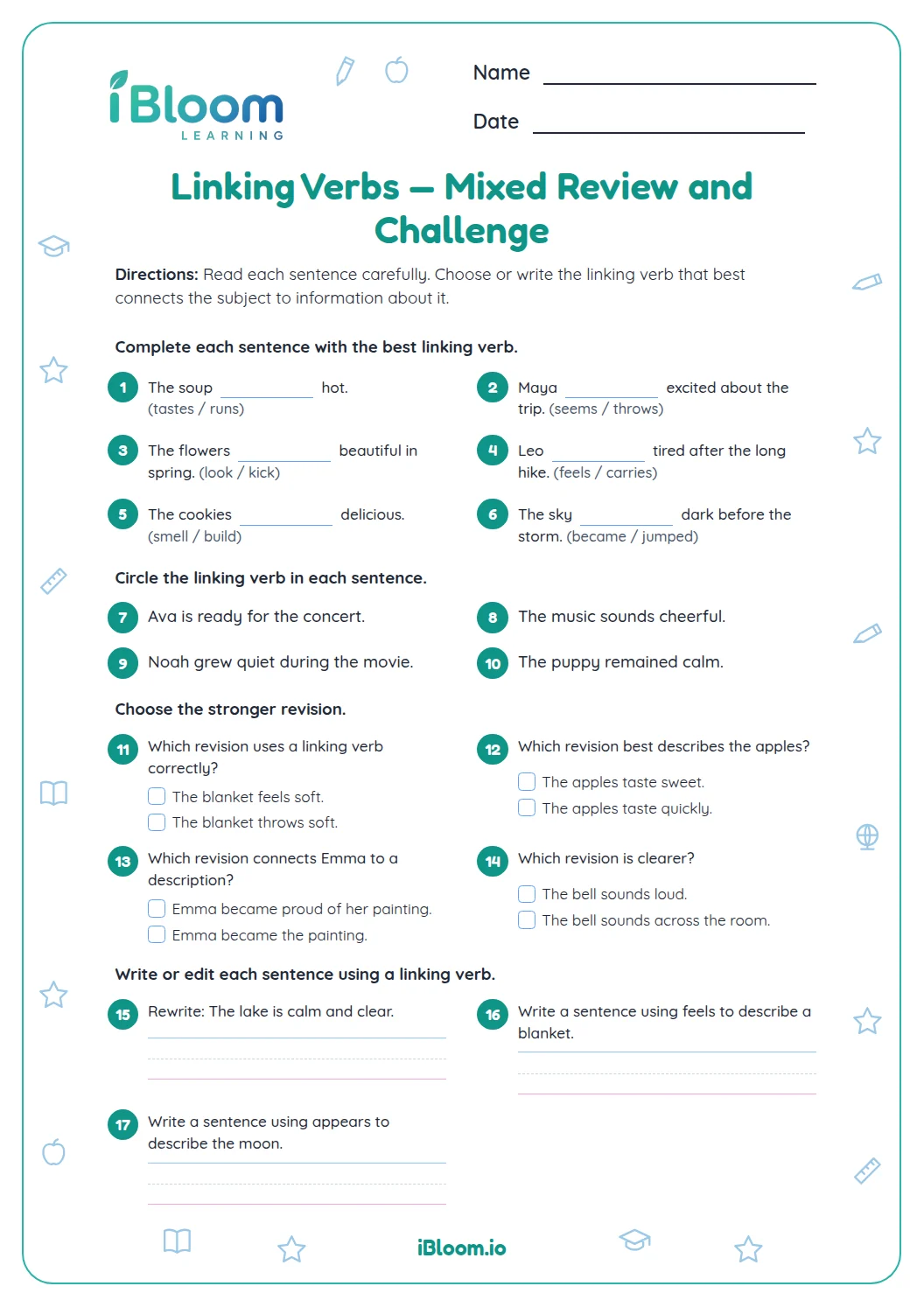
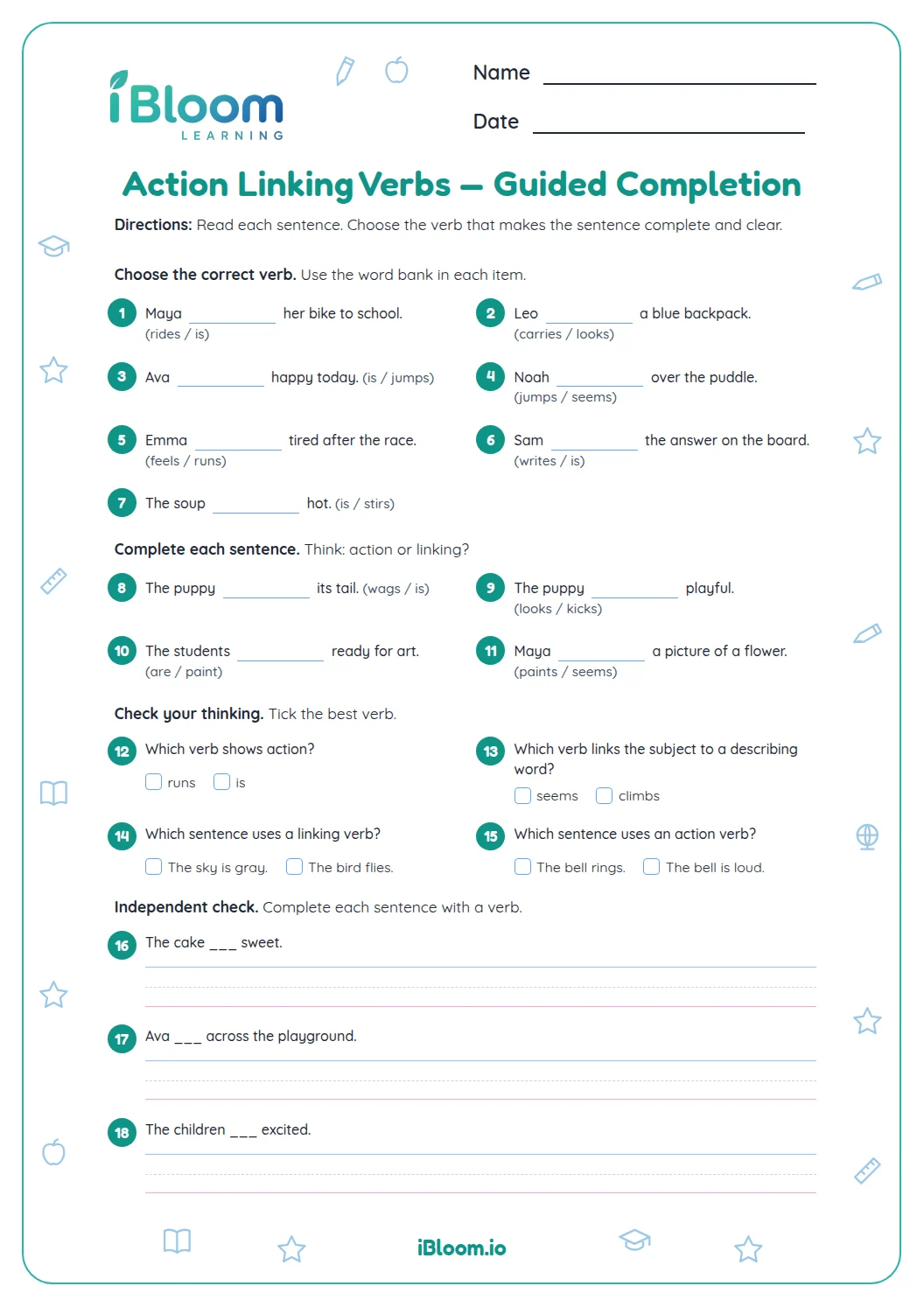
This Grade 3 grammar worksheet practices linking verbs in sentences. Learners choose a verb to complete each of 12 sentences, then write two original sentences using specified linking verbs. The separate answer key gives the correct choices and sample writing responses. The practice supports CCSS L.3.1 grammar and usage in writing.
Aligned to L.3.1
How does a linking verb connect ideas?
A linking verb connects the subject to a describing word or phrase. In “The soup is spicy,” is links soup with spicy. The sentence tells what the soup is like rather than showing an action the soup performs.
Which verb form fits the subject?
Check whether the subject is singular or plural and read the whole sentence aloud. In q3, puppies is plural, so are completes “The puppies are sleepy.” In q7–q12, choose a verb that makes the complete sentence clear.
How can you write your own linking-verb sentence?
For q13, use is and include a subject plus a description: “The garden is peaceful.” For q14, use smells or tastes to connect an object with a description. The key offers samples, but other grammatical sentences can also work.
How to use this worksheet
- 1Find the subject of the sentence.
- 2Choose a linking verb that agrees with that subject.
- 3Read the completed sentence to check its meaning.
- 4For the writing items, include a subject and a clear description.
- 5Use the answer key’s samples as models, not the only possible sentences.
Common mistakes and quick fixes
The mistake
Using are with a singular subject.
The fix
Match the verb to who or what the sentence names.
The mistake
Choosing an action verb that does not link to a description.
The fix
Check whether the next word tells what the subject is like.
The mistake
Writing a fragment for an open response.
The fix
Include both a subject and a complete thought.
These activities connect practice to the following standard.
Use linking verbs and simple verb forms in complete sentences.
On this sheet:
Show the official wordingHide the official wording
Demonstrate command of the conventions of standard English grammar and usage when writing or speaking.
What to practice next
Make more practice
Further reading
Questions parents and teachers ask
What is a linking verb?
A linking verb connects a subject to a word or phrase that describes or renames it. In “The kitten feels soft,” feels links kitten with soft. The worksheet asks learners to recognize and use linking verbs in complete sentences.
How many questions are included?
There are 14 questions: 12 sentence completions and two prompts for original writing. The first items practice selecting a suitable verb, while the final items ask learners to use linking verbs in sentences of their own. A separate key includes examples for checking.
What should a complete written answer include?
A complete response needs a subject and a linking verb, followed by a meaningful description or name. For example, “The garden is peaceful” uses is to link garden with peaceful. Other correct sentences can differ from the answer key’s samples.
Why do some items use feels, looks, or smells?
These verbs can link a subject to a description, as in “The kitten feels soft” or “The moon looks bright.” The sentence context helps show whether the verb connects the subject to a description. Read the entire sentence when choosing.
How can I check the writing questions?
Use the answer key’s sample as one model, then check that the learner wrote a complete and sensible sentence using the requested verb. The exact subject and describing word may vary, as long as the linking verb is used correctly.