





About this worksheet
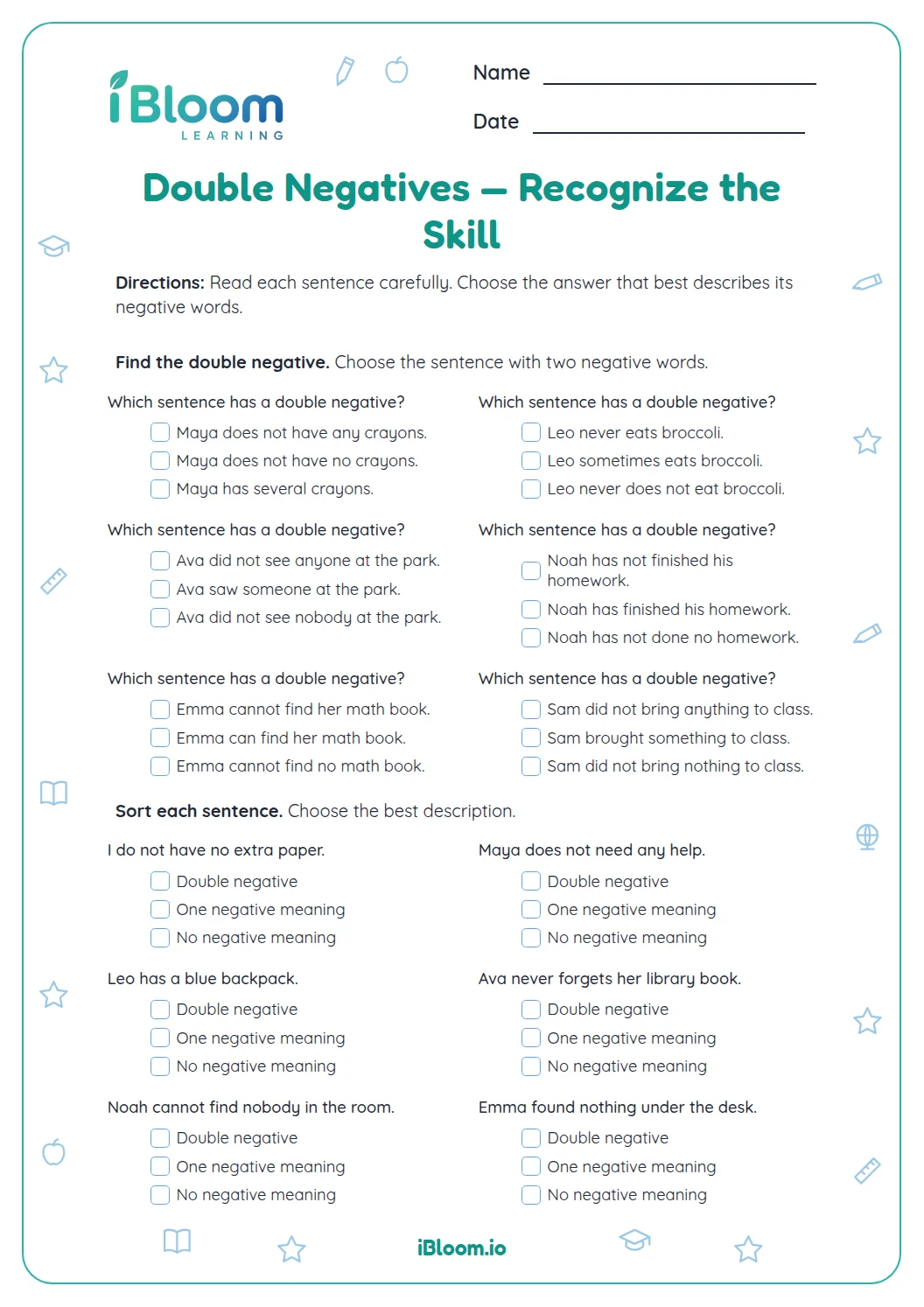
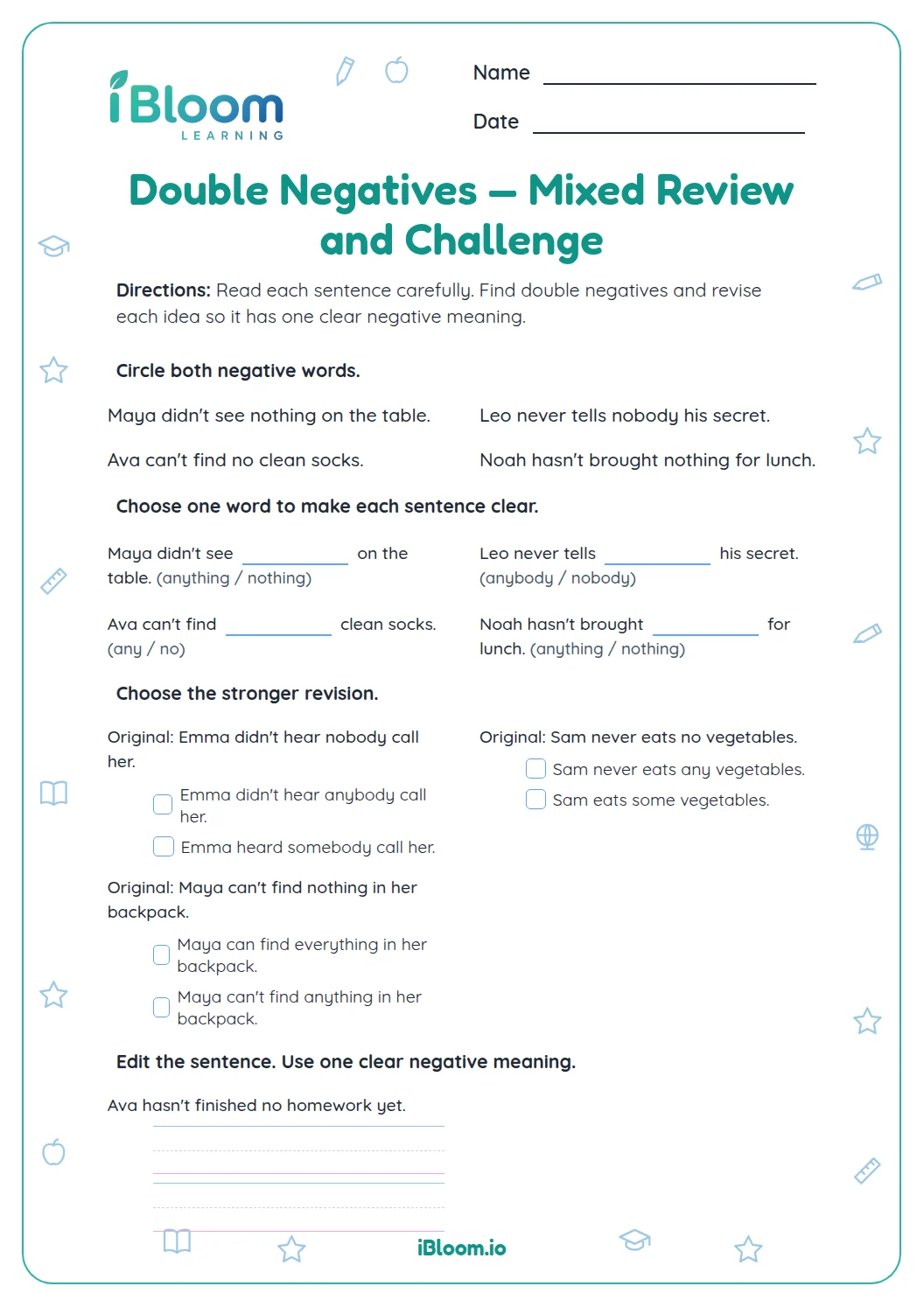
This free Grade 4 worksheet helps students edit double negatives in standard written English. Part A gives four sentences with a word to replace and three replacement choices. Part B gives four sentences to repair by writing a replacement word. Part C asks students to rewrite four complete sentences using directions about what to keep or change. The edits preserve the intended negative meaning while removing a second negative such as nothing, nobody, or never. This is grammar and usage practice for Common Core L.4.1. A separate answer key supplies every replacement and corrected sentence.
Aligned to L.4.1
Which words make these sentences negative?
Words such as no, nobody, nothing, nowhere, and never carry a negative meaning. The contractions don’t, didn’t, can’t, hasn’t, couldn’t, and doesn’t also contain a negative: not. Students need to notice the contraction as well as the separate word they are editing.
The worksheet asks students to use standard written English and preserve the intended negative meaning. Its directions identify what to keep or change, while students choose the correction.
How can a small edit preserve the meaning?
Change the extra negative to the matching any- word, or change never to ever. Keep the other negative in place. Removing both negatives would turn the intended message into an affirmative statement.
- 1Question 1: We don't have NO tape.
- 2Keep don't, which contains not.
- 3Replace no with any.
- 4Corrected: We don't have any tape.
Why rewrite four complete sentences?
The final four questions ask students to choose an edit and write the complete corrected sentence. Each prompt identifies what to keep or change. Students must preserve the remaining words, the capital letter, and the period.
Question 11 keeps nobody at the beginning and changes wasn’t to was. The result, “Nobody was ready,” still says that no person was ready. Read it aloud to check the meaning as well as the grammar.
How to use this worksheet
- 1Read the instructions and explain the goal of standard written English.
- 2Find both negative expressions in each Part A sentence before choosing a replacement.
- 3Use the matching any- word to repair each sentence in Part B.
- 4In Part C, follow the keep-or-change direction, choose the correction, and write the complete sentence.
- 5Read each correction aloud and check that it still communicates the intended negative meaning.
Mistakes to check
The mistake
Missing the negative hidden inside didn’t.
The fix
Expand didn’t to did not before checking the rest of the sentence.
The mistake
Changing no to none after don’t.
The fix
Use any after don’t in question 1; none would add another negative.
The mistake
Removing both negative expressions.
The fix
Keep one negative so “I don’t need any help” still says that help is not needed.
Common Core alignment
Edit sentences to use one negative expression for the intended negative meaning.
On this sheet: Students choose replacement words and revise double negatives in standard written English.
Show the official wordingHide the official wording
Demonstrate command of the conventions of standard English grammar and usage when writing or speaking.
What to practice next
Make more practice
Further reading
Questions parents and teachers ask
What is a double negative in these questions?
Each practice sentence uses two negative expressions where standard written English calls for one to express the intended meaning. In “We don’t have no tape,” both don’t and no are negative. Changing no to any keeps the message that there is no tape available.
Why does Part B ask for an any- word?
The instruction makes the intended correction clear while keeping the negative contraction. No becomes any, nothing becomes anything, nobody becomes anybody, and nowhere becomes anywhere. Students write only the replacement word in Part B, then practice carrying specified changes into complete sentences in Part C.
Does never count as a negative?
Yes, never already expresses a negative meaning. In “He hasn’t never skated,” hasn’t also contains not. The worksheet keeps hasn’t and changes never to ever. The corrected sentence, “He hasn’t ever skated,” preserves the meaning that he has not skated at any time.
Why does question 11 keep nobody?
Nobody already supplies the negative meaning in question 11, so the direction keeps that subject and asks students to correct the verb. Changing wasn’t to was gives “Nobody was ready.” This practices editing the verb while keeping a negative subject at the beginning of the sentence.
Can I accept a different correct rewrite?
Other rewrites may be grammatical, but these questions specify which words to keep or change. Check whether the student followed that direction and preserved the intended meaning. For question 11, keeping Nobody means correcting the verb to was. Discuss other valid ways to express the same idea afterward.