







About this worksheet
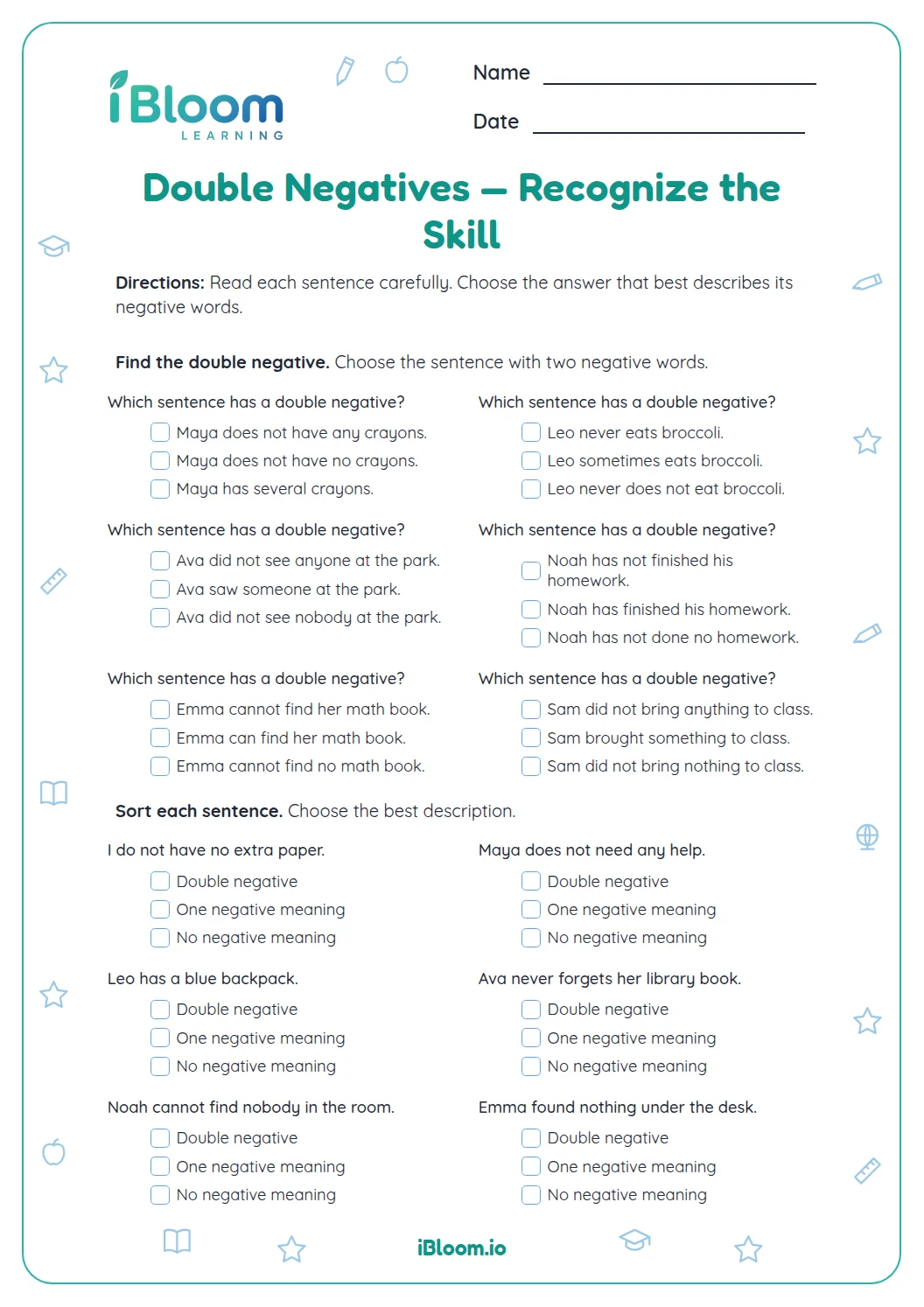
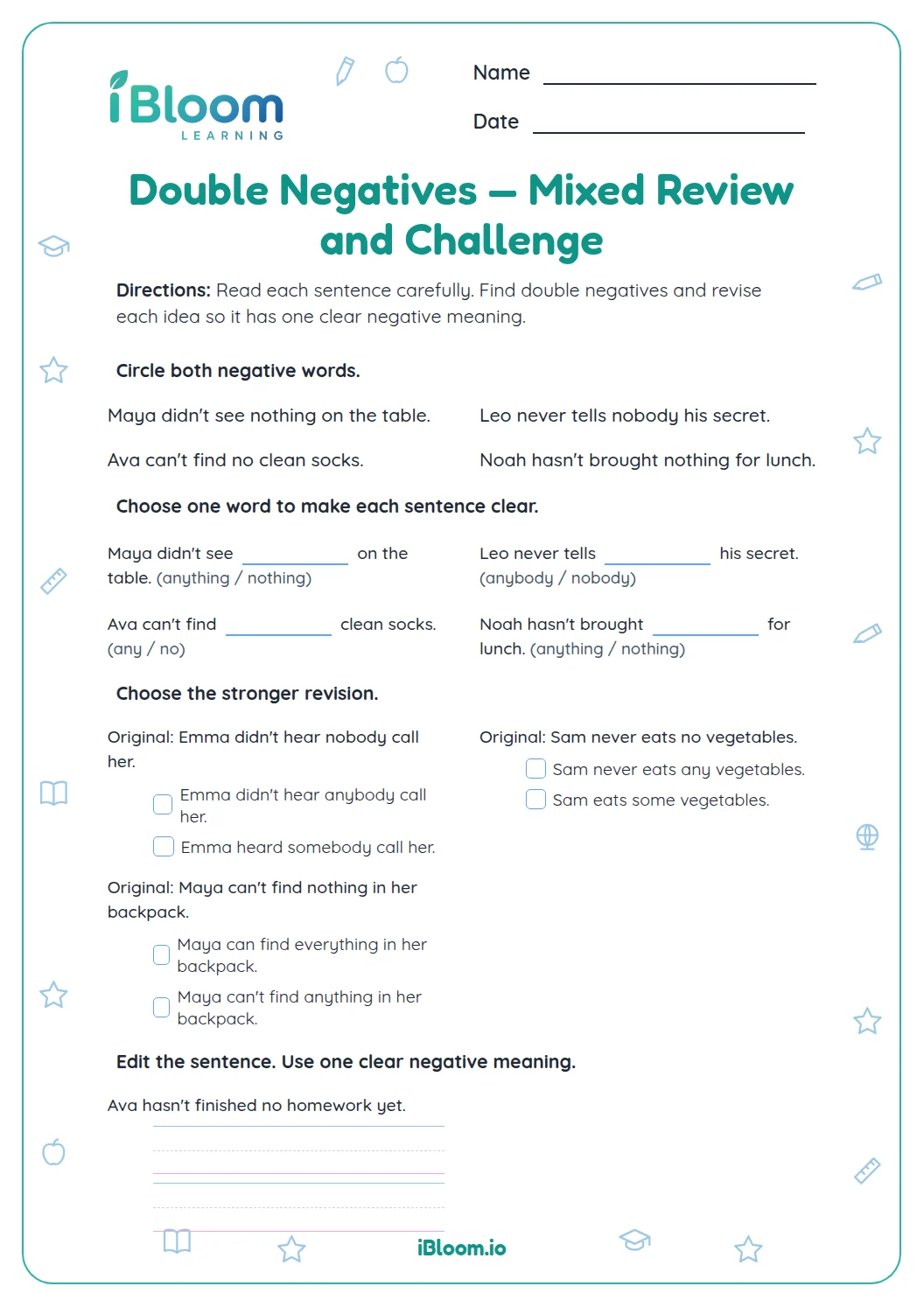
This Grade 4 grammar worksheet guides children through completing and revising sentences with double negatives. Students choose one negative expression that fits a sentence, then rewrite examples so they keep the intended meaning in clear standard English. Fourteen questions progress from completion to editing, and a separate key offers model revisions. The work practices CCSS L.4.1.
Aligned to L.4.1
How does one negative keep a sentence clear?
A double negative uses two negative words for one intended negative meaning, as in “I didn’t see nobody.” Revise the sentence to say the same thing with one negative expression.
- 1I did not see nobody at the park.
- 2I did not see anyone at the park.
- 3The revised sentence keeps one negative.
How can context guide a sentence completion?
Read the whole sentence and decide whether it says something happened or did not happen. Then choose a word that fits the meaning and grammar. “Already” fits a sentence about finishing; “never” would change its meaning.
How should a revision preserve meaning?
Replace the extra negative with a clear word such as any, anyone, anything, or anywhere. Reread the revised sentence to make sure it still says what the original speaker meant.
How to use this worksheet
- 1Read the whole sentence to identify its intended meaning.
- 2For a blank, compare each choice with the sentence context.
- 3For a revision, keep one negative expression.
- 4Replace the extra negative with an any-word when that keeps the meaning.
- 5Reread for a complete sentence and matching meaning.
Common mistakes and quick fixes
The mistake
Changing “did not see nobody” to “did see somebody.”
The fix
Keep the negative meaning: “did not see anybody.”
The mistake
Removing both negative words and reversing the meaning.
The fix
Leave one clear negative expression in the sentence.
The mistake
Choosing never when the sentence means not yet.
The fix
Use context clues to preserve the original time and meaning.
Common Core alignment
This sheet gives focused practice with the standard below.
Revise sentences using conventional grammar and usage.
On this sheet:
Show the official wordingHide the official wording
Demonstrate command of the conventions of standard English grammar and usage when writing or speaking.
What to practice next
Make more practice
Further reading
Questions parents and teachers ask
What is a double negative?
A double negative uses two negative words for one intended negative meaning, as in “I did not see nobody.” This worksheet asks children to complete clear sentences and revise examples so the intended meaning is expressed with one negative. The worksheet uses standard written English.
Can more than one revision be correct?
Yes. A sentence may have more than one clear revision if it keeps the original meaning and uses one negative expression. For example, “I did not see anybody” and “I saw nobody” can both express that no person was seen; the key gives one model.
Should a child remove every word like “not”?
No. The goal is to remove the extra negative while keeping the intended meaning. A sentence with “not” may already be correct, so children should revise only when the sentence contains two negatives that create the intended meaning. The printed key gives model revisions.
What happens in the final part?
The final part has four written responses: one sentence expressing that no one called, followed by three double-negative revisions. Children write or revise a complete sentence in each response space, and the key provides a model for checking meaning. The response spaces support complete written sentences.
How can I check a revised sentence?
Check that the response keeps the original idea, reads as a complete sentence, and uses one negative expression for the intended meaning. The model answers show one acceptable version; another clear sentence can work when it preserves the prompt’s meaning.