



About this worksheet
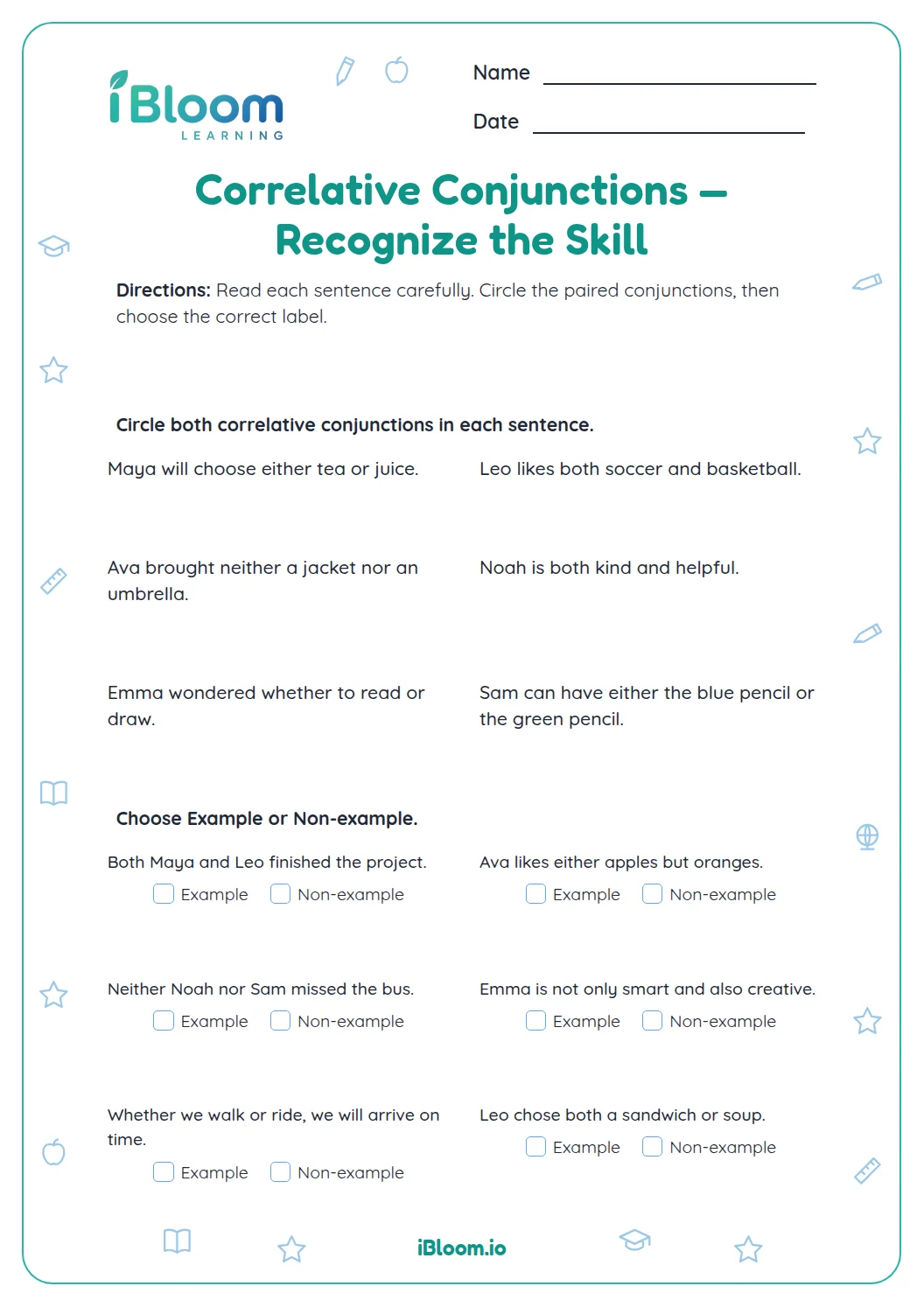
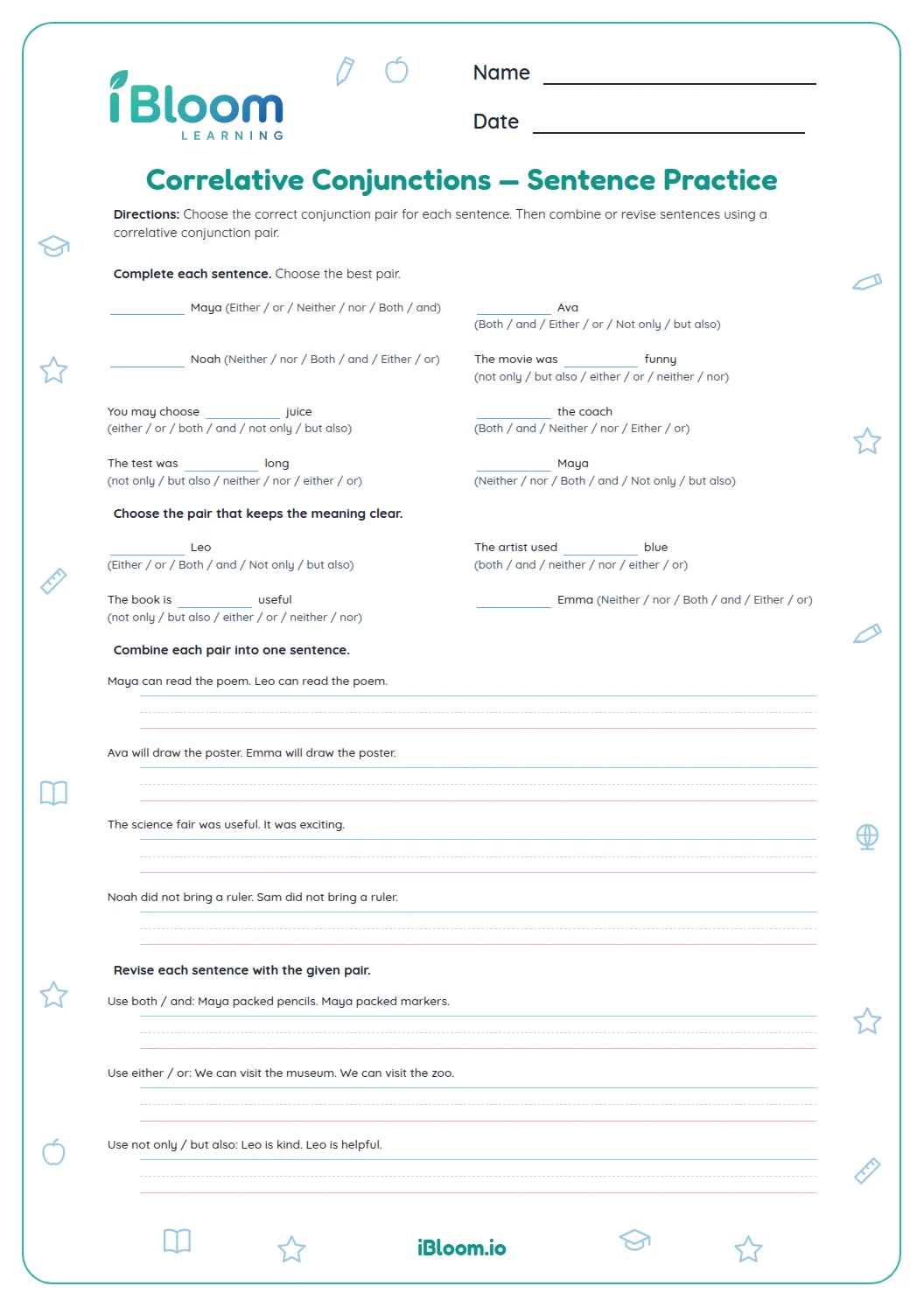
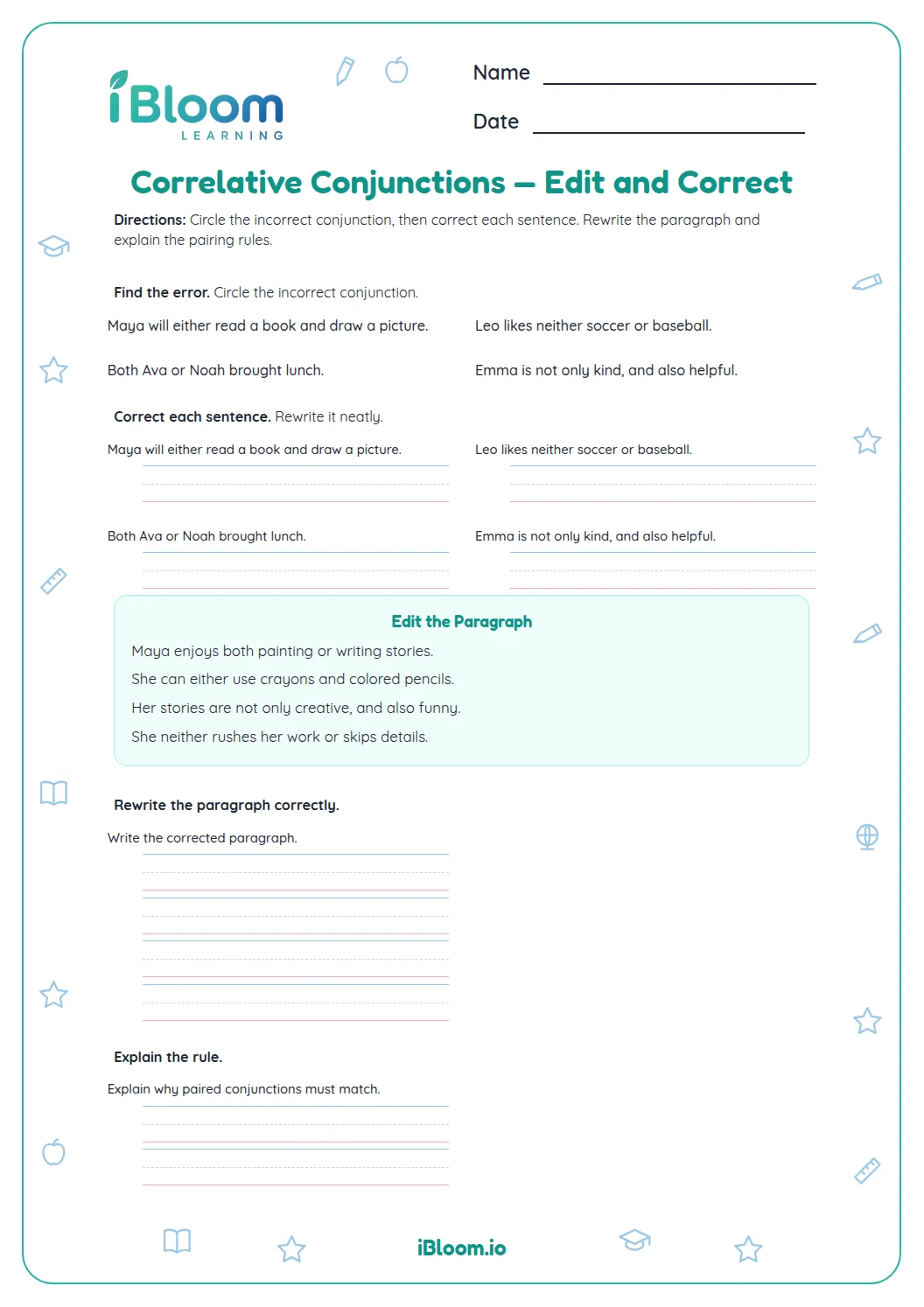
This Grade 5 printable gives students 14 questions on correlative conjunctions. They complete pairs such as either/or and not only/but also, write sentences with two named pairs, and choose a pair that matches a sentence relationship. The answer key includes completions and sample writing.
How do the conjunction pairs work?
Part A asks for the missing partner in either/or, neither/nor, both/and, and not only/but also. Read the full sentence to see whether it expresses a choice, two absences, two subjects or ideas, or an added detail.
How can you check a completed pair?
For “The book is not only funny ___ useful,” the missing words are but also. Read the sentence aloud to hear the two linked descriptions: funny and useful.
What makes a written sentence balanced?
In Part B, use both members of the named pair and connect matching sentence parts. For example, either/or should introduce two alternatives, while neither/nor should link two things that are both absent or did not act.
How to use this worksheet
- 1Read both halves of the sentence before filling a partner.
- 2Name the relationship: choice, paired subjects, absence, or added detail.
- 3Check that both conjunction words appear in the sentence.
- 4For writing prompts, use the named pair and keep the linked ideas parallel.
- 5Use the key to compare completions and treat written answers as models.
Common mistakes and quick fixes
The mistake
Using a partner from a different pair.
The fix
Recall the full pair together: either/or, neither/nor, both/and, or not only/but also.
The mistake
Writing only one half of the named pair.
The fix
Underline both pair words in the finished sentence.
The mistake
Joining unlike sentence parts.
The fix
Make the two choices or linked ideas use the same grammatical form.
What to practice next
Questions parents and teachers ask
Which correlative pairs appear on this worksheet?
The questions practice either/or, neither/nor, both/and, and not only/but also. Students complete the missing partner, use pairs in original sentences, and identify a pair from its meaning. Have students underline both partners and explain whether the sentence gives a choice, joins ideas, or adds detail.
How do I decide which partner belongs in a blank?
Read the complete sentence and decide what relationship it expresses. Either/or introduces alternatives, neither/nor links two negatives, both/and joins two items, and not only/but also adds a second detail. Have students underline both partners and explain whether the sentence gives a choice, joins ideas, or adds detail.
What does “balanced pair” mean in the writing section?
The two parts joined by a pair should have matching grammatical roles. For instance, either/or can connect two subjects that could perform the same action, or two actions someone may choose between. Have students underline both partners and explain whether the sentence gives a choice, joins ideas, or adds detail.
Are there multiple correct written answers?
Yes. The two writing prompts invite original sentences, so the key gives samples rather than the only possible wording. Check that the required pair appears and that the sentence clearly expresses the requested relationship. Have students underline both partners and explain whether the sentence gives a choice, joins ideas, or adds detail.
How many questions are included?
The worksheet has 14 questions across four parts: six pair completions, two sentence-writing prompts, two more completions, and four multiple-choice items. The two-page answer key includes all responses and sample sentences. Have students underline both partners and explain whether the sentence gives a choice, joins ideas, or adds detail.