



About this worksheet
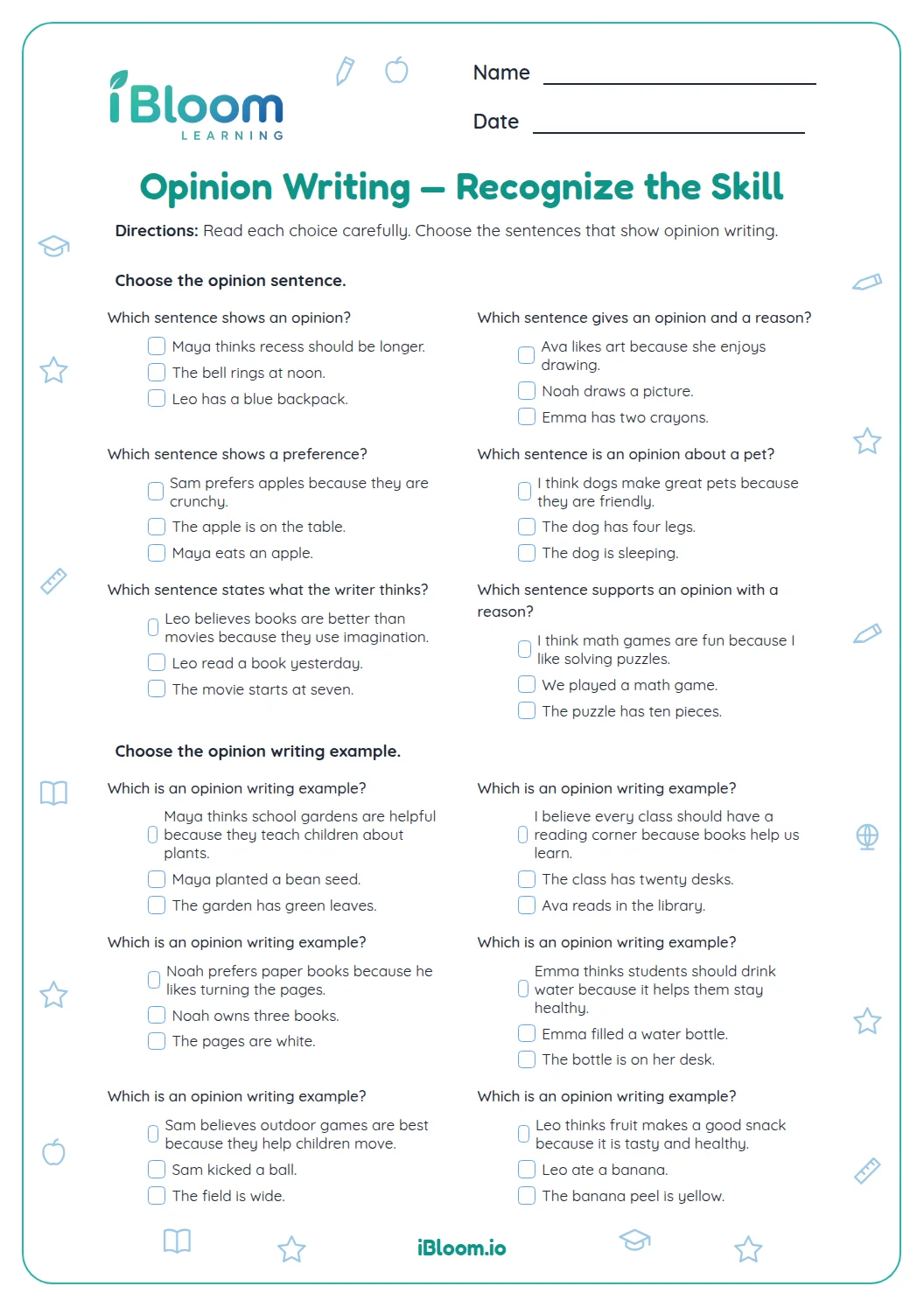
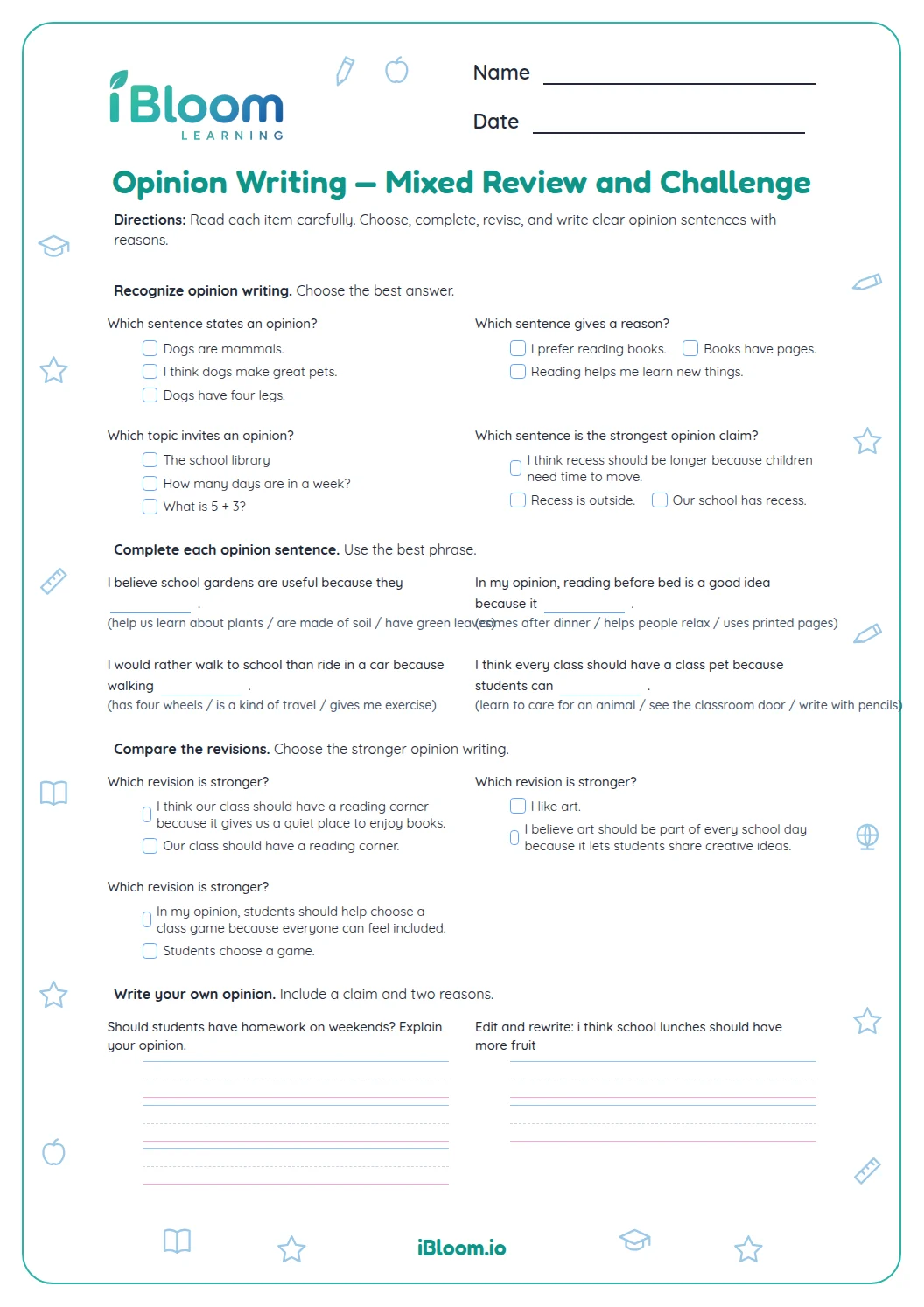
This free opinion writing worksheet gives children in Grades 1–5 practice saying what they think and why. Two questions identify opinions, and two ask children to choose supporting reasons. Three more combine an opinion and a reason using because. The last three invite original sentences about books, games, and art. The ten questions practice Common Core W.3.1b and W.3.1c: supplying reasons and linking them to opinions. Younger writers can rehearse aloud before writing; older writers can make their reasons more specific. A separate key includes sample sentences.
Aligned to W.3.1b and W.3.1c
How can children recognize an opinion?
An opinion tells what someone thinks or prefers. In Part A, “Dogs are the best pets” expresses a judgment. “Dogs need water” states a fact that can be checked.
Read all three sentences before choosing. Ask which words reveal a preference: best in question 1 and favorite in question 2.
What makes a reason useful?
A useful reason explains the opinion in the same sentence. If the opinion is that libraries are helpful, borrowing books is a reason. Saying that a library has a roof describes the building but does not explain its usefulness.
For the two supporting-reason questions in Part A, read the opinion before checking the choices. Have children say the whole sentence with their chosen reason so they can hear whether the ideas belong together.
How does because connect two ideas?
Because introduces the reason. In Part B, children keep the opinion first and turn the second sentence into an explanation. A capital letter begins the combined sentence, and one period ends it.
- 1I like puzzles. They make me think.
- 2I like puzzles because they make me think.
- 3“I like puzzles” gives the opinion; “they make me think” gives the reason.
How can children make the sentences their own?
Part C asks for a favorite book, a preferred game, and an opinion about art time. Any clear opinion with a connected reason can work. A child might enjoy a book for its funny characters or its surprising ending.
Use the sample key to discuss sentence structure. Judge the child’s reason by how well it explains the opinion; agreement with the sample preference is unnecessary.
How to use this worksheet
- 1Identify the two opinions in Part A by looking for a preference or judgment.
- 2Finish Part A by choosing the reason that best supports each opinion.
- 3Combine the two ideas in each Part B question using because.
- 4Say each Part C sentence aloud before writing it.
- 5Check that every sentence has an opinion, a connected reason, a capital, and an ending mark.
Mistakes to check and how to fix them
The mistake
Writing “I like puzzles because I like puzzles.”
The fix
Ask what makes puzzles enjoyable; name thinking, solving, or another specific feature.
The mistake
Choosing a true detail that does not explain the opinion.
The fix
Try the detail after because and ask how it supports the preference.
The mistake
Writing only “Because it is fun.”
The fix
Add the opinion before because so the sentence makes sense by itself.
Common Core alignment
Choose and write reasons that support a stated opinion.
On this sheet: Children select relevant reasons in Part A and supply their own in Part C.
Show the official wordingHide the official wording
Provide reasons that support the opinion.
Connect an opinion to its reason with because.
On this sheet: Part B combines pairs of ideas, and Part C uses because in original sentences.
Show the official wordingHide the official wording
Use linking words and phrases (e.g., because, therefore, since, for example) to connect opinion and reasons.
What to practice next
Make more practice
Further reading
Questions parents and teachers ask
What will my child write on this worksheet?
Your child will write six complete opinion sentences after identifying two opinions and choosing two supporting reasons. Part B supplies pairs of ideas to combine with because. Part C invites original opinions about a book, a game, and art time. The key gives models for all six written responses.
Can younger children use the sentence practice?
Yes, an adult can read the prompts and help younger children rehearse aloud. Start with the two opinion choices and two supporting reasons, then say each combined sentence together. Let the child choose the opinions in Part C, and help with spelling after the child has expressed a clear reason.
Must the written answers match the key?
No, the sample sentences show one acceptable way to answer each writing prompt. Check that the child states an opinion, connects a relevant reason with because, and writes a complete sentence. Different book choices, games, or opinions about art time are welcome when the explanation makes sense.
Why use because in every writing question?
Because makes the relationship between an opinion and its reason easy to hear. Repeating that connection lets children focus on choosing a meaningful explanation. After completing the sheet, invite a child to say one sentence again using since and discuss whether the same reason still supports the opinion.
How can I help a child improve a vague reason?
Ask a question about the exact book, game, or activity the child chose. If the child writes that a game is good because it is fun, ask what happens in the game that feels fun. Help the child replace the vague wording with that concrete detail in the sentence.