








About this worksheet
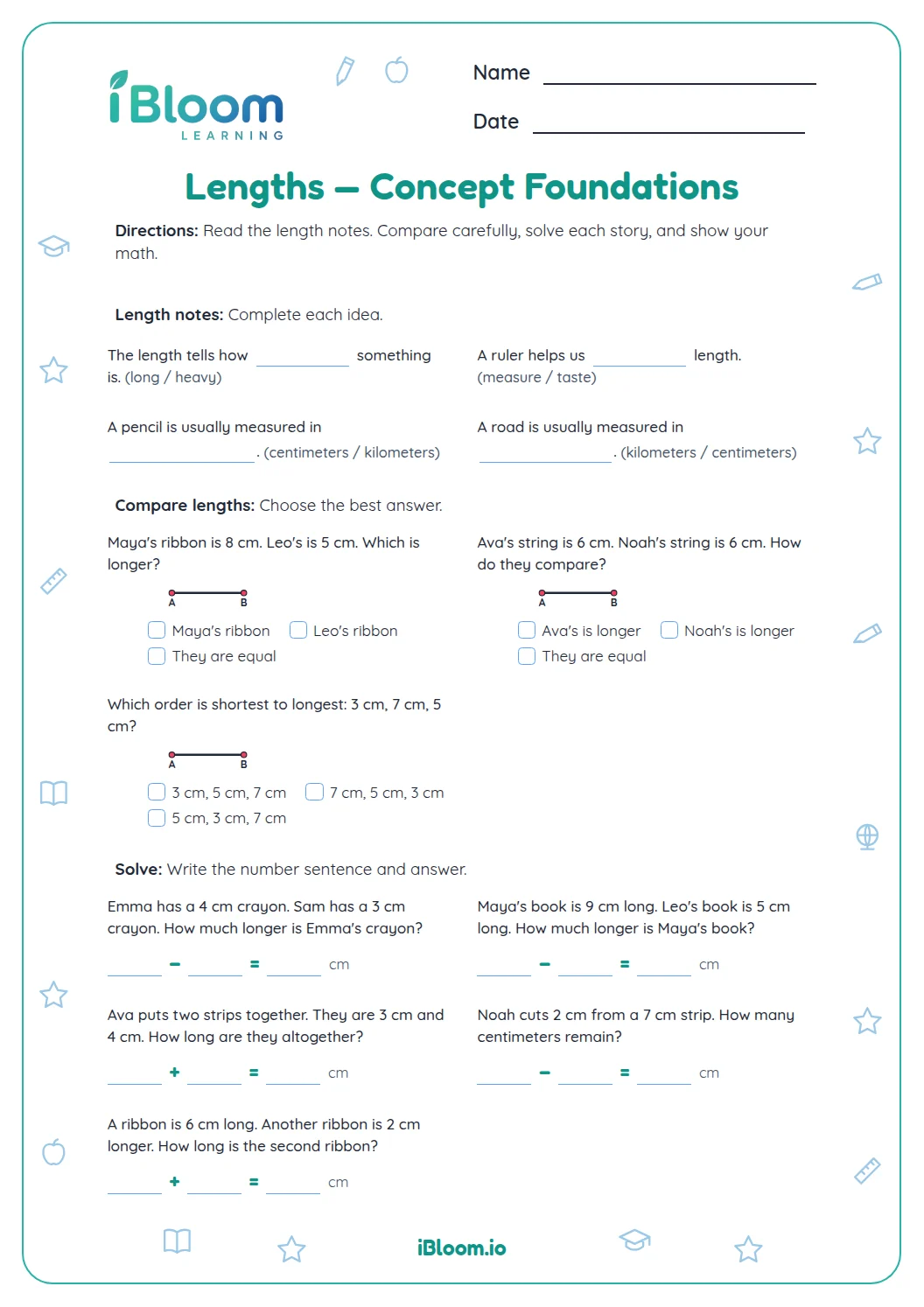
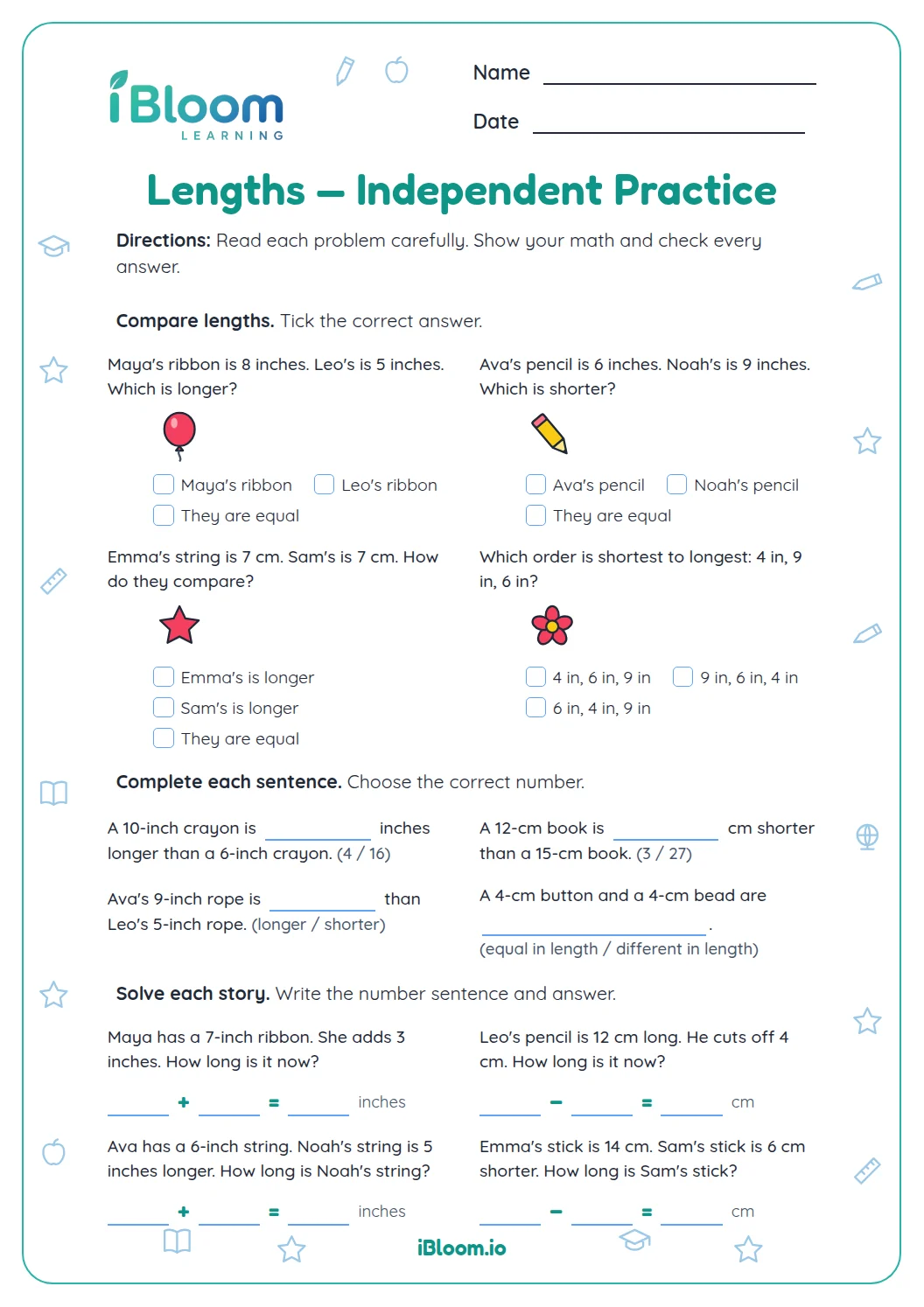
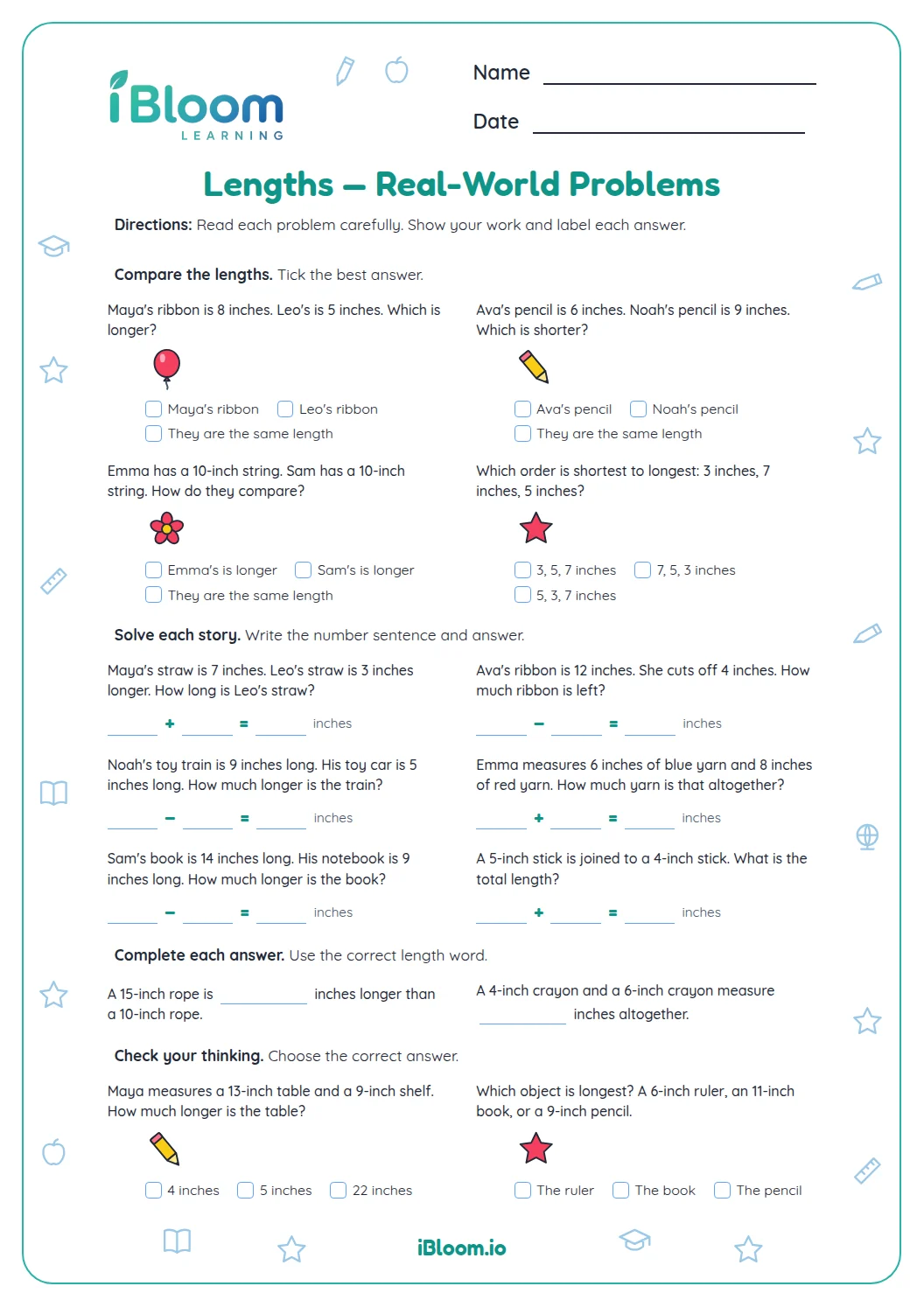
This free printable gives Grade 1 students 14 questions about comparing and solving length problems. It keeps the original sheet’s mix of nonstandard units such as cubes and paper clips, metric comparisons, and inch stories. Part A orders and compares lengths, Part B uses addition and subtraction, and Part C checks reasoning. The answer key gives a concise response for every question.
Aligned to 1.OA.A.1 and 1.MD.A.1
How can students compare lengths?
Part A compares cube counts, paper clips, and centimeter measurements. In question 3, ordering 9 cm, 4 cm, and 7 cm from shortest to longest gives 4 cm, 7 cm, 9 cm.
Which operation fits a length story?
Part B uses addition and subtraction with inches. A 9-inch ribbon that loses 4 inches has 5 inches left: 9 − 4 = 5. Keep the unit with the answer.
How can students check a length claim?
Part C checks whether a statement follows from the given lengths. A 10-inch ribbon that loses 2 inches has 8 inches left, so Sam’s claim of 12 inches is incorrect.
How to work through the page
- 1Identify what is being compared and how each length was measured.
- 2For ordering, place the smallest measurement first and the largest last.
- 3For stories, decide whether lengths are joined, removed, or missing.
- 4Keep inches or centimeters in the final answer.
Common mistakes and quick fixes
The mistake
Reversing shortest-to-longest order.
The fix
Start with the smallest number and check that each next length is larger.
The mistake
Adding when a strip loses length.
The fix
A removed piece makes the remaining length smaller, so subtract.
The mistake
Ignoring the stated unit.
The fix
Write the unit from the question, such as inches or centimeters.
Common Core alignment
This practice connects length comparisons and addition and subtraction stories to the listed Grade-level standard.
Solve addition and subtraction word problems about joining, taking away, and comparing. Within 20.
On this sheet:
Show the official wordingHide the official wording
Use addition and subtraction within 20 to solve word problems involving situations of adding to, taking from, putting together, taking apart, and comparing, with unknowns in all positions, e.g., by using objects, drawings, and equations with a symbol for the unknown number to represent the problem.
Compare lengths indirectly and order lengths using a third object.
On this sheet:
Show the official wordingHide the official wording
Order three objects by length; compare the lengths of two objects indirectly by using a third object.
What to practice next
Make more practice
Further reading
Questions parents and teachers ask
How many questions are on this worksheet?
There are 14 questions in three compact parts. Students compare and order lengths, solve short inch stories, and check claims against the measurements. Every item has a matching answer in the separate key, including the unit where the answer is a length.
Which units appear in the practice?
The worksheet uses cubes, paper clips, centimeters, and inches, matching the old page’s comparison and story contexts. Students compare counts or lengths and solve inch addition and subtraction stories. They do not need a ruler or a picture to answer any question.
How does question 3 practice ordering?
Question 3 asks students to arrange 9 cm, 4 cm, and 7 cm from shortest to longest. Compare the numbers because all three lengths use centimeters; the correct order is 4 cm, 7 cm, 9 cm. The choices keep the task brief.
What should students do when a ribbon loses length?
Subtract the part that is removed from the starting length. For example, a 9-inch ribbon that loses 4 inches has 5 inches remaining. Keeping inches in the answer helps students recognize that the story is about length, not just a number.
Does the worksheet include long written explanations?
No. The revised sheet uses selected answers for comparisons, calculations, and reasoning checks, so students can focus on the length clues. The page still includes claims to evaluate, such as whether 12 inches remain after 2 inches are cut from a 10-inch ribbon.