




About this worksheet
This free printable Grade 2 worksheet has story problems that add a one-digit number to a two-digit number, such as 18 crayons plus 4 more or 86 points plus 9 more. Children first match each story to its number sentence, then write the sentence and solve four stories with room to show their work, and finally find the mistake in two friends' answers. It practices Common Core 2.OA.A.1 and 2.NBT.B.5 and suits second graders who can add within 100. Every solve-it story makes a new ten, and a separate answer key is included.
Aligned to 2.OA.A.1 and 2.NBT.B.5
How do you add a 1-digit number to a 2-digit number?
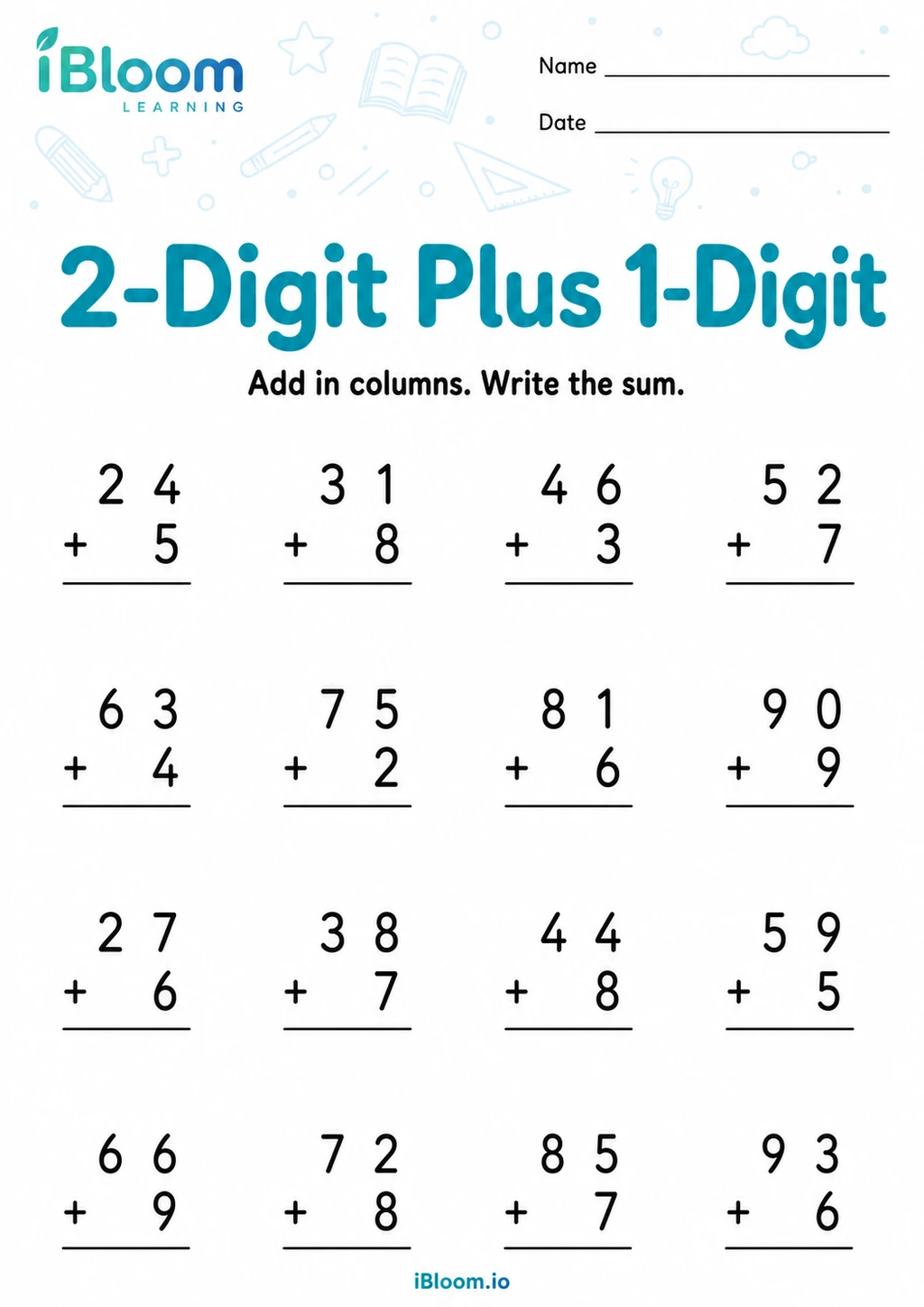
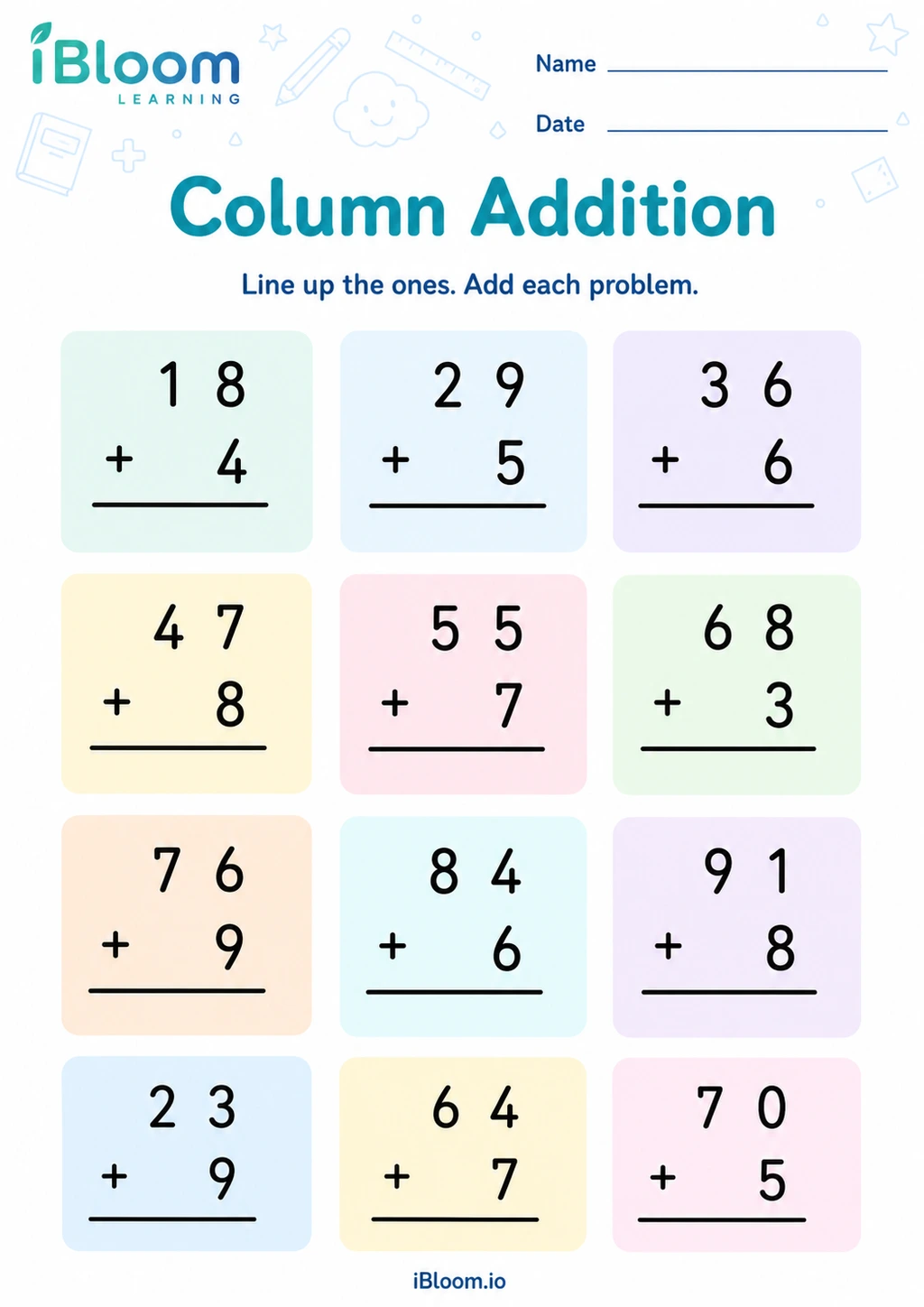
Keep the tens where they are and work with the ones. If the ones add to 10 or more, that makes a new ten. A helpful way is to make the next ten first: 18 needs 2 more to reach 20, so split the 4 into 2 and 2.
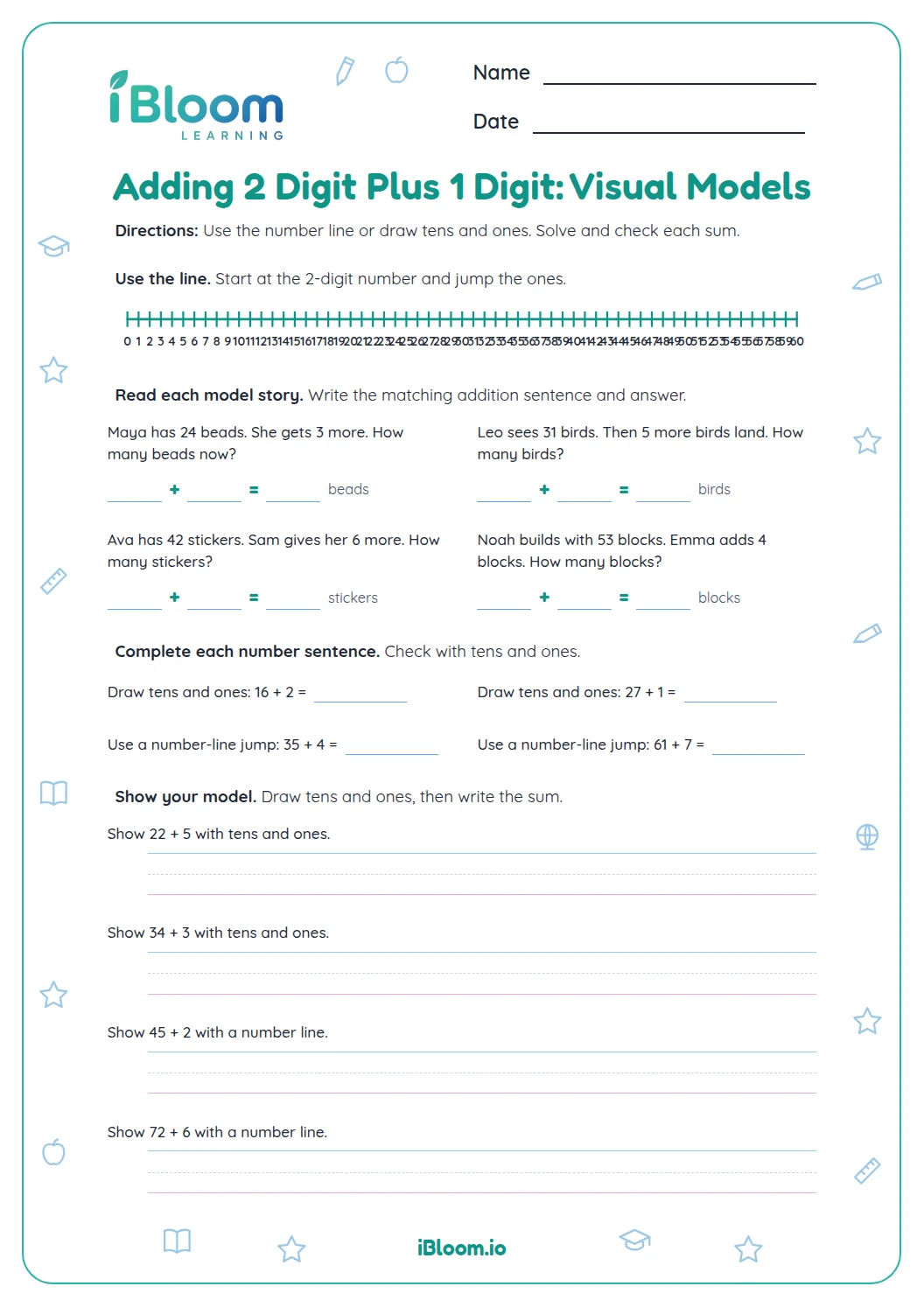
Children can also draw tens and ones or count on from the larger number. All of these methods use place value, which is what 2.NBT.B.5 asks for. The answer box holds the result, such as 22 crayons, and the working space shows how your child got there.
- 1Emma has 18 crayons. She gets 4 more.
- 218 + 4 = ___
- 318 + 2 = 20 (use 2 of the 4 to make a ten)
- 420 + 2 = 22 (add the other 2)
- 5Emma has 22 crayons.
How do children know a story needs adding?
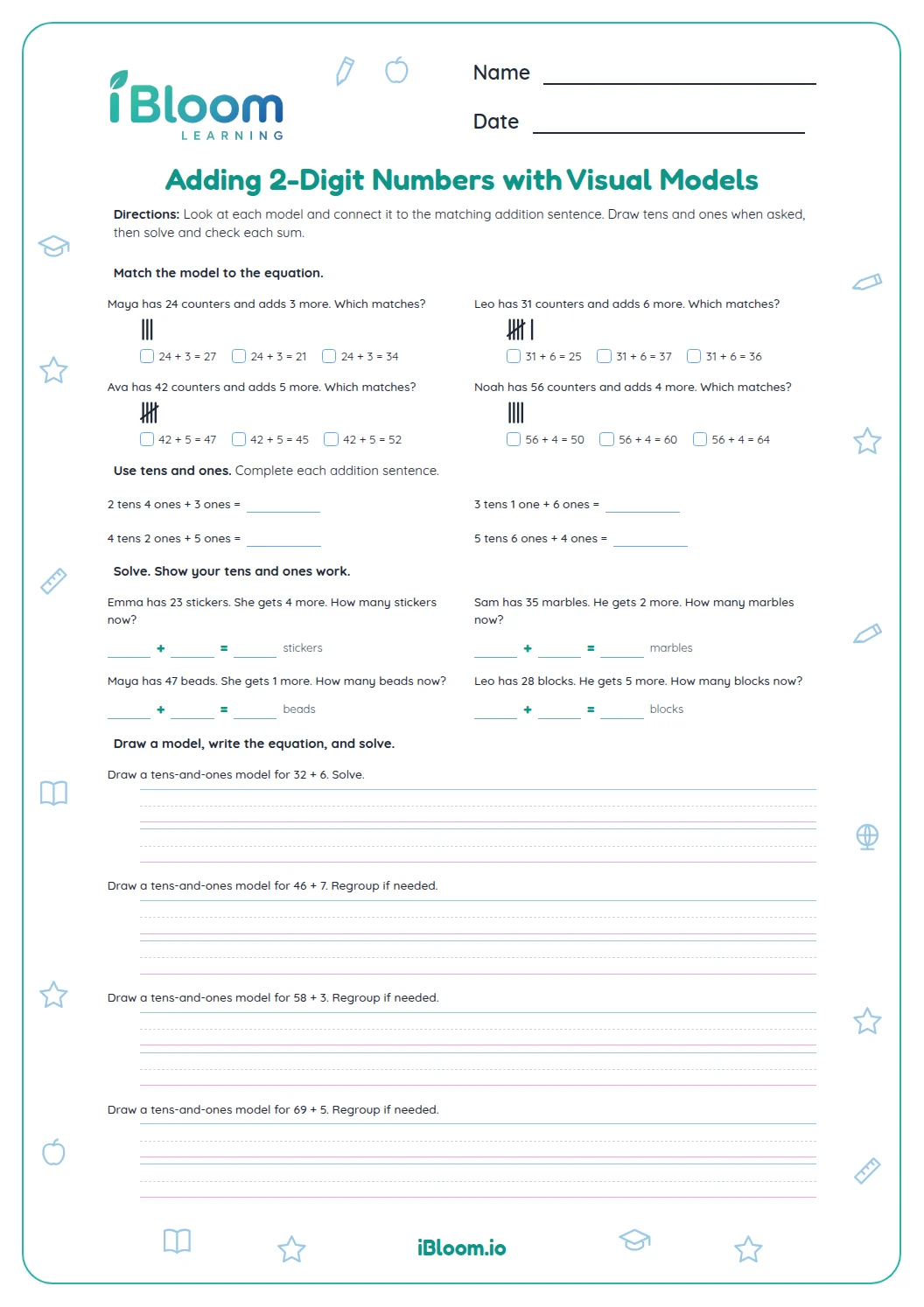
Phrases like 6 more get on, reads 6 more, finds 7 more and adds 3 more all say that a group is growing. Part A uses four of these stories and asks children to pick the number sentence before they solve anything. The wrong choices are easy slips: subtracting (38 − 6), swapping the digits (83 + 6) or adding the 1-digit number as tens (31 + 60).
Naming the numbers first (what do we start with, and what is added?) helps children see the plan before they calculate. It also prepares them for stories where the unknown is in a different place.
What is on this worksheet?
Ten questions in three parts on two pages. Every story adds a 1-digit number to a 2-digit number, so the skill stays the same while the contexts change.
- Part A, Pick the number sentence: four stories, each with three number sentences to choose from
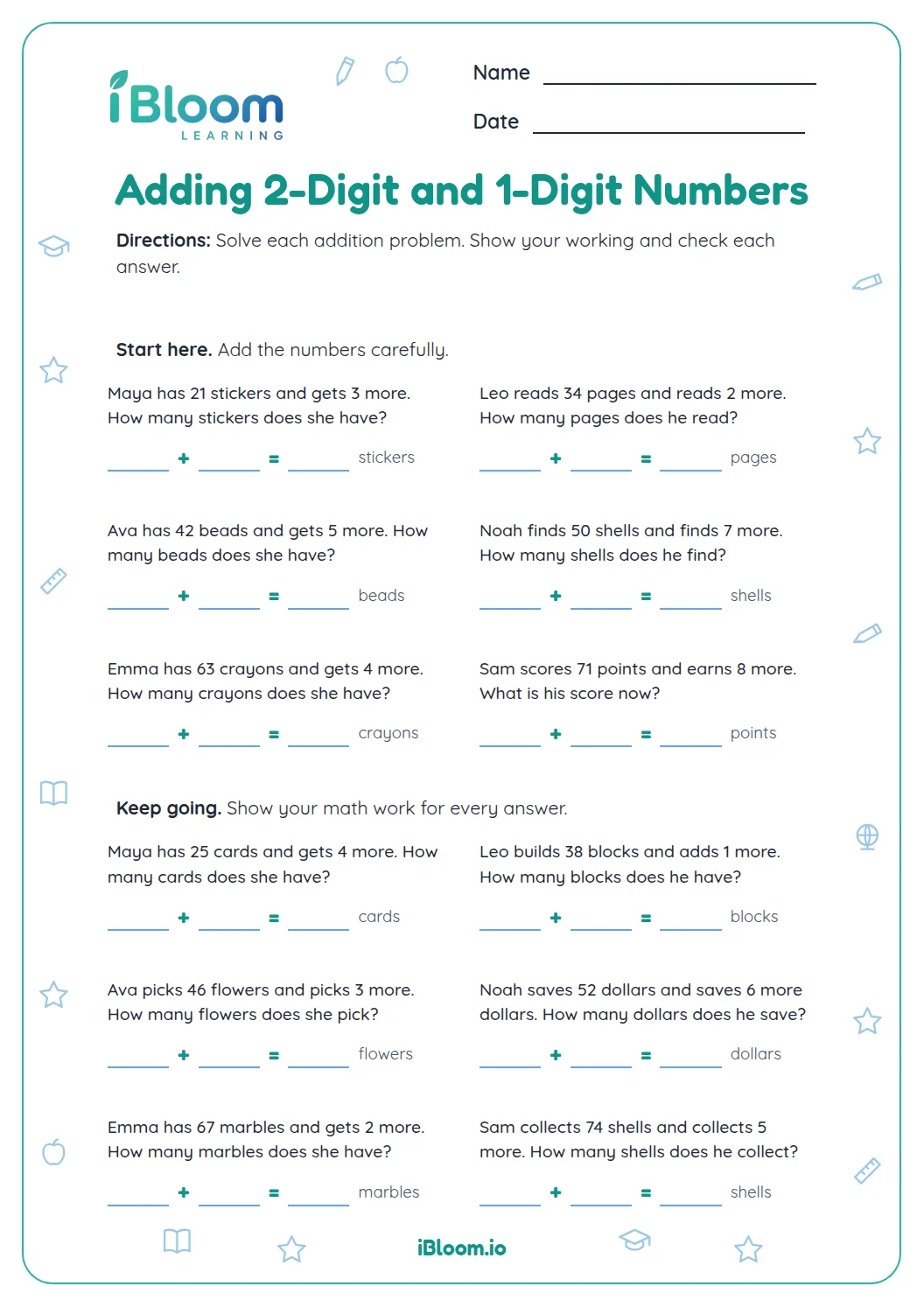
- Part B, Solve it: four stories with working space to write the sentence, add, and label the answer
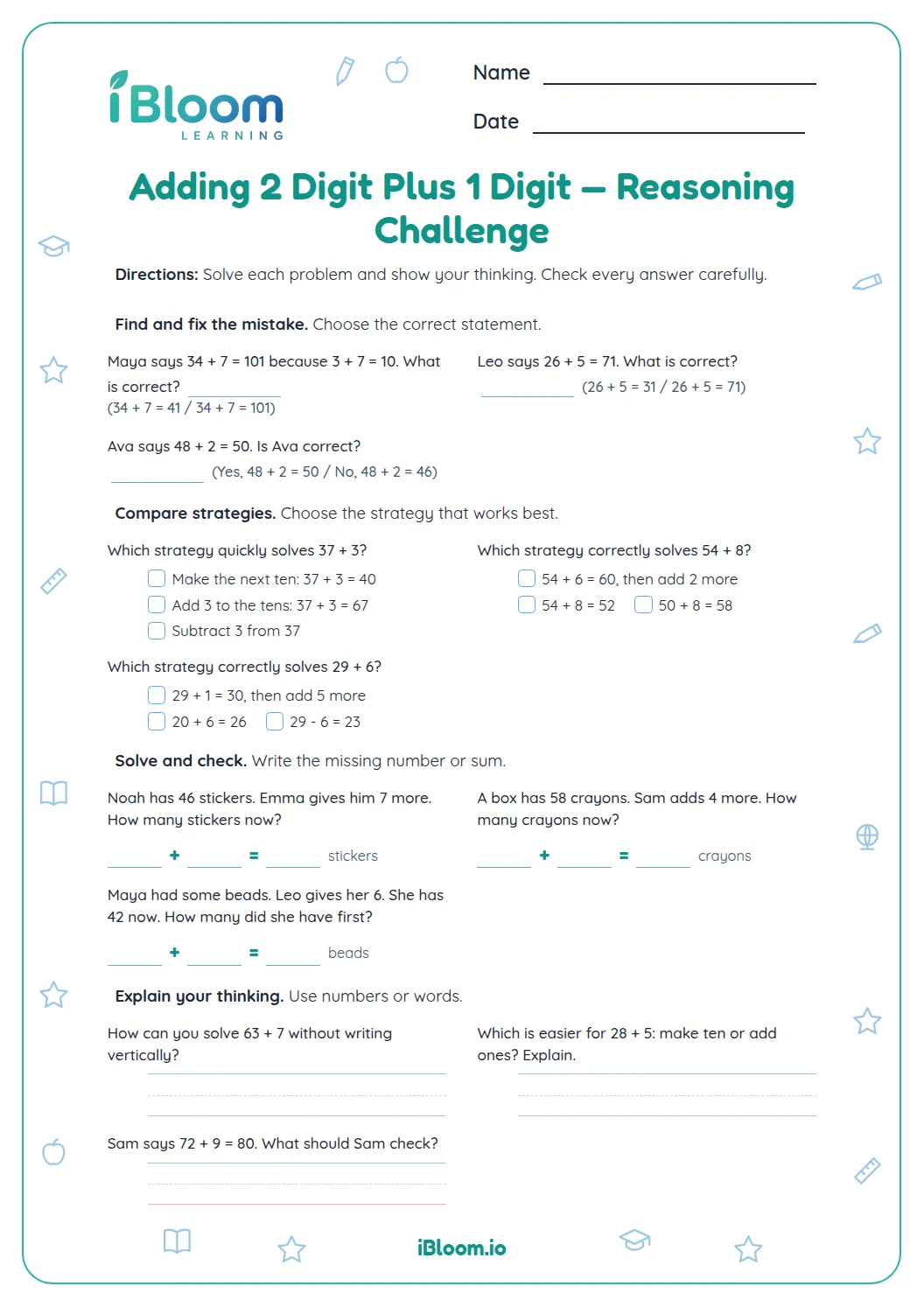
- Part C, Check the answer: two friends made mistakes, so children find the right sum
- A two-page answer key with every number sentence, sum and label
What mistake does question 9 show?
Zoe wrote 25 + 8 = 213. She added the ones (5 + 8 = 13) and then wrote the 13 next to the 2 tens, as if the tens and ones were separate numbers. Children who do this have not yet seen that 13 ones is 1 ten and 3 ones.
The fix is to regroup: 13 ones becomes 1 ten and 3 ones, so there are now 3 tens and 3 ones, and 25 + 8 = 33. Asking whether 213 is a reasonable answer for a number that started as 25 helps children catch it themselves.
How to use this worksheet at home or in class
- 1Warm up with two mental sums such as 15 + 3 and 15 + 7. Ask which one needs a new ten.
- 2Read the first story in Part A out loud and ask your child to tell you what the story starts with and what is added.
- 3Let your child pick the number sentences in Part A, then check each one by saying the story back using the sentence.
- 4For Part B, have your child write the sentence first, then solve in the working space, and finally write the label such as crayons or points.
- 5In Part C, ask your child to explain what each friend did before they pick the right sum.
- 6Check with the answer key and revisit any problem that crossed a ten with a drawing of tens and ones.
Common mistakes and quick fixes
The mistake
Writing both digits of the ones sum, as in 25 + 8 = 213.
The fix
Regroup the 13 ones into 1 ten and 3 ones, then add the new ten to the 2 tens. Use drawn tens and ones to show it.
The mistake
Adding the single digit to the tens digit, as in 56 + 3 = 86.
The fix
Say the place values: 56 is 5 tens and 6 ones. The 3 belongs with the 6 ones, so 6 + 3 = 9 and the answer is 59.
The mistake
Subtracting even though the group grows, as in 38 − 6 for a bus with 38 riders when 6 more get on.
The fix
Ask whether the group gets bigger or smaller. When more riders get on, the group grows, so the sentence uses +.
Common Core alignment
This sheet practices Grade 2 adding-to word problems and place-value addition within 100.
Solve one-step word problems within 100 and write them as number sentences.
On this sheet: Every story is an adding-to situation, and children write an equation with a blank for the answer.
Show the official wordingHide the official wording
Use addition and subtraction within 100 to solve one- and two-step word problems involving situations of adding to, taking from, putting together, taking apart, and comparing, with unknowns in all positions, e.g., by using drawings and equations with a symbol for the unknown number to represent the problem.
Add within 100 with place-value strategies, such as making the next ten in 18 + 4.
On this sheet: Children add a one-digit number to a two-digit number, regrouping ones into a new ten in all four Part B stories.
Show the official wordingHide the official wording
Fluently add and subtract within 100 using strategies based on place value, properties of operations, and/or the relationship between addition and subtraction.
What to practice next
Make more practice
Further reading
Questions parents and teachers ask
Why does every Part B story make a new ten?
Part B practices the harder step. In 18 + 4, 35 + 6, 67 + 5 and 86 + 9, the ones add to 10 or more, so a new ten is made. Part A is mainly about choosing the operation, so three of its four stories (31 + 6, 42 + 7, 56 + 3) need no new ten.
Does my child have to write the number sentence?
Yes, it is part of the skill. Each Part B story has a working space for the number sentence and the adding, and an answer box for the result. Writing 18 + 4 = 22 shows that your child turned the story into math, and a label such as crayons reminds them what the number means.
What strategies can my child use to add 18 + 4?
Any strategy that uses place value works. Children can make a ten (18 + 2 = 20, then 20 + 2 = 22), count on from 18, draw tens and ones, or use a number line. Let your child choose a method and explain it. Speed is less important than understanding why it works.
What is the answer to Maya saving $35 and earning $6 more?
The answer is $41. Thirty-five plus six: 5 + 6 = 11 ones, which is 1 ten and 1 one, so 3 tens + 1 ten = 4 tens and 1 one. The answer key shows $41 with its label. Ask your child to say it as 35 + 6 = 41 dollars.
Why are the wrong number sentences in Part A so close to the right one?
They match slips that are easy to make: subtracting instead of adding (38 − 6), swapping the digits (83 + 6), or adding the 1-digit number as tens (31 + 60 or 56 + 30). Children have to think about what happens in the story, not only spot familiar numbers. Talk about why each wrong choice does not fit.
Is there an answer key for this worksheet?
Yes. A separate two-page answer key marks the right number sentence in Part A, gives each sum with its label in Part B, and shows the correct sums for Zoe's and Noah's problems in Part C. Print the worksheet by itself and keep the key for checking, or download both from this page as a free PDF.