

About this worksheet
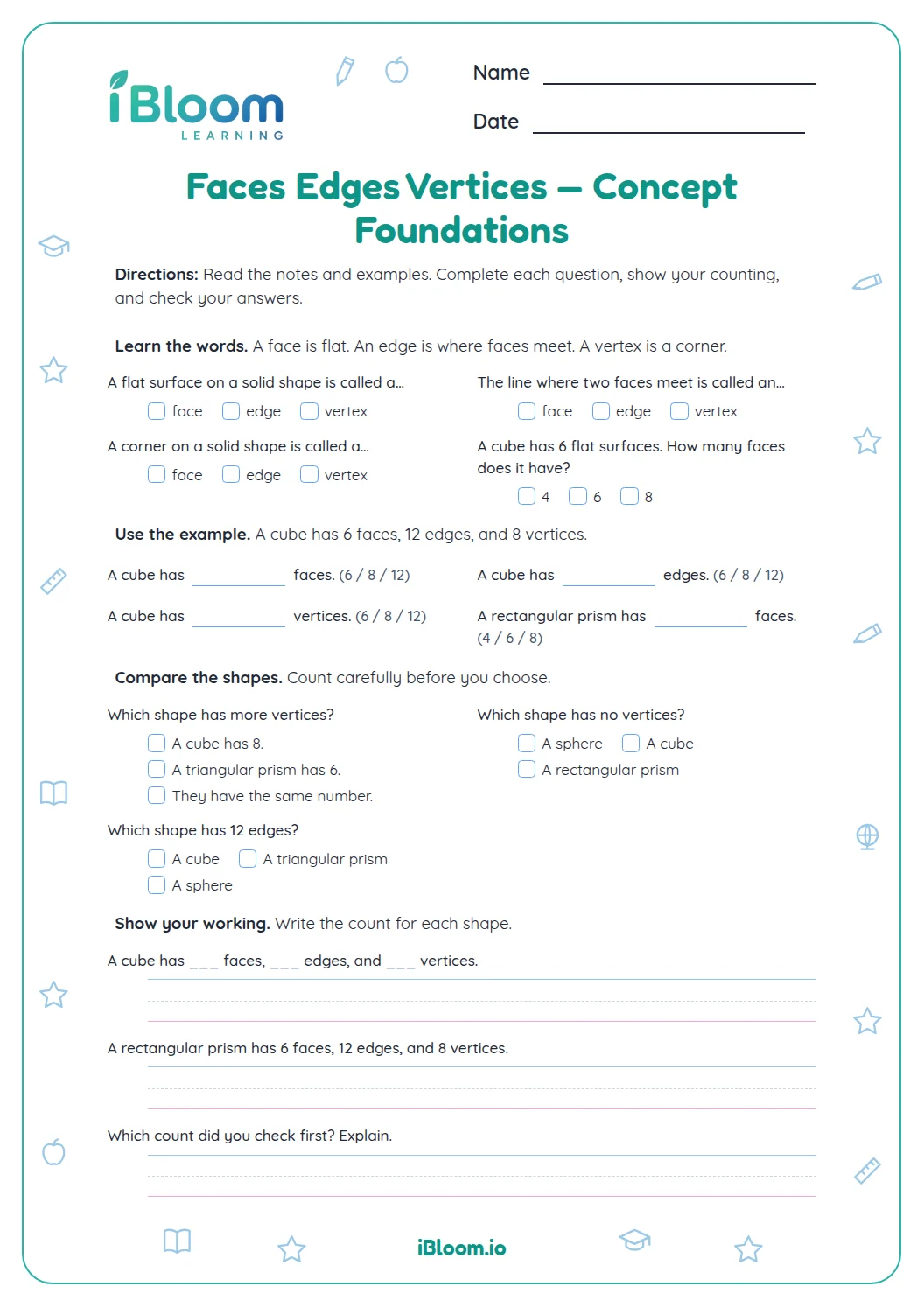
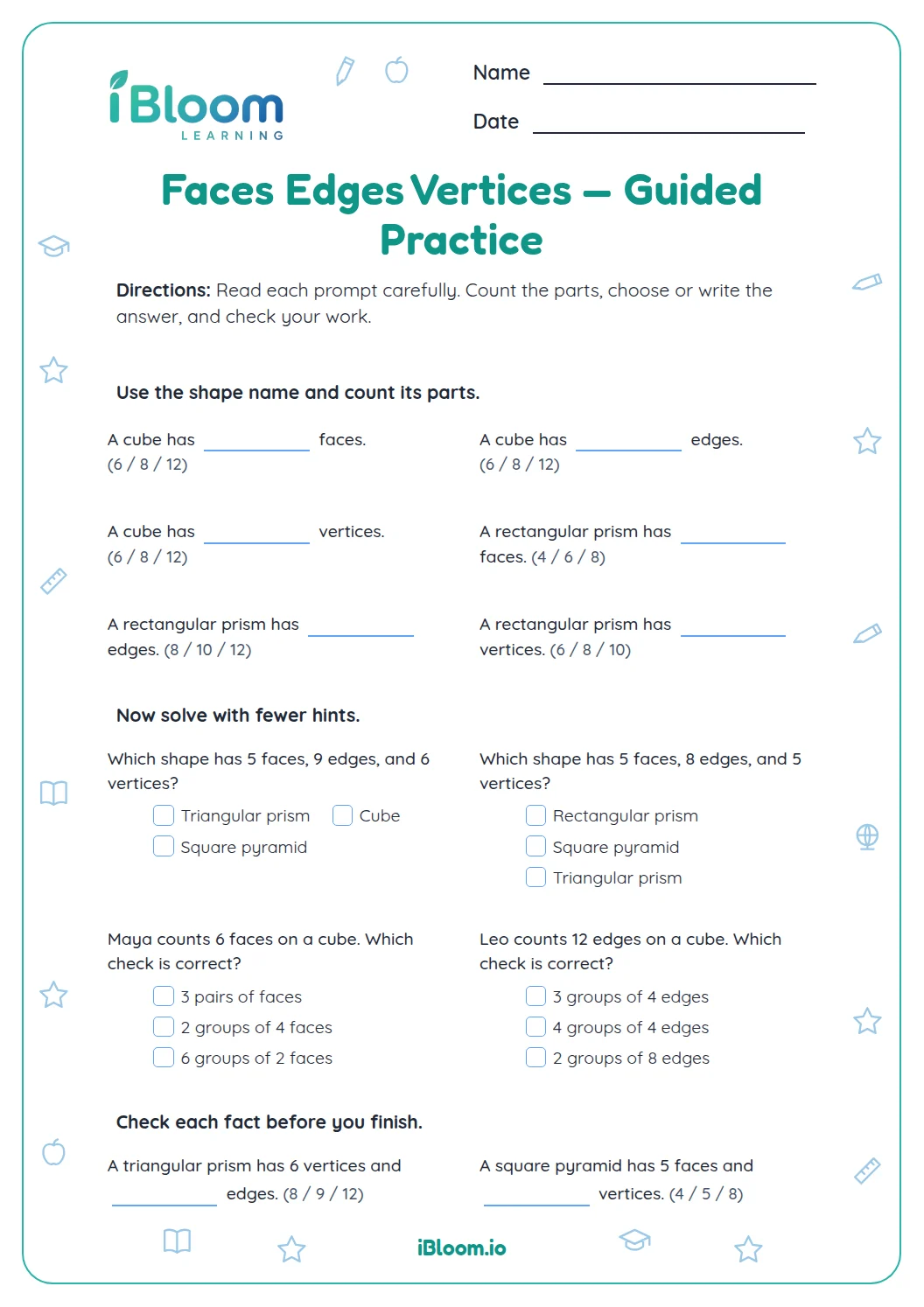
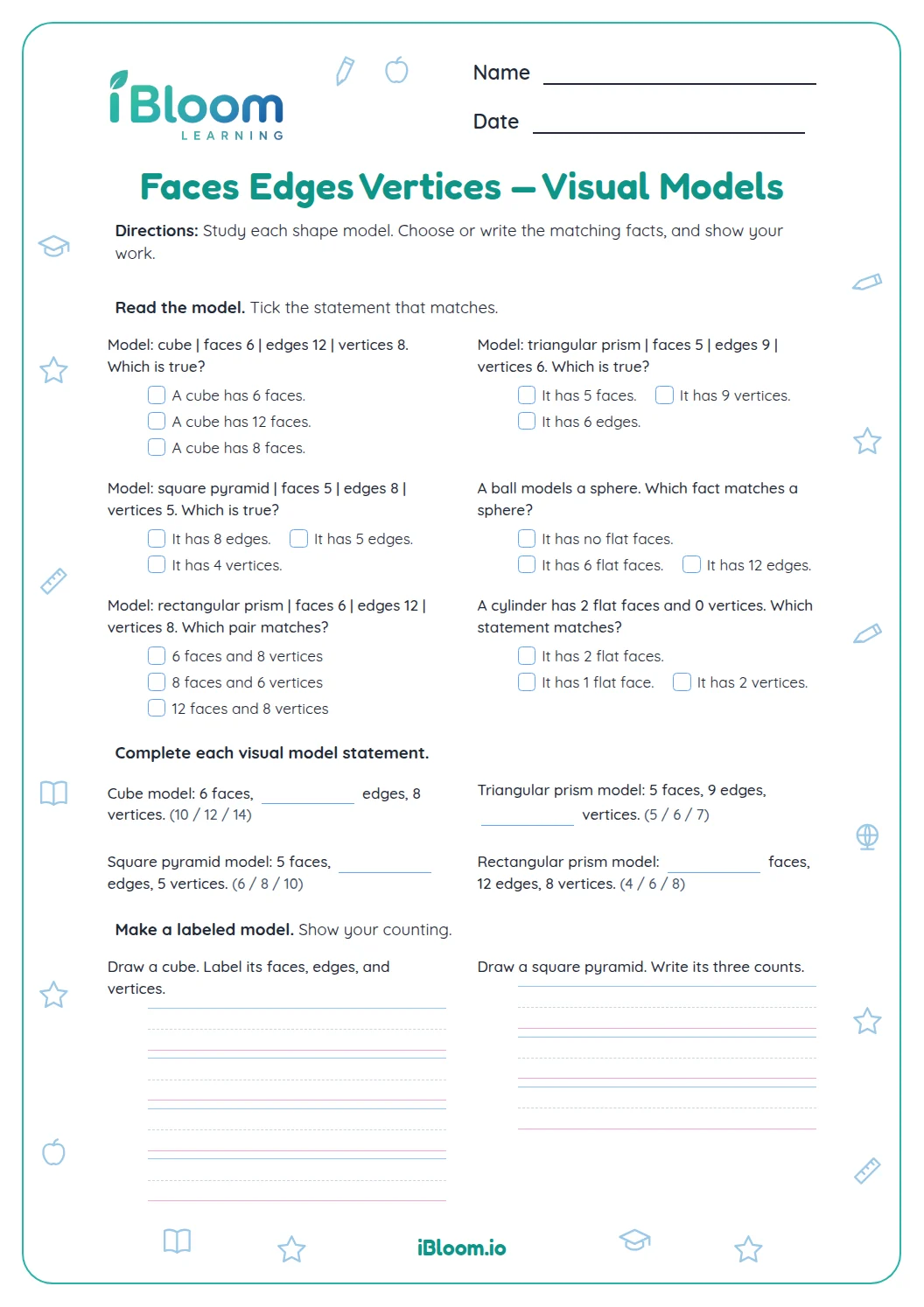
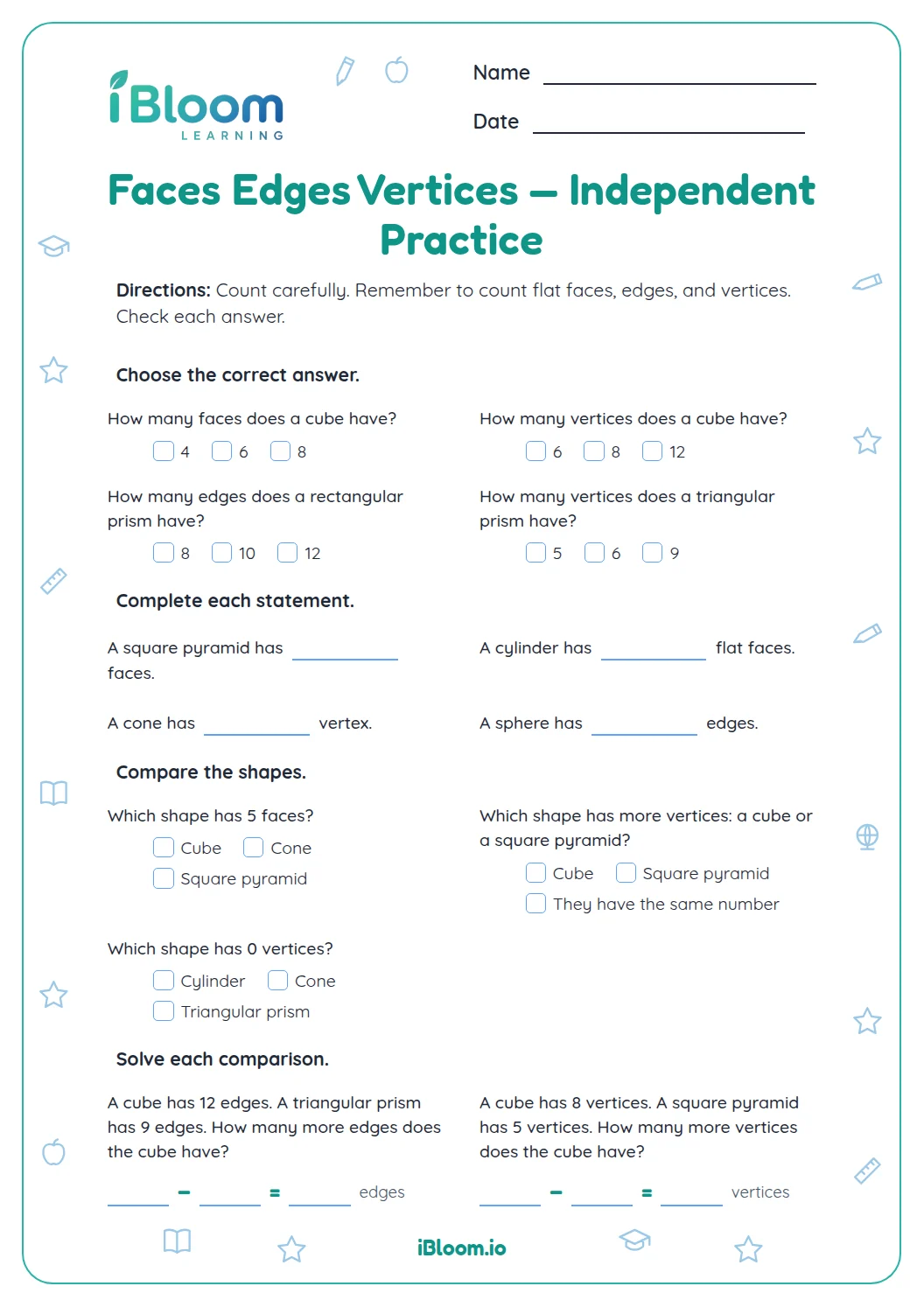
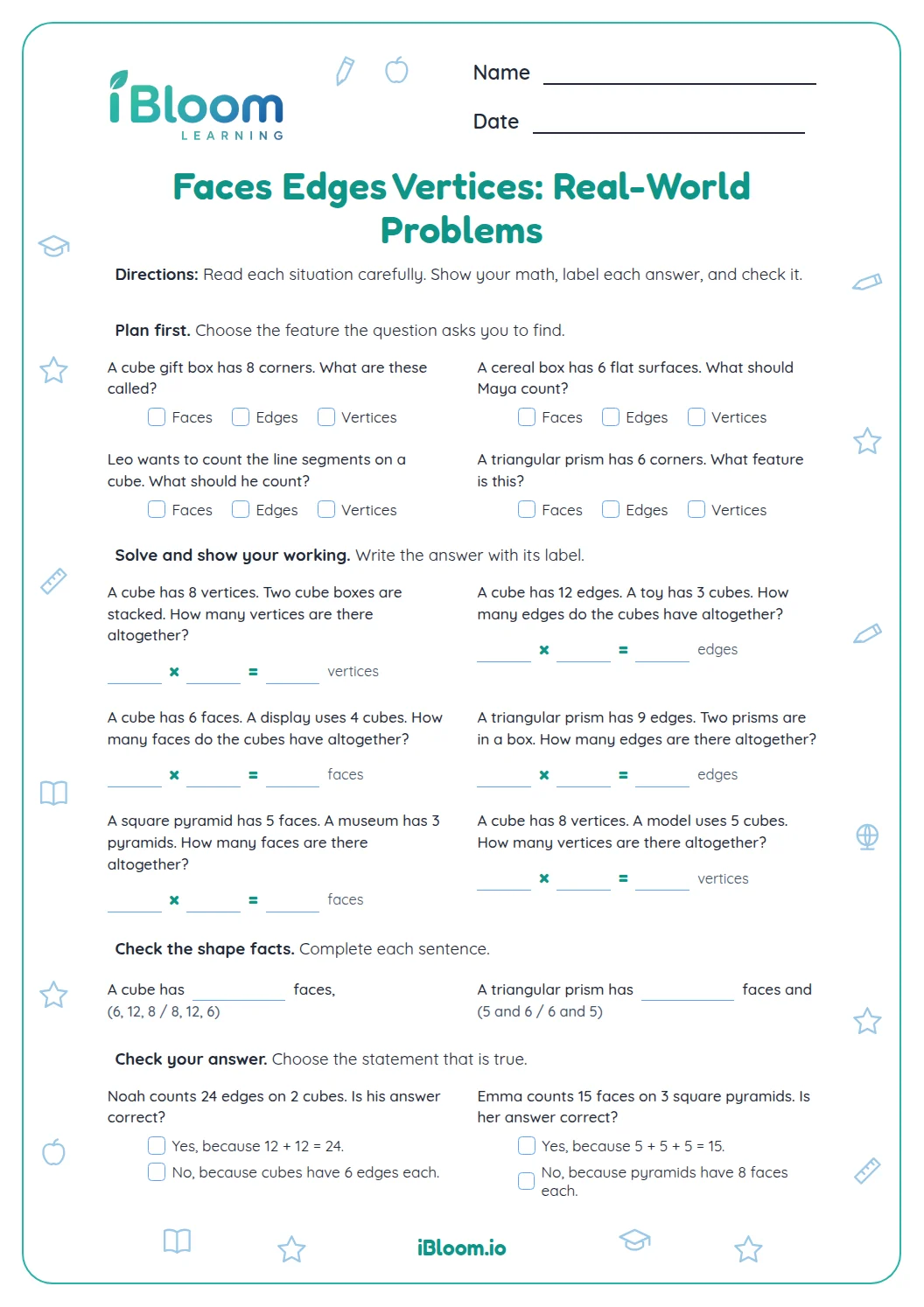
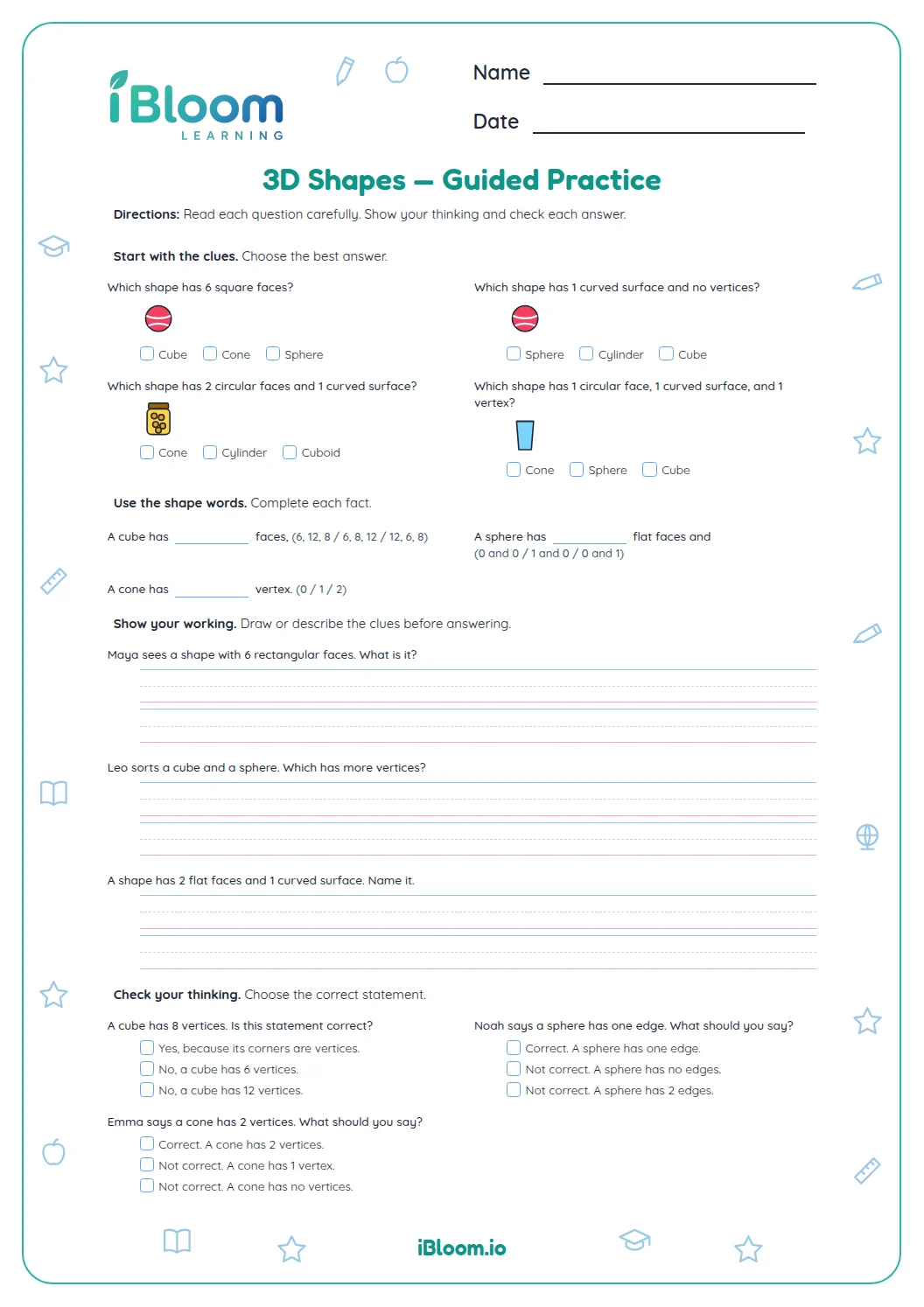
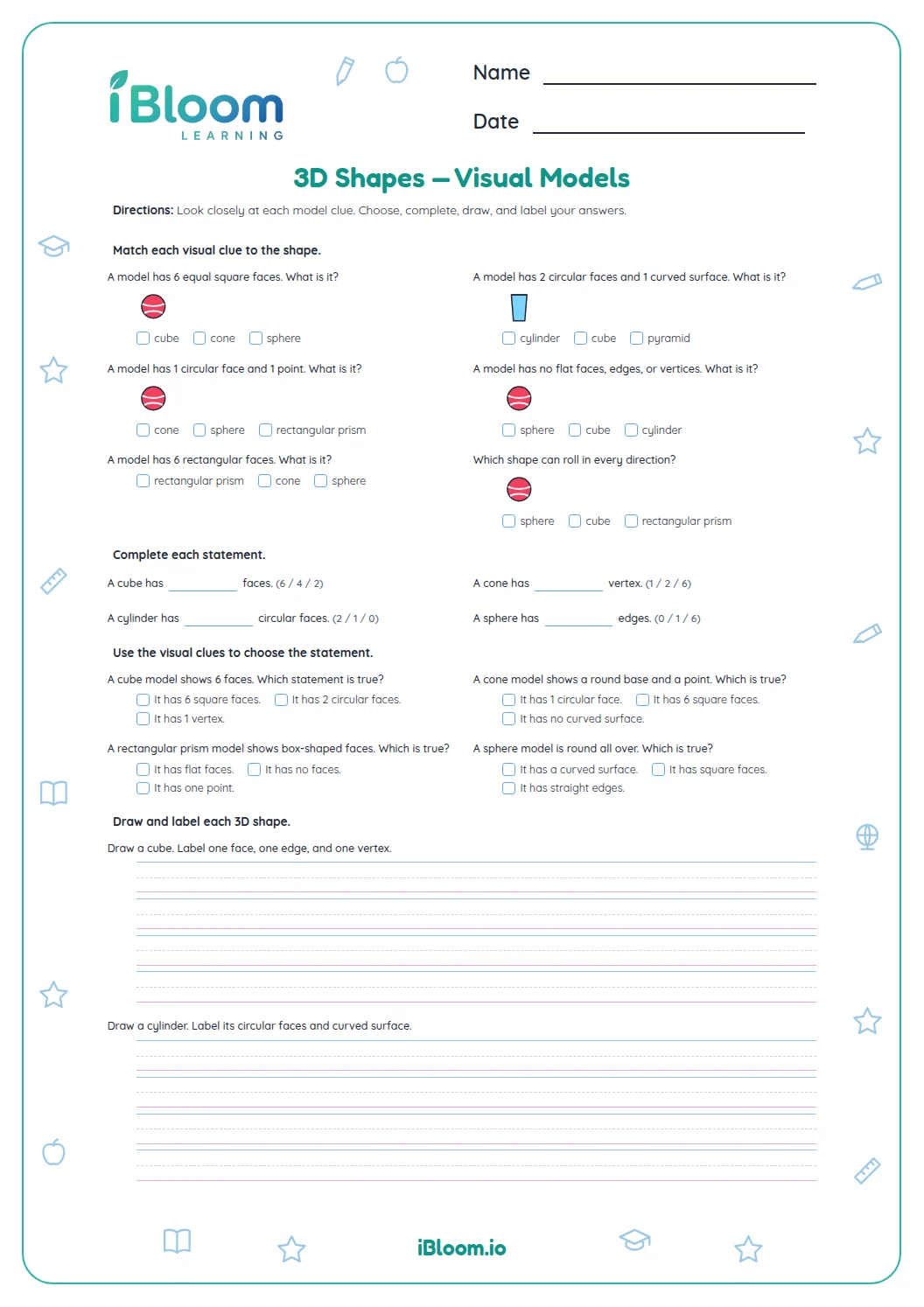
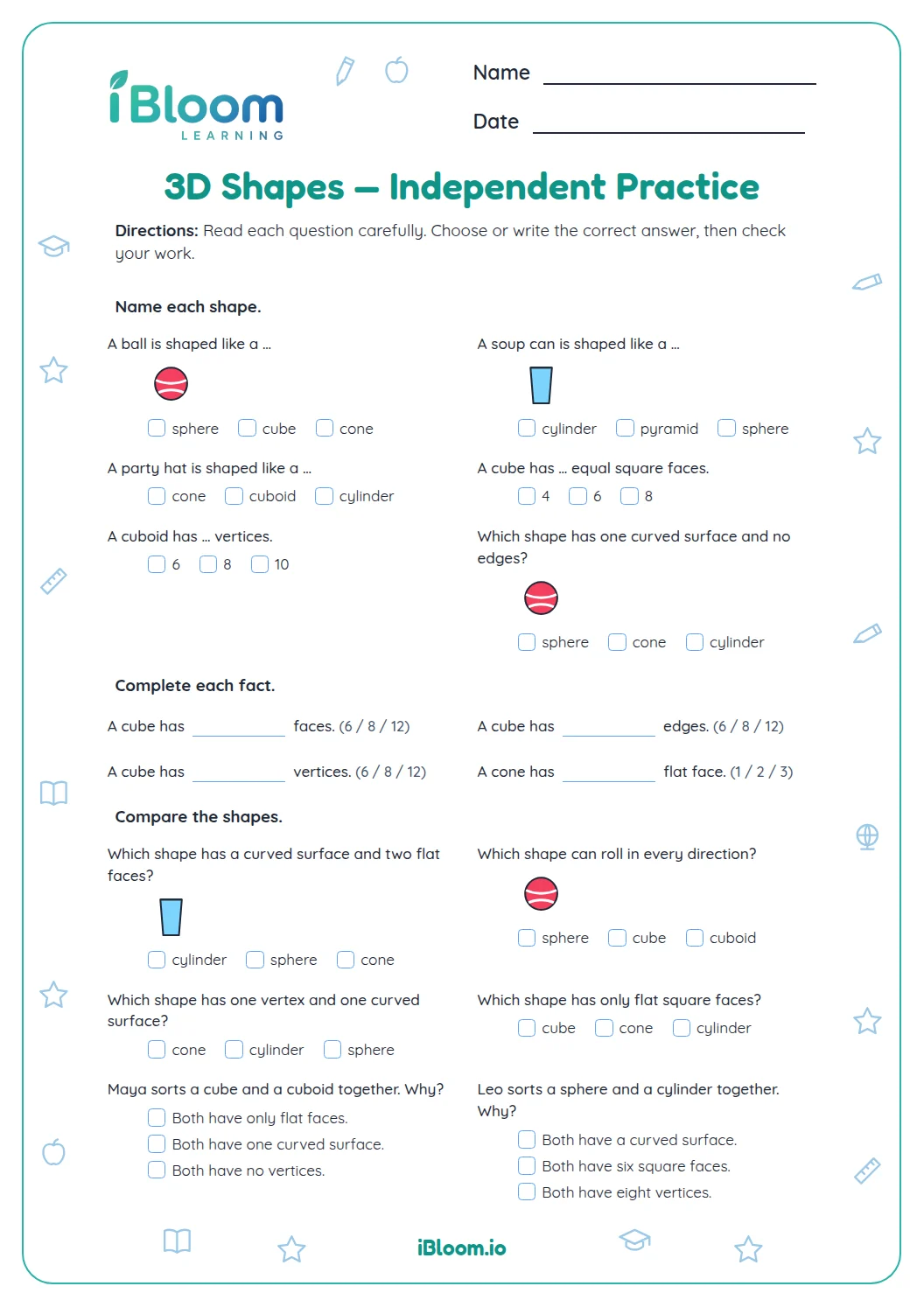
This Grade 2 reasoning page explores faces, edges, and vertices on cubes, rectangular prisms, triangular prisms, and square pyramids. Students count and compare the shape facts, identify a solid from its attributes, and sketch three solids with labeled parts. The answer key lists counts and sample responses.
What does each part ask students to do?
Students begin by sketching and labeling a cube, rectangular prism, and triangular prism. They can refer to those drawings while answering questions about the solids and a square pyramid.
- Sketch and label a face, edge, and vertex
- Count parts on cubes and prisms
- Compare and identify solids from their counts
How do faces, edges, and vertices differ?
A face is a flat surface. An edge is where two faces meet, and a vertex is where edges meet. Question 2 asks students to count the faces on their cube sketch.
- 1Look at the cube sketch.
- 2Count each flat face once.
- 3A cube has 6 faces.
How can several counts identify a solid?
Compare every clue when identifying a solid. A square pyramid has five faces, eight edges, and five vertices; its face types and counts work together.
How to use this worksheet
- 1Read whether the question asks for faces, edges, or vertices.
- 2For a solid, recall how its flat faces meet along edges and corners.
- 3Trace each polygon once and count each corner once.
- 4Compare every number in a clue before choosing a solid.
- 5Check all 18 answers with the separate key.
Common mistakes and quick fixes
The mistake
Mixing up an edge and a vertex.
The fix
An edge is a line between faces; a vertex is a point where edges meet.
The mistake
Counting a polygon corner twice at the end of a trace.
The fix
Start at one corner and stop when you return to it.
The mistake
Identifying a solid from only one attribute.
The fix
Check its face, edge, and vertex counts against the whole clue.
What to practice next
Make more practice
Questions parents and teachers ask
How many questions are on the sheet?
There are 14 questions: one opening sketch, ten counts, two identification or comparison items, and one explanation. Students sketch a cube and two prisms first, then use those models while answering. The separate key lists the counts and sample responses.
What is a face on a solid?
A face is a flat surface on a solid. The opening question asks students to sketch a cube, rectangular prism, and triangular prism, then label a face on each. Later questions use those sketches to count faces, edges, and vertices.
What does the square-pyramid clue describe?
The clue describes a square pyramid: it has one square face, four triangular faces, eight edges, and five vertices. Its base contributes four vertices, and the top point adds one more. Question 12 asks students to identify the solid from those facts.
What grade is this worksheet for?
The worksheet is written for Grade 2 geometry practice. Students sketch solids, count faces, edges, and vertices, and use those attributes to compare or identify figures. The separate answer key lists the counts and sample explanation so students can check their work.
Is an answer key included?
Yes. The separate answer key covers all 14 questions. It gives the solid counts and names the square pyramid from its attributes. For the sketch and explanation items, it describes one acceptable response; students can use other clear sketches and edge-counting strategies.