
About this worksheet
This Grade 2 math worksheet gives students 14 situations built around groups and jumps of 100. The first part asks for the next number in a count; the second uses totals and amounts left in everyday settings. Students practice counting within 1,000 by hundreds, aligned with CCSS 2.NBT.A.2, and can check work with the answer key.
Aligned to 2.NBT.A.2
How do you keep a count moving by 100?
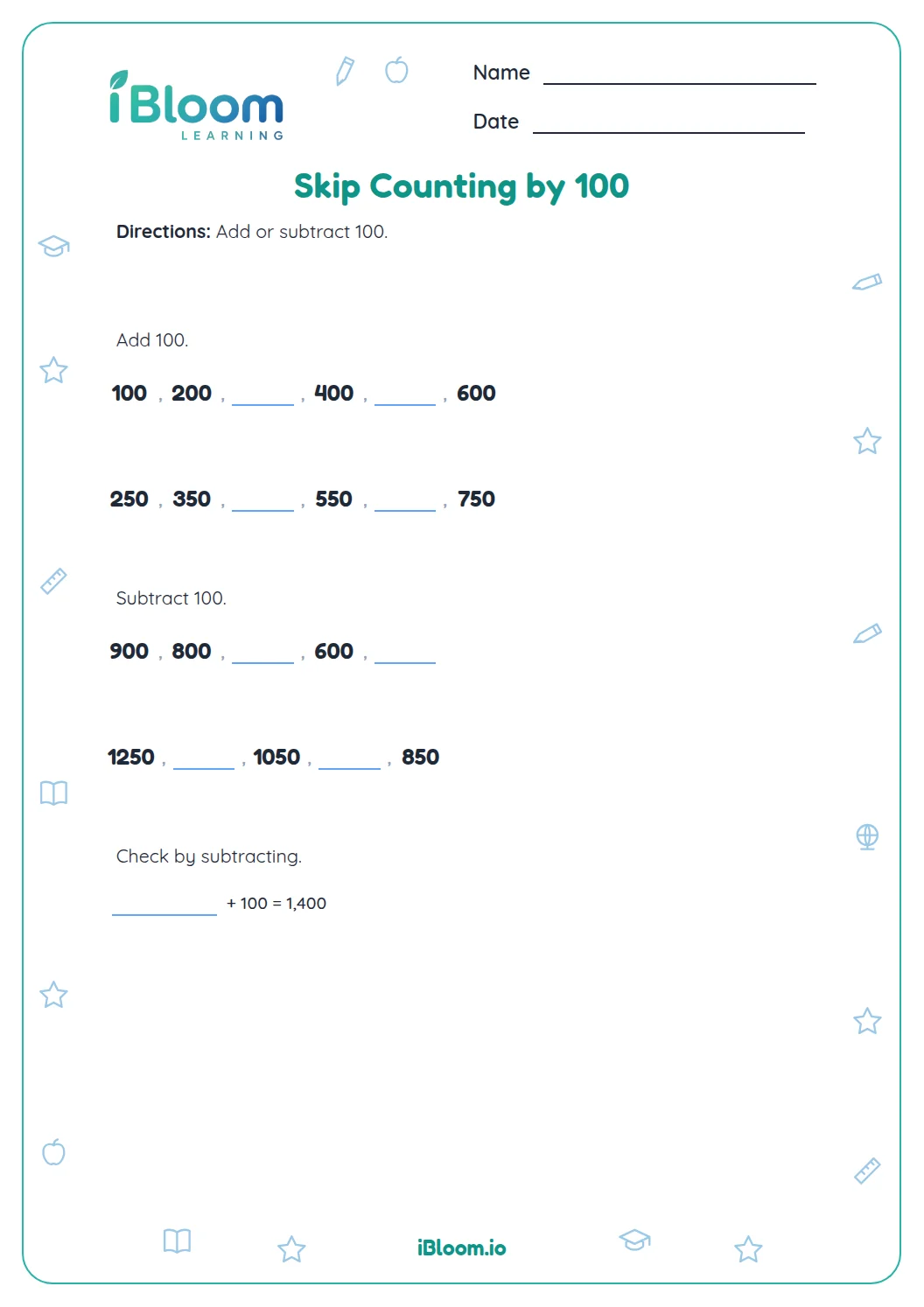
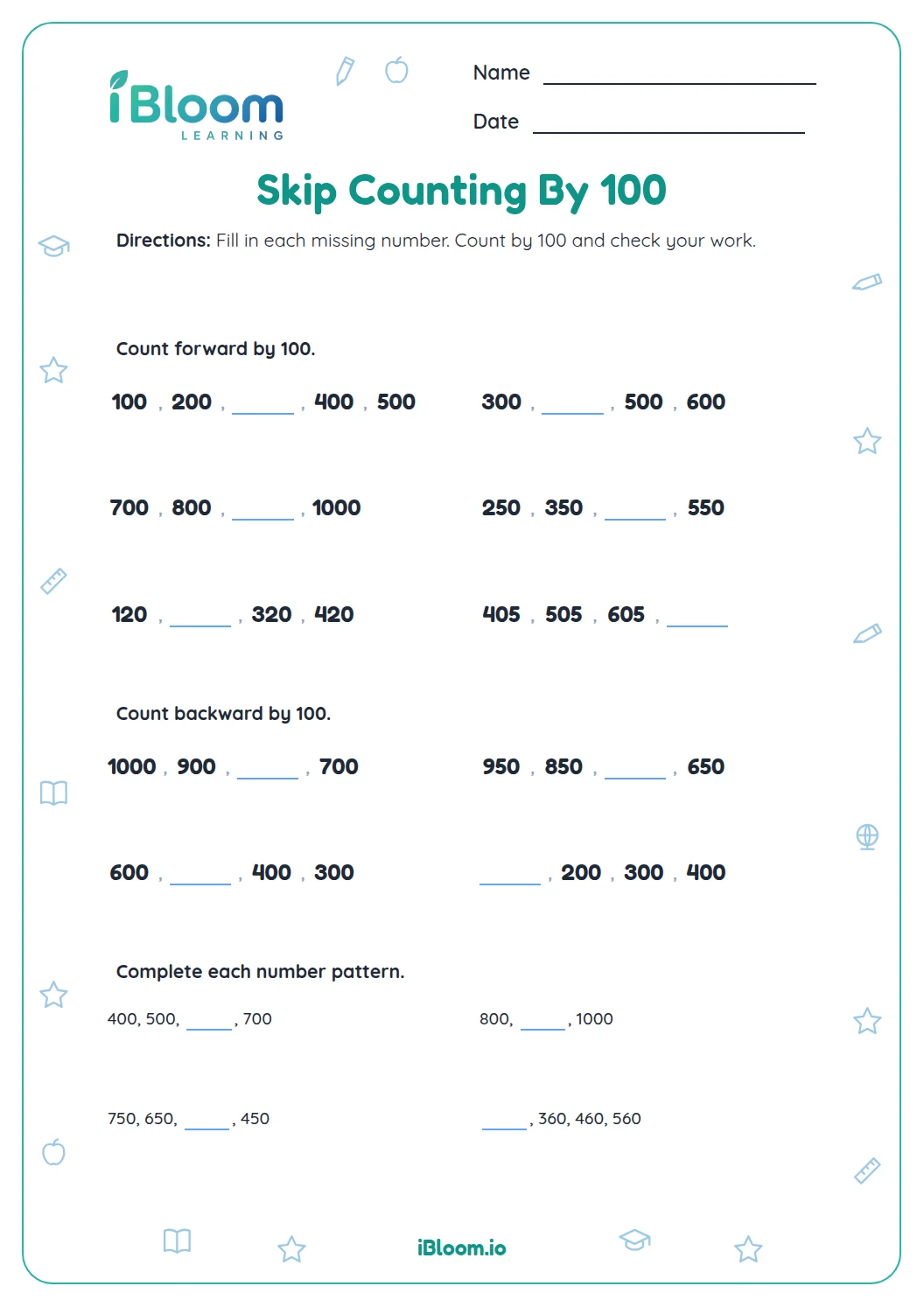
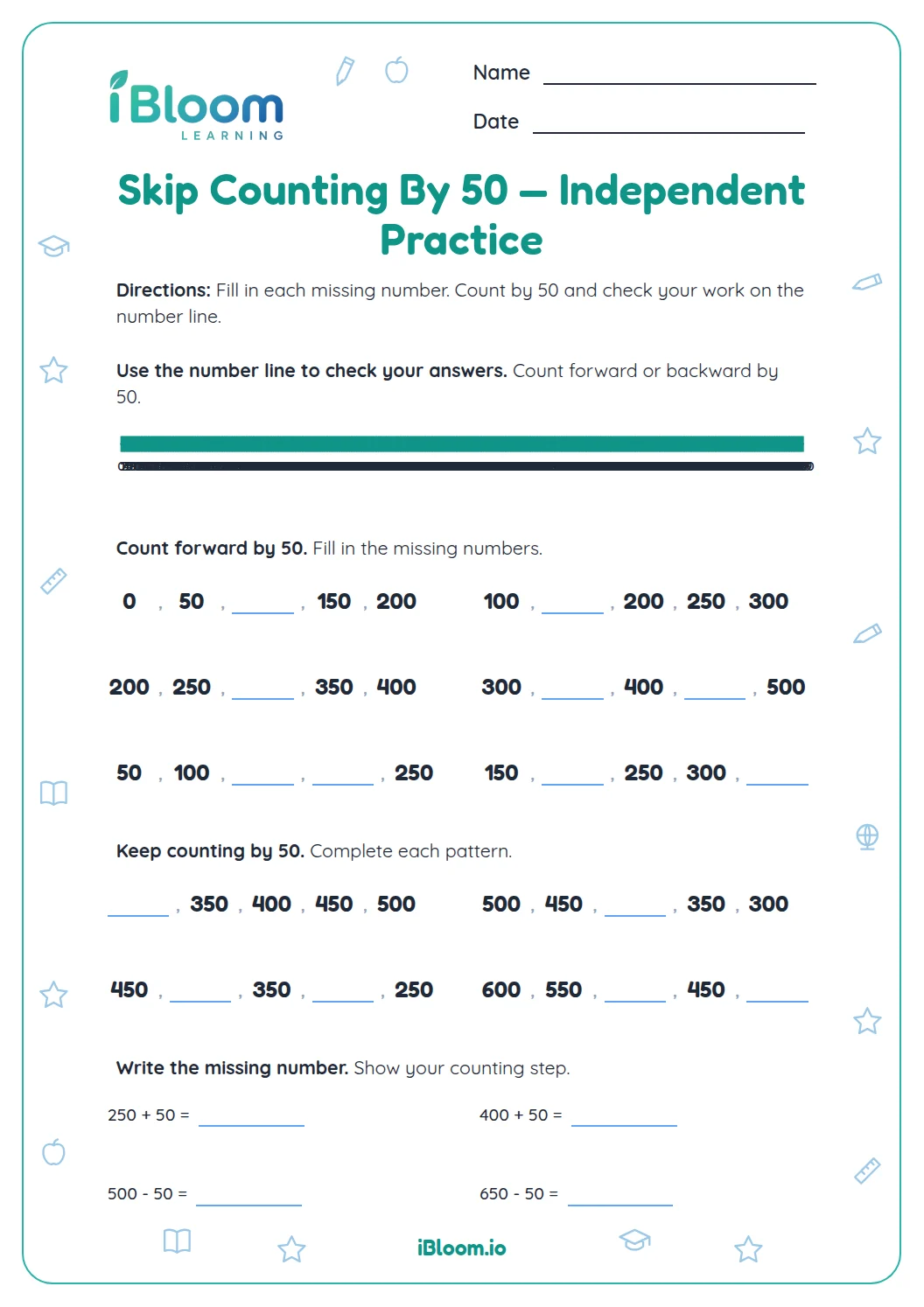
Count forward by adding 100 at each step. In q1, 100, 200, ___ continues to 300. Keep each jump the same size, then check that the sequence stays within 1,000.
- 1100, 200, ___
- 2Add one hundred: 200 + 100 = 300
- 3Next total: 300
How does the same pattern work in a story?
For an amount altogether, count forward by hundreds or combine the hundreds. For an amount left, count backward by hundreds. The story tells whether the total grows or shrinks.
How can students check their totals?
Use a quick sequence of hundreds and make sure it starts at the amount in the story. Keep the count within 1,000, and include the named unit such as chairs, dollars, or meters.
How to use this worksheet
- 1Find the starting amount in the story.
- 2Decide whether the amount increases or decreases.
- 3Count forward or backward in jumps of 100.
- 4For a next-number question, say the sequence aloud.
- 5Write the final amount and its unit when asked.
- 6Check that the number stays within 1,000.
Common mistakes and quick fixes
The mistake
Changing by 10 instead of 100.
The fix
Say “one hundred more” at every jump and check the hundreds digit.
The mistake
Counting forward when the story says some were removed.
The fix
Removal means count backward or subtract hundreds.
The mistake
Leaving off what is being counted.
The fix
Write the unit named in the problem, such as tickets or meters.
Common Core alignment
Students count by hundreds and use that pattern in short situations.
Count within 1,000 by hundreds in forward sequences and stories.
On this sheet: Count within 1,000 by hundreds in forward sequences and stories.
Show the official wordingHide the official wording
Count within 1000; skip-count by 5s, 10s, and 100s.
What to practice next
Make more practice
Further reading
Questions parents and teachers ask
What does skip-counting by 100 mean?
It means adding 100 at each step when counting forward, or taking away 100 at each step when counting backward. For example, 300, 400, 500 increases by 100 each time. For example, after 100 and 200, the next count is 300.
Why does the worksheet use word problems?
The stories show when a count by hundreds represents real objects or amounts. Students decide whether to count forward for an increasing total or backward for an amount that decreases. Each story uses a change of 100, so the count can be tracked in equal jumps.
Are the answers within 1,000?
Yes. Every sequence and story stays within 1,000, matching the range named in the Grade 2 counting standard. The units are included in the answer key where the question asks for a quantity. The sequences and story answers stay within the Grade 2 counting range.
Should students write equations?
They may write an equation or count aloud by hundreds. The story questions provide work space, and a written equation can help students keep track of whether an amount is added or removed. Writing an equation is optional; counting aloud by hundreds also works.
Is an answer key included?
Yes. The separate key lists all 14 results. For story questions, it includes the unit so students can check both the number and what that number counts. Yes. The separate key lists all 14 totals and amounts remaining.