
About this worksheet
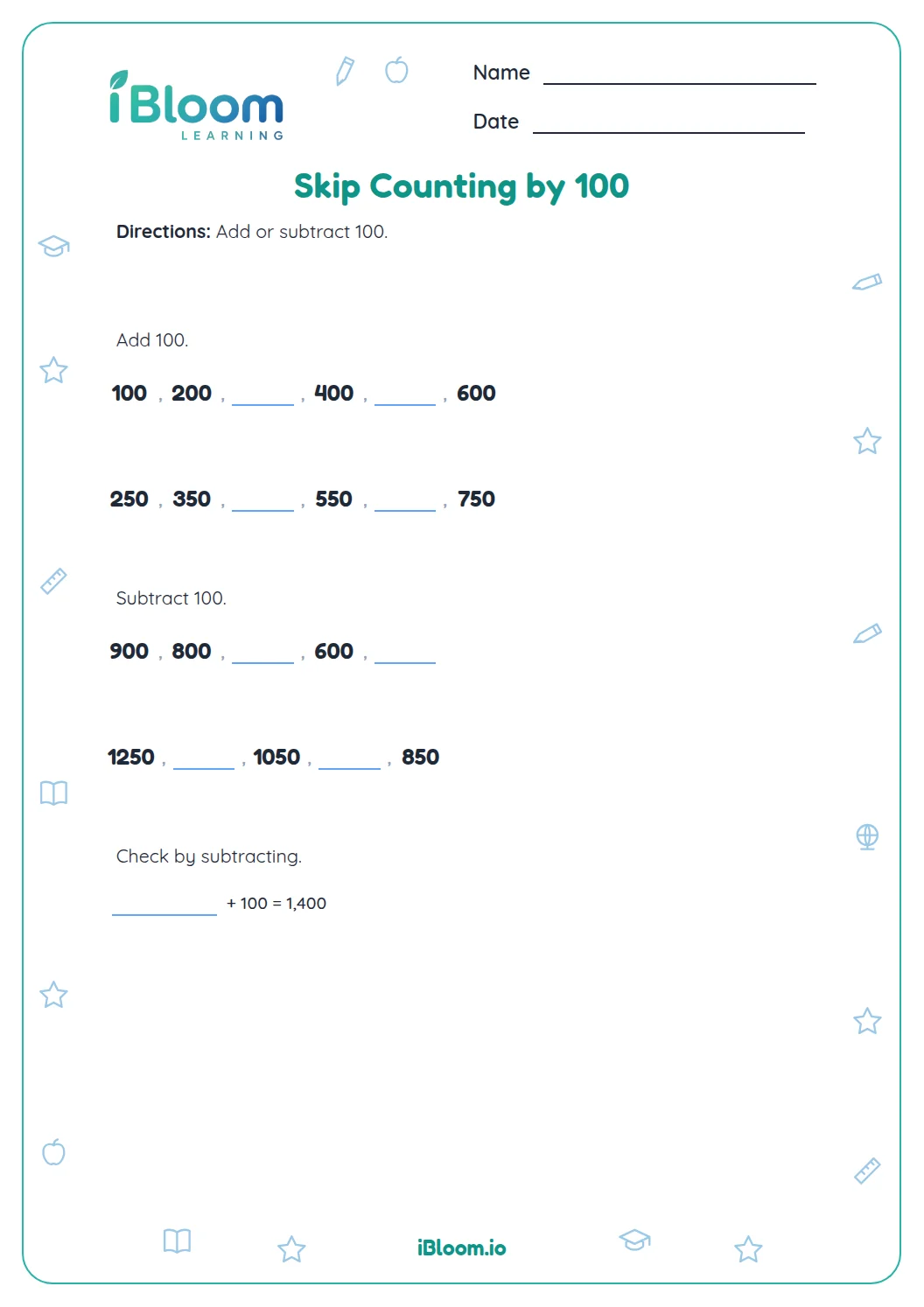
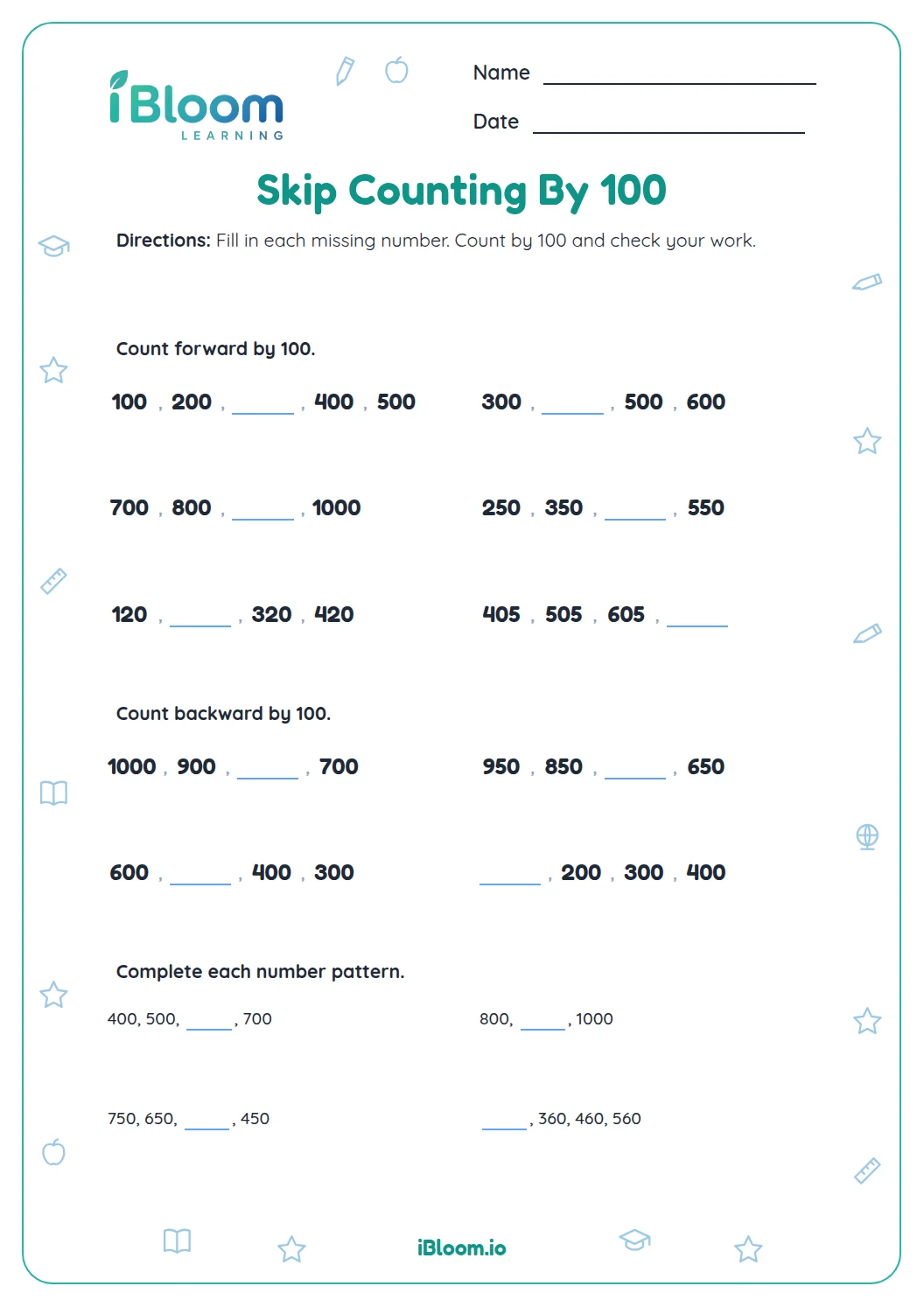
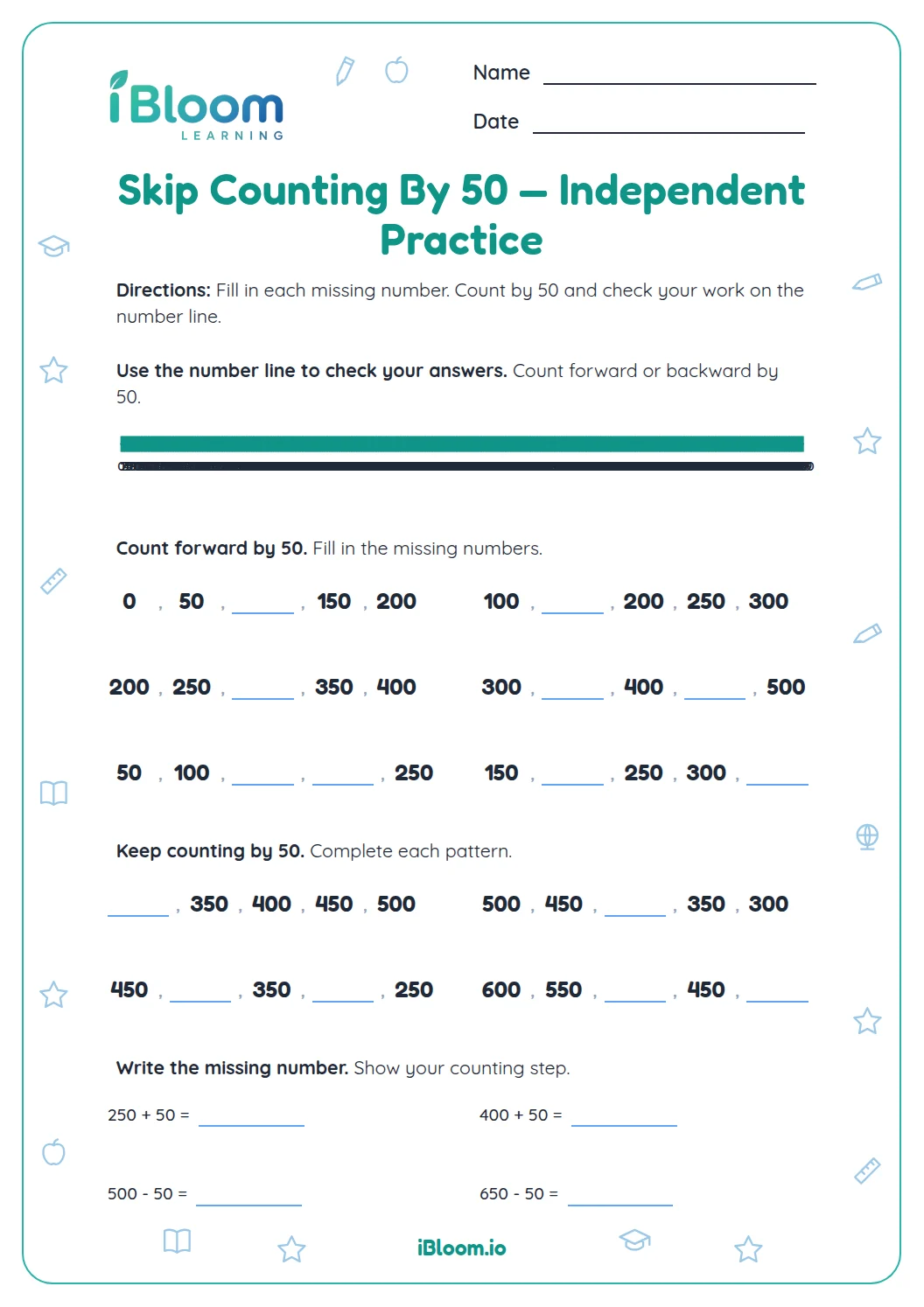
This Grade 2 worksheet has 20 number sequences and missing terms that change by 100. Students count forward and backward, including sequences that start with numbers such as 350 or 820. The three parts move from completing a pattern to identifying its change and using the same rule with new numbers. Each answer can be checked by adding or subtracting 100.
Aligned to 2.NBT.A.2
How can you spot a pattern of 100?
In a sequence that moves forward by 100, each term is 100 greater than the one before it. For example, 350, 450, ___, 650 has 550 in the blank. Moving backward means subtracting 100 at each step.
The worksheet includes starting numbers with different tens and ones digits. Look at the difference between neighboring terms rather than assuming every number ends in zero.
- Part A: complete forward and backward sequences
- Part B: identify the amount of change
- Part C: fill missing terms in new sequences
How to use this worksheet
- 1Compare two neighboring numbers to identify the direction.
- 2Add 100 or subtract 100 to find the next term.
- 3Check the blank by comparing it with the term on its other side.
- 4Use the answer key after trying all three parts.
Common mistakes and quick fixes
The mistake
Changing the tens digit by 1 instead of the hundreds value.
The fix
Add or subtract 100, then read the whole number.
The mistake
Continuing forward when the sequence is counting backward.
The fix
Compare the first two terms to find the direction.
The mistake
Assuming a sequence must start or end in zero.
The fix
Apply the same change even when the tens or ones digit is nonzero.
Common Core alignment
This worksheet practices the grade-level skill named below.
Count within 1,000 by hundreds.
On this sheet: The questions give students practice applying this standard.
Show the official wordingHide the official wording
Count within 1,000; skip-count by 5s, 10s, and 100s.
What to practice next
Make more practice
Further reading
Questions parents and teachers ask
How many questions are included?
The worksheet contains 20 questions in three parts. Students complete sequences, identify whether numbers increase or decrease by 100, and find missing terms. The answer key is provided separately so learners can try the sequences first. Read each prompt carefully, write one response in every blank, and use the included key after attempting the problem independently.
Do all sequences start at a multiple of 100?
No. Some start with numbers such as 350, 820, or 399. Students still add or subtract 100 each time, keeping the tens and ones digits consistent as the hundreds value changes. Read each prompt carefully, write one response in every blank, and use the included key after attempting the problem independently.
How can a student check a missing term?
Use the term before the blank to calculate the next number, then use the term after the blank to check the same change. For a backward pattern, subtract 100; for a forward pattern, add 100. Read each prompt carefully, write one response in every blank, and use the included key after attempting the problem independently.
Does the worksheet include counting backward?
Yes. Several sequences decrease by 100, so students practice recognizing the direction and finding a missing term in a backward pattern. Reading two given terms before answering helps identify whether to add or subtract. Read each prompt carefully, write one response in every blank, and use the included key after attempting the problem independently.
What should I do if a student misses a sequence?
Ask the student to state the change between two neighboring terms and write an addition or subtraction sentence. Then return to the blank and apply that same operation. This makes the rule visible and helps catch a direction error. Read each prompt carefully, write one response in every blank, and use the included key after attempting the problem independently.