



About this worksheet
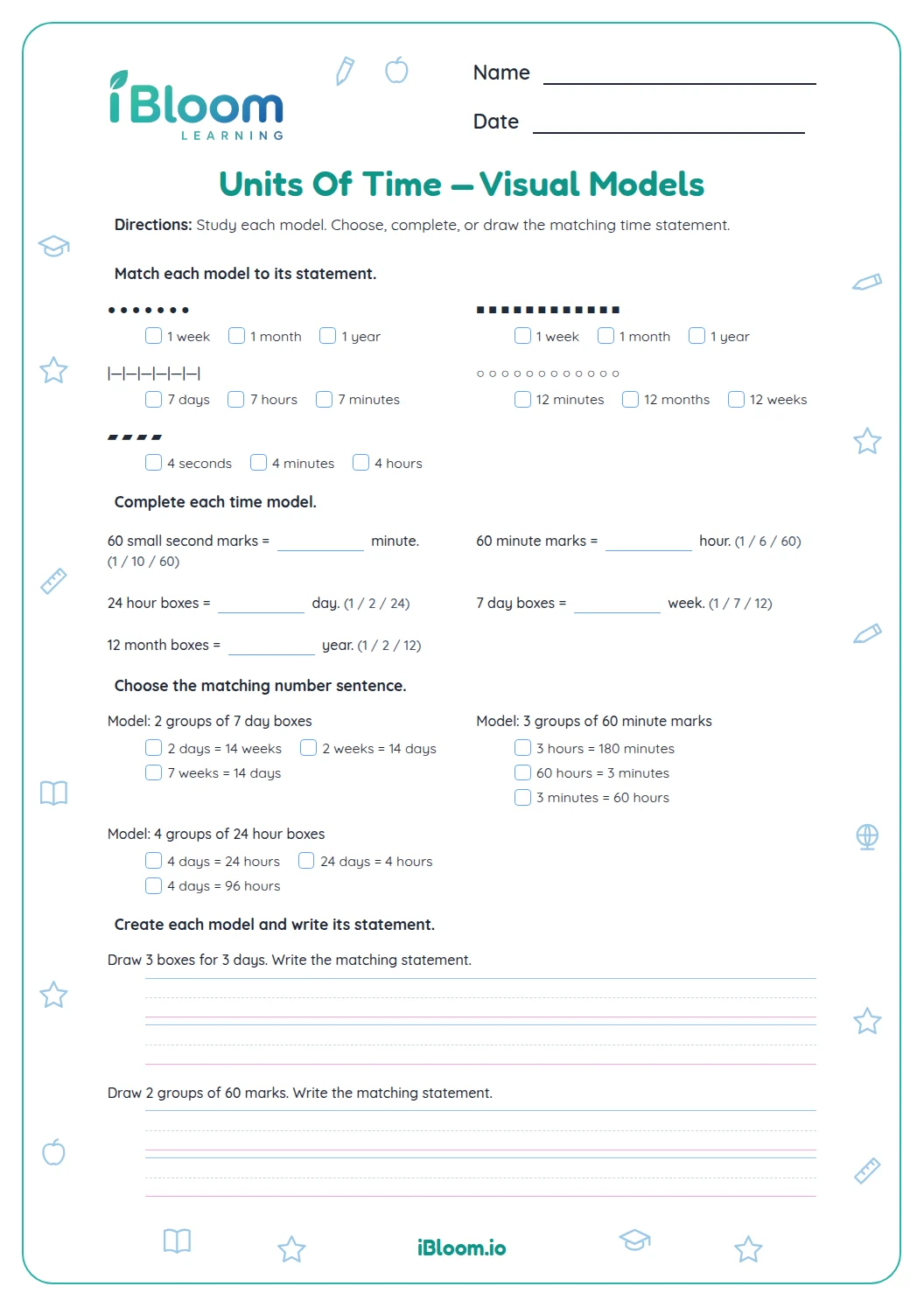
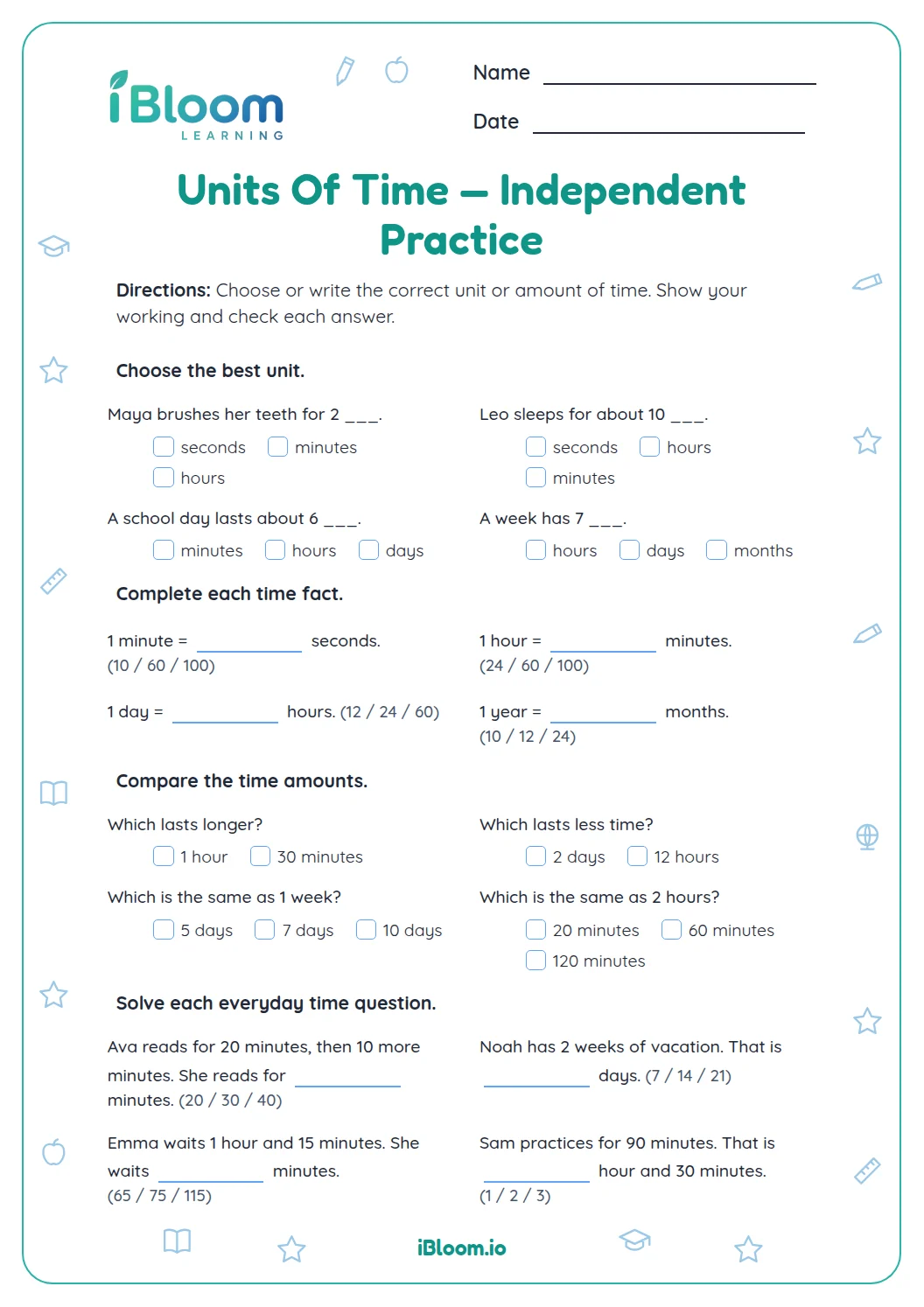
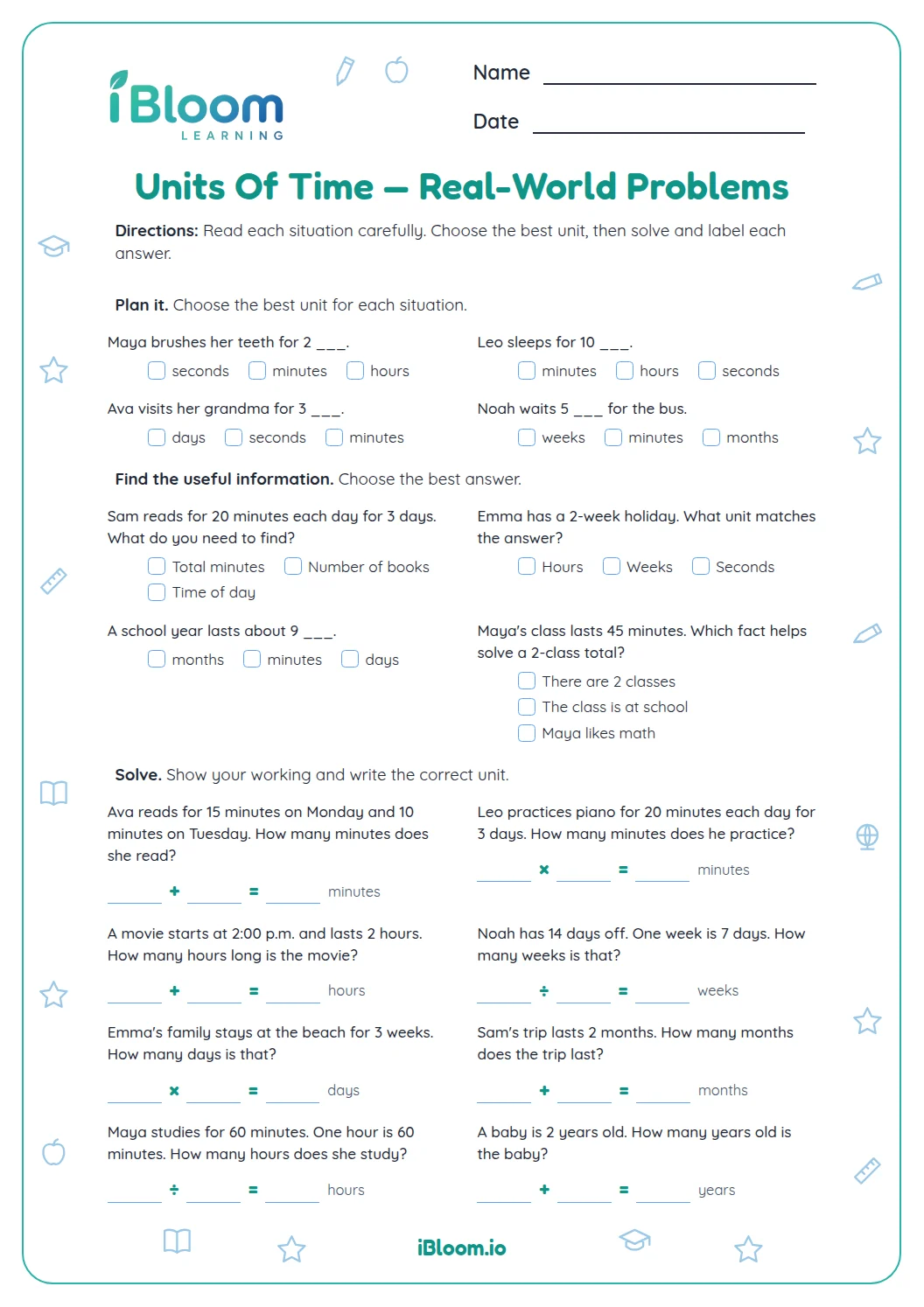
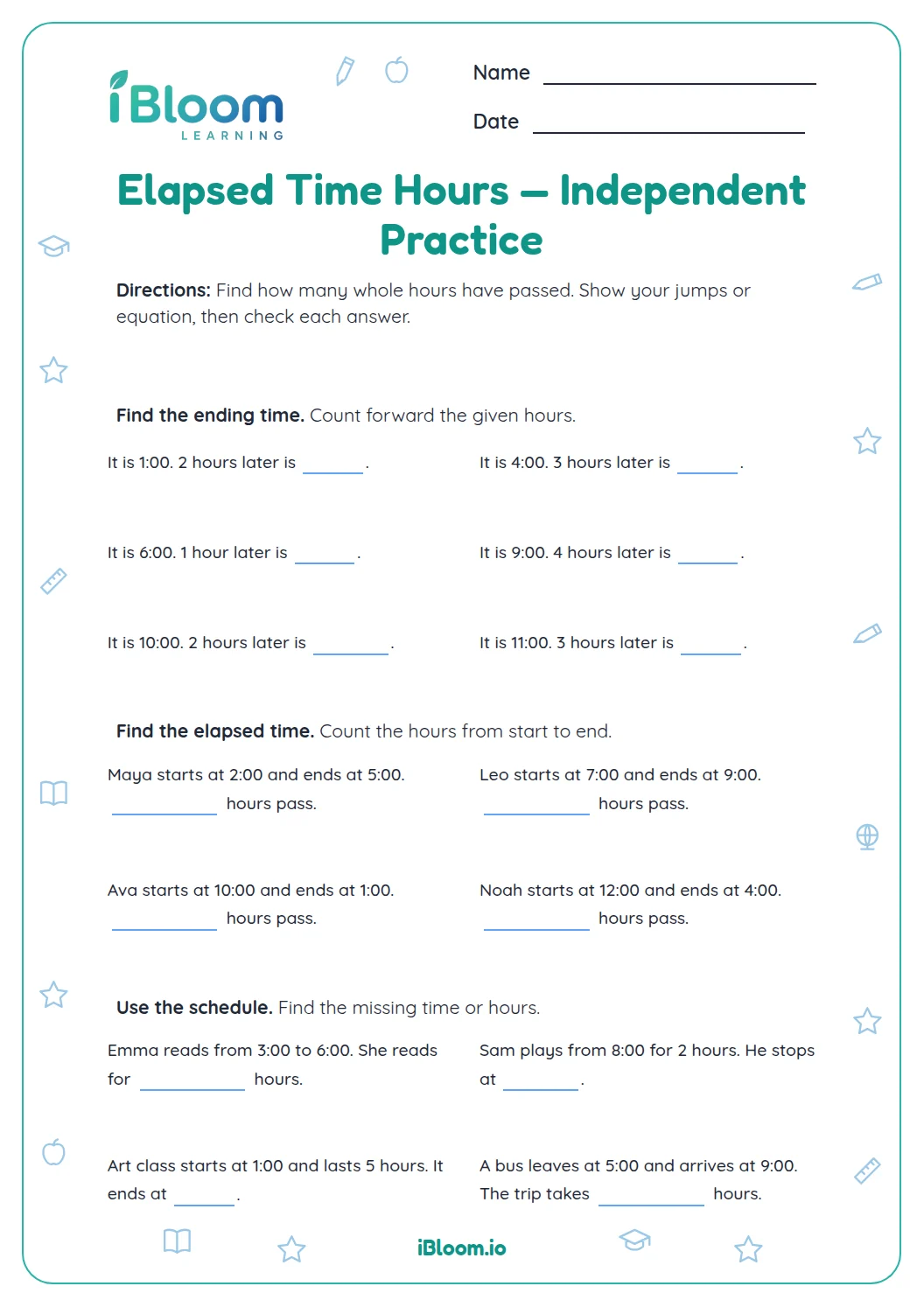
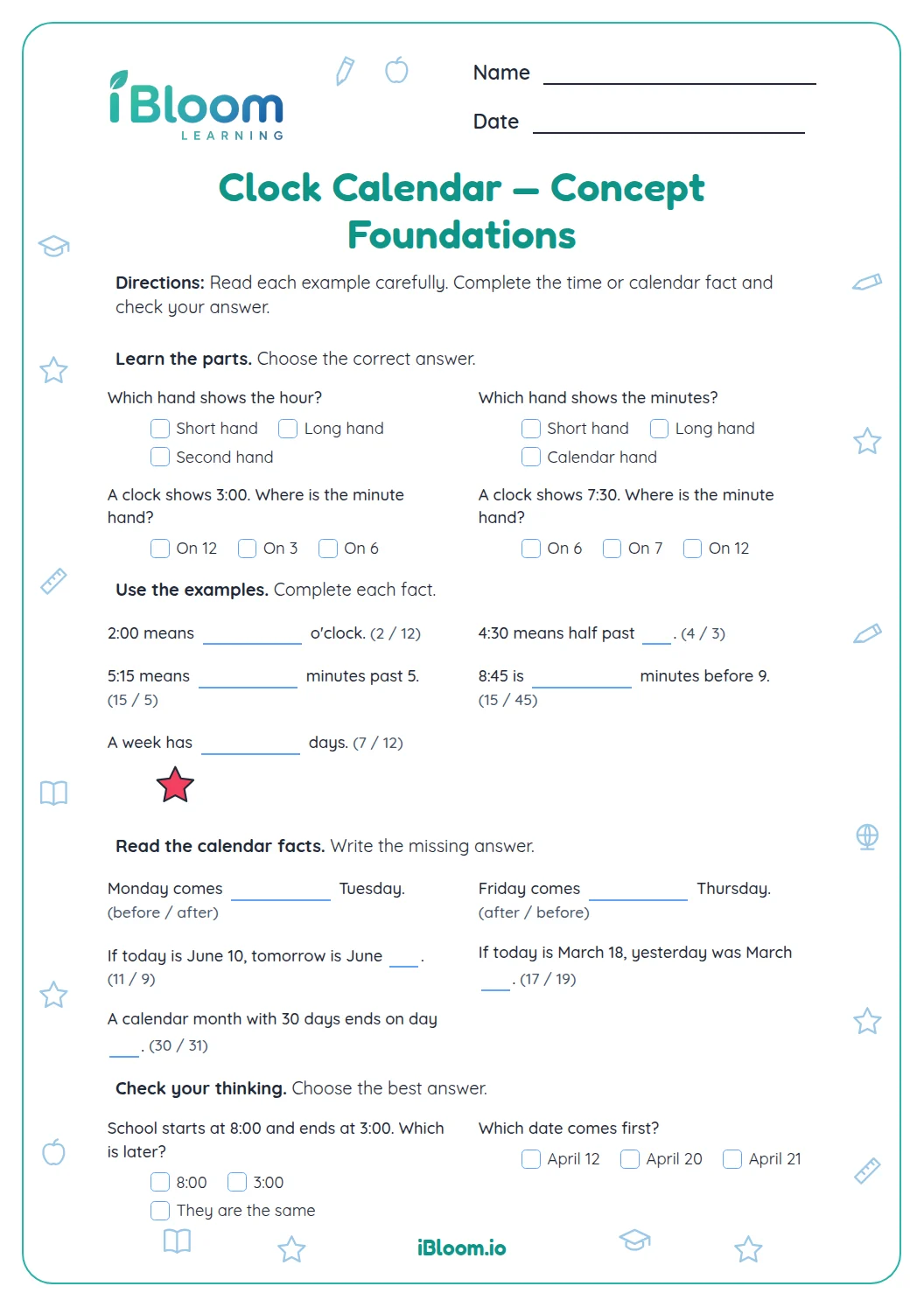
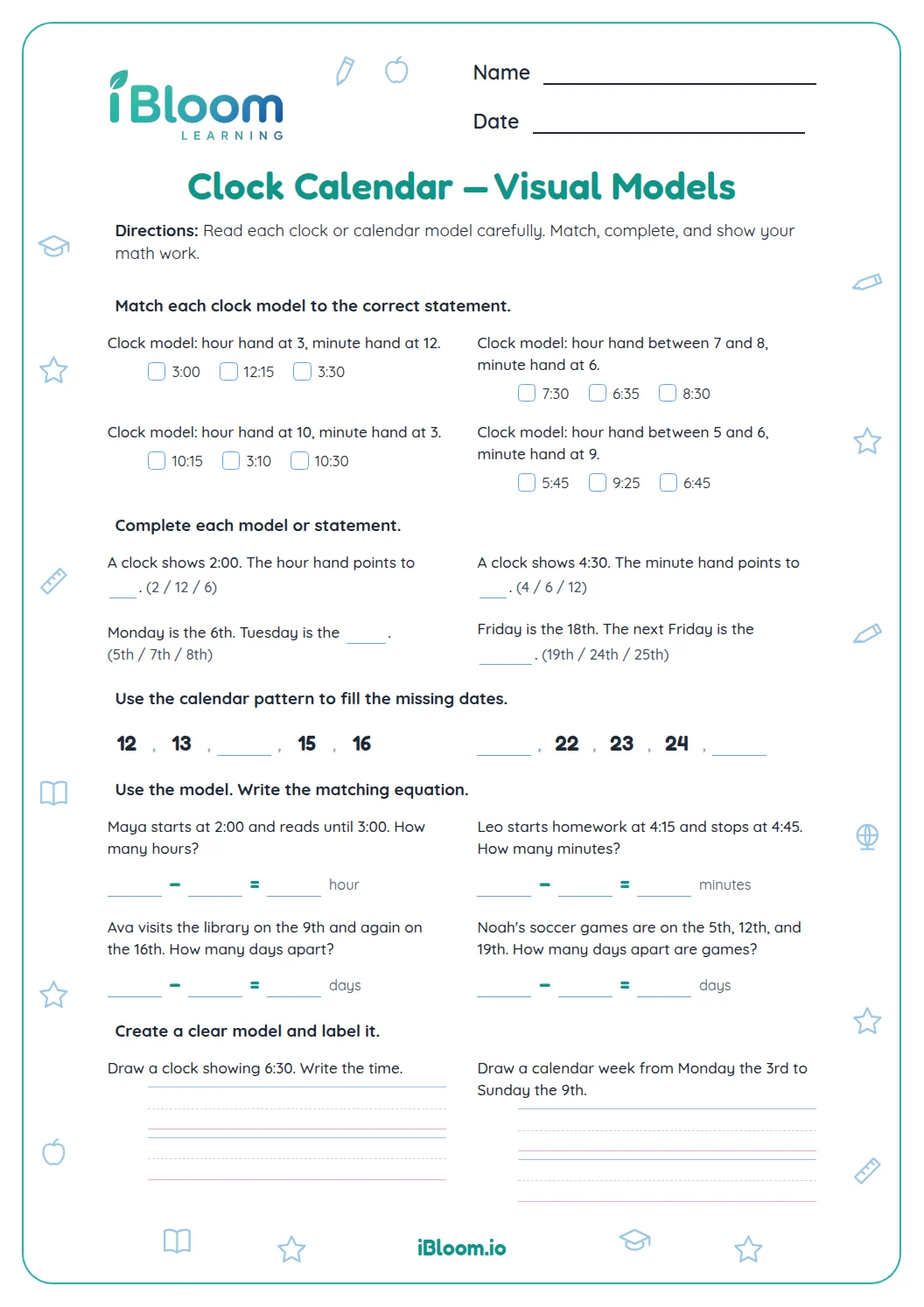
This free Grade 2 worksheet combines familiar time units with analog clock reading. Children choose sensible units, read five clock faces to the nearest five minutes, and use relationships among minutes, hours, days, and weeks. A separate answer key lists each response. The clock-reading questions practice CCSS 2.MD.C.7.
Aligned to 2.MD.C.7
How can a child choose a useful time unit?
Think about how long the event lasts. A blink takes seconds, while a school day is measured in hours. Minutes fit shorter everyday activities, and days or weeks describe longer spans.
The opening questions ask children to compare units and recall familiar relationships before reading clocks.
How do you read an analog clock to five minutes?
The short hand points near the hour, and the long hand shows the minutes. Each number on the clock stands for five minutes when the long hand is counting around the face. At 4:30, the minute hand points to 6 and the hour hand is between 4 and 5.
- 1The long hand points to 6: 6 × 5 = 30 minutes.
- 2The short hand is between 4 and 5, so the hour is 4.
- 3The clock shows 4:30.
Which time relationships help with conversions?
One hour equals 60 minutes, one day equals 24 hours, and one week equals 7 days. Use those facts to multiply when changing larger units into smaller units. For a time such as 90 minutes, first make one full hour, then name the remaining 30 minutes.
How to use this worksheet
- 1Read the event and choose a unit that fits its length.
- 2For each clock, find the long hand first.
- 3Count five minutes for each number the minute hand passes.
- 4Use the short hand to identify the hour.
- 5Recall the conversion fact before multiplying or splitting time.
- 6Write the unit with each conversion answer.
Common mistakes and quick fixes
The mistake
Reading the short hand as the minutes.
The fix
The long hand gives minutes; the short hand gives the hour.
The mistake
Calling 90 minutes one hour.
The fix
Trade 60 minutes for one hour, then count the remaining 30.
The mistake
Using 12 hours for a full day.
The fix
Remember a full day has 24 hours, including day and night.
Common Core alignment
Read and write times to the nearest five minutes.
On this sheet: Five analog-clock questions ask students to read times to the nearest five minutes.
Show the official wordingHide the official wording
Tell and write time from analog and digital clocks to the nearest five minutes, using a.m. and p.m.
What to practice next
Make more practice
Further reading
Questions parents and teachers ask
How many minutes are in an hour?
There are 60 minutes in one hour. The conversion questions use this fact to change hours into minutes or split a number of minutes into hours and leftover minutes. For example, 90 minutes is 1 hour and 30 minutes, because 60 + 30 = 90.
How many questions are on the sheet?
There are 16 questions across three parts. Children answer five unit and time-fact choices, read five analog clocks, and complete six statements about time relationships. The separate answer key lists all 16 responses for checking after the sheet is complete.
How should a child read the clock faces?
Start with the long minute hand and count five minutes for each number it points to. Then use the short hand to name the hour it has passed. Write the time with a colon, such as 4:30. All five clock drawings use five-minute intervals.
Why does the sheet include minutes and days together?
Both are common ways to describe time, but they fit different spans. The questions practice choosing a unit and using straightforward relationships: 60 minutes per hour, 24 hours per day, and 7 days per week. Each fact helps solve a conversion on the worksheet.
Does the answer key show the clock answers?
Yes. It lists the digital time for each of the five analog clock drawings as well as the unit choices and completed time statements. Have the child point to the minute hand if a clock answer needs review, then recount by fives together.