
About this worksheet
This free two-page worksheet gives Grade 3 students fourteen problems about right angles in everyday objects and turns. Part A uses angle and rectangle models for a tile corner, sign corner, ramp, and window. Part B asks students to count corners, find unknown groups, and calculate total turns in degrees. Part C checks a rotated square frame and two right-angle turns. Identifying right angles practices Common Core 4.G.A.1. A separate key gives the choices, numerical answers, and sample explanations.
Aligned to 4.G.A.1
What does a right angle look like?
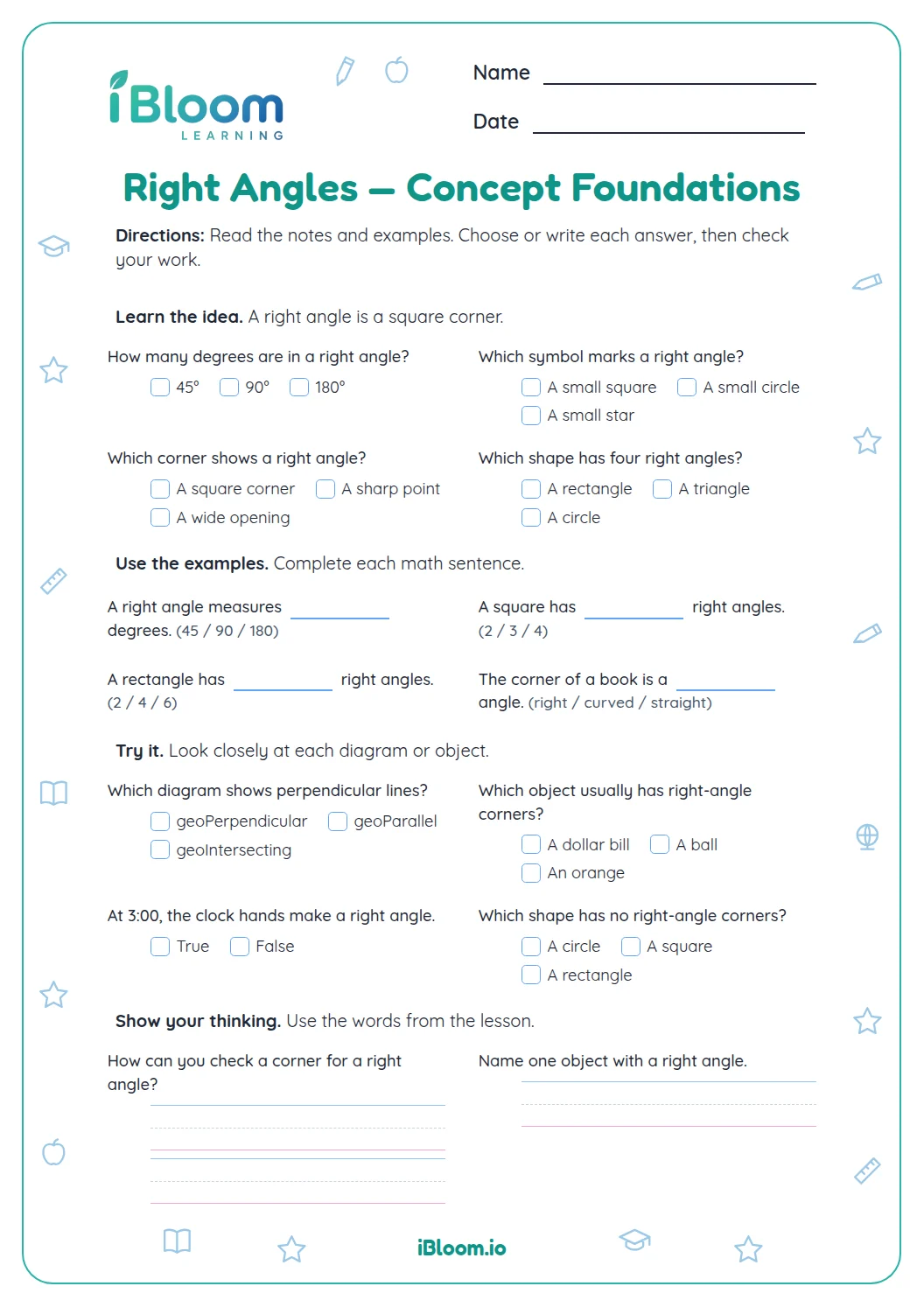
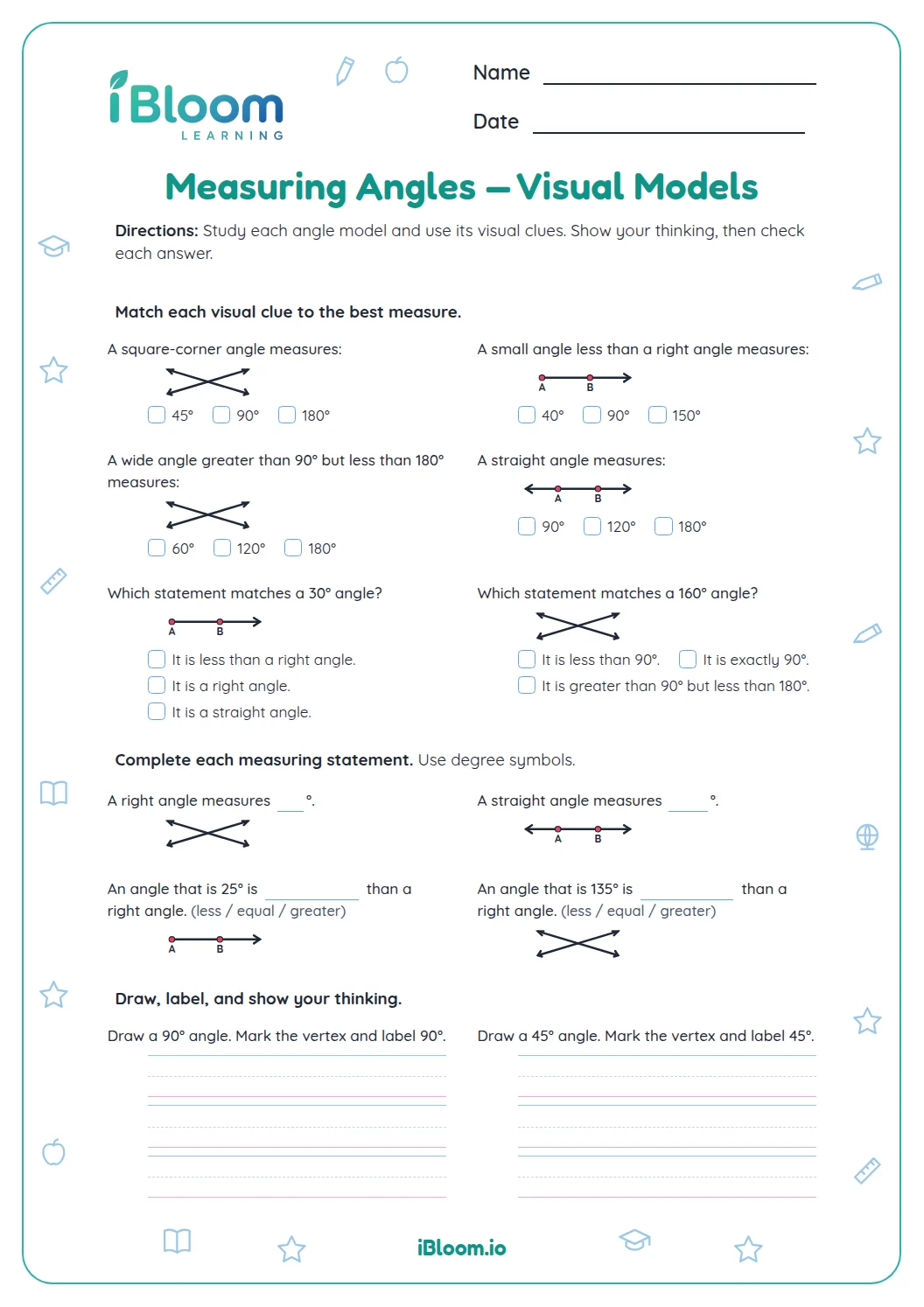
A right angle is a square corner measuring 90 degrees. Its two sides meet with the same opening as the corner of a rectangular sheet of paper. The small square mark in the first angle drawing shows that opening.
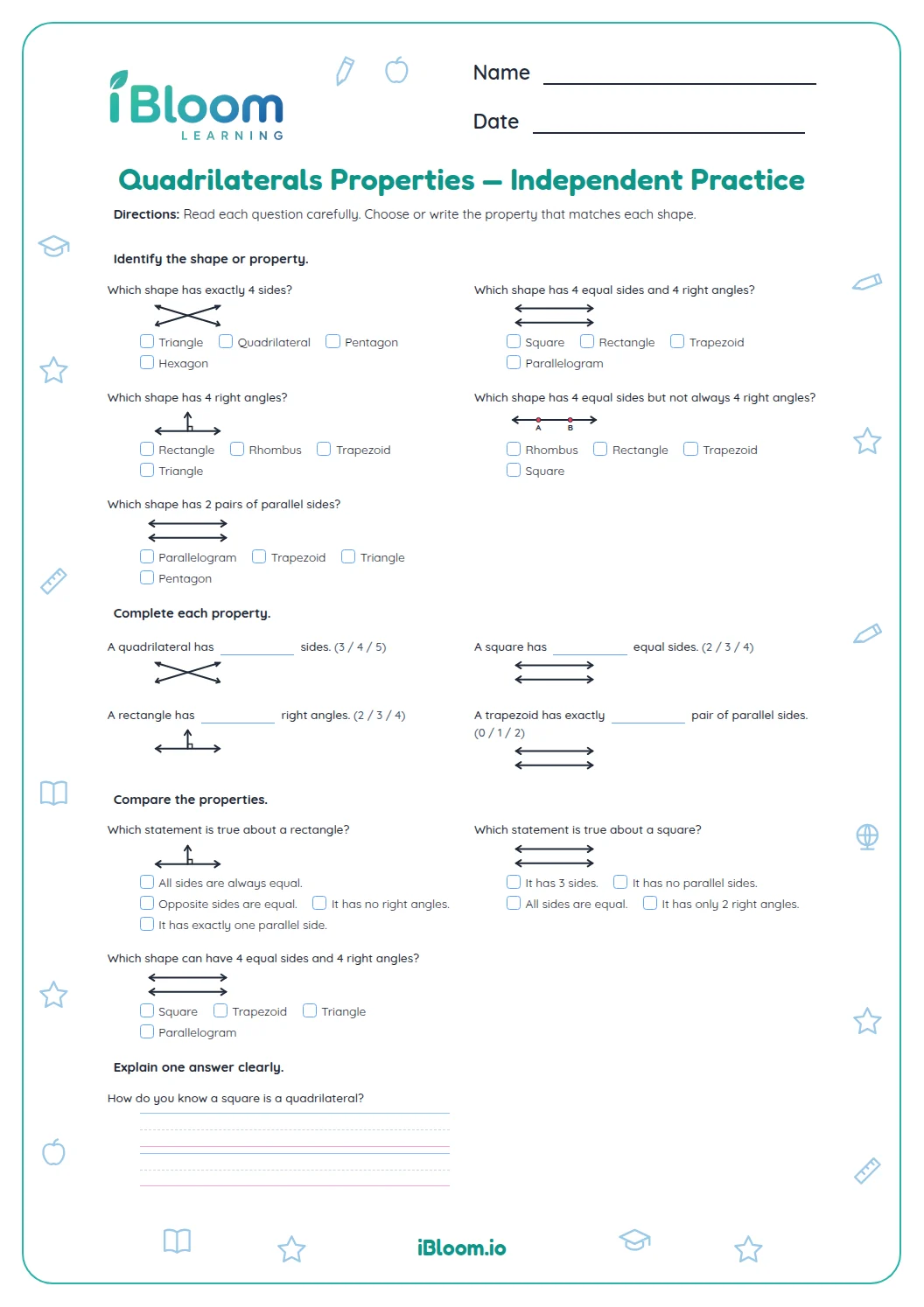
In Part A, drawings stand for familiar objects. Children compare the corner of a square floor tile with a sign corner and a ramp angle, then count the square corners of a rectangular window model.
How do children solve the corner and turn problems?
Count the right angles in one object before counting the whole group. In question 5, each rectangular photo has four right-angle corners. Two separate photos therefore have eight.
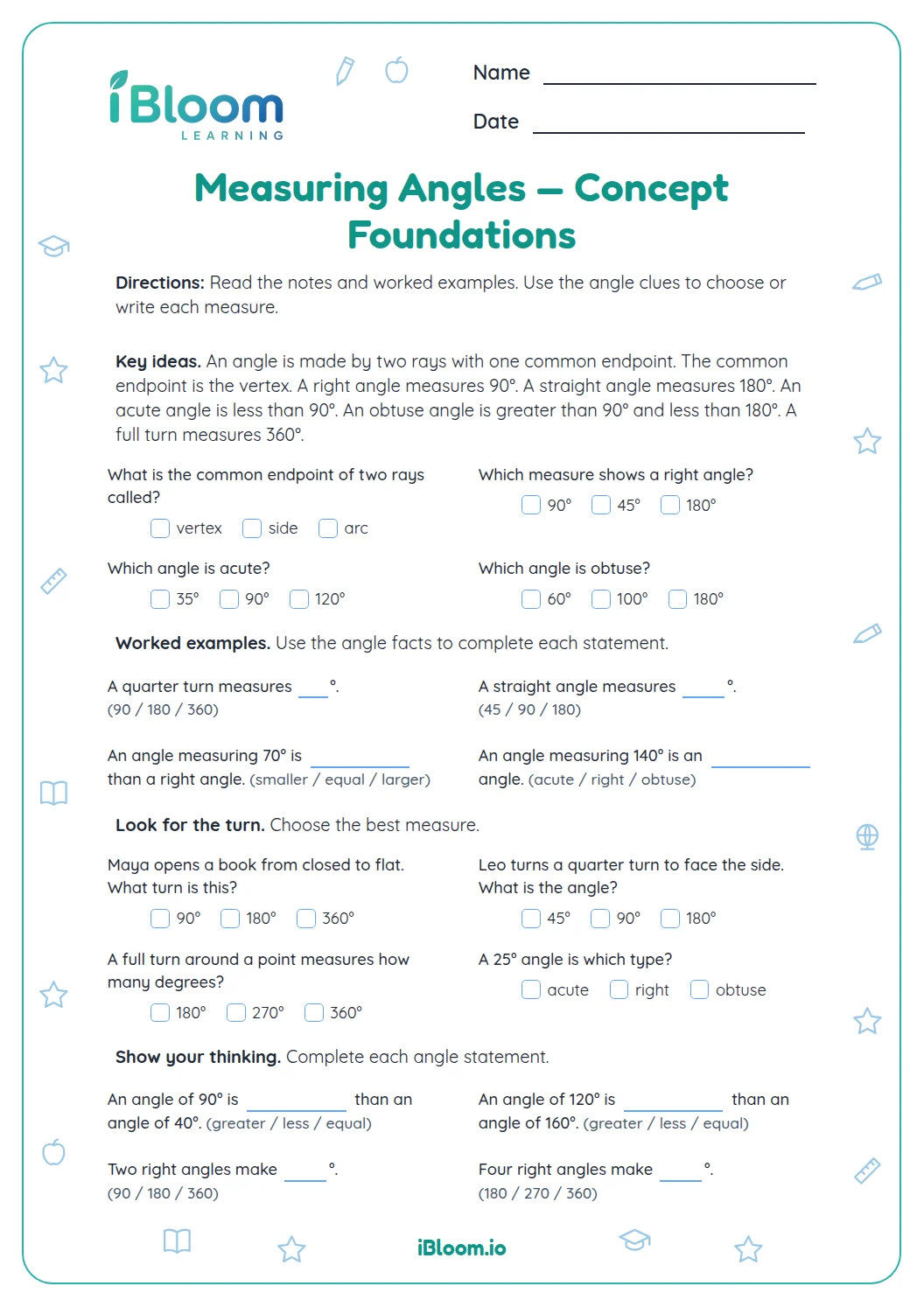
For an unknown number of objects, divide the total corners by four. For robot turns, use 90 degrees for each right-angle turn. Three clockwise turns total 270 degrees; five total 450 degrees because the robot turns more than one full revolution.
- 1One rectangular photo has 4 right angles.
- 2There are 2 separate photos.
- 34 + 4 = 8 right-angle corners.
Why do the last two questions ask for reasons?
A tilted frame can make a familiar square look different. Question 13 asks students to explain why turning it does not change its four right angles: the whole frame moves, but the openings at its corners stay the same.
Question 14 checks whether two clockwise right-angle turns total 180 degrees. A useful explanation names the 90-degree turn size and combines two of those turns: 90 + 90 = 180.
How to work through the sheet
- 1Match a paper corner to the first right-angle drawing.
- 2For each Part A model, compare the opening with the paper corner before choosing.
- 3Find four corners on a real rectangular page before starting Part B.
- 4In Part B, use four corners per rectangle or square and 90 degrees per right-angle turn.
- 5Read the Part C reasons aloud and check that they describe corners or angle openings.
Mistakes to discuss and fix
The mistake
Calling an angle right because one side points to the right.
The fix
Compare the size of its opening with a square corner instead of its direction.
The mistake
Counting sides instead of right-angle corners.
The fix
Point to where two straight sides meet, then decide whether that opening is square.
The mistake
Thinking a turned square has lost its right angles.
The fix
Rotate a paper square and match the same paper corner to it again.
Common Core alignment
Identify right angles in shapes that model everyday objects.
On this sheet: Students recognize square corners, compare angle openings, and explain right angles in familiar shapes.
Show the official wordingHide the official wording
Draw points, lines, line segments, rays, angles (right, acute, obtuse), and perpendicular and parallel lines. Identify these in two-dimensional figures.
What to practice next
Make more practice
Further reading
Questions parents and teachers ask
Does my child need a protractor for this sheet?
No. A square corner from a piece of paper is enough to compare the drawings in Part A. The first model also includes the small square mark used to identify a right angle. Children can then use square-corner reasoning to count the corners in the object problems.
Are the pictures drawings of actual household objects?
The drawings are simple geometry models of the named objects. For example, a rectangle represents the outline of a window, and an angle represents the opening of a ramp. This keeps attention on the corners. Children can compare those models with similar objects at home after completing the sheet.
Why does Part B say the objects are separate?
Part B tells students to count each object separately. Two rectangular photos have eight right-angle corners altogether. If objects overlapped or joined into one outline, counting could mean something different. Here each object keeps its own set of corners, making the intended total clear.
Does turning a square change its right angles?
No. Turning the whole square changes where its sides point, but the corner openings remain the same. Question 13 asks students to explain this for a square frame. They can test the idea by rotating a paper square and matching its corners with the corner of another sheet.
Can a robot’s total turn be more than 360 degrees?
Yes. Question 12 adds five clockwise right-angle turns, so the total is 5 × 90 = 450 degrees. That is one full turn plus another right-angle turn. Count all the turning the robot does, including the full revolution, when finding the total angle turned.