



About this worksheet
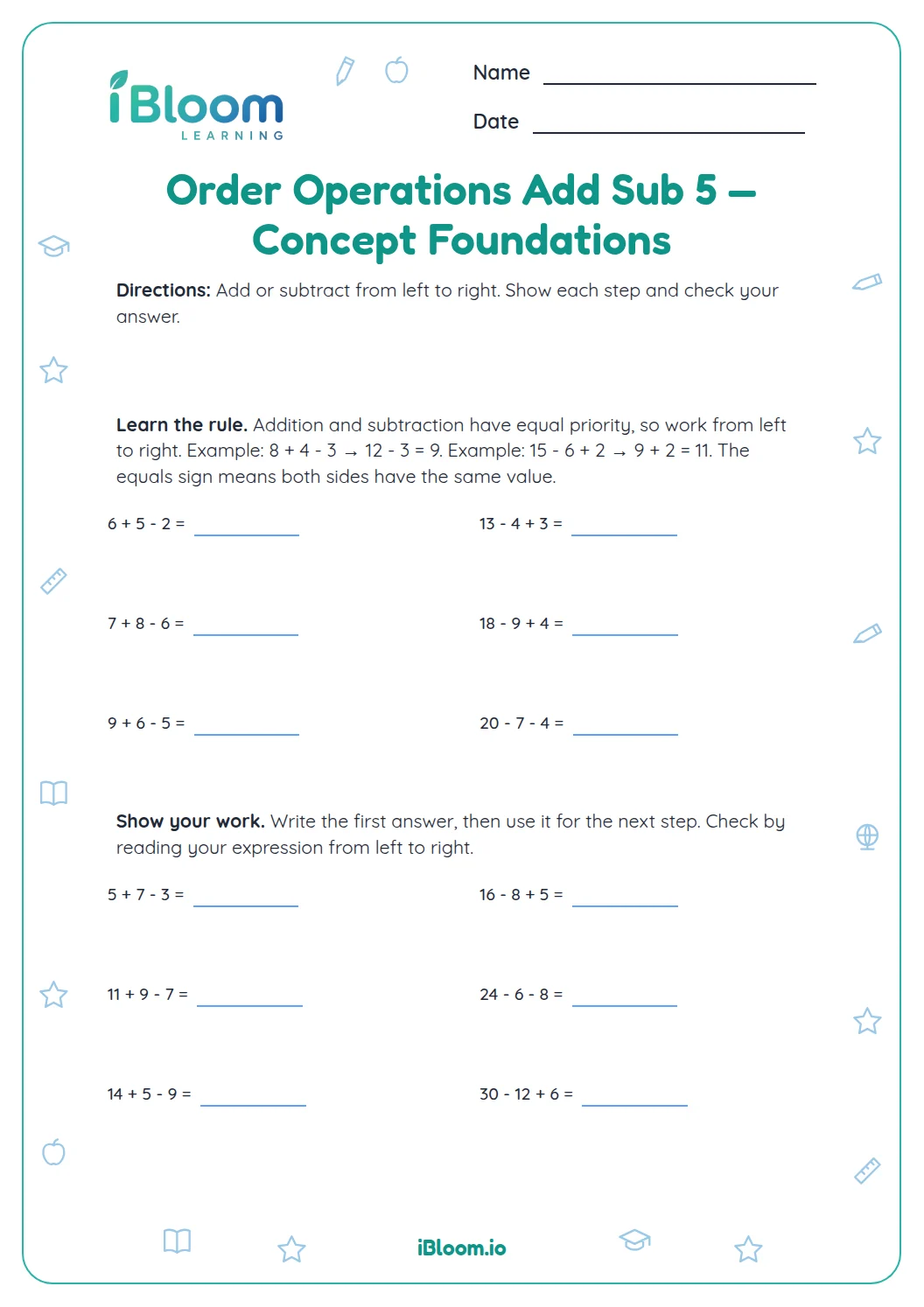
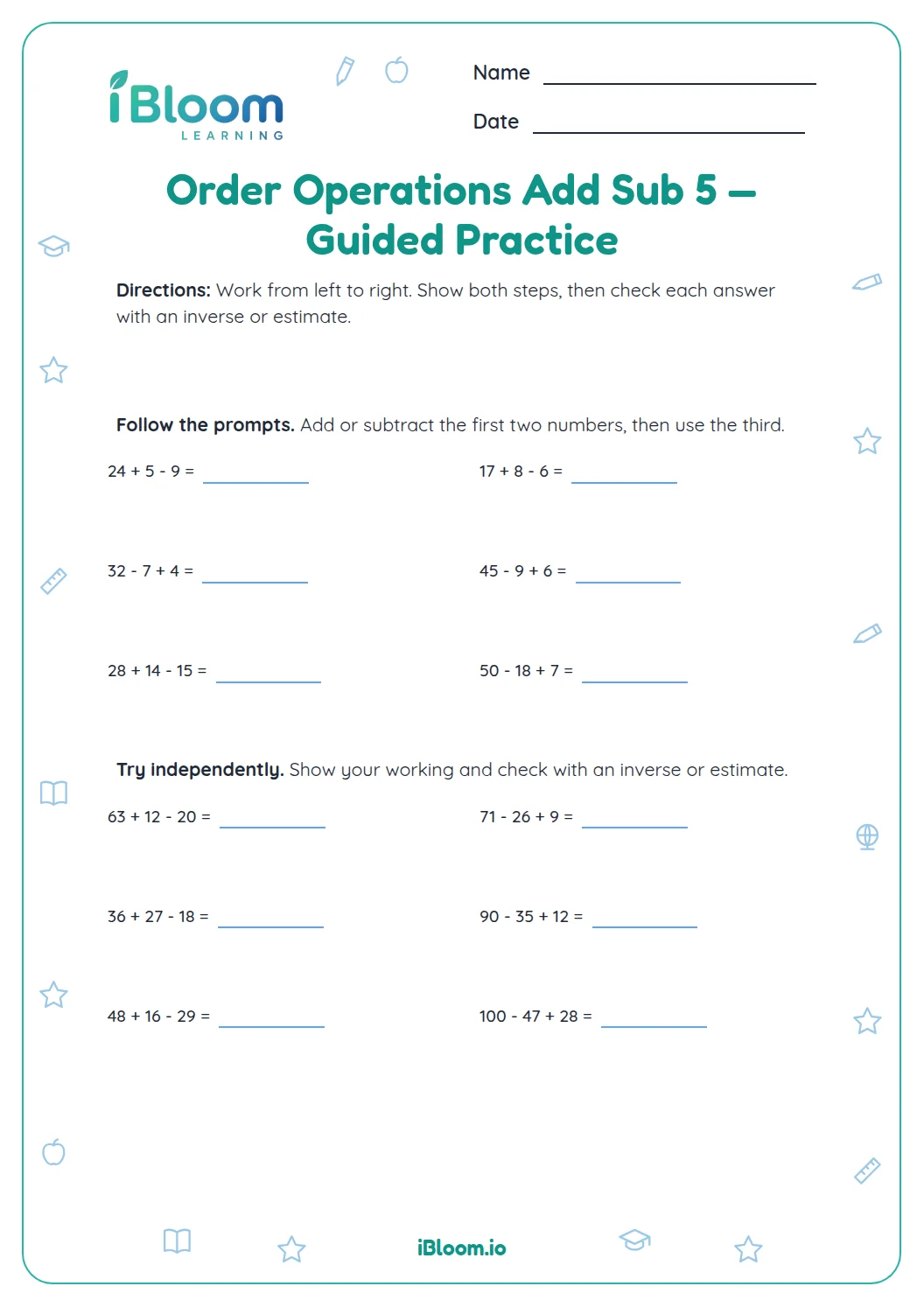
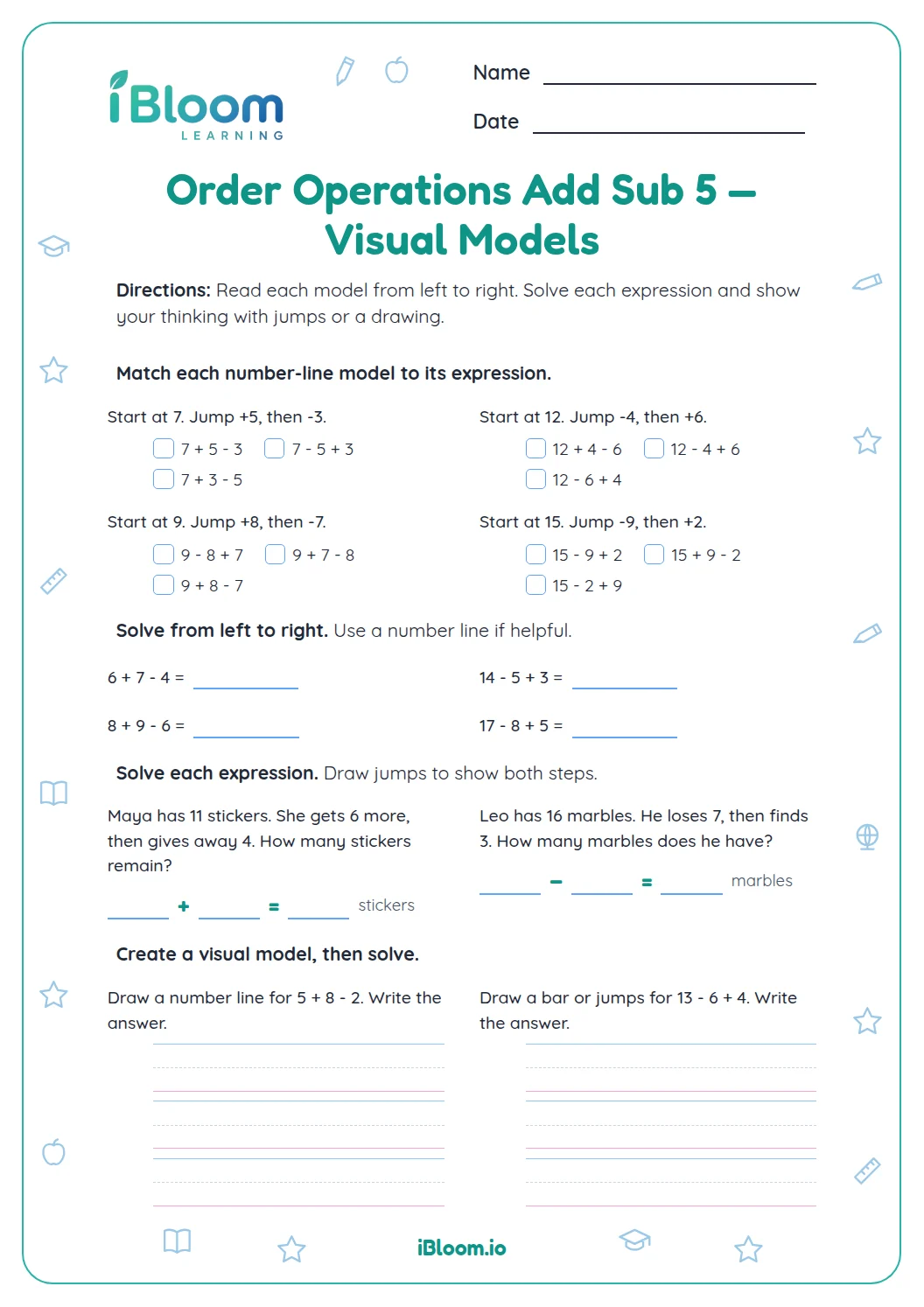
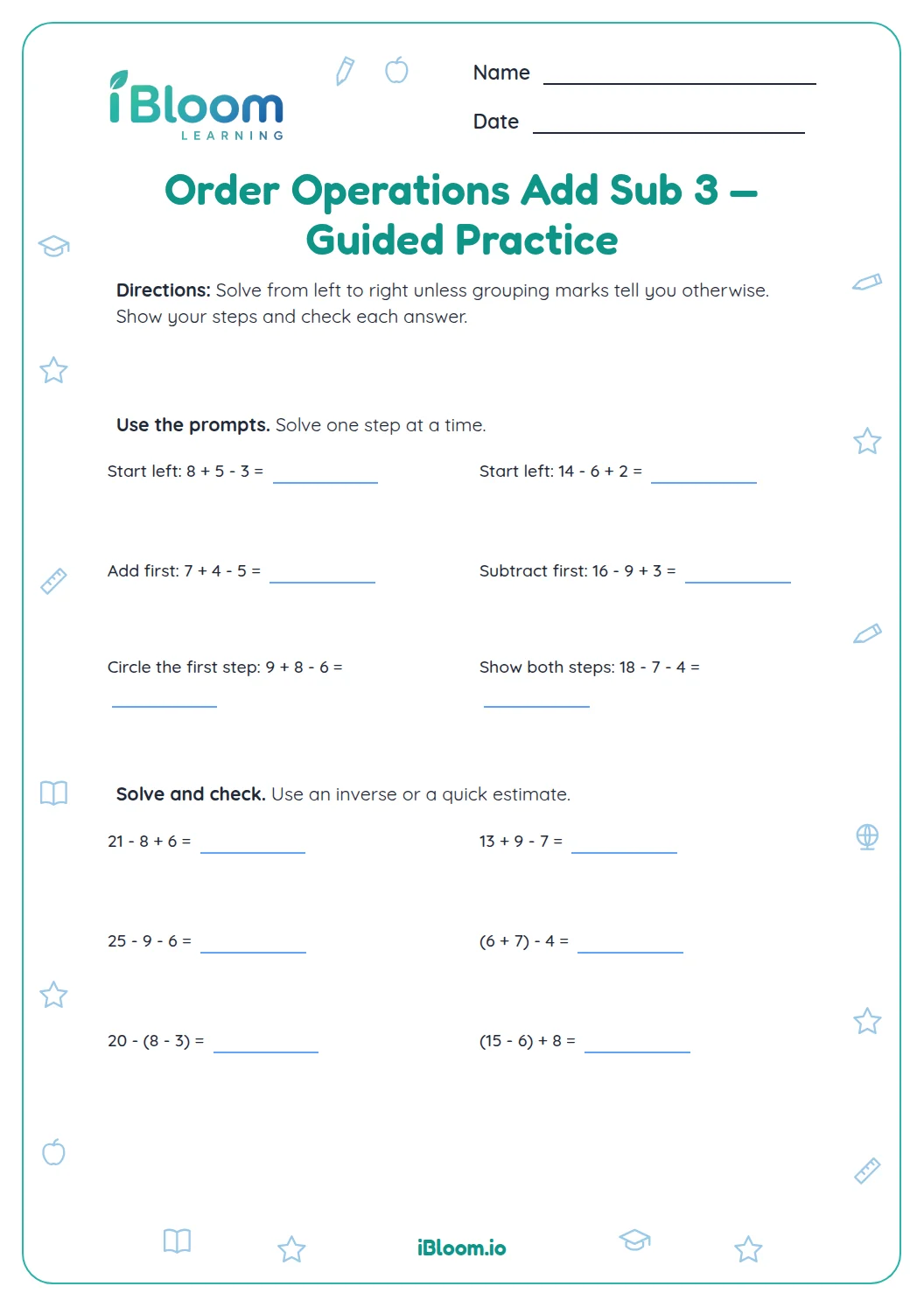
This free printable worksheet helps Grade 3 students work expressions that have only addition and subtraction, such as 30 − 8 + 5, in the right order: from left to right. Instead of plain drills, it asks children to reason about the order. In Part A they decide who is right. In Part B they finish the working and find missing numbers. In Part C they solve a bus story with several steps. The practice supports Common Core 3.OA.D.8 and 3.NBT.A.2, and the answer key shows each result.
Aligned to 3.OA.D.8 and 3.NBT.A.2
What is on this worksheet?
Eleven questions in three parts, from thinking about order to using it. Every number stays under 100, so the work is about the order of the steps and not about hard arithmetic.
Part A gives five short pieces of reasoning to check, such as a student who added first by mistake. Part B has five number sentences: finish the working, solve a four-number expression, or find the missing number. Part C is a bus story whose answer needs three steps, with a grid for working and a box for the answer.
- Part A: who is right, five multiple-choice questions (1 to 5)
- Part B: finish the working and missing numbers, five questions (6 to 10)
- Part C: a three-step bus story with working space (11)
- Answer key with every result
Why work from left to right?
Addition and subtraction are read like a sentence, from the left. In 30 − 8 + 5, the minus sign belongs to the 8, so the first job is 30 − 8. Doing 8 + 5 first changes the problem into 30 − 13, which is a different number.
Question 1 shows this: Jo got 17 by adding 8 and 5 first. Working left to right gives 27.
- 11) 30 − 8 + 5
- 2Left to right: 30 − 8 = 22
- 3Then: 22 + 5 = 27
- 4Jo’s way: 8 + 5 = 13, then 30 − 13 = 17. That is not the same expression.
How do the “finish the working” questions help?
Rewriting an expression after each step is a good way to keep track. In question 6, 27 + 8 − 6 is rewritten as ___ − 6, so the child does the first step, 27 + 8 = 35, and writes 35 in the blank. Question 7 asks for the same first step in a four-number expression.
Copying the leftover numbers onto each new line means nothing gets lost, and if an answer is wrong, the lines show exactly which step went astray.
- 17) 50 − 12 + 9 − 7 = ___ + 9 − 7
- 2First step: 50 − 12 = 38
- 3The blank is 38, and the rest is copied: 38 + 9 − 7
How can children find a missing number?
Two of the number sentences hide a number, as in 36 − ___ + 8 = 29. A child can work backward from 29: take away the 8 that was added to get 21, then ask what was taken from 36 to leave 21. The answer is 15.
The best check is to put the number back and work left to right: 36 − 15 = 21, and 21 + 8 = 29.
How to use this worksheet at home or in class
- 1Read the line under the title together: with only + and −, work from left to right.
- 2Do question 1 together. Ask: “Which operation comes first when you read from the left?”
- 3Let your child finish Part A, then check the answers and talk about any that differ.
- 4For Part B, have your child write each new line of working so the leftover numbers are copied correctly.
- 5For the missing numbers, ask your child to put the answer back and work left to right to check.
- 6In Part C, ask your child to say each step in words before writing the answer.
Common mistakes and quick fixes
The mistake
Adding the two numbers on the right first, as Jo did in question 1 (8 + 5 before 30 − 8).
The fix
Read the expression like a sentence from the left. The first two numbers and the sign between them make the first step.
The mistake
Dropping the last number when rewriting, so 27 + 8 − 6 becomes 35 and the − 6 disappears (question 6).
The fix
After each step, copy everything that is left. The new line must still have a minus 6 at the end.
The mistake
Writing 7 for 36 − ___ + 8 = 29 (question 9) by doing 36 − 29 and ignoring the + 8.
The fix
Put the answer back and work left to right: 36 − 7 = 29, then 29 + 8 = 37, which is not 29. The missing number must be 15.
Common Core alignment
Most US states teach this with the Common Core standards or a close state version. These two Grade 3 standards name the work on this page.
Solve a story that takes several steps, working the operations in order.
On this sheet: Part C solves a bus story in three steps, subtracting, adding and subtracting again, in order.
Show the official wordingHide the official wording
Solve two-step word problems using the four operations. Represent these problems using equations with a letter standing for the unknown quantity. Assess the reasonableness of answers using mental computation and estimation strategies including rounding.
Add and subtract numbers under 100 accurately in a chain of steps.
On this sheet: Every question uses addition and subtraction with numbers under 100, and the missing-number questions use the link between the two.
Show the official wordingHide the official wording
Fluently add and subtract within 1000 using strategies and algorithms based on place value, properties of operations, and/or the relationship between addition and subtraction.
What to practice next
Make more practice
Further reading
Questions parents and teachers ask
Why do we work from left to right when there is only plus and minus?
Adding and subtracting are read like words in a sentence, from the left, and the sign belongs to the number after it. In 30 − 8 + 5, the minus sign goes with the 8, so 30 − 8 comes first. Changing the order changes the number you subtract, which gives a different answer.
What does the worksheet mean by “Who is right?”
Each question in Part A shows what a student did or said, and children decide whether it is correct. Jo adds first and gets 17, and Mia gets 13 for 36 − 14 + 9. Checking someone else’s steps shows why the order matters, and the key gives the correct result.
How do I help if my child writes the wrong missing number?
Ask your child to put the number back into the sentence and work left to right. For 36 − ___ + 8 = 29, a child who writes 7 will find 36 − 7 + 8 = 37, not 29. That check shows the mistake without telling the answer, and your child can try again.
Why are the numbers on this sheet small?
Every number is under 100 so that children can focus on the order of the steps and not on difficult arithmetic. The longest expressions have four numbers. If your child finds even these slow, write each new line of working underneath the one before it.
Why is there only one story problem?
The bus story takes three steps, so one question gives a full chance to practice them in order, with a grid for working and a separate box for the answer. Children can say what happens at each stop in words first. The answer key shows the result: 31 riders.
What should my child do after this worksheet?
Ask your child to write an expression with four numbers, add and subtract in order, and explain each step aloud. After that, try the Add Sub 3 or Add Sub 4 sets for more expressions to work left to right, or Add Sub Mult 5 when you want multiplication mixed into the same order of steps.