


About this worksheet
This Grade 3 worksheet uses familiar counts from libraries, gardens, schools, and events to practice comparing, ordering, and rounding whole numbers. Sixteen questions ask learners to compare counts, place numbers in order, and round to the nearest ten or hundred. A number-line question and short contexts connect the digits to practical quantities. A separate answer key is included.
Aligned to 3.NBT.A.1
How do you compare two large counts?
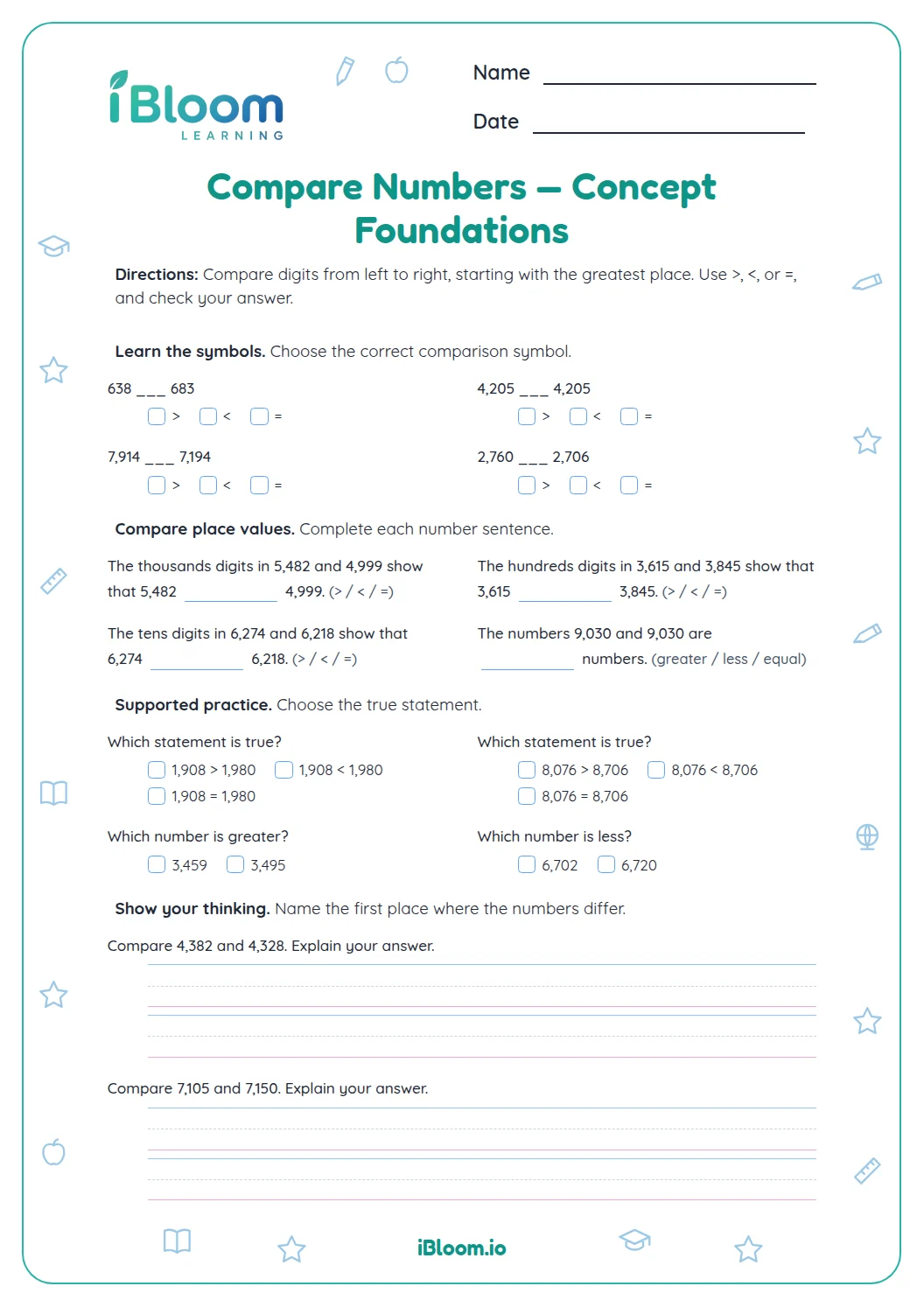
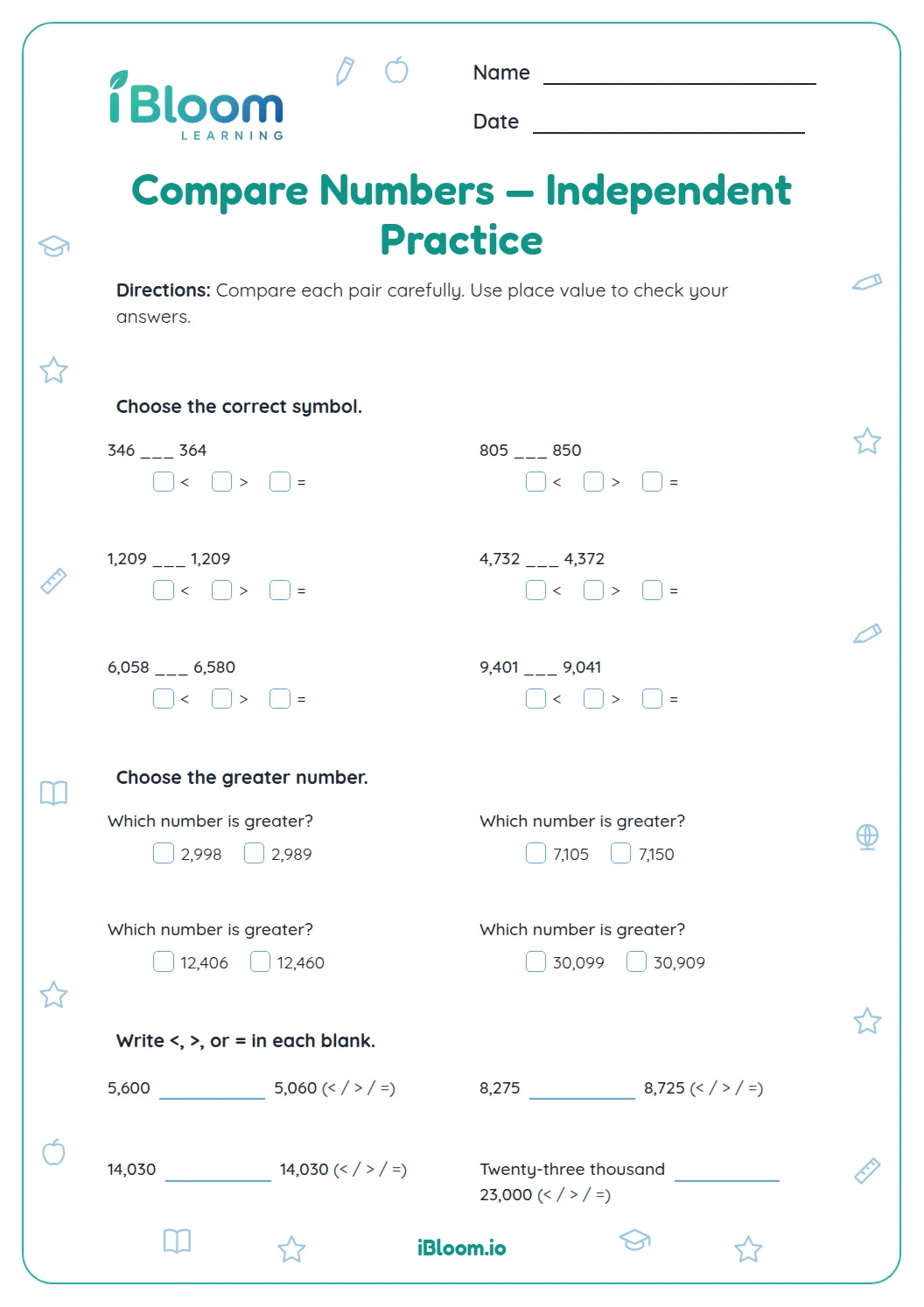
Start with the greatest place value. If those digits match, compare the next place, continuing until they differ. Question 2 compares 2,438 and 2,483: thousands and hundreds match, then 3 tens is less than 8 tens.
- 12,438 vs. 2,483
- 2Thousands: 2 = 2
- 3Hundreds: 4 = 4
- 4Tens: 3 < 8, so 2,483 is greater
How do you put several numbers in order?
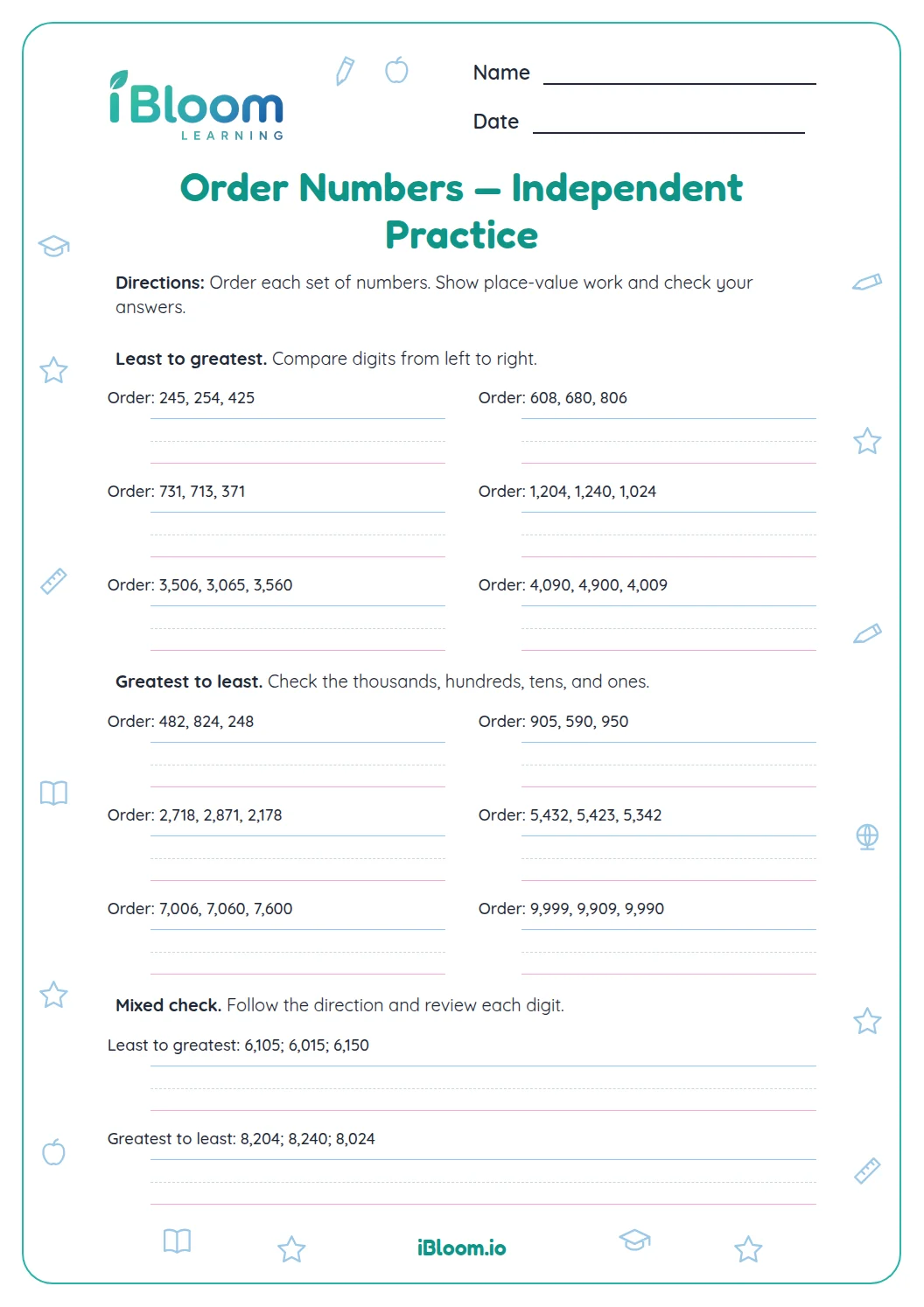
Compare each number from left to right and place the smallest first for least-to-greatest order. Check the list one adjacent pair at a time.
What digit tells you how to round?
Locate the place named in the question. The digit to its right tells whether the named digit stays the same or increases by one; replace digits to the right with zeros.
How to use this worksheet
- 1Read the place values from left to right.
- 2Compare the first digits that differ.
- 3For ordering, arrange the values in the requested direction.
- 4For rounding, circle the requested place and check the digit to its right.
- 5Check that the result has zeros in the places to the right.
Common mistakes and quick fixes
The mistake
Comparing only the last digits.
The fix
Begin at the thousands or hundreds place and move right.
The mistake
Reversing least-to-greatest order.
The fix
Check that each number is at least as large as the one before it.
The mistake
Changing digits left of the rounding place.
The fix
Keep digits to the left; change the rounding digit only when needed.
This worksheet gives learners practice with the stated skill.
rounding whole numbers to the nearest 10 or 100
On this sheet:
Show the official wordingHide the official wording
Use place value understanding to round whole numbers to the nearest 10 or 100.
What to practice next
Make more practice
Further reading
Questions parents and teachers ask
What skills are practiced on this Grade 3 worksheet?
The 16 questions ask learners to read a number line, compare and order four-digit counts, and round whole numbers to the nearest ten or hundred. Several prompts place the numbers in contexts such as visitors, books, and produce. Use the page to check each step.
How do you compare four-digit numbers?
Compare digits from left to right, starting with the thousands. If those digits match, compare the hundreds, then tens and ones. In question 2, both counts have 2 thousands and 4 hundreds, while 8 tens is greater than 3 tens.
How do you round to the nearest hundred?
Look at the tens digit. If it is 5 or more, increase the hundreds digit by one; if it is 4 or less, keep the hundreds digit. For question 6, 4,268 rounds to 4,300 because the tens digit is 6.
Does the worksheet include ordering numbers?
Yes. Some questions ask learners to arrange three counts from least to greatest or greatest to least. For example, question 3 orders 1,208, 1,280, and 1,082 from least to greatest as 1,082, 1,208, 1,280. The worked examples use the same kind of quantities and relationships that appear in these questions, so learners can follow the reasoning and check a result.
Is an answer key included?
Yes. The separate answer key gives the selected value or ordered list for all 16 questions. If a response needs another look, compare the digits in the place named by the prompt before checking the key again. Use the page to check each step.