



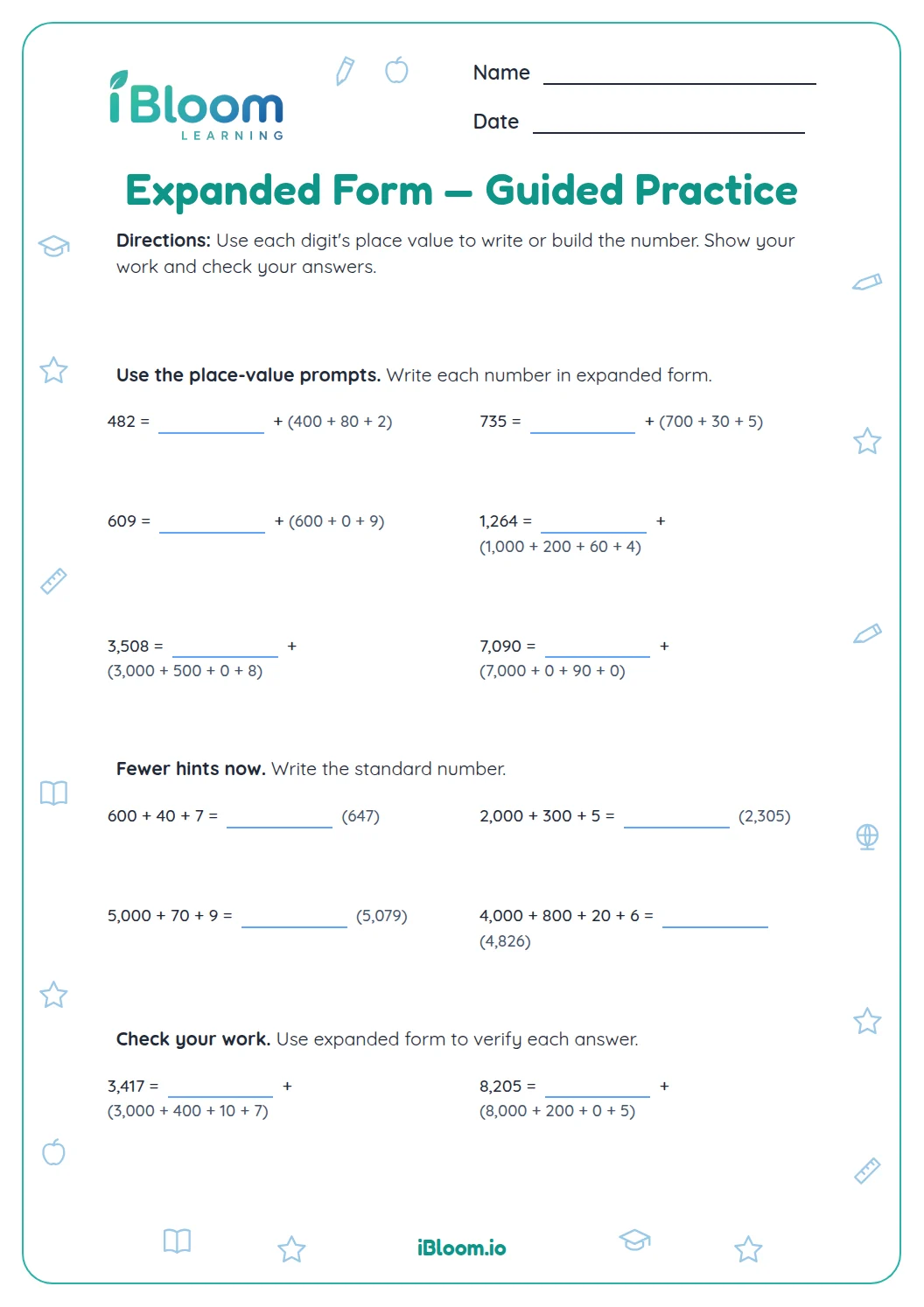

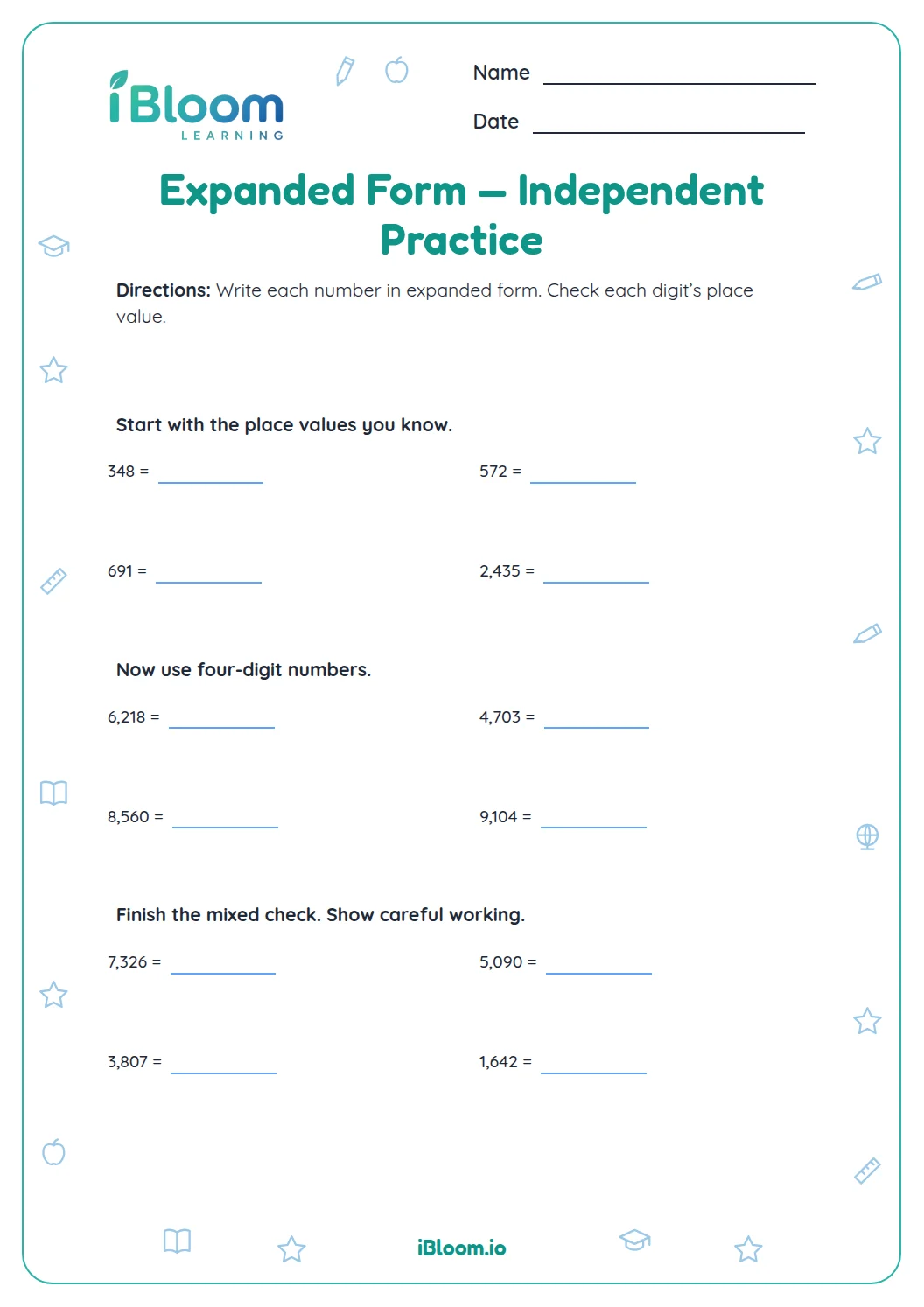
About this worksheet
This printable gives Grade 3 learners practice reading and writing four-digit numbers. They build numbers from thousands, hundreds, tens, and ones; write an expanded form; compare two values; and solve short number clues set in everyday contexts. The questions use standard form and place-value reasoning throughout, with a separate answer key for checking each response.
Aligned to 4.NBT.A.2
What kinds of four-digit numbers are on the sheet?
The worksheet moves from writing numbers from place-value clues to comparing numbers and applying the same idea in short contexts. Part A builds standard form and includes one expanded-form item. Part B compares two four-digit values. Part C combines place-value clues, digit values, and addition of one thousand.
- Part A: build four-digit numbers and write one in expanded form
- Part B: compare two numbers with the same thousands digit
- Part C: use digit values and place-value clues in contexts
How do you build a number from its place values?
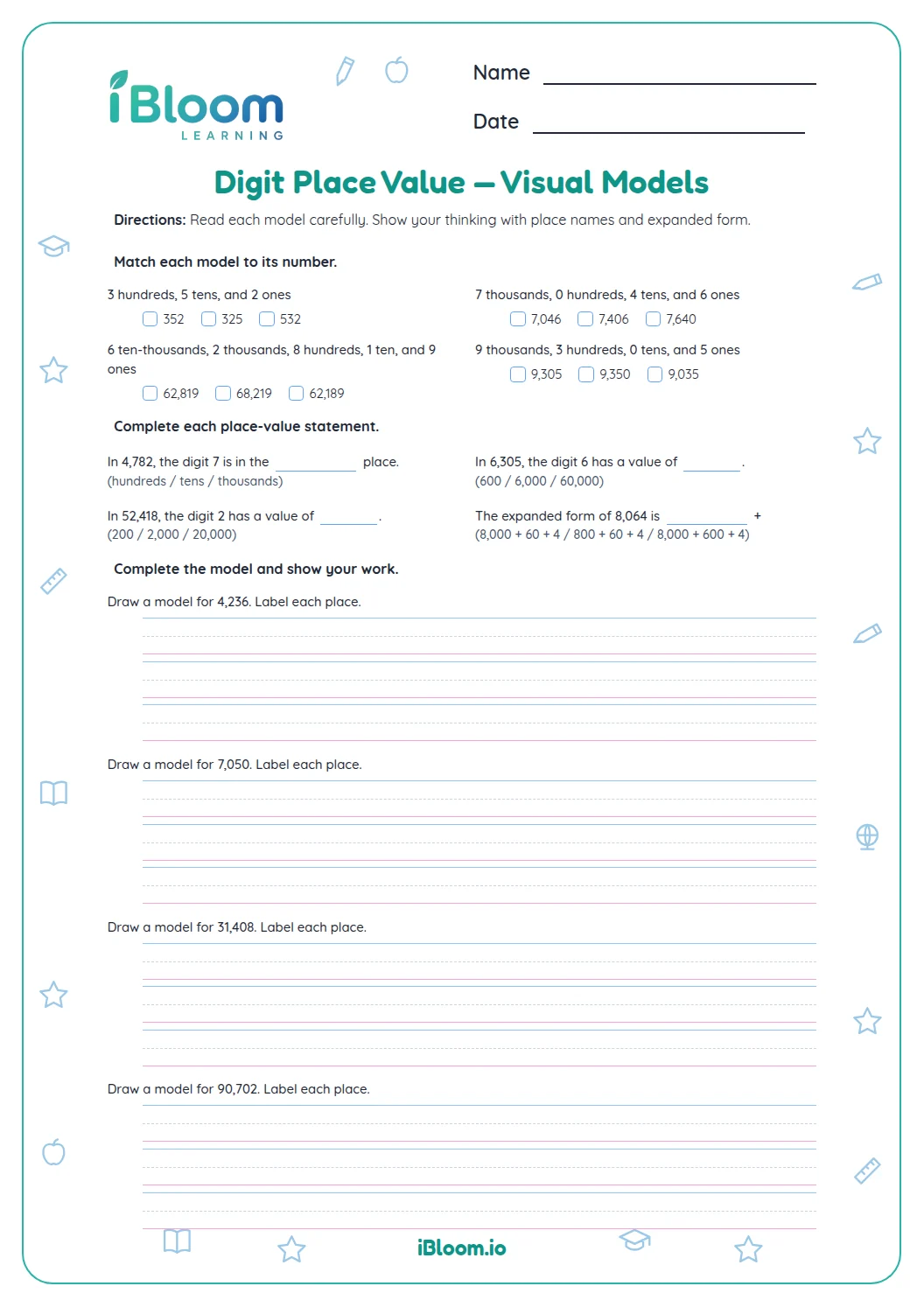
Read each place from left to right: thousands, hundreds, tens, then ones. A zero means that place contributes nothing, but it still holds its position. For example, 5 thousands, 0 hundreds, 8 tens, and 1 one makes 5,081.
- 15 thousands, 0 hundreds, 8 tens, 1 one = 5,081
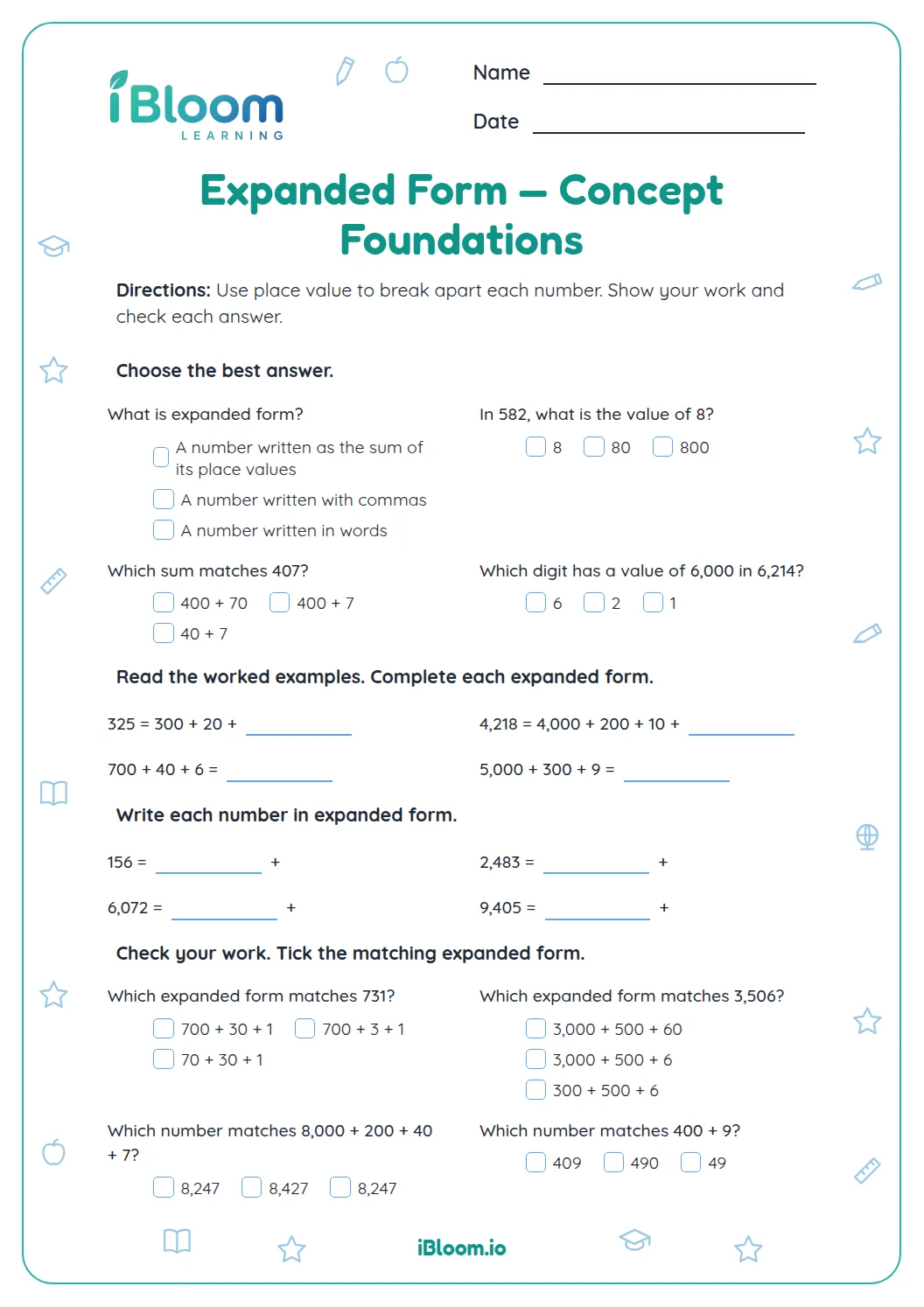
- 2Expanded form: 4,018 = 4,000 + 10 + 8
How can you compare two four-digit numbers?
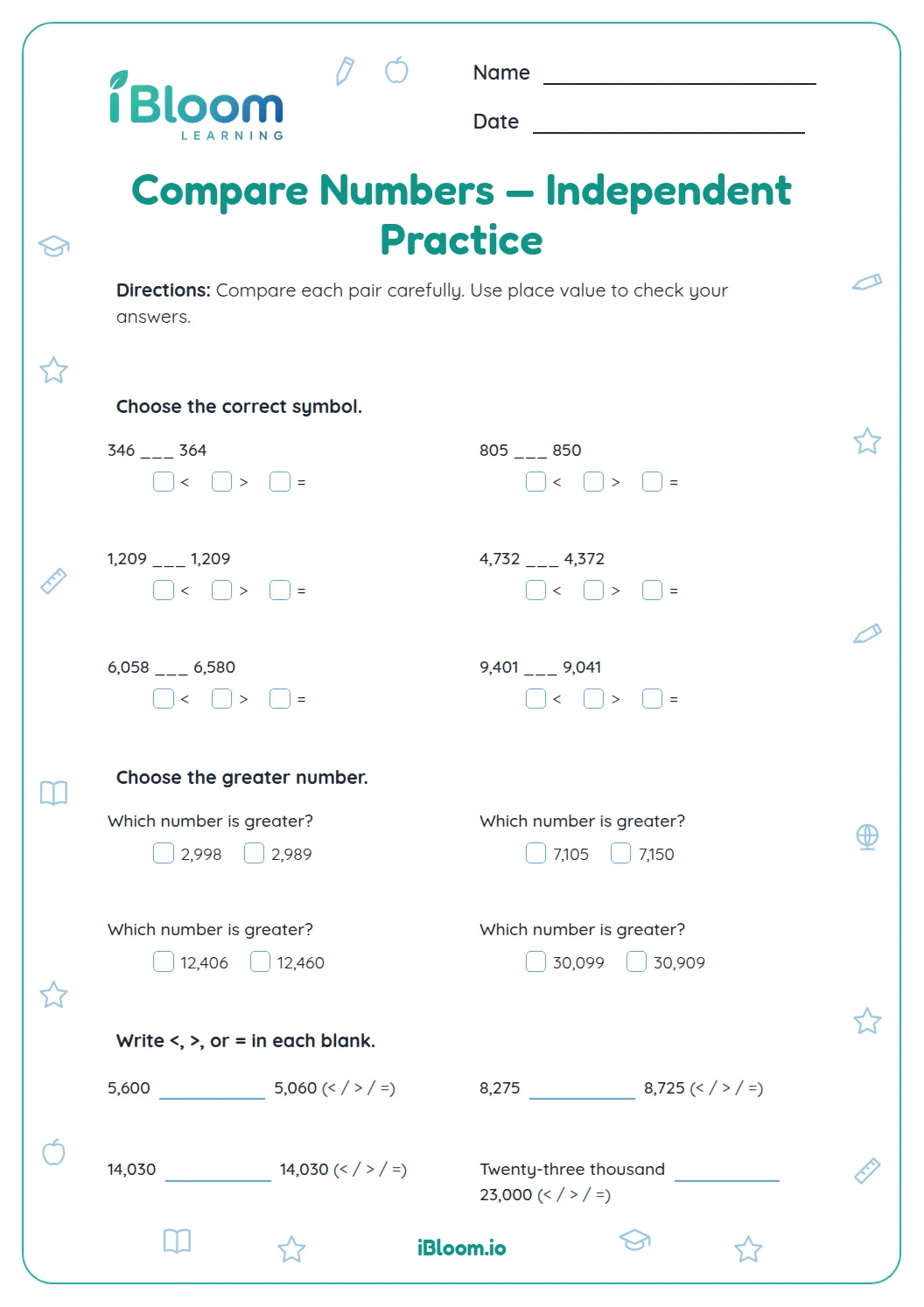
Compare the digits in the same place, starting with the thousands. If those match, compare the hundreds, then tens, then ones. In Part B, 7,204 and 7,240 have the same thousands and hundreds; 4 tens is greater than 0 tens, so 7,240 is greater.
How does place value help with the word problems?
Translate each clue into a number before you write the answer. A phrase such as “8,000 + 500 + 30 + 4 visitors” names four place values, so the total is 8,534 visitors. For a question about a digit’s value, name the whole value of its place, not only the digit.
How to work through the sheet
- 1Read the full clue and mark the place named by each number.
- 2Write each digit in its correct place, including a zero placeholder when needed.
- 3For expanded form, write the nonzero place values and add them.
- 4When comparing, start at the thousands place and move right only when digits tie.
- 5For a real-world clue, assemble the number first, then reread the question.
- 6Use the answer key after finishing and correct any place-value slip.
Common place-value mistakes
The mistake
Writing 5,081 as 581 because the hundreds place is zero.
The fix
Keep the zero in the hundreds place so the tens and ones stay in the right positions.
The mistake
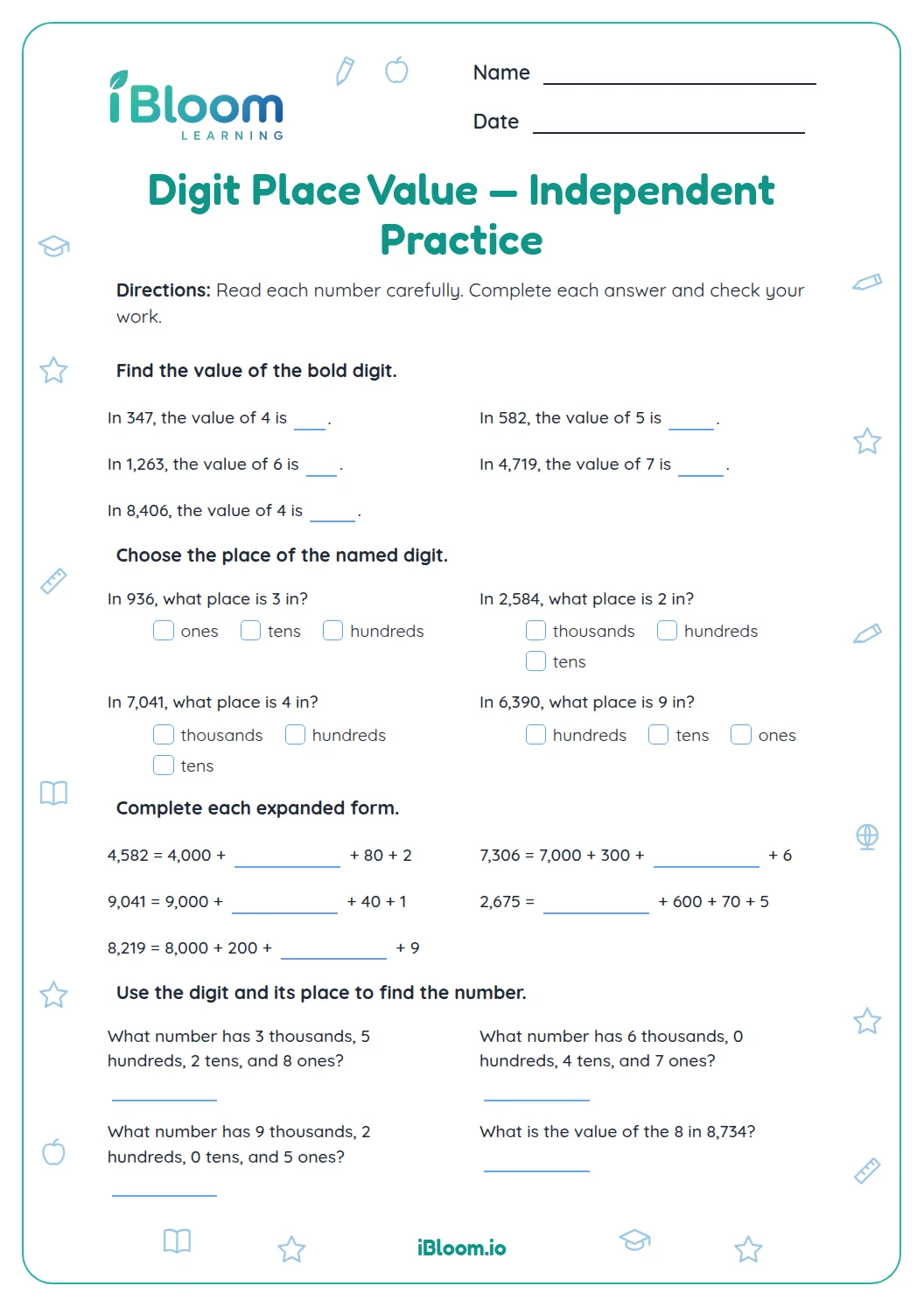
Writing only 3 instead of 300 for the value of the 3 in 9,361.
The fix
Ask which place the digit occupies; a 3 in the hundreds place has a value of 300.
The mistake
Comparing 7,204 and 7,240 by looking only at the last digit.
The fix
Compare from left to right. The first different place is the tens place, where 4 tens is more than 0 tens.
Common Core alignment
This page practices reading, writing, expanding, and comparing multi-digit whole numbers.
Read, write, expand, and compare multi-digit whole numbers by place value.
On this sheet: The questions ask learners to build four-digit numbers, write expanded form, identify digit values, and compare numbers.
Show the official wordingHide the official wording
Read and write multi-digit whole numbers using base-ten numerals, number names, and expanded form. Compare two multi-digit numbers based on meanings of the digits in each place, using >, =, and < symbols to record the results.
What to practice next
Make more practice
Further reading
Questions parents and teachers ask
What is standard form?
Standard form writes a number with digits, such as 4,018. On this worksheet, learners build standard form from thousands, hundreds, tens, and ones, then write one number in expanded form. The zero in 4,018 keeps the hundreds place empty and holds the other digits in position.
How is expanded form different from standard form?
Expanded form shows the value contributed by each nonzero digit. For example, 4,018 is 4,000 + 10 + 8. The worksheet includes this kind of decomposition alongside standard-form clues, so learners can see how the place values combine to make the number.
What does the comparison question ask learners to do?
The comparison item asks which of 7,204 and 7,240 is greater. Their thousands and hundreds digits match, so the tens place decides it: 4 tens is more than 0 tens. The answer is 7,240, and the same left-to-right check works for other four-digit numbers.
Does this worksheet include rounding?
The assigned skill is writing four-digit numbers in standard form and applying place-value reasoning. The questions cover number building, one expanded-form expression, comparison, and place-value clues; they do not ask learners to round. The separate key lets an adult check each of the 15 responses.
How many questions and pages are included?
There are 15 questions across three parts on two worksheet pages, followed by a two-page answer key. The parts move from building numbers to comparison and applications. Plan about 20 minutes, allowing extra time for learners who want to explain how they used each place.
Which skill should come next?
Learners can continue with expanded-form practice, then work on comparing and ordering larger numbers. The linked expanded-form page gives a focused next step. Ask the learner to explain what each digit is worth before moving on to more complex number tasks.