

About this worksheet
This Grade 4 measurement worksheet practices customary capacity relationships: 1 cup = 8 fluid ounces and 1 quart = 4 cups. Across 15 questions, learners convert in both directions, compare amounts, check a faulty conversion, and solve short problems involving recipes and containers. The two worksheet pages are followed by a separate answer key. The work practices expressing measurements in smaller units, as described in CCSS 4.MD.A.1.
Aligned to 4.MD.A.1
Which conversion facts should learners use?
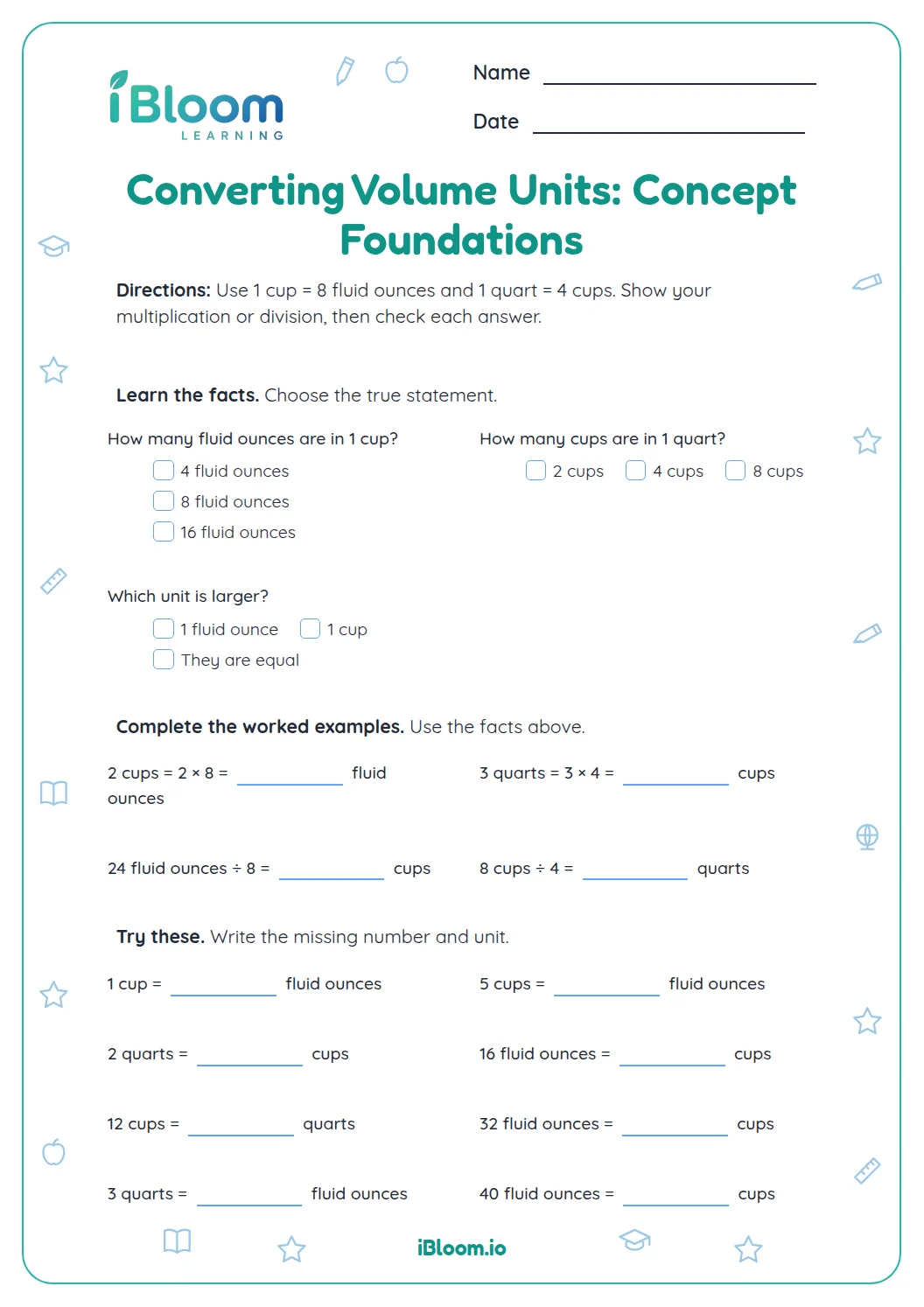
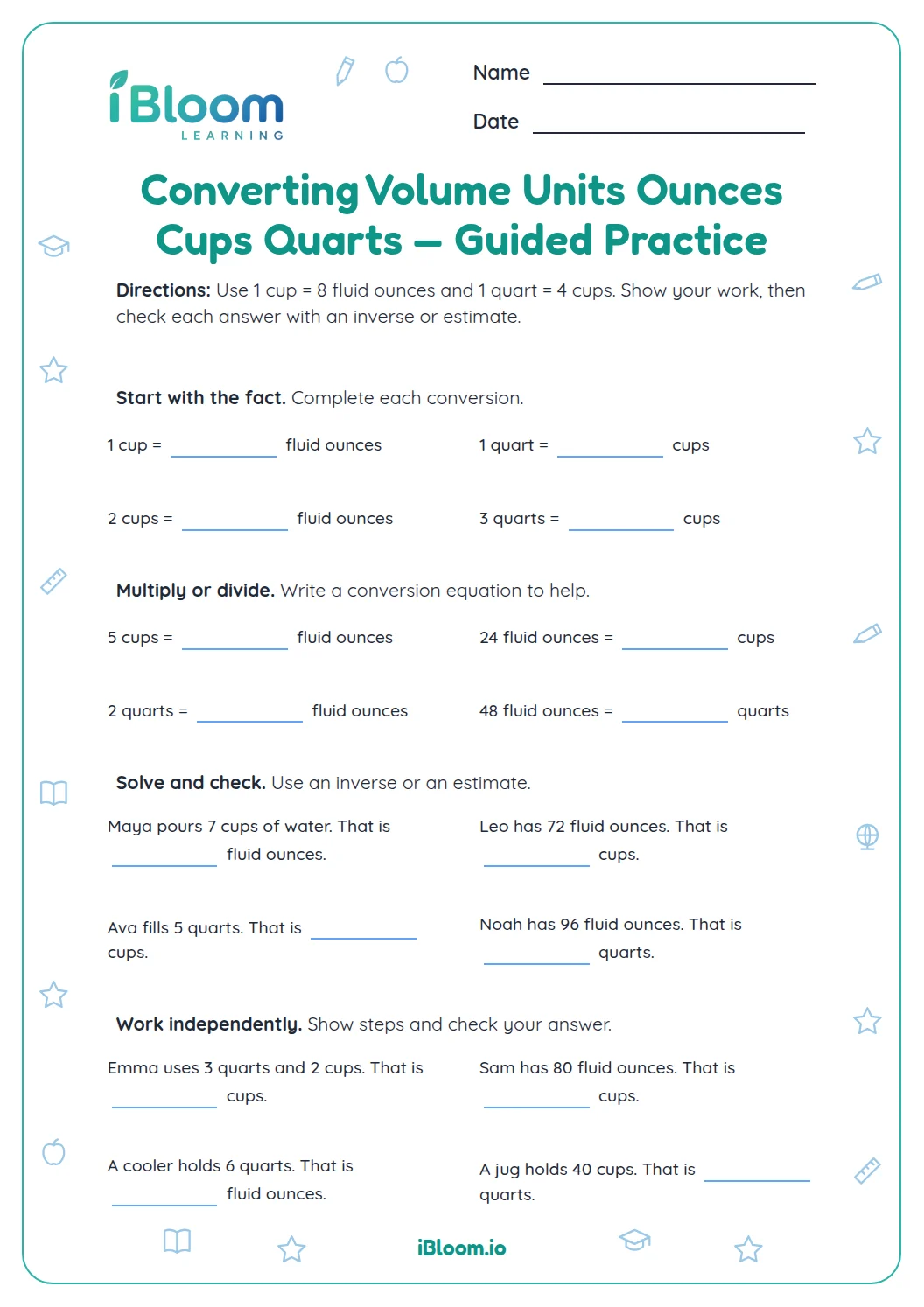
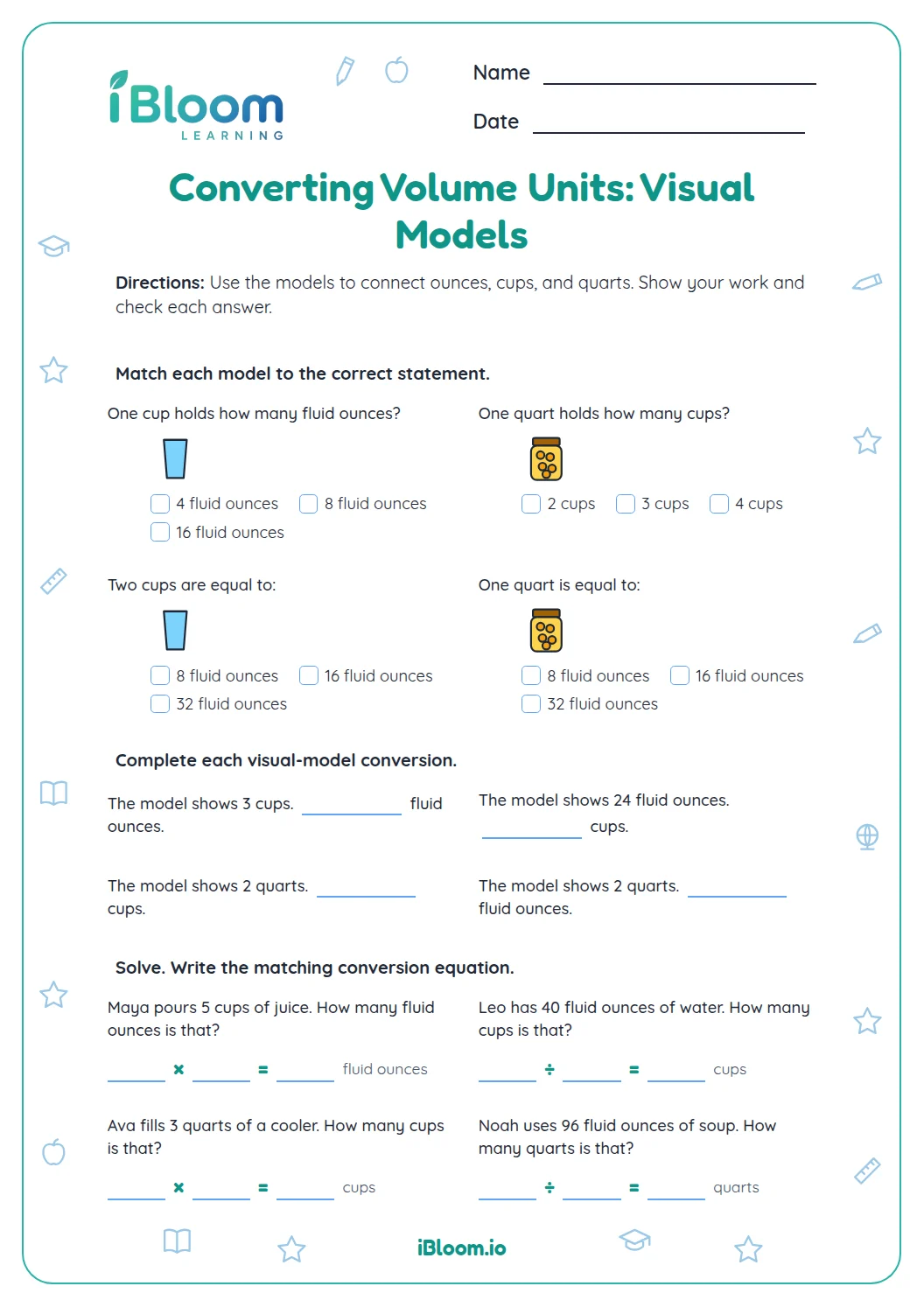
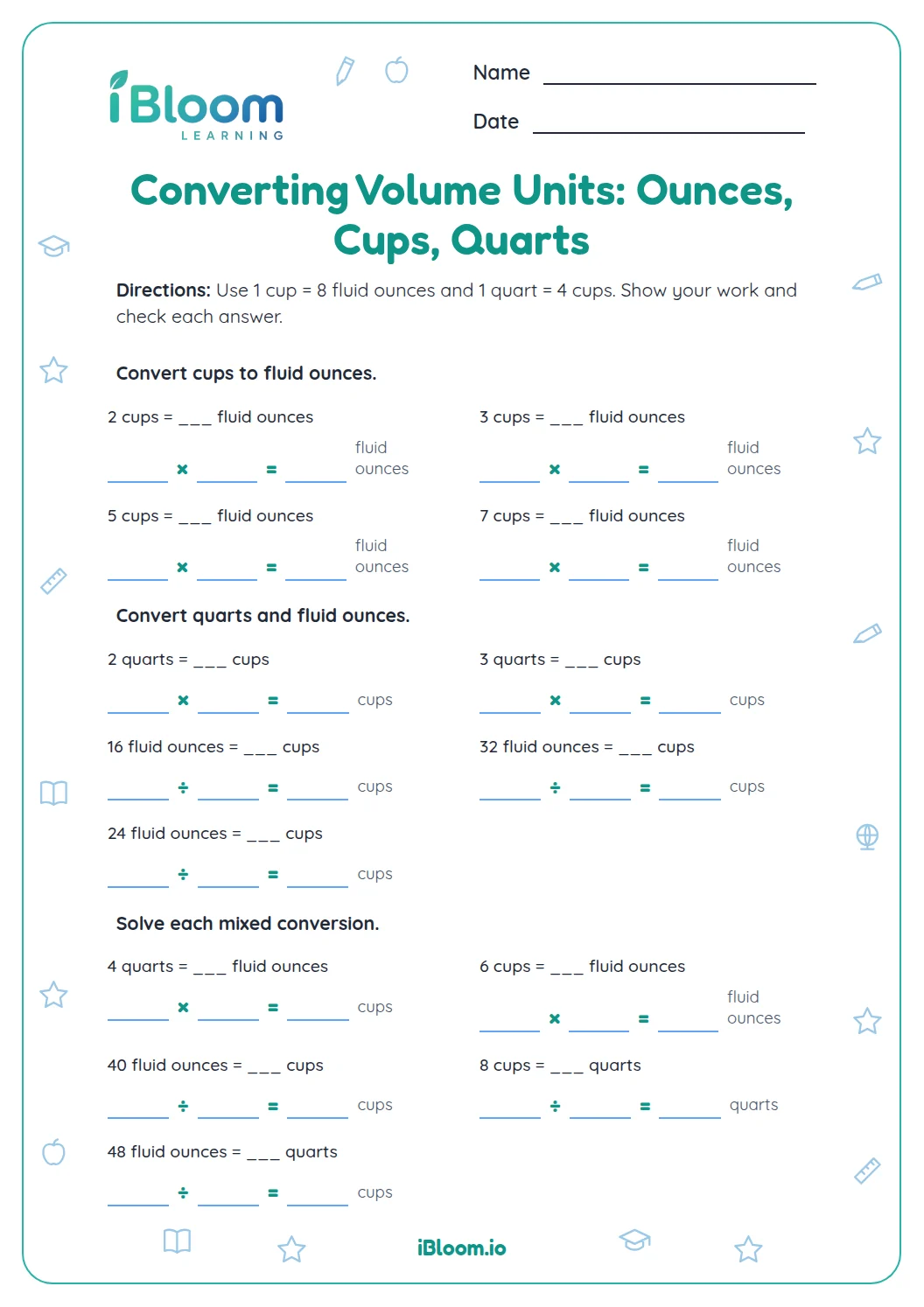
The directions give two relationships: 1 cup = 8 fluid ounces and 1 quart = 4 cups. Together they show that 1 quart = 32 fluid ounces. Questions 1–8 use these facts to convert amounts, including 48 fluid ounces to 1 1/2 quarts.
- 148 fluid ounces = ___ quarts
- 248 ÷ 8 = 6 cups, then 6 ÷ 4 = 1 1/2 quarts.
- 3Check: 1 1/2 quarts × 32 fluid ounces per quart = 48 fluid ounces.
How can two amounts be compared fairly?
First express both amounts in the same unit. For question 9, 3 cups equal 24 fluid ounces, which is greater than 20 fluid ounces. Question 10 compares 1 quart with 5 cups; since a quart is 4 cups, 1 quart is the smaller amount.
How do the word problems use conversion facts?
Questions 12–14 apply the relationships to a jug, a recipe, and a cooler: 3 quarts are 12 cups, 40 fluid ounces are 5 cups, and 1 quart plus 3 cups is 7 cups. Question 15 explains why 1 quart cannot equal 4 fluid ounces.
How to use this worksheet
- 1Keep the two given facts visible: 1 cup = 8 fluid ounces and 1 quart = 4 cups.
- 2Choose the unit that makes the conversion direct.
- 3Multiply when changing a larger count of units into smaller units; divide in the reverse direction.
- 4For comparisons, convert both amounts to the same unit first.
- 5Check a result by converting it back or using the related unit fact.
Common mistakes and quick fixes
The mistake
Treating 1 quart = 4 cups as 1 quart = 4 fluid ounces.
The fix
Convert each of the four cups in a quart: 4 × 8 = 32 fluid ounces.
The mistake
Dividing when converting cups to fluid ounces.
The fix
Each cup contains 8 fluid ounces, so multiply the number of cups by 8.
The mistake
Comparing amounts while they use different units.
The fix
Rewrite both amounts in cups or fluid ounces before deciding which is larger.
Curriculum alignment
This sheet practices the standard listed below.
Learners convert customary volume measures to a shared unit to compare and solve problems.
On this sheet: Learners convert customary volume measures to a shared unit to compare and solve problems.
Show the official wordingHide the official wording
Know relative sizes of measurement units within one system of units including km, m, cm; kg, g; lb, oz; l, ml; hr, min, sec. Within a single system of measurement, express measurements in a larger unit in terms of a smaller unit.
What to practice next
Make more practice
Further reading
Questions parents and teachers ask
What are the conversion facts on this worksheet?
The directions state that 1 cup equals 8 fluid ounces and 1 quart equals 4 cups. Combining them gives 1 quart = 32 fluid ounces. These relationships are used throughout the 15 questions to convert, compare, and solve capacity problems.
How many questions are there?
There are 15 questions in four parts. Learners solve eight conversions, answer three comparison or error-check items, and complete four application questions. The worksheet spans two pages, followed by a separate answer key. Learners can verify each conversion by reversing the operation.
How do I compare 3 cups and 20 fluid ounces?
Convert the cups to fluid ounces: 3 × 8 = 24 fluid ounces. Since 24 fluid ounces is greater than 20 fluid ounces, 3 cups is more. Converting to one shared unit makes the comparison straightforward. These comparisons use the facts provided in the directions.
Why is 1 quart not equal to 4 fluid ounces?
A quart contains 4 cups, and each cup contains 8 fluid ounces. Multiply 4 × 8 to get 32 fluid ounces in 1 quart. The worksheet’s final question asks learners to explain this unit relationship. This same relationship explains the other conversion items.
Is an answer key included?
Yes. A separate answer key follows the two worksheet pages and lists the conversion results, comparisons, and application answers. For the final explanation, a response should state that a quart is 4 cups and each cup is 8 fluid ounces.