
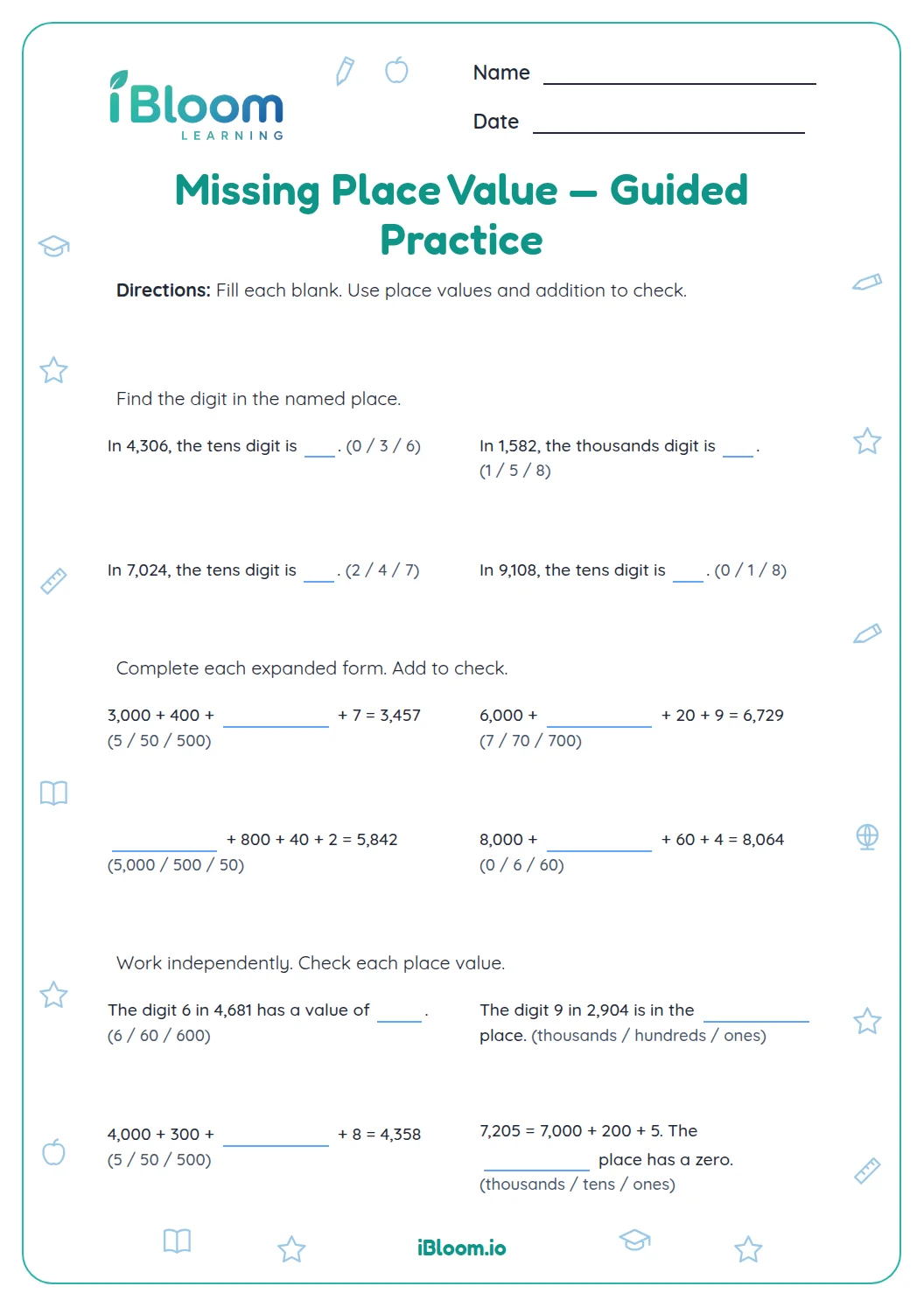

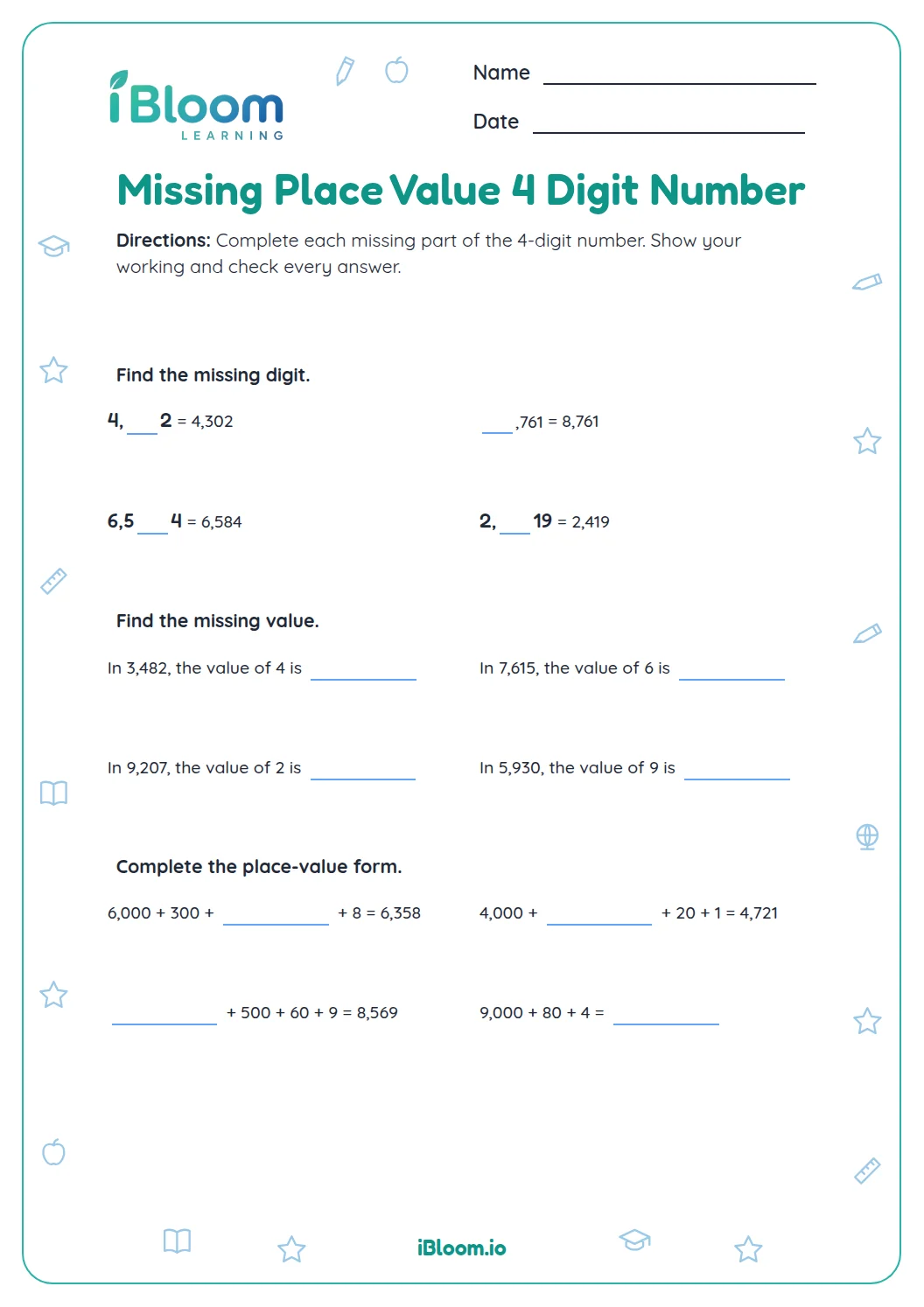
About this worksheet
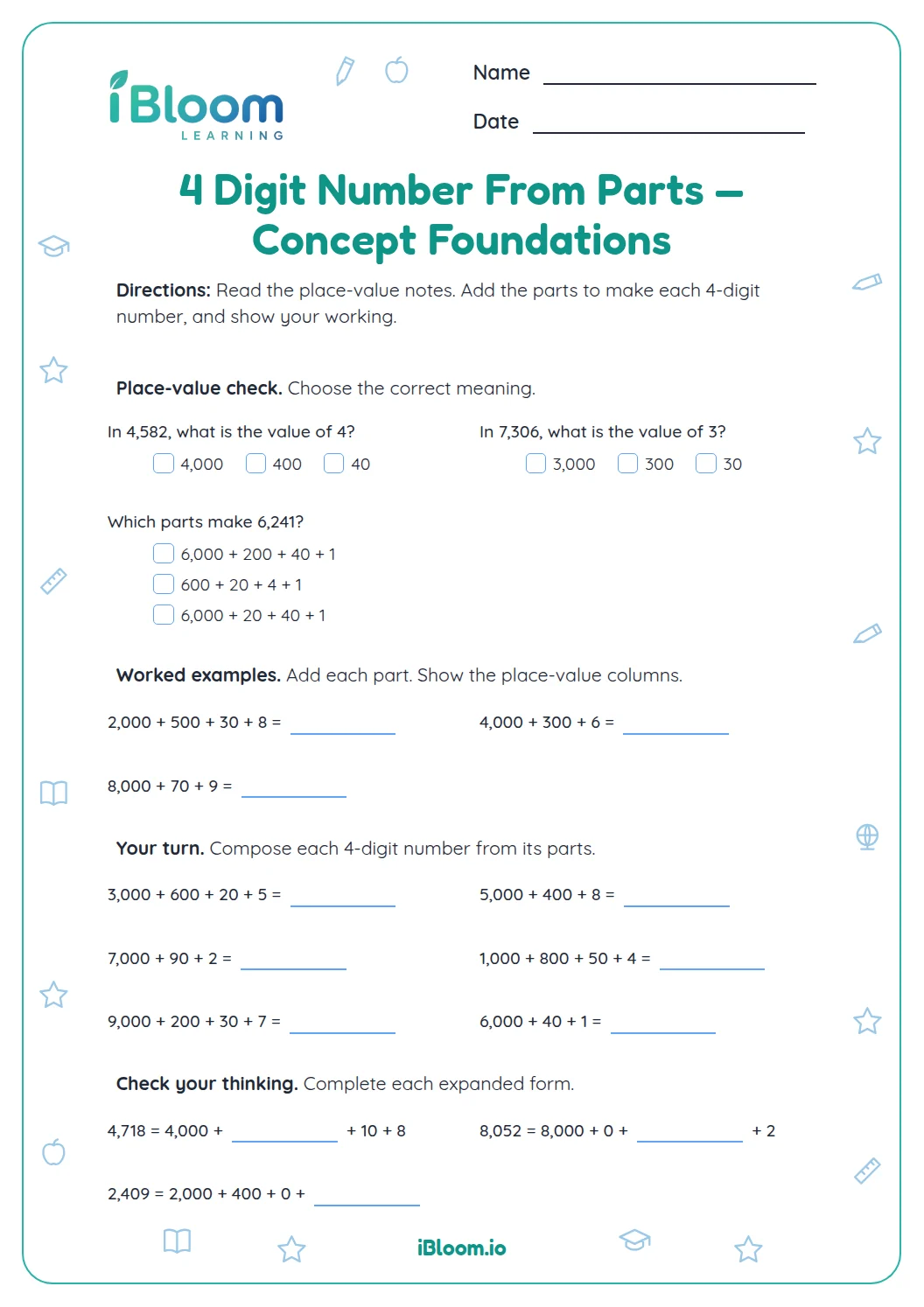
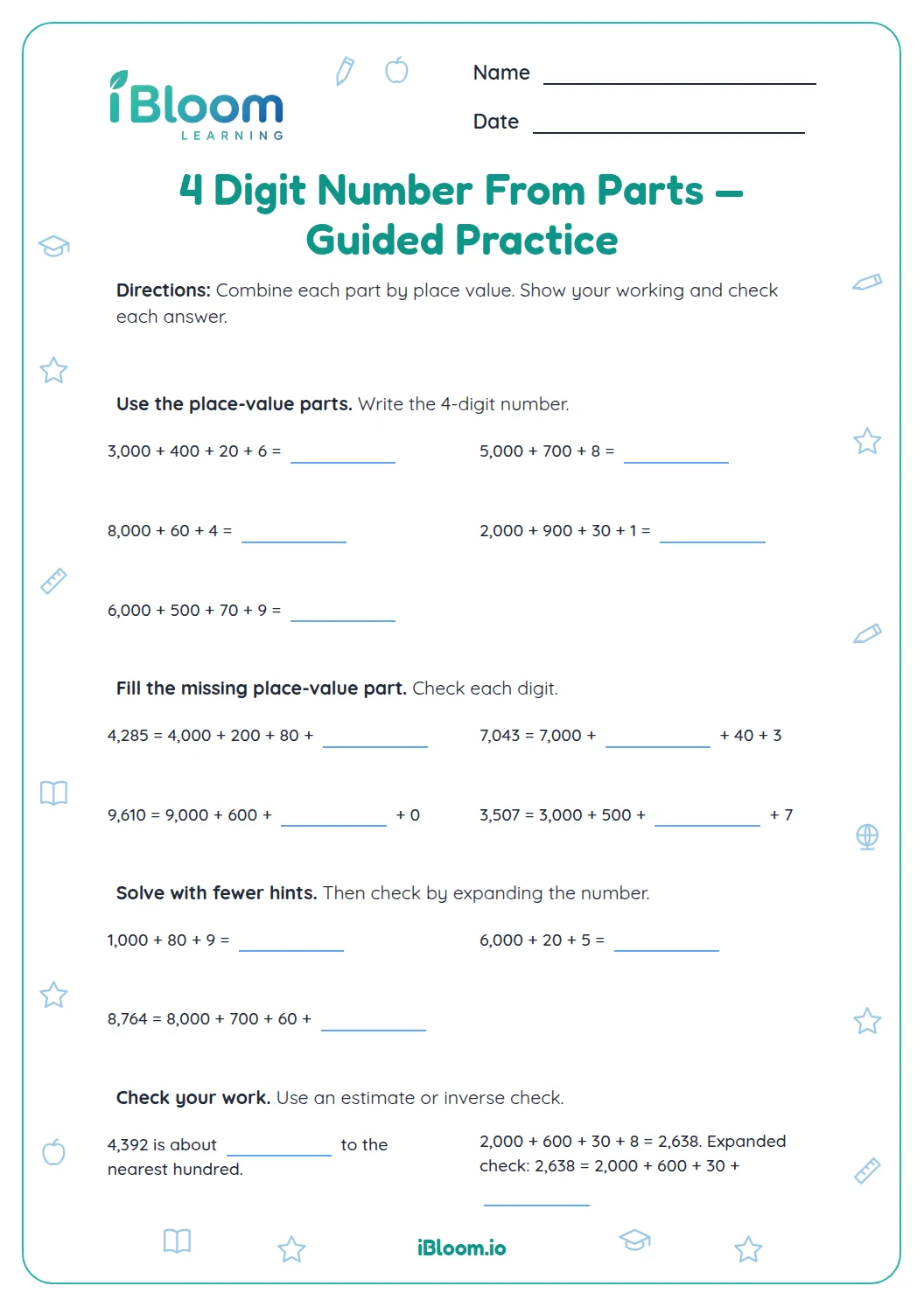
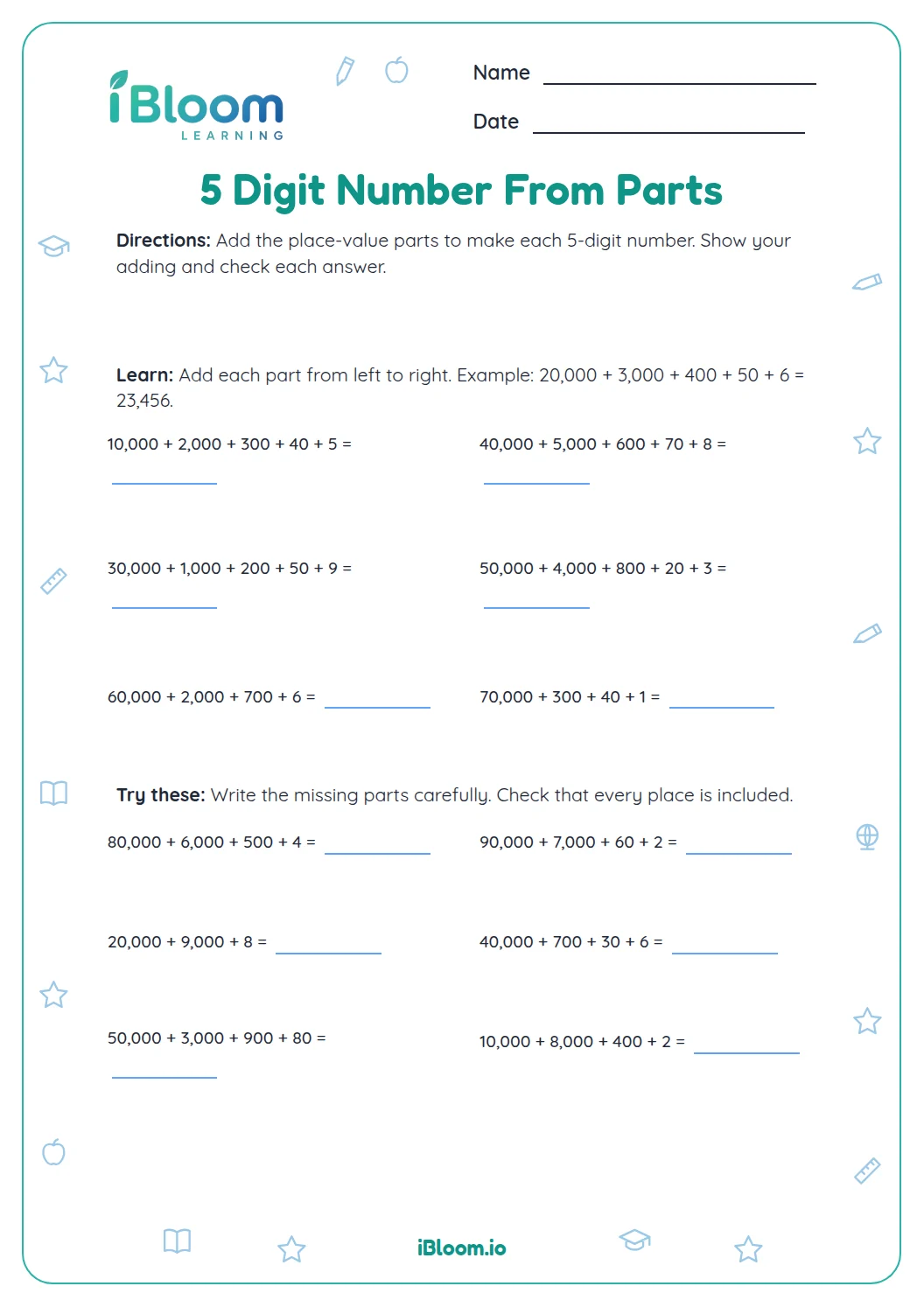
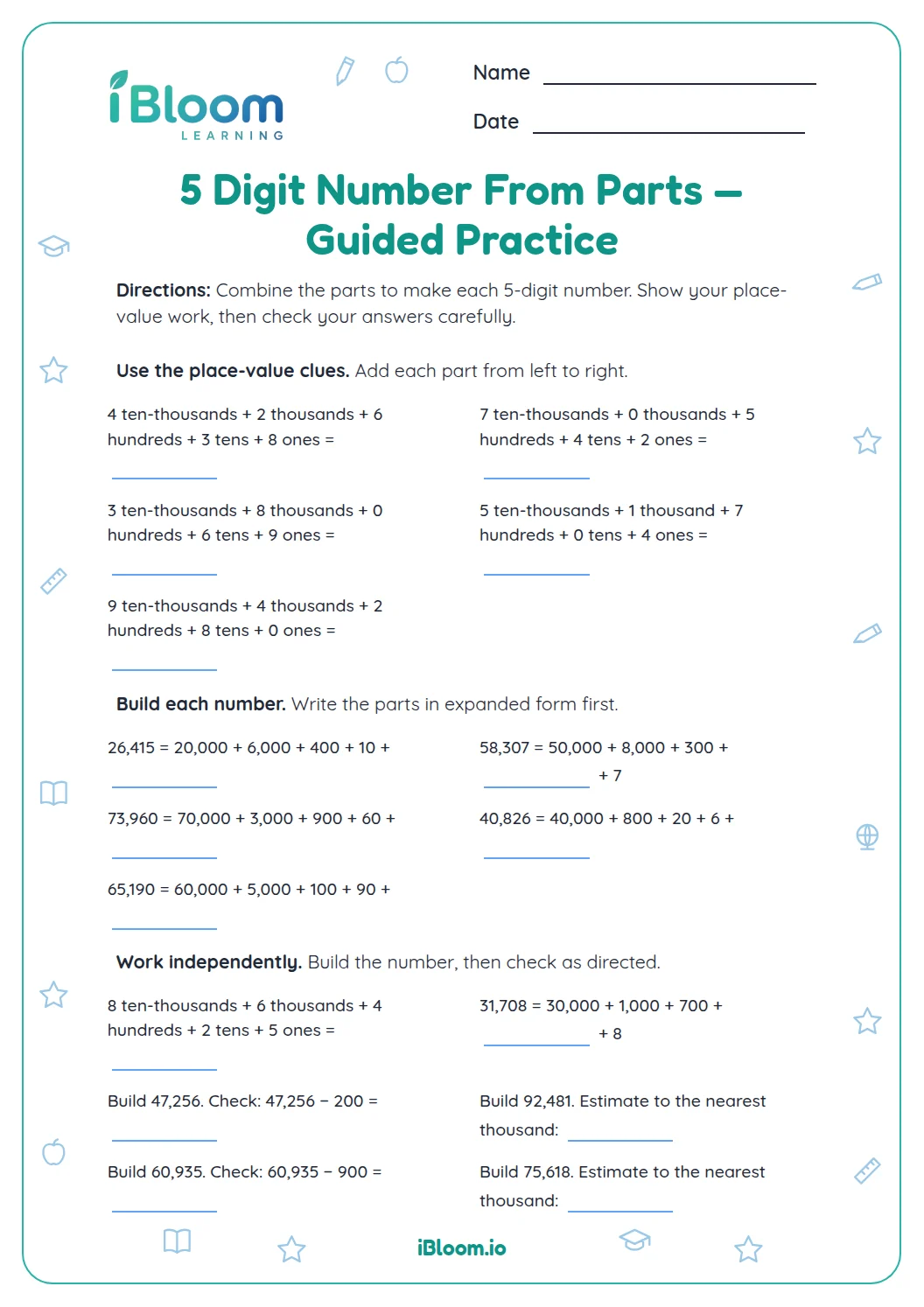
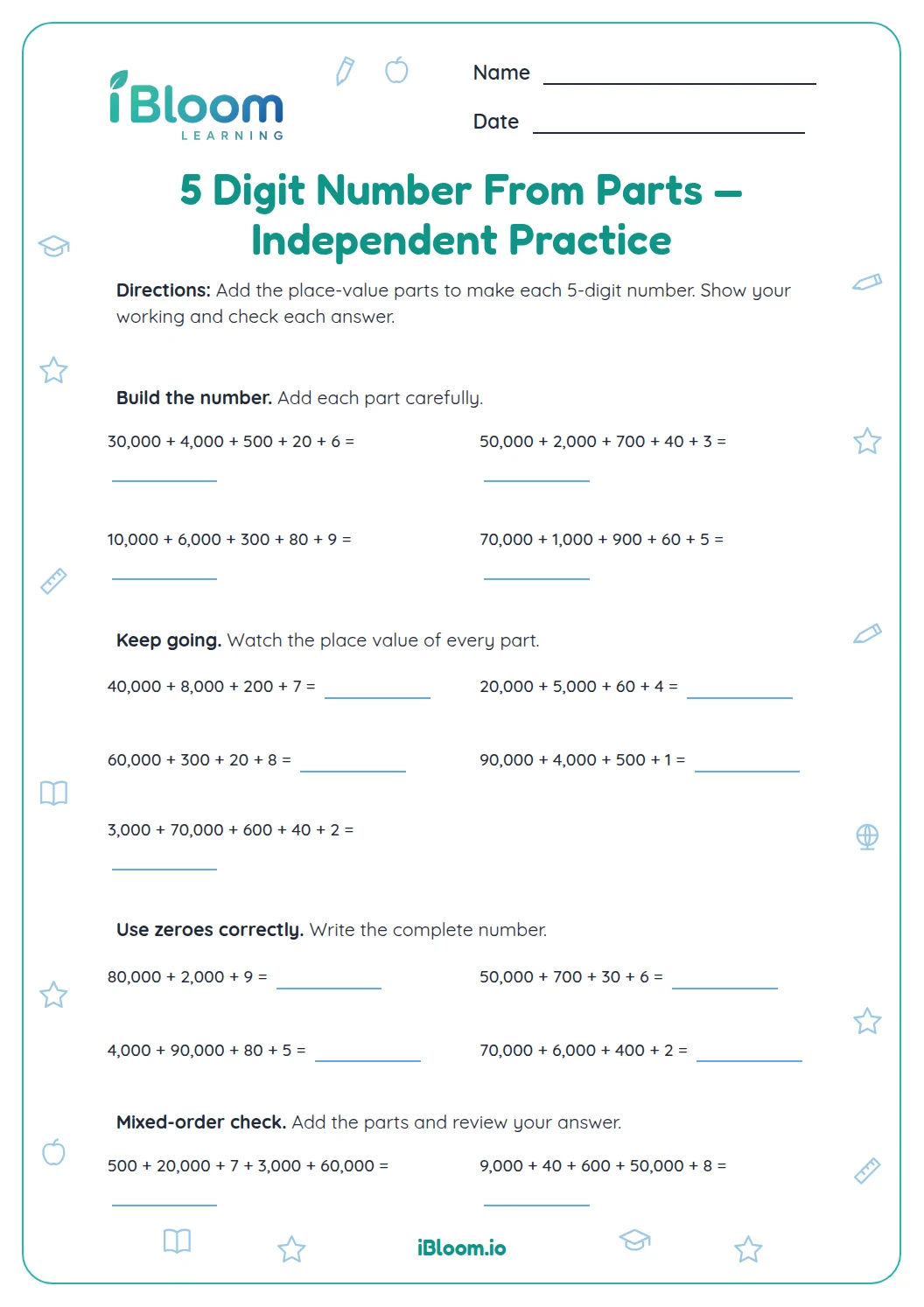
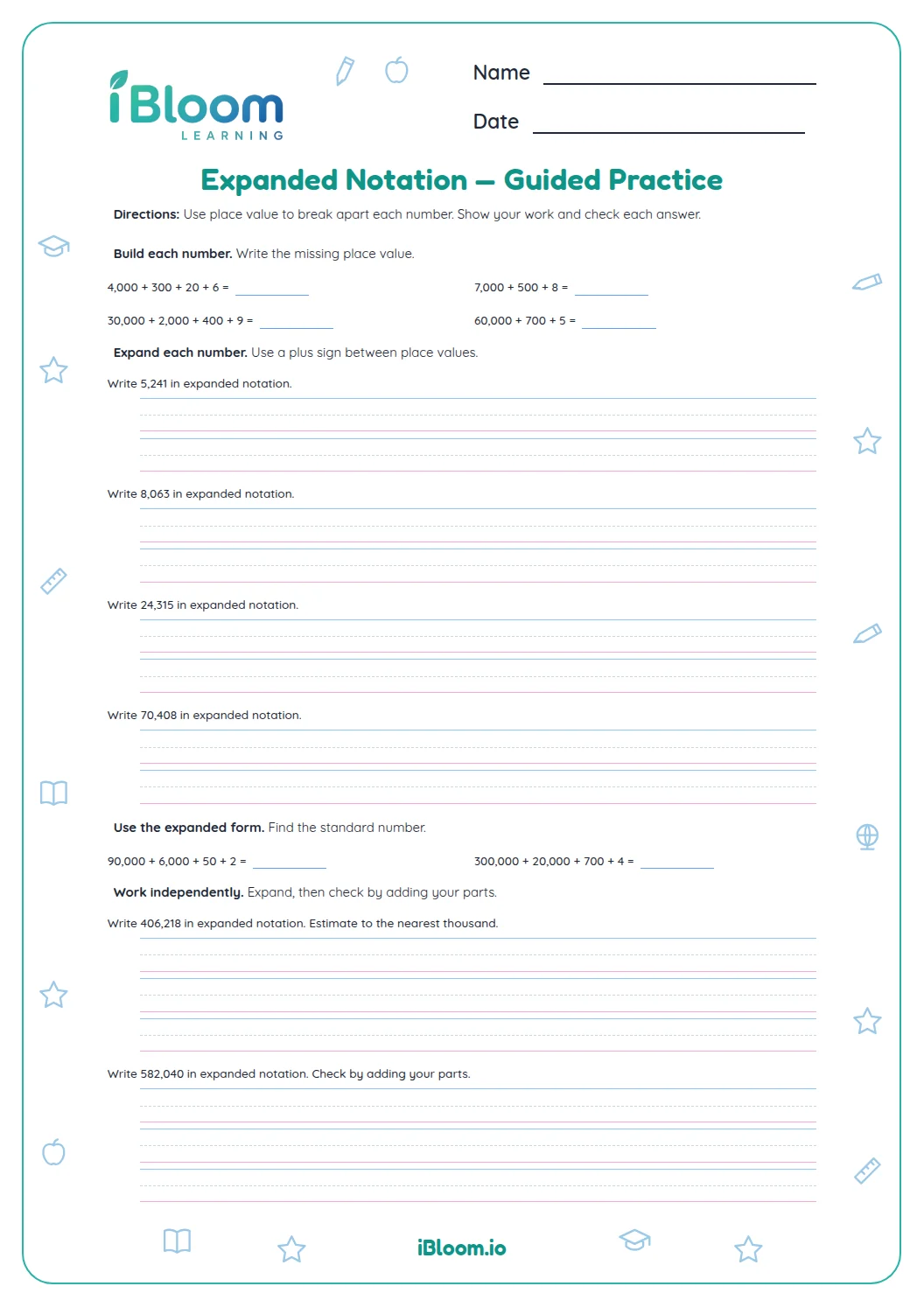
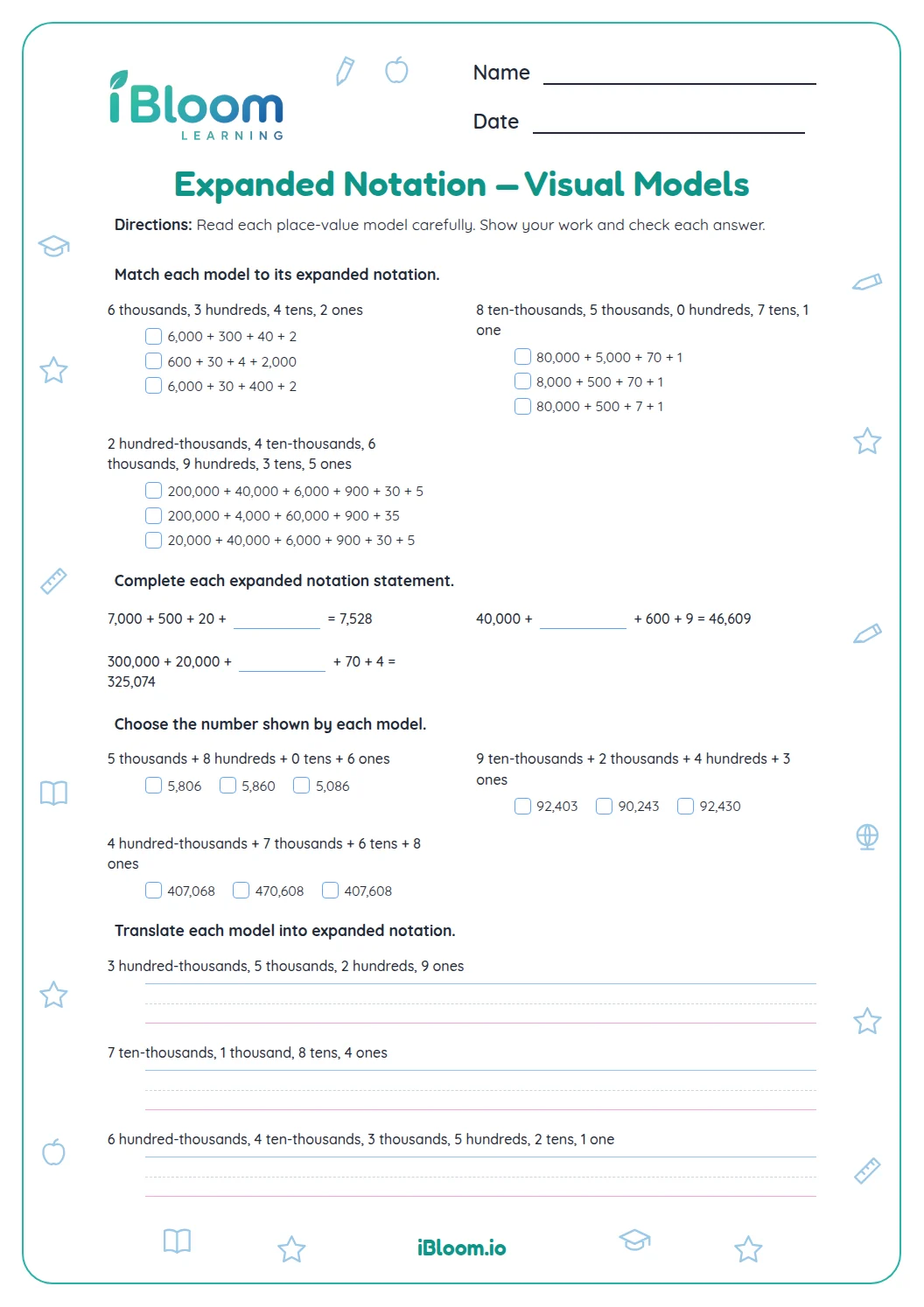
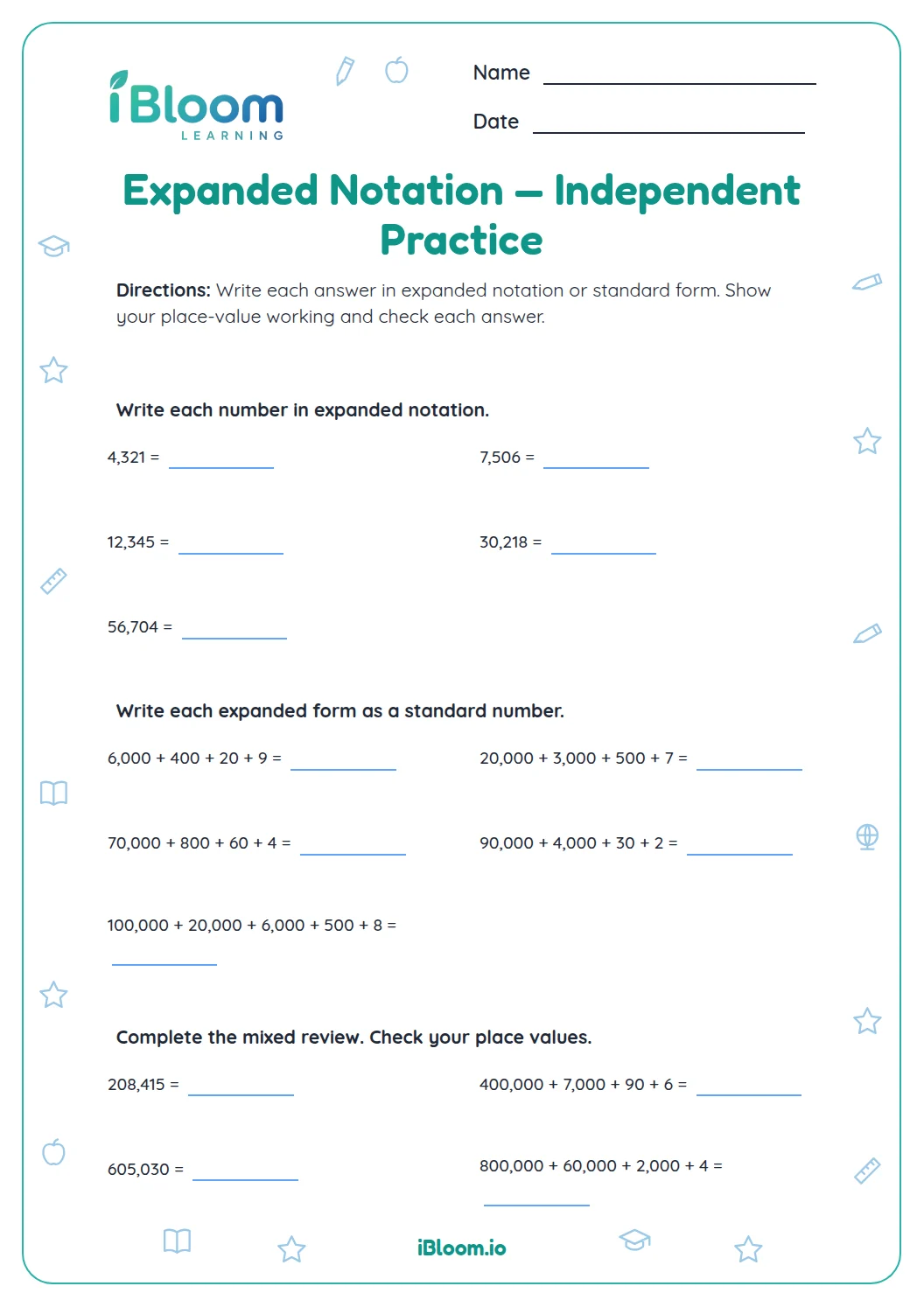
This Grade 4 worksheet asks children to build four-digit numbers from expanded notation and place-value descriptions. It includes regrouping, missing values, comparisons, and a digit-arrangement challenge across 16 questions. The questions focus on how each digit contributes thousands, hundreds, tens, or ones. The printable includes a separate answer key and aligns with Common Core 4.NBT.A.2 for reading and writing multi-digit whole numbers in expanded form.
Aligned to 4.NBT.A.2
How do you combine place-value parts?
Each part names a value, not just a digit. Add the thousands, hundreds, tens, and ones to form the numeral.
In question 1, 3,000 + 400 + 20 + 6 has 3 thousands, 4 hundreds, 2 tens, and 6 ones, so it is 3,426.
- 13,000 + 400 + 20 + 6
- 2= 3,426
What if a part has more than nine hundreds?
Regroup ten hundreds as one thousand. In question 11, 6,000 + 1,400 + 20 = 7,420.
What kinds of number puzzles are included?
The page moves from composing numerals to comparing, expanding, regrouping, and placing digits. The key gives the answer for each prompt.
How to use this worksheet
- 1Mark the place named by each part.
- 2Write each value in the matching place.
- 3Add the values or regroup when needed.
- 4Read the numeral aloud to check each digit.
- 5Use the answer key after completing the page.
Common mistakes and quick fixes
The mistake
Using a digit’s face value instead of its place value
The fix
Say the place aloud: in 4,000 + 500 + 5, the 5 represents five hundreds and the other 5 represents five ones.
The mistake
Dropping a zero placeholder
The fix
Name all four places before writing the number. A zero keeps the other digits in their correct places.
The mistake
Leaving 14 hundreds unregrouped
The fix
Trade 10 hundreds for 1 thousand, then combine the thousands and remaining hundreds.
Common Core alignment
The questions practice reading, writing, expanding, and comparing four-digit numbers by place value.
Compose, expand, and compare four-digit numbers by the value of each place.
On this sheet: Children compose and expand four-digit numerals from place-value parts and compare two numerals using <.
Show the official wordingHide the official wording
Read and write multi-digit whole numbers using base-ten numerals, number names, and expanded form. Compare two multi-digit numbers based on meanings of the digits in each place, using >, =, and < symbols to record the results of comparisons.
What to practice next
Make more practice
Further reading
Questions parents and teachers ask
What does “number from parts” mean?
It means combining place-value amounts to write one standard numeral. For example, 3,000 + 400 + 20 + 6 is 3,426. The worksheet also reverses the task: children start with a numeral and identify a missing place-value part. The answer key also shows standard numerals for checking.
How many problems are included?
There are 16 questions in four parts. Children compose numerals, compare two numbers, regroup hundreds, complete expanded forms, and arrange digits. The worksheet and its answer key each use two pages, and the key lists a numeral, missing value, or comparison sign for each item.
Why does 6 thousands and 14 hundreds equal 7,400?
Fourteen hundreds equals 1,400, or 1 thousand and 4 hundreds. Add that to 6,000 and then include 20: 6,000 + 1,400 + 20 = 7,420. Regrouping ten hundreds as one thousand keeps the total value unchanged. Check by regrouping the total into thousands and hundreds.
What should children do with a zero place?
Keep a zero when a place has no value. In 8,205, the zero marks the tens place; without it, 825 would name a different number. The worksheet includes numbers with zero hundreds or tens so children attend to every place.
Is there a key?
Yes. A separate answer key page lists the standard numerals, missing parts, expanded forms, and comparison sign. For a missed item, ask the child to name the thousands, hundreds, tens, and ones before writing the numeral again. Use each prompt’s place-value wording to trace a mistake to the correct digit.