





About this worksheet
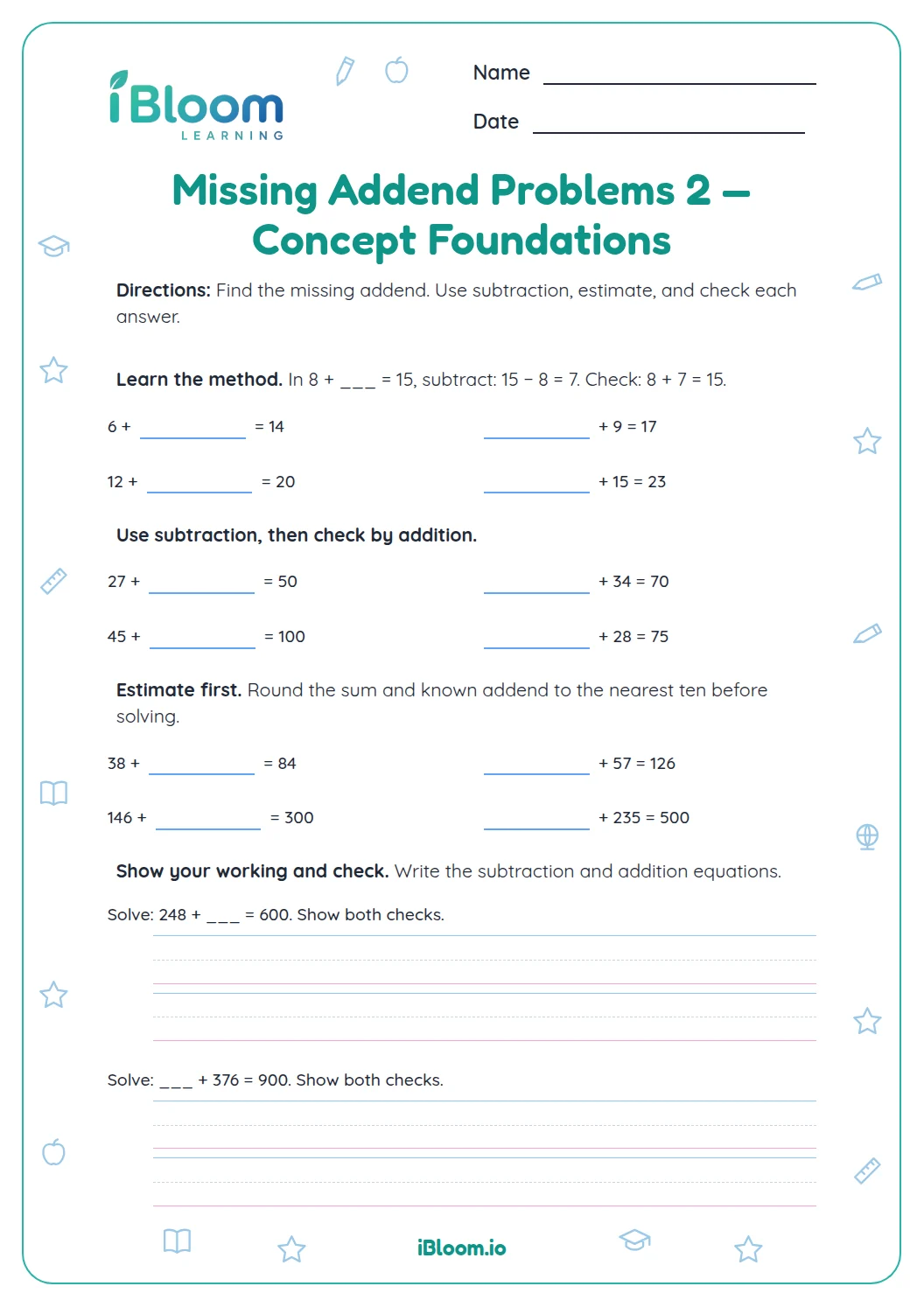
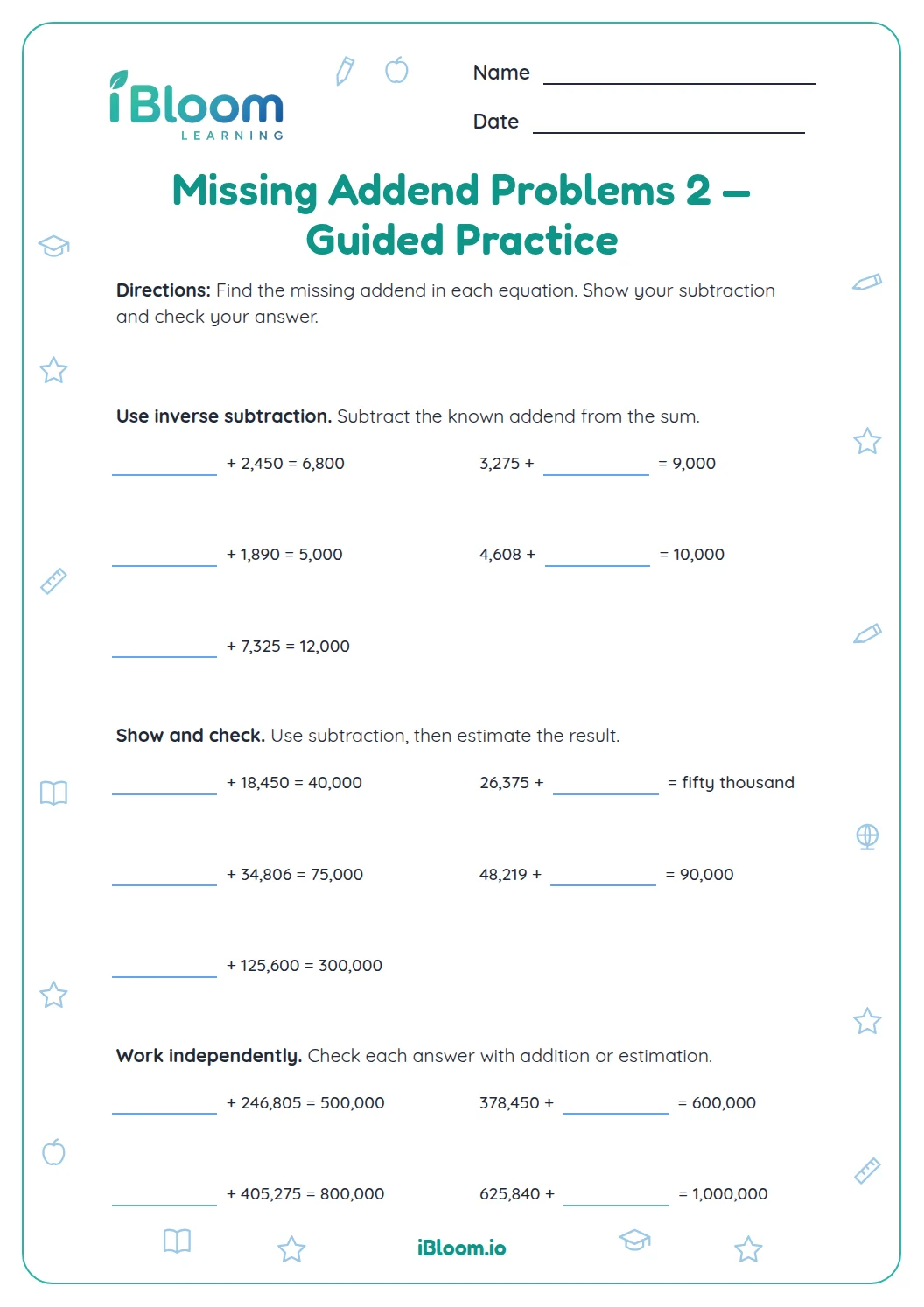
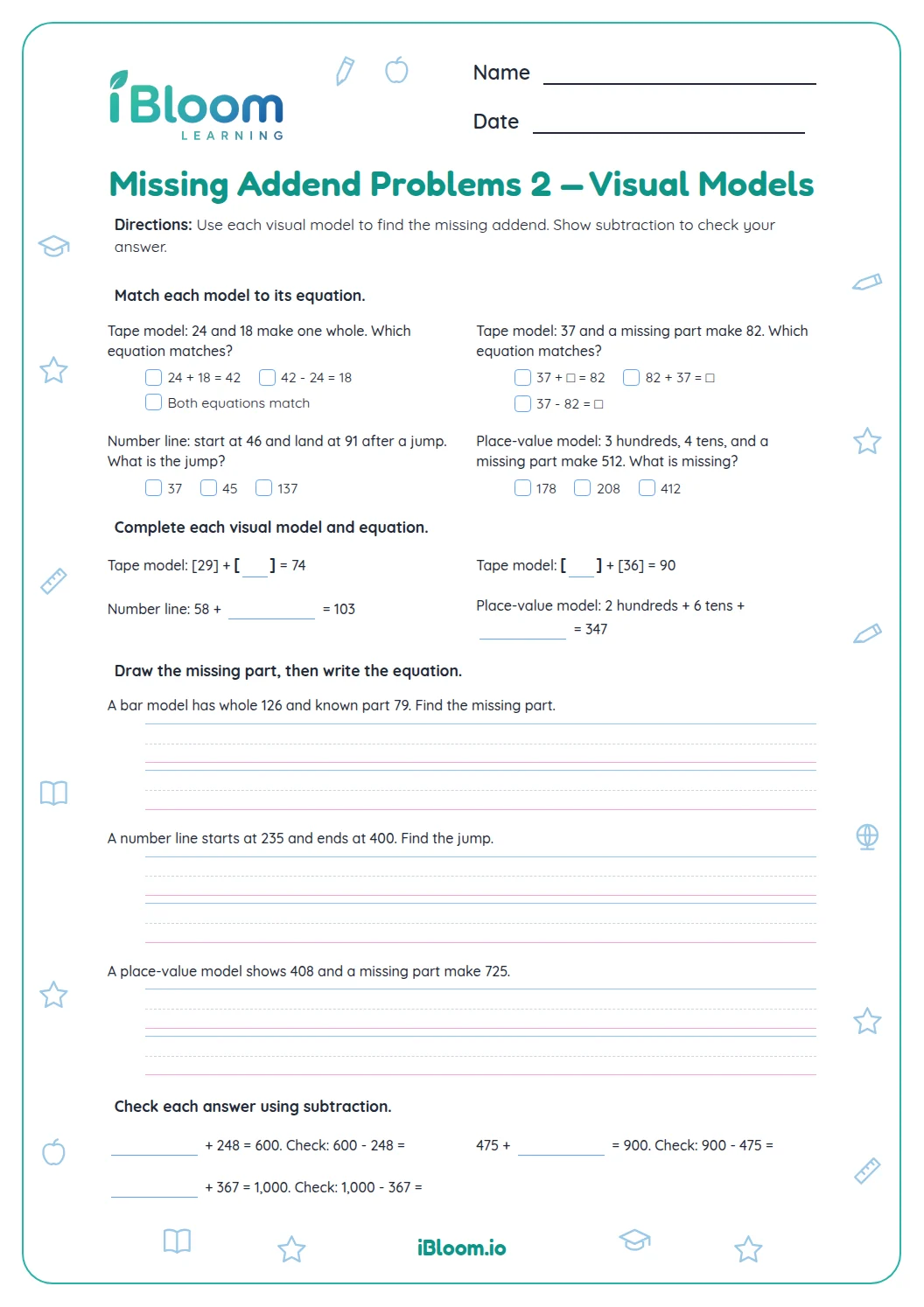
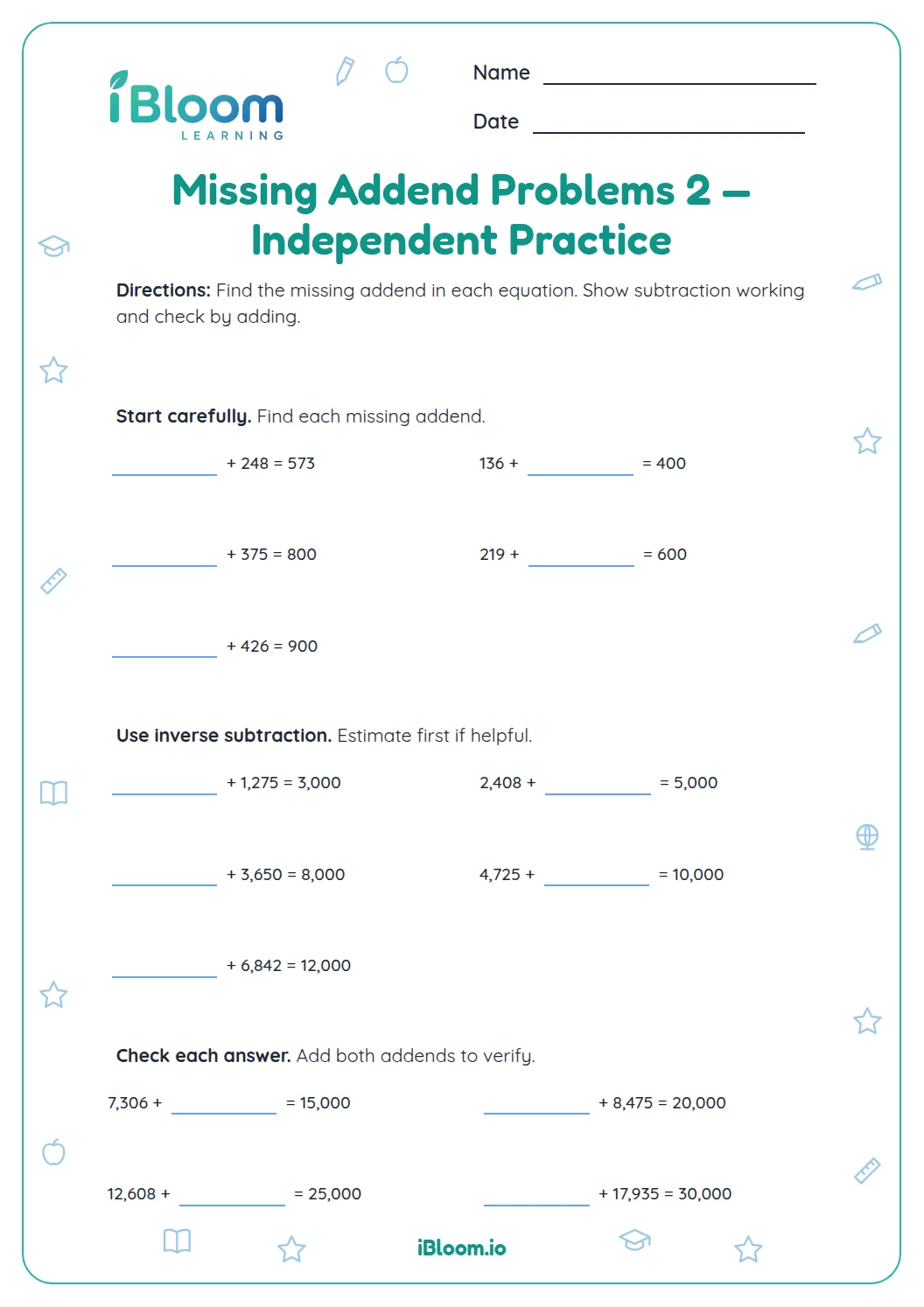
This Grade 5 worksheet gives 16 missing-number addition and subtraction equations with large whole numbers. Children find missing addends, starting numbers, and subtrahends by using inverse operations, then check each value in the original equation. The final five questions ask children to write a check. It practices CCSS 4.NBT.B.4 through multi-digit addition and subtraction.
Aligned to 4.NBT.B.4
How do inverse operations reveal a missing number?
The worksheet has three parts and 16 number sentences. Part A asks for missing addends and subtrahends; Part B asks children to use inverse operations and check; Part C uses larger values and asks for a reason or verification.
Question 3 uses the same idea in reverse: 75,000 − ___ = 28,450, so subtract 28,450 from 75,000 to find the missing amount.
- 14,725 + ___ = 8,000
- 28,000 − 4,725 = 3,275
- 3Check: 4,725 + 3,275 = 8,000
How can you check a subtraction blank?
If a number is subtracted from a starting amount, add the answer back to the remainder. For ___ − 16,725 = 42,275, combine 42,275 and 16,725 to recover 59,000.
How does an inverse-operation check work?
For Question 14, first find 44,322 in 90,000 − ___ = 45,678. Then add the remainder and the missing subtrahend: 45,678 + 44,322 = 90,000. The check returns the starting number.
How does an inverse-operation check work?
For Question 14, first find 44,322 in 90,000 − ___ = 45,678. Then add the remainder and the missing subtrahend: 45,678 + 44,322 = 90,000. The check returns the starting number.
How can I use this worksheet?
- 1Read which number is missing before choosing an operation.
- 2Use subtraction to find a missing addend.
- 3For a missing starting number, add the subtracted amount to the result.
- 4Write digits in matching place-value positions.
- 5Put the value back into the original equation to check.
Common mistakes and quick fixes
The mistake
Subtracting the two addends in a sum without considering the total.
The fix
Subtract the known addend from the sum.
The mistake
For ___ − 16,725 = 42,275, subtracting instead of adding.
The fix
Add the remainder and amount taken away to recover the start.
The mistake
Dropping a zero in a large number.
The fix
Align place values and check the result in the original sentence.
Common Core alignment
This worksheet practices the standard below through multi-digit number sentences.
Use addition and subtraction relationships to find missing whole-number values.
On this sheet: The equations require multi-digit addition or subtraction to recover a missing value.
Show the official wordingHide the official wording
Fluently add and subtract multi-digit whole numbers using the standard algorithm.
What to practice next
Make more practice
Further reading
Questions parents and teachers ask
What operation finds a missing addend?
Subtract the known addend from the sum. In Question 1, 8,000 − 4,725 = 3,275, so 4,725 + 3,275 = 8,000. Substitution checks the result in the original equation. Children can use the same inverse relationship for each addition blank.
How do I find a missing subtrahend?
Subtract the remainder from the starting number. For 75,000 − ___ = 28,450, calculate 75,000 − 28,450 = 46,550. Then check by subtracting 46,550 from 75,000 and confirming that 28,450 remains. This uses subtraction to undo subtraction and verify the blank.
How do I find a missing starting number?
When the starting number is missing in ___ − 16,725 = 42,275, add the remainder and the amount taken away: 42,275 + 16,725 = 59,000. Subtract 16,725 from 59,000 to check. This check returns the known remainder in the equation.
How many problems are included?
There are 16 missing-number questions in three parts. Part A builds inverse-operation practice, Part B asks children to solve and check, and the final part asks for written checks. The worksheet and answer key each have three pages.
Is an answer key included?
Yes. A separate three-page key lists the missing values for all 16 questions and shows sample inverse-operation checks for the final part. Ask the child to substitute a value into its equation; that confirms the operations and place values.