


About this worksheet
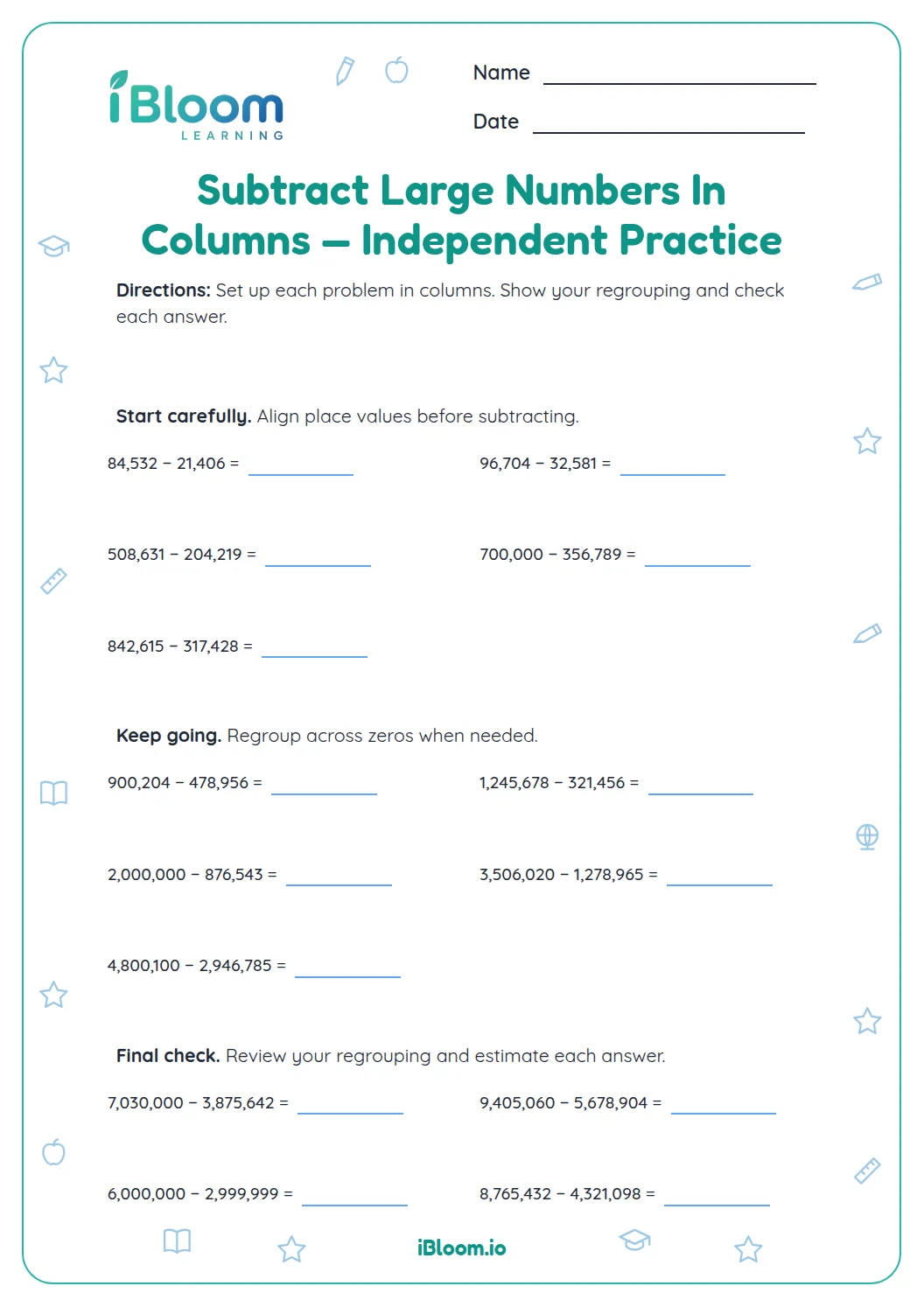
This Grade 5 printable gives students room to practice subtraction with multi-digit whole numbers. The first set builds column fluency; the next set includes zeros that require careful renaming. Two final scenarios ask students to choose subtraction and label the result.
Aligned to 4.NBT.B.4
Start with place value
Write ones under ones, tens under tens, and so on. Subtract from right to left. If the top digit is smaller, rename one unit from the next place as ten units in this place.
Regroup across zeros carefully
When a place has zero, move left until you reach a place with a unit to rename. Each zero you pass becomes 9 after it gives one ten to the place on its right. Recheck the digits before subtracting.
- 170,506 − 28,347
- 2Rename across the zero in the hundreds place.
- 3Subtract each place, then add 28,347 back to check.
How the practice builds
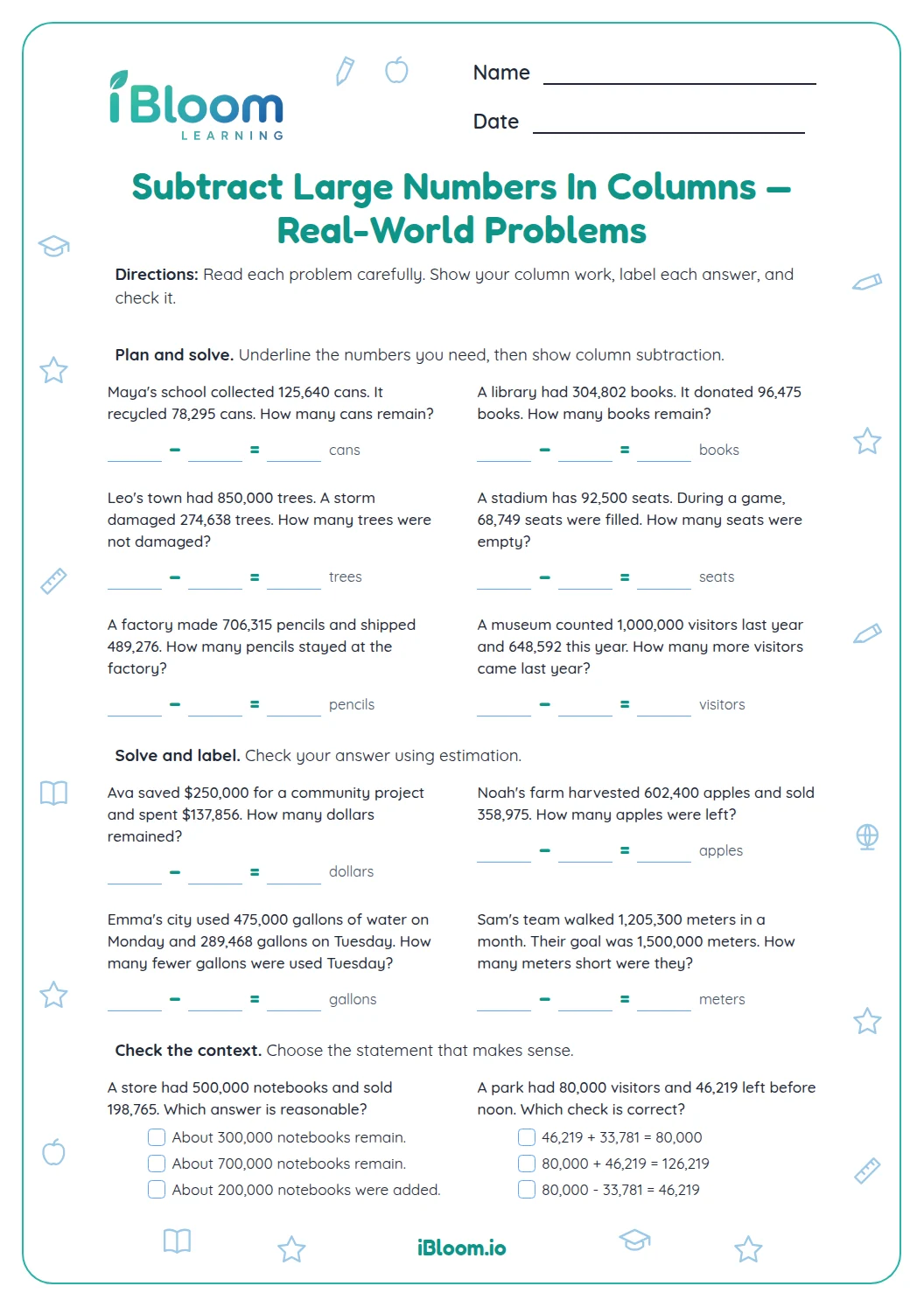
Questions 1–6 use five-digit numbers. Questions 7–12 move to six-digit values and more regrouping. Questions 13 and 14 apply subtraction in short contexts; the last two questions work backward or check a difference.
A steady column routine
- 1Copy the minuend and subtrahend with digits in matching columns.
- 2Start at the ones and rename when the top digit is too small.
- 3Track borrowing through zeros one place at a time.
- 4Subtract each column and bring down the result digit.
- 5Add the difference to the subtrahend to check.
Common regrouping slips
The mistake
Changing a zero to 9 without reducing the next nonzero digit by 1.
The fix
Follow the chain of regrouping from the first nonzero place and record each change.
The mistake
Subtracting the smaller digit from the larger digit in every column.
The fix
Regroup when the top digit is smaller; keep the subtraction order as top minus bottom.
Common Core alignment
Students practice multi-digit subtraction with the standard algorithm.
Fluently add and subtract multi-digit whole numbers using the standard algorithm.
On this sheet: Students subtract multi-digit whole numbers with regrouping, including across zeros.
Show the official wordingHide the official wording
Fluently add and subtract multi-digit whole numbers using the standard algorithm.
What to practice next
Make more practice
Further reading
Questions parents and teachers ask
How can I check a subtraction answer?
Line up ones under ones, tens under tens, and continue through the largest place. Begin in the ones column. When the top digit is smaller, rename one unit from the place to its left as ten units in the current place, then subtract.
What happens when I regroup across zeros?
Move left until you reach a place with a digit that can give one unit. That digit decreases by one. Each zero you pass becomes 9 after it gives one ten to the place on its right. Record the changes carefully before subtracting each column.
Why do the last problems include words?
Add the difference to the number that was subtracted. The total should equal the starting number. Estimation is another useful check: round both numbers to nearby thousands, subtract, and see whether the exact difference is a sensible size.
Is an answer key included?
Yes. Questions 13–16 place subtraction in museum, library, number, and stadium situations. Students identify the starting amount and the amount removed or compared, write a subtraction sentence where useful, and label an answer with the correct unit or quantity.
How can students check a subtraction answer?
Add the difference to the number that was subtracted. The sum should match the starting number. For example, after solving 70,506 − 28,347, add the result to 28,347. This inverse operation can reveal a regrouping error before the learner moves on.