


About this worksheet
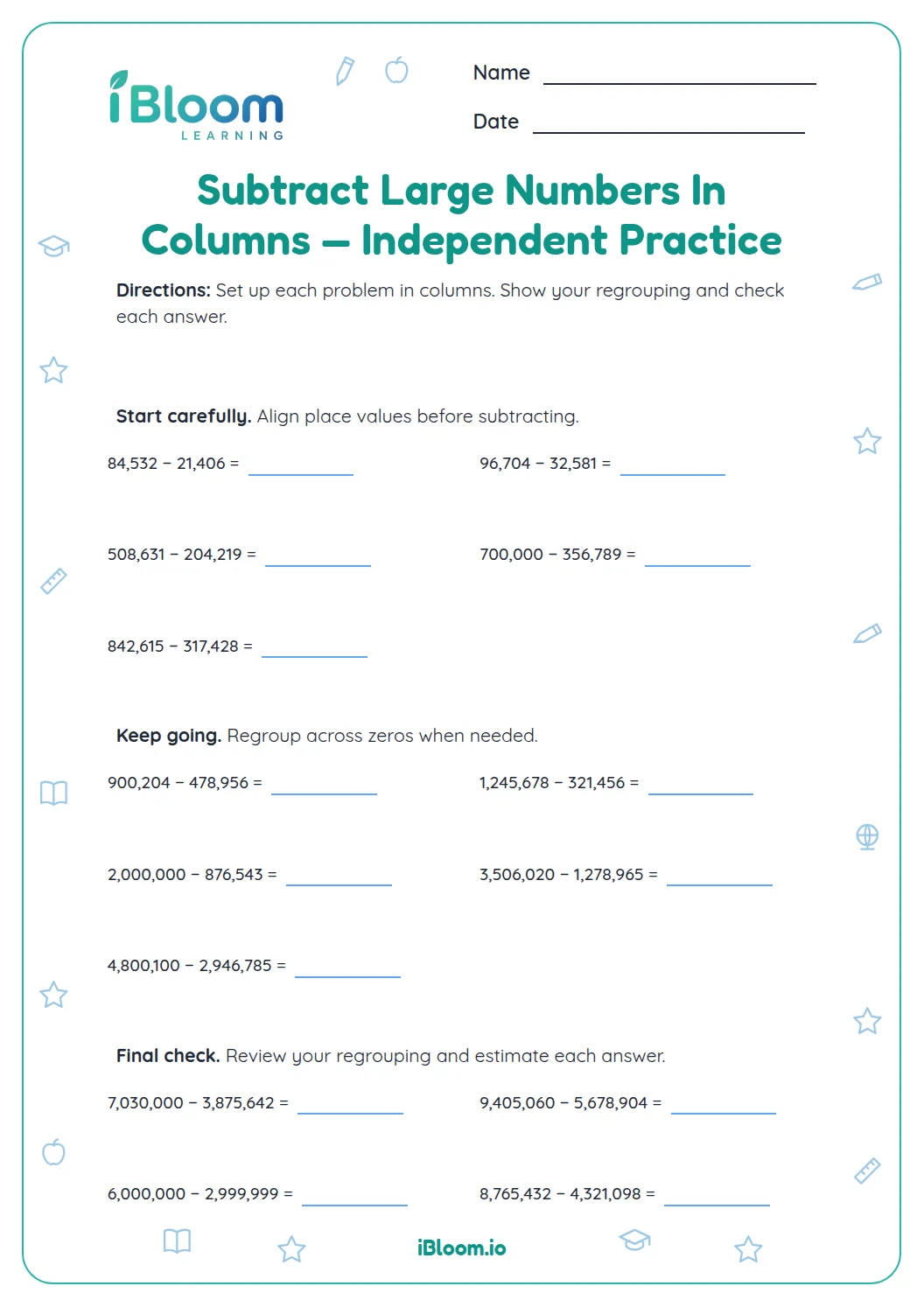
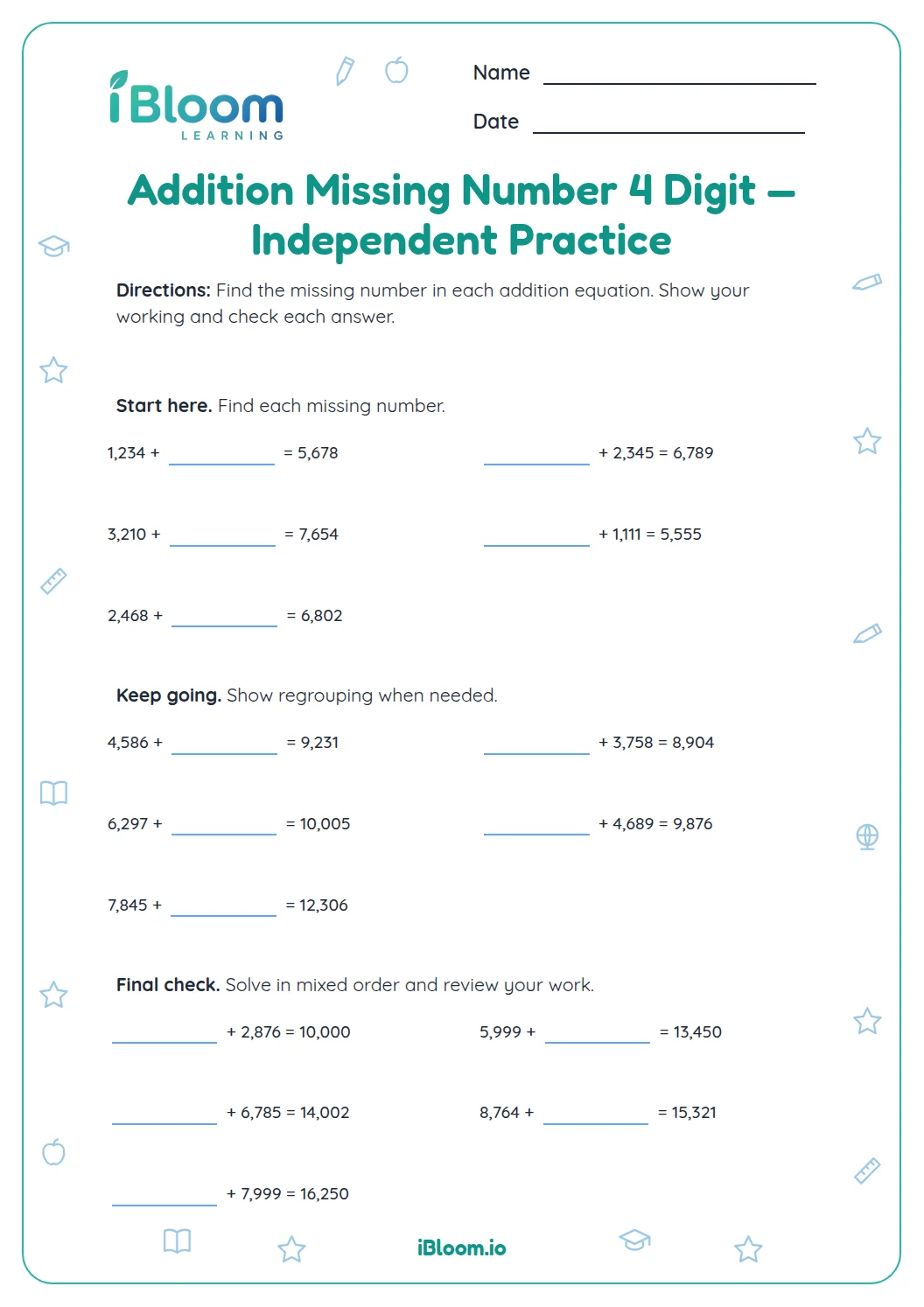
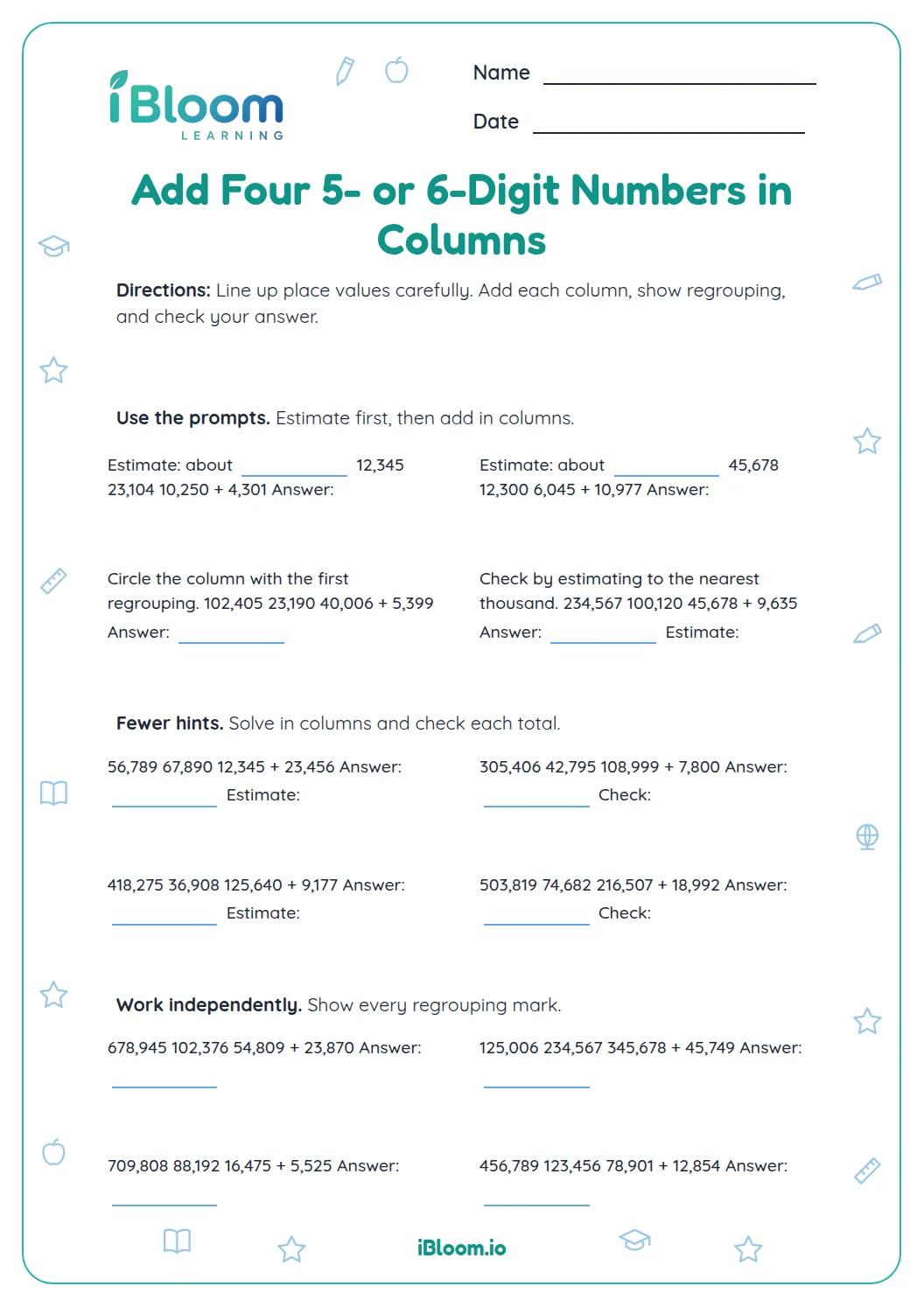
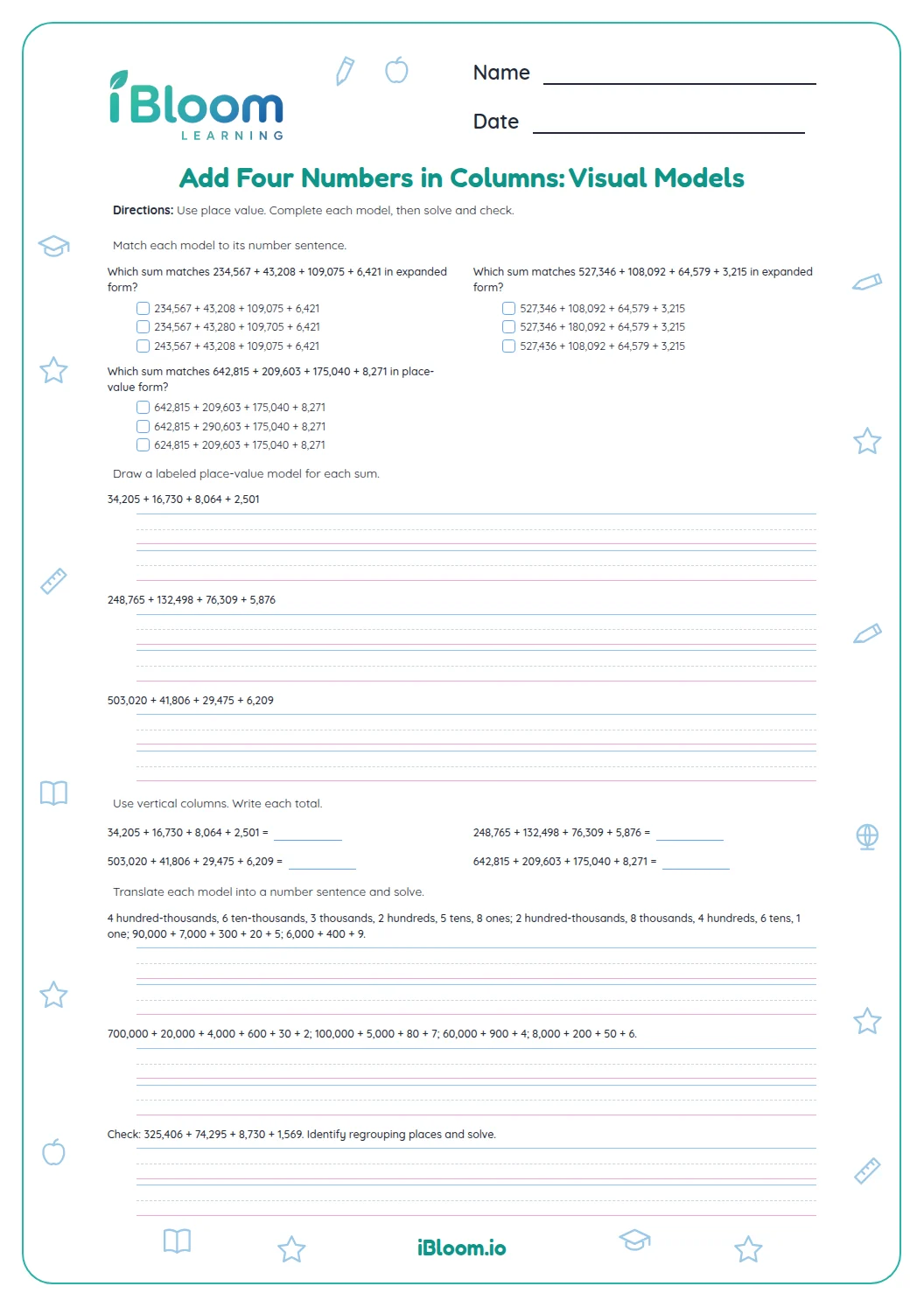
This free printable Grade 5 worksheet gives students 16 large-number subtraction problems to solve in columns. Part A begins with four calculations that need no regrouping. Part B has four problems with regrouping, and Part C includes eight calculations that require regrouping across zeros. Students set up each calculation vertically on scratch paper and record the difference on the sheet. The practice reinforces the standard subtraction algorithm in Common Core 4.NBT.B.4, and the answer key lists all 16 differences.
Aligned to 4.NBT.B.4
How should students line up large numbers?
Start with the ones digits at the right. Tens belong under tens, hundreds under hundreds, and so on. Set up each calculation vertically on scratch paper, then record its difference on the worksheet.
The first four problems need no regrouping. Students can focus on staying in the correct column and recording every digit of the difference.
What does regrouping change?
Regrouping changes how a number is represented, not its value. When a top digit is smaller than the digit being subtracted, trade one unit from the column to the left for ten units in the current column. Update both columns before continuing.
- 1Ones: trade 1 ten for 10 ones; 13 − 7 = 6.
- 2Tens: the 8 tens became 7 tens; 7 − 6 = 1.
- 3Hundreds: trade 1 thousand; 12 − 8 = 4.
- 4Thousands: the 4 became 3; 3 − 1 = 2.
- 5Ten-thousands: 6 − 2 = 4. Difference: 42,416.
How do students regroup across zeros?
For question 9, 70,004 − 28,657, the nearest nonzero digit to supply the ones column is the 7 in the ten-thousands place. Regroup through each zero, recording the changed digits before subtracting. Part C gives eight opportunities to practice this process.
The top number can be represented as 6 ten-thousands, 9 thousands, 9 hundreds, 9 tens, and 14 ones. Subtracting gives 41,347. Adding 28,657 and 41,347 restores 70,004, which checks the calculation.
How to use this worksheet
- 1Write the two numbers vertically, aligning the ones digits.
- 2Subtract each column from right to left in Part A.
- 3In Part B, mark both digits affected by each regrouping step.
- 4In Part C, move to the nearest nonzero place and track each trade through the zeros.
- 5Add the difference to the number subtracted to check a result.
- 6Compare all twelve final differences with the answer key.
Mistakes to check together
The mistake
Subtracting the smaller digit from the larger digit in each column.
The fix
Keep the subtraction in top-minus-bottom order; regroup when the top digit is too small.
The mistake
Regrouping into a column without reducing the column to its left.
The fix
Cross out and rewrite both affected digits before subtracting.
The mistake
Changing every zero to 9, including the column that receives the final trade.
The fix
The final receiving column gains 10 units; intervening zero columns retain 9 after passing a unit on.
Common Core alignment
Use the standard algorithm to subtract five- and six-digit whole numbers.
On this sheet: All twelve problems ask students to set up column subtraction and record the difference.
Show the official wordingHide the official wording
Fluently add and subtract multi-digit whole numbers using the standard algorithm.
What to practice next
Make more practice
Further reading
Questions parents and teachers ask
Are the subtraction problems already arranged vertically?
Students arrange each printed subtraction in columns themselves. The worksheet gives a line for each difference. Students can set up the calculation vertically on scratch paper, starting with the ones column and placing each remaining digit to the left.
How many problems require regrouping?
Twelve of the 16 problems require regrouping. Part A has four without regrouping, Part B has four with regrouping, and Part C has eight involving zeros in the top number. This order lets students establish careful column alignment before tracking several changes to the top digits.
How can my child check 64,283 − 21,867?
Add the difference, 42,416, to 21,867. Their sum is 64,283, so the subtraction checks. If the sum differs, look first at the regrouped ones and hundreds columns, then confirm that the digits in the columns supplying those trades were each reduced by one.
What happens when there are several zeros?
Regroup from the nearest nonzero digit to the left and pass the value through each place. For 70,004, the useful regrouping is 6 ten-thousands, 9 thousands, 9 hundreds, 9 tens, and 14 ones. Record those changes before subtracting 28,657 so no trade is lost.
What does the answer key show?
The answer key gives the final difference for each of the 16 calculations. Use it after reviewing the column work, since a correct result is most useful when the place-value trades also make sense. Ask your child to check one result by addition and explain one regrouping step.