



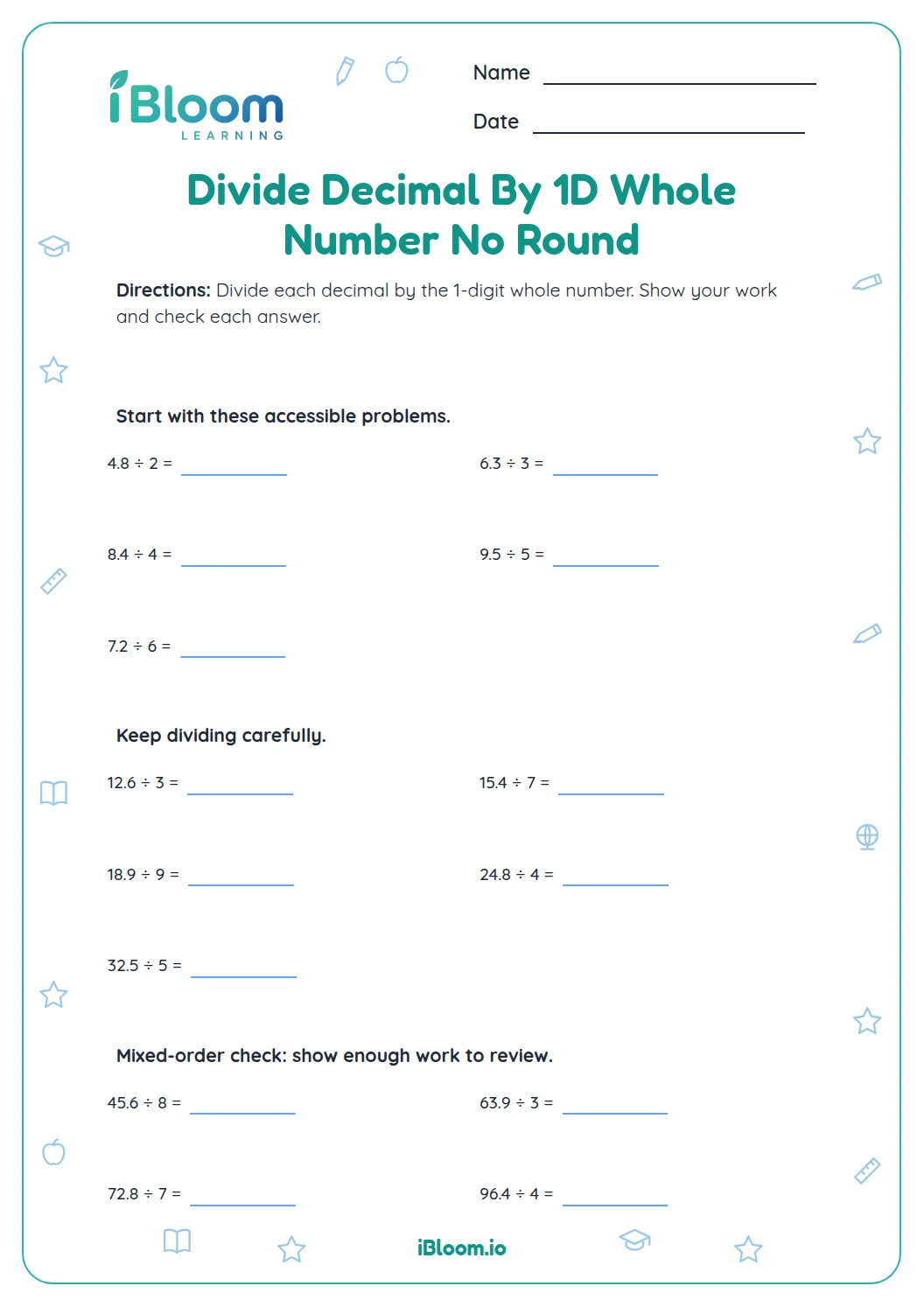


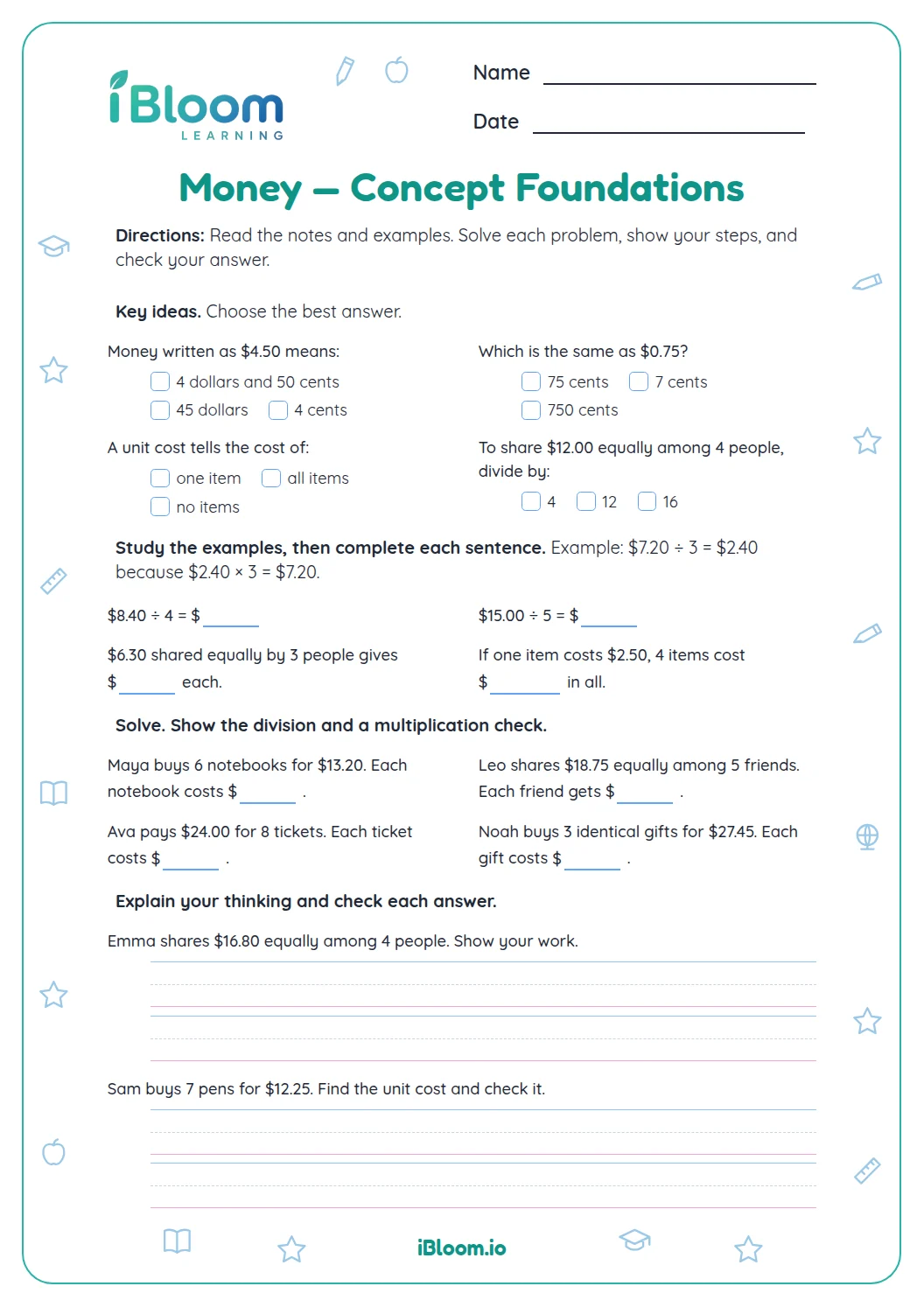


About this worksheet
This free Grade 5 worksheet challenges children to find what is missing in a decimal division equation. Part A mixes missing dividends, whole-number divisors, and quotients. Part B asks children to choose checks and diagnose decimal-place mistakes. Part C requires two short explanations. All 14 questions use exact answers through hundredths and practice Common Core 5.NBT.B.7. A separate answer key includes multiplication checks and sample explanations, so adults can check the reasoning as well as the number.
Aligned to 5.NBT.B.7
Why does the position of the blank matter?
The dividend is the amount being divided. The divisor tells the number of equal groups, and the quotient tells the amount in each group. Their relationship stays the same when one number is hidden.
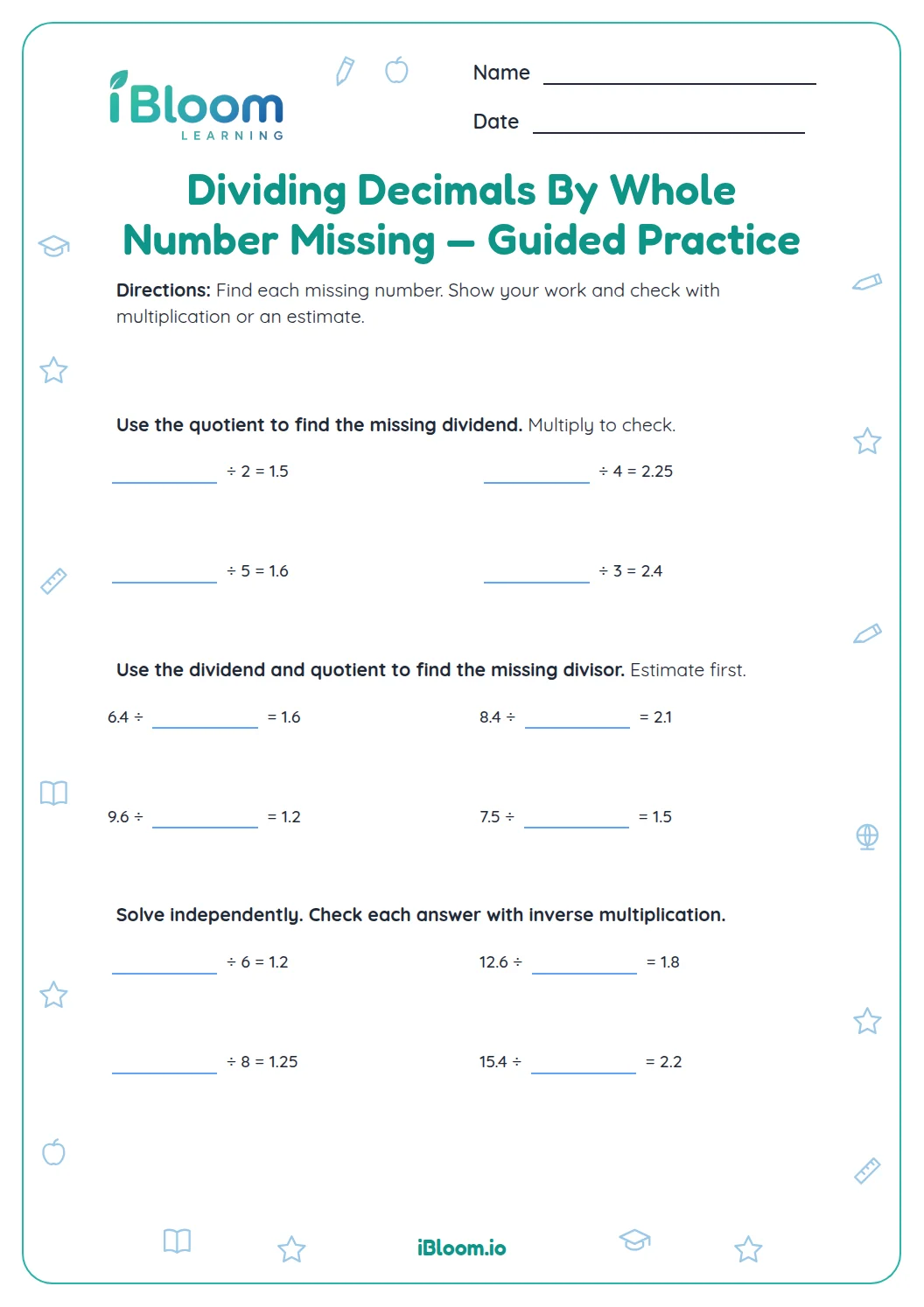
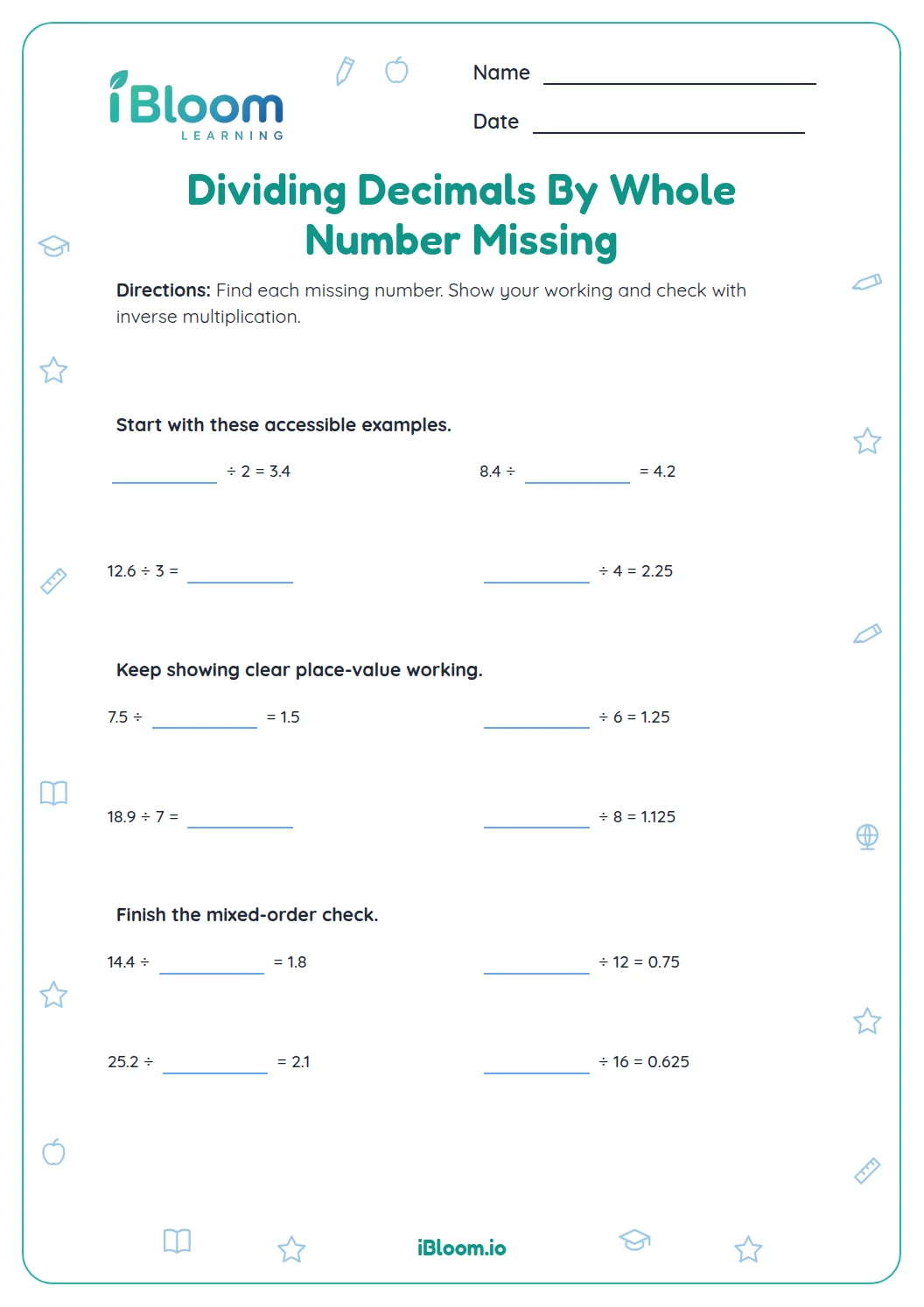
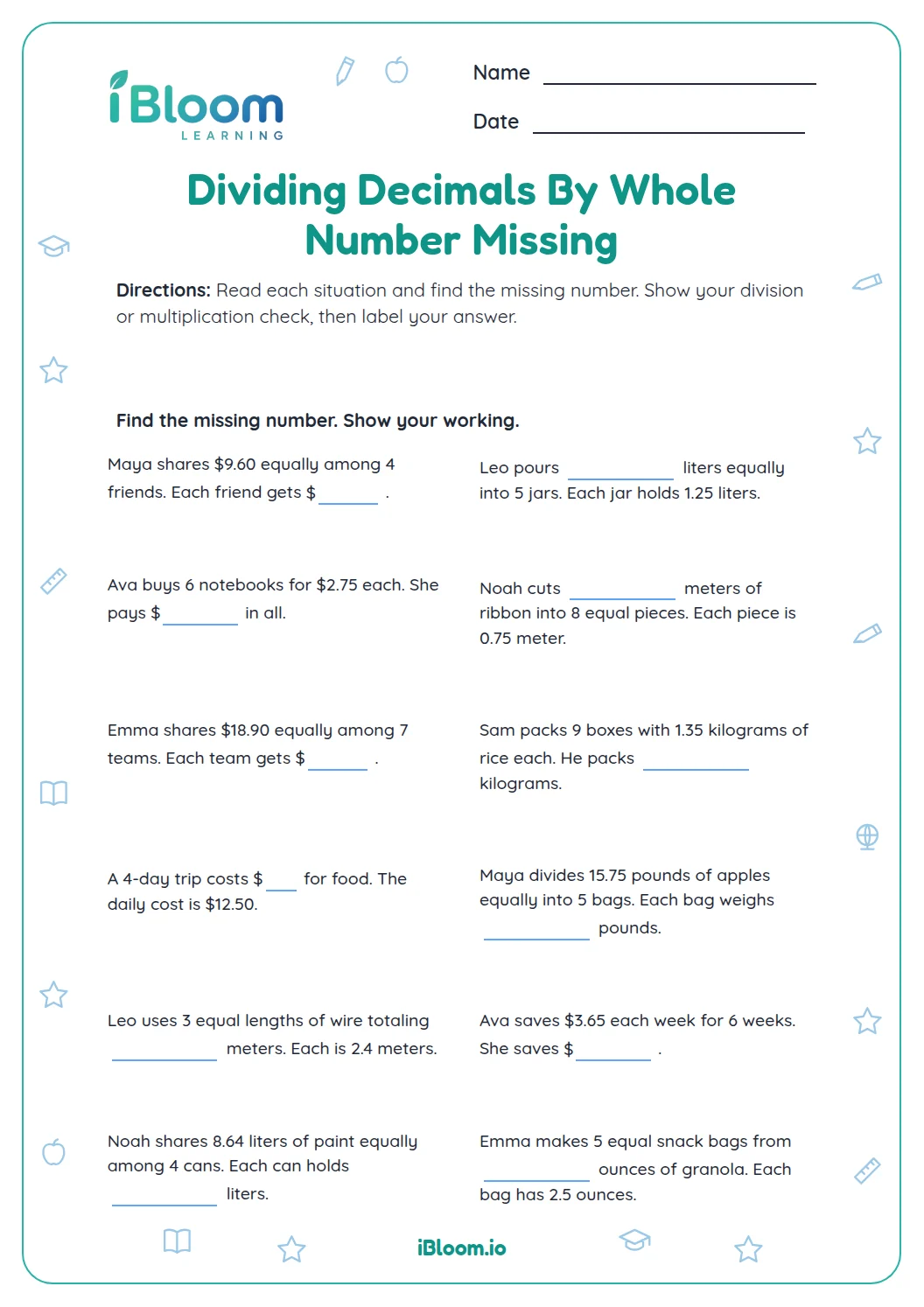
For a missing dividend, multiply the divisor by the quotient. For a missing divisor, find how many groups of the quotient make the dividend. For a missing quotient, divide the dividend by the divisor.
How can multiplication check a decimal answer?
Use the answer in the original equation, then reverse the division. Question 3 asks how many groups of 0.9 make 6.3. Seven groups do, since 7 × 0.9 = 6.3.
- 16.3 ÷ ___ = 0.9
- 263 tenths ÷ 9 tenths = 7 groups
- 37 × 0.9 = 6.3
- 4The missing whole-number divisor is 7.
What makes these questions a reasoning challenge?
Part A changes the position of the blank. Part B includes a decimal-place error, a multiplication check, a missing dividend with a reason, and an estimate about a quotient smaller than one.
Part C asks for words as well as numbers. For 0.48 ÷ 4, naming hundredths explains why the answer is 0.12. A statement such as “I moved the decimal” does not explain the equal groups.
How to use this worksheet
- 1Name the dividend, divisor, and quotient in question 1.
- 2Label the job of each blank before calculating Part A.
- 3Use a multiplication fact to check every completed equation.
- 4Read the reasons in Part B and reject any that do not prove the result.
- 5For Part C, include the place-value unit or the full multiplication check.
Mistakes to notice and fix
The mistake
Dividing 0.24 by 5 to find the blank in ___ ÷ 5 = 0.24.
The fix
The blank is the total: multiply 5 × 0.24 to get 1.2.
The mistake
Writing 9 for 3.6 ÷ 4 because 36 ÷ 4 = 9.
The fix
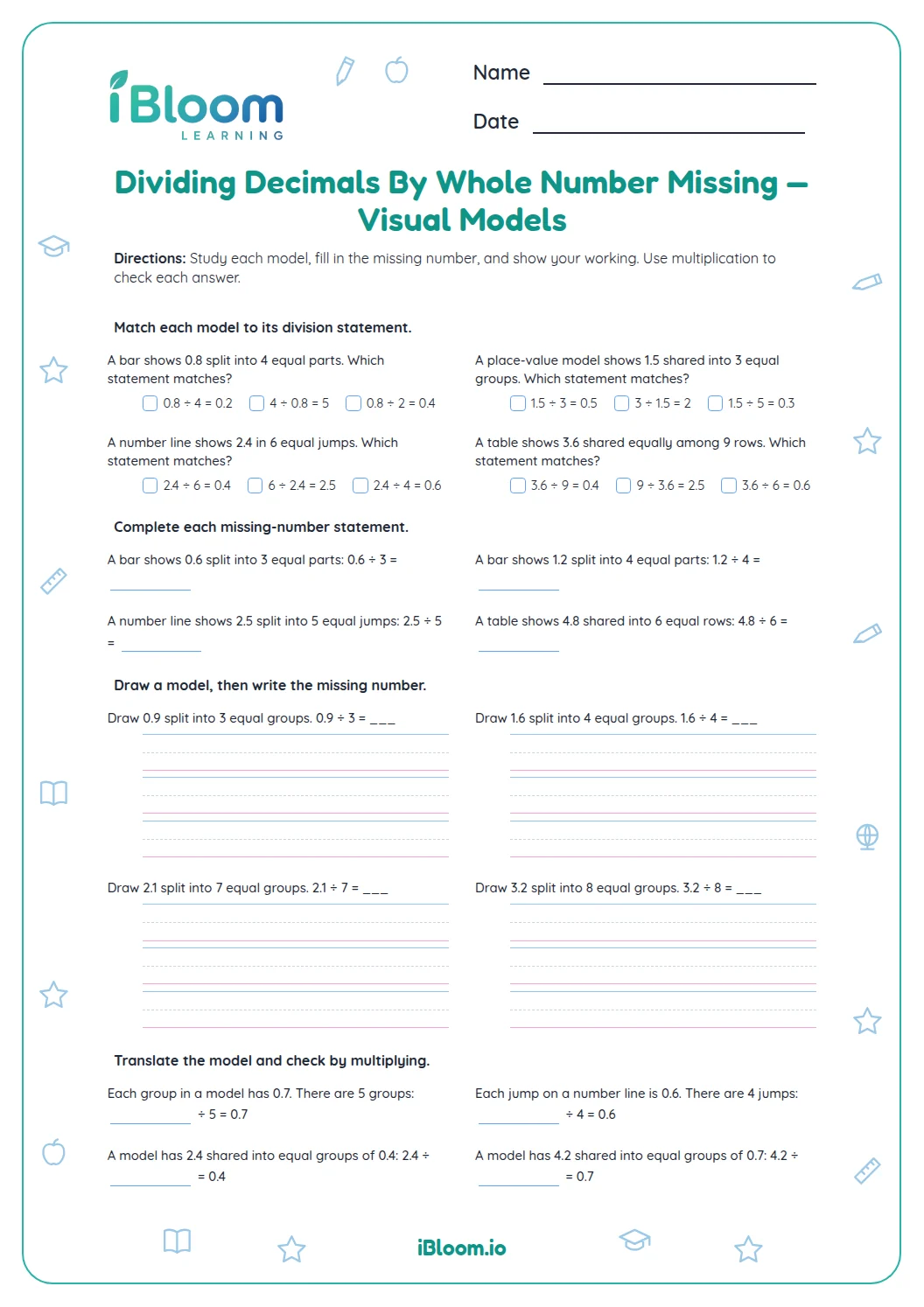
Name the units: 36 tenths divided by 4 gives 9 tenths, or 0.9.
The mistake
Assuming any decimal dividend gives a quotient below one.
The fix
Compare the dividend with the divisor; 8.4 ÷ 4 is 2.1, but 2.4 ÷ 6 is 0.4.
Common Core alignment
Find missing decimal dividends, whole-number divisors, and quotients; explain and check the results.
On this sheet: Missing-number equations, error analysis, and explanations connect decimal division with multiplication.
Show the official wordingHide the official wording
Add, subtract, multiply, and divide decimals to hundredths, using concrete models or drawings and strategies based on place value, properties of operations, and/or the relationship between addition and subtraction; relate the strategy to a written method and explain the reasoning used.
What to practice next
Make more practice
Further reading
Questions parents and teachers ask
Which missing numbers appear on this worksheet?
The blanks include dividends, whole-number divisors, and quotients. Part A gives two examples of each type, so children must read the whole equation before choosing an operation. Later questions revisit a missing divisor and a missing dividend with answer choices that include reasons or multiplication checks.
Do children need to round any answers?
No rounding is needed because every division has an exact answer. The questions use tenths and hundredths, including 0.48 ÷ 4 = 0.14. Encourage children to keep the original place-value units in mind and multiply back to the dividend before deciding that a quotient is correct.
Why is 3.6 divided by 4 equal to 0.9?
There are 36 tenths in 3.6, and sharing them among four equal groups gives nine tenths in each group. Nine tenths is 0.9. The multiplication check is 4 × 0.9 = 3.6; multiplying four by nine instead would give 36, ten times the intended dividend.
What should a good Part C explanation include?
A good explanation connects the calculation to place value or multiplication. For question 11, children can describe sharing 48 hundredths into four groups of 14 hundredths. For question 14, they should identify nine as the missing divisor and use 9 × 0.6 = 5.4 to check it.
How can I help without giving the missing number?
Ask the child to name the job of the blank and read the equation as equal groups. Then ask which multiplication would put those groups back together. For ___ ÷ 5 = 0.24, five groups of 0.24 make the missing total, so the next step becomes clear.