


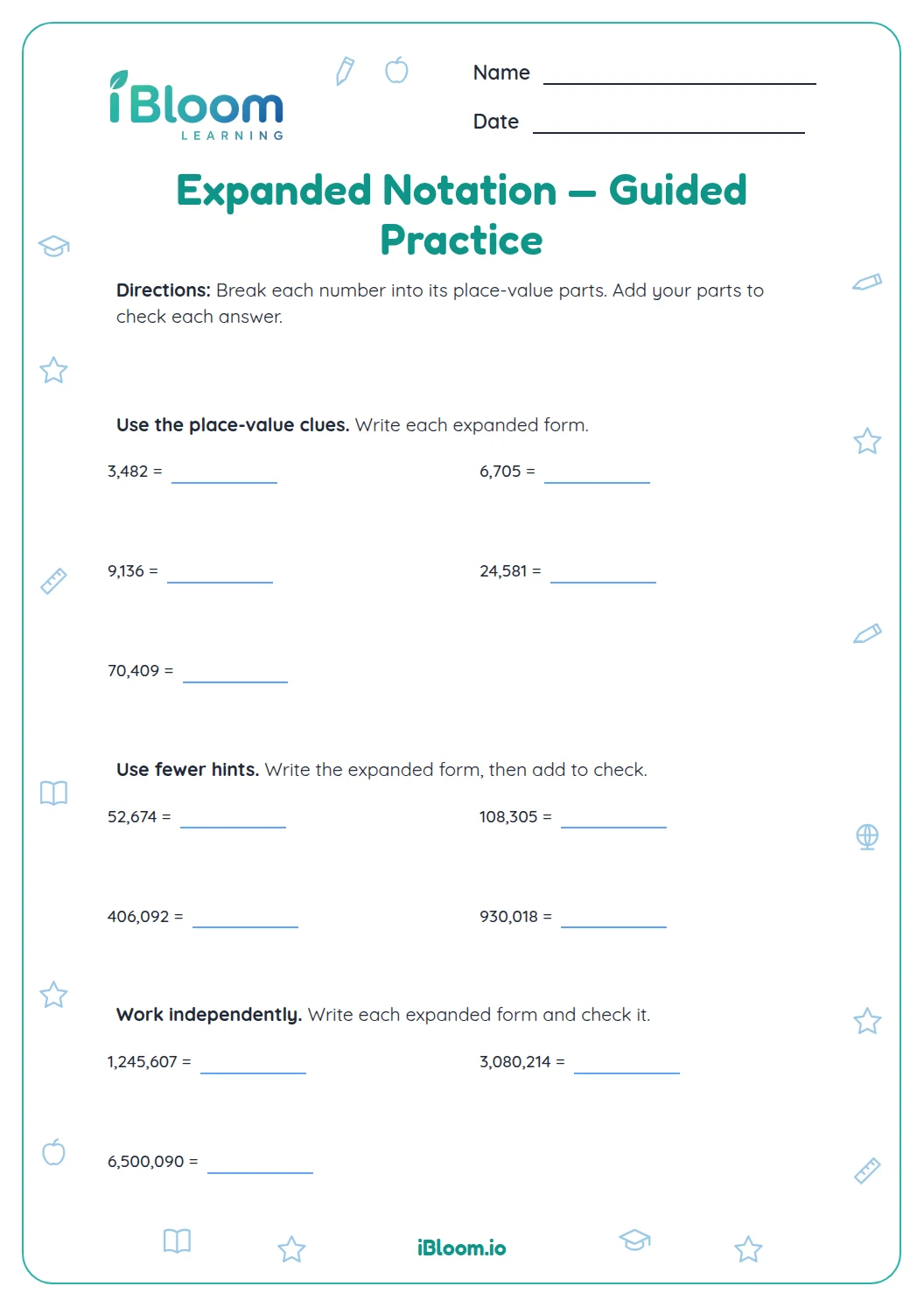
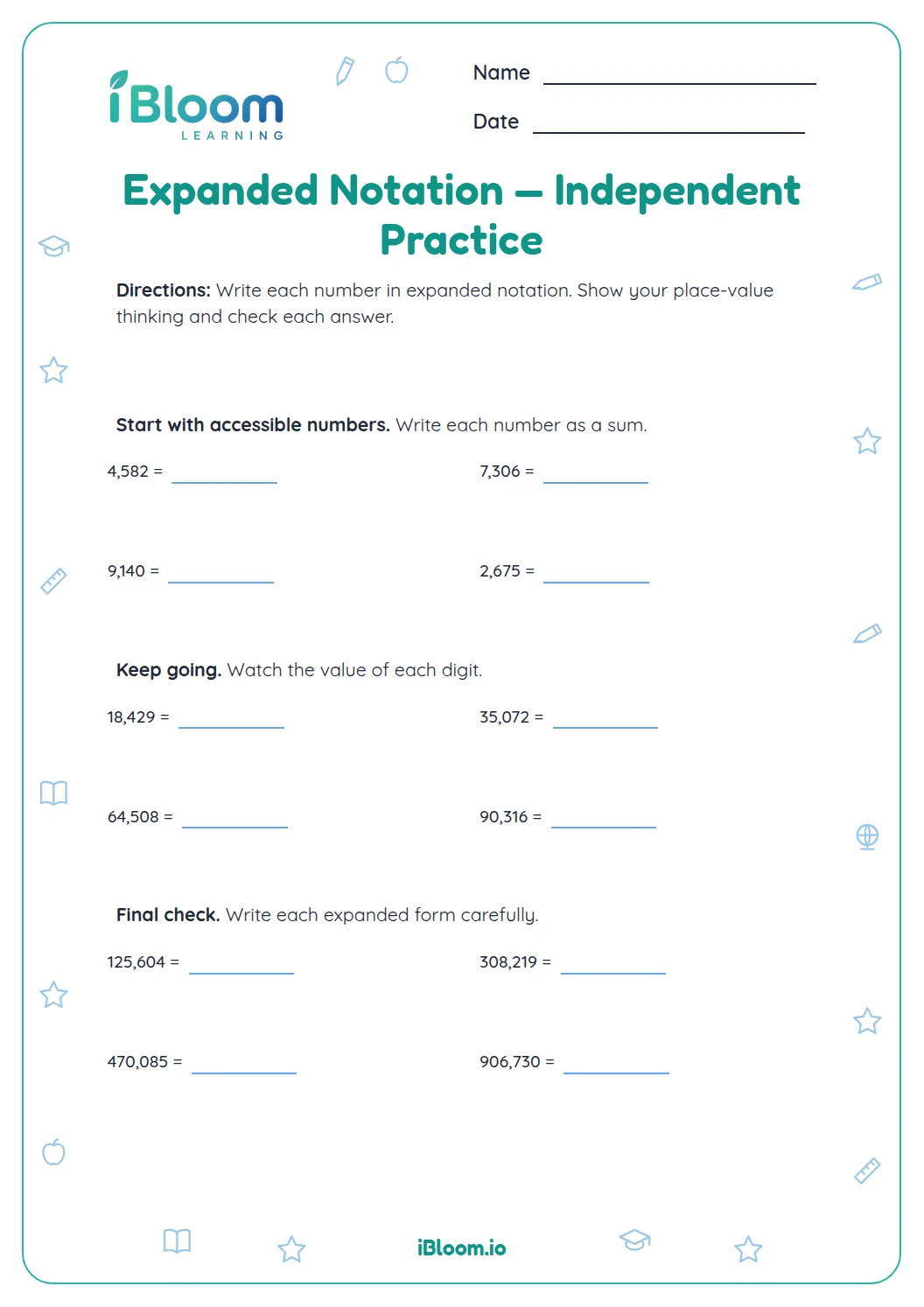
About this worksheet
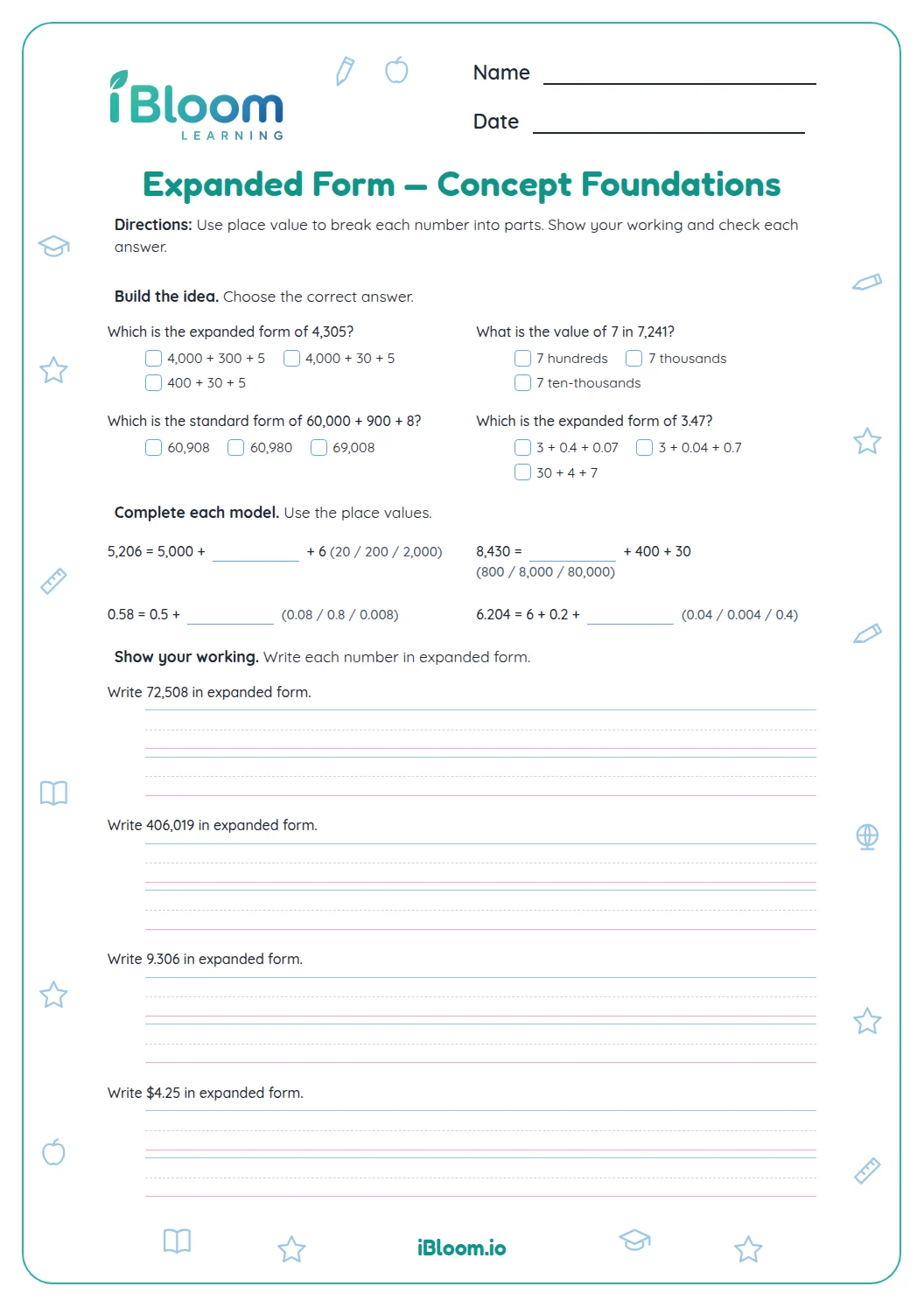
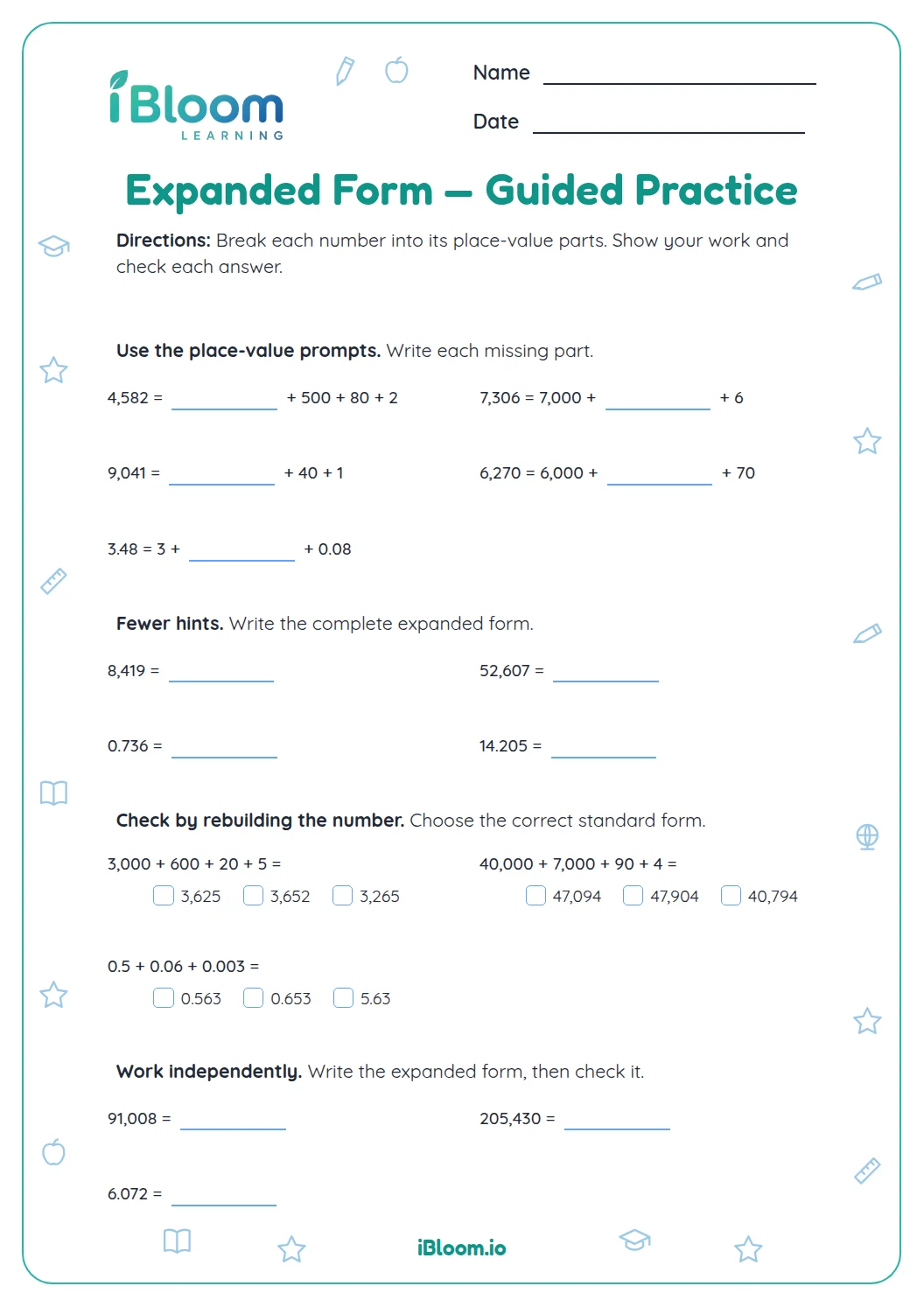
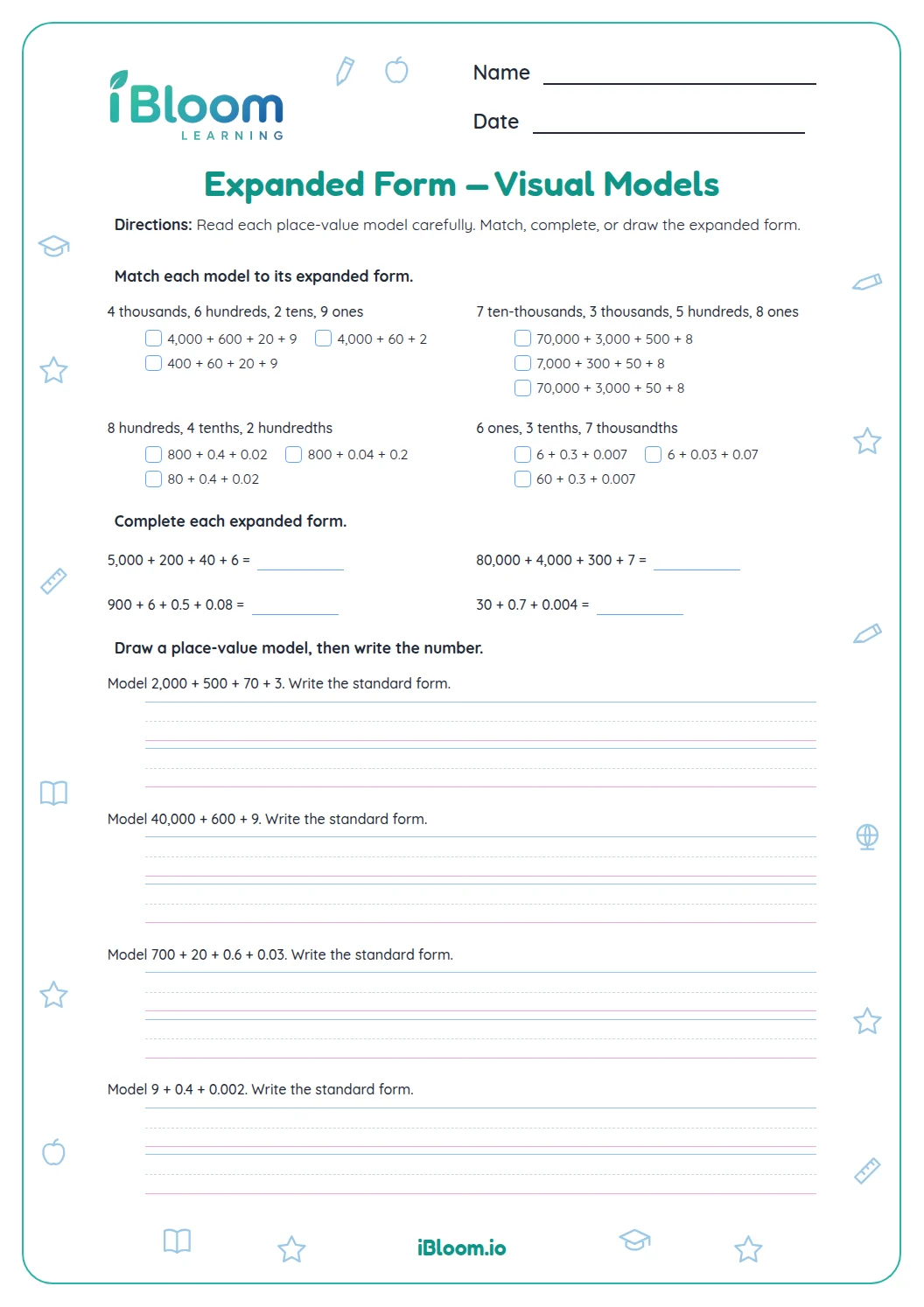
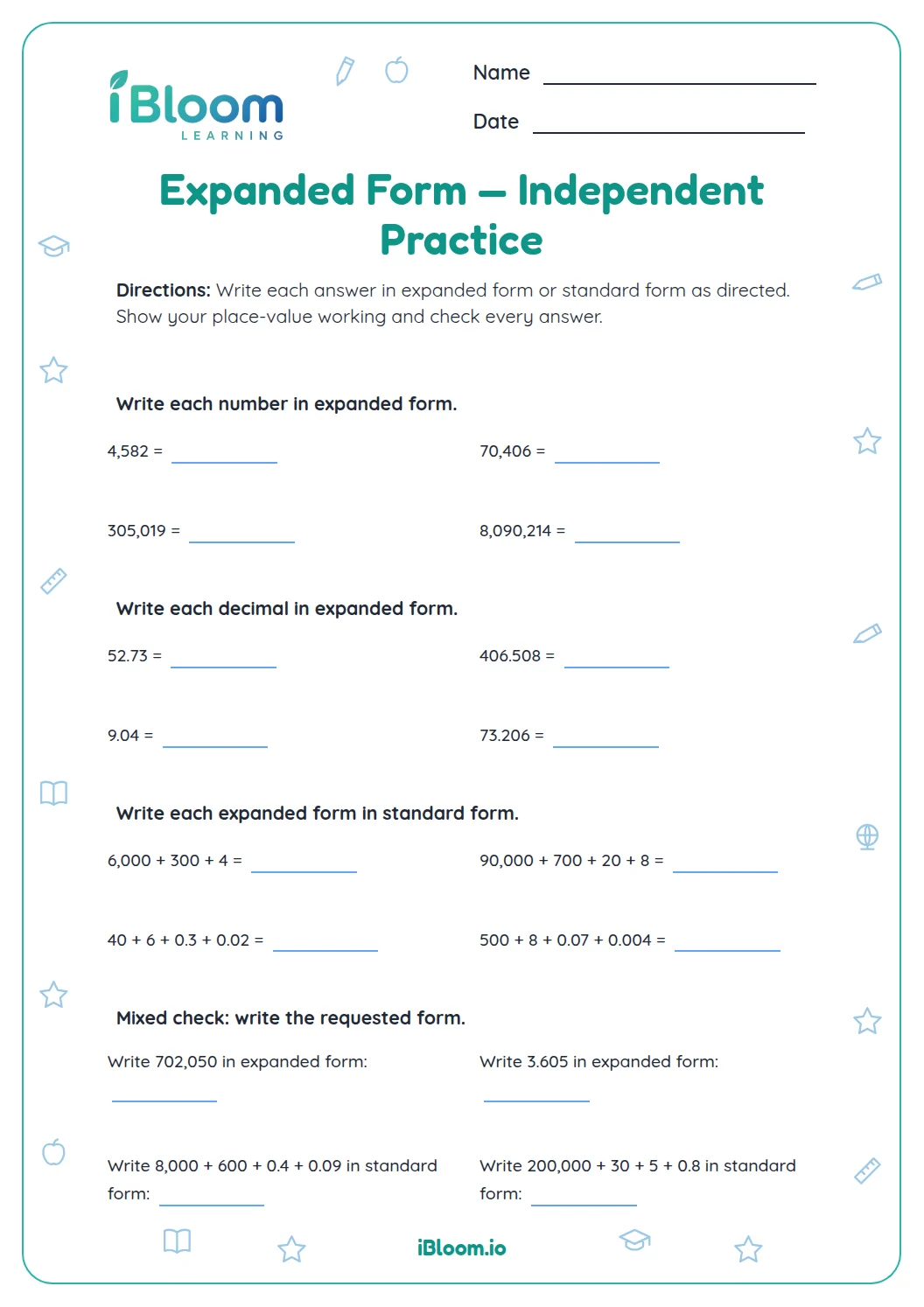
This free Grade 5 worksheet connects expanded form to situations involving visitors, distances, supplies and measurements. Students identify place-value sums, write whole numbers and decimals in expanded form, and solve three story problems. The work supports CCSS 5.NBT.A.1 by focusing on how each digit’s value depends on its place. A separate key shows the expanded forms and computations.
Aligned to 5.NBT.A.1
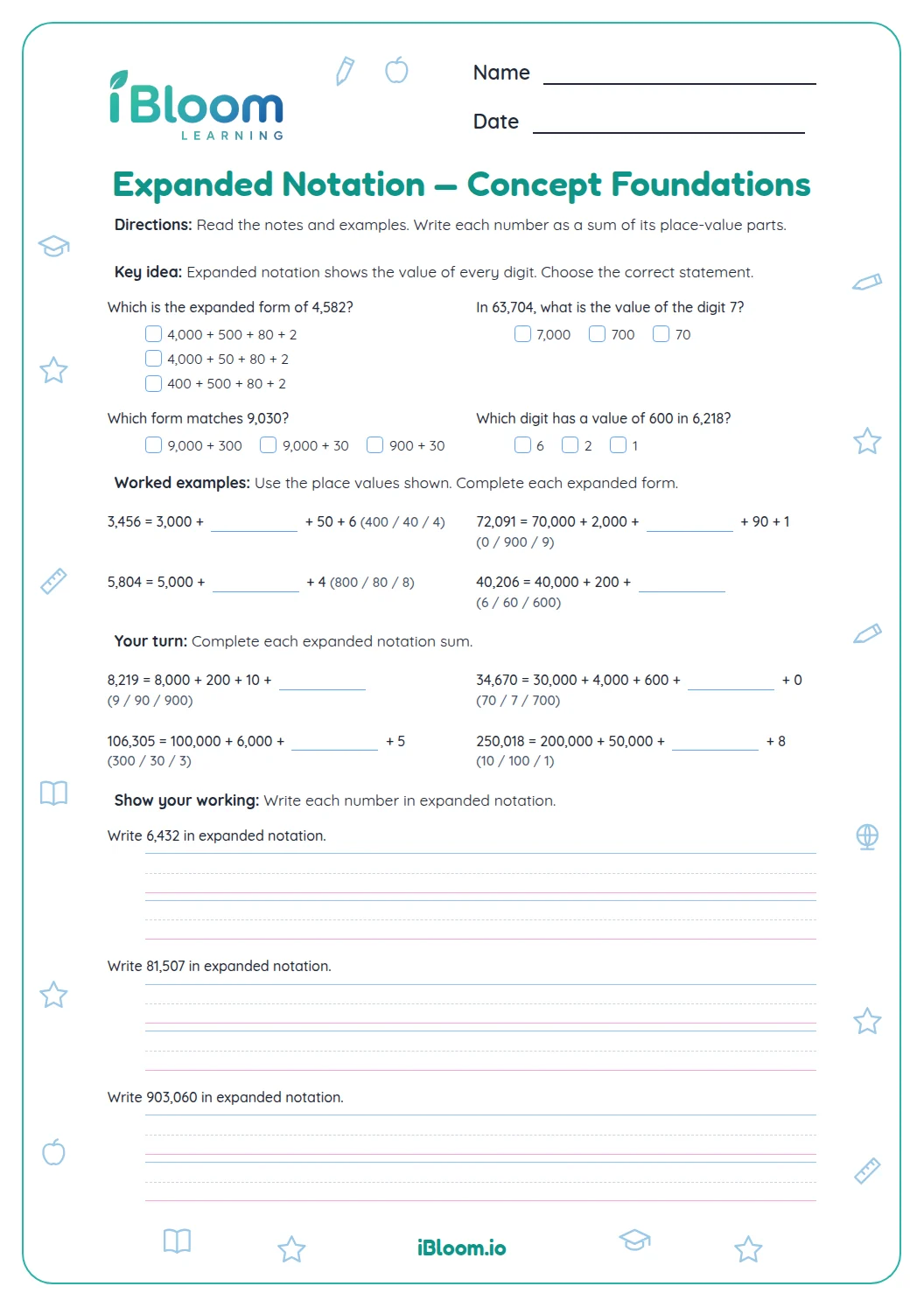
How do you expand a whole number?
Write each digit’s value as a sum. In 305,042, the nonzero digits represent 300,000, 5,000, 40 and 2. A zero place contributes no addend.
- 1305,042 = 300,000 + 5,000 + 40 + 2
- 2The 5 is in the thousands place, so its value is 5,000.
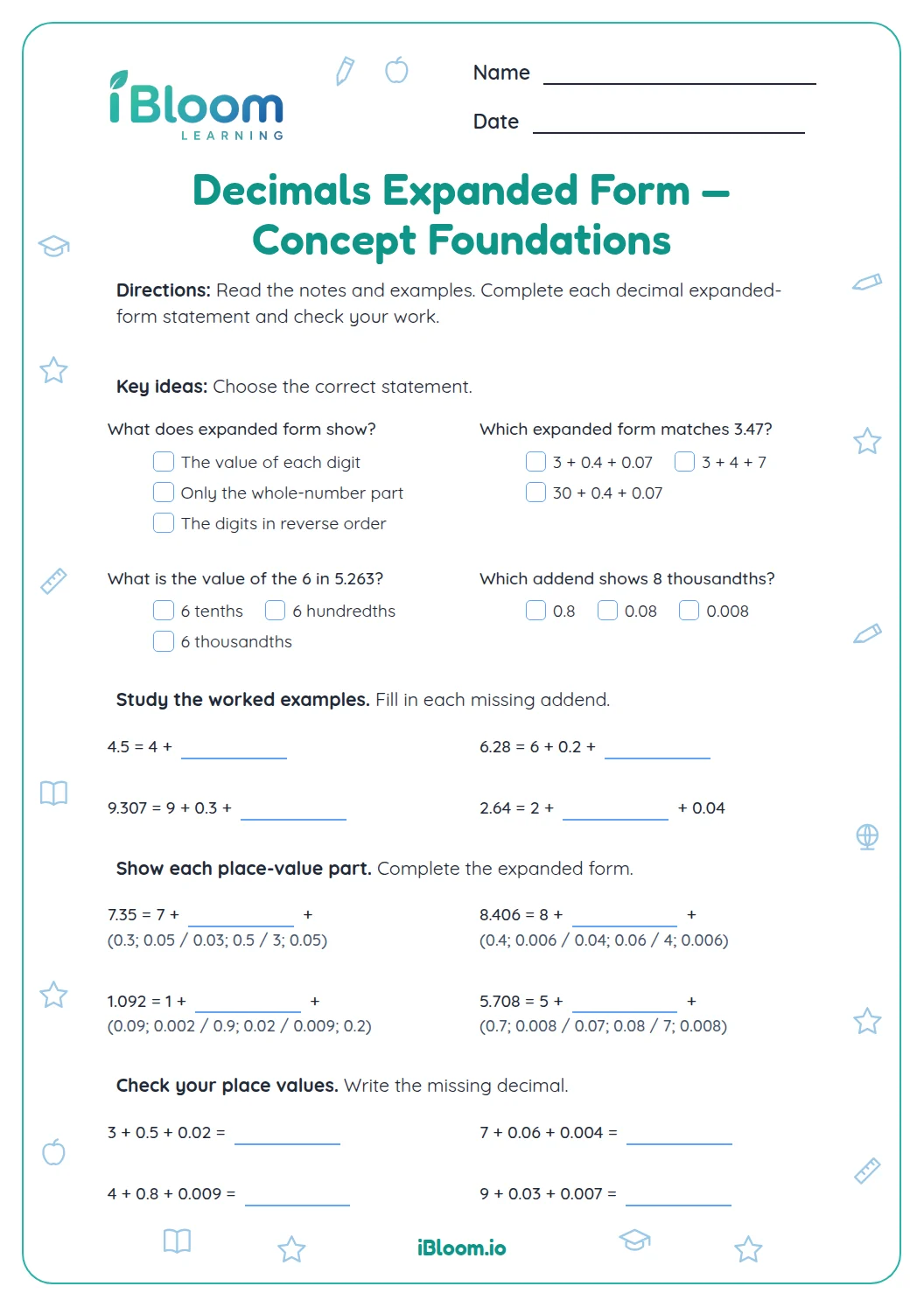
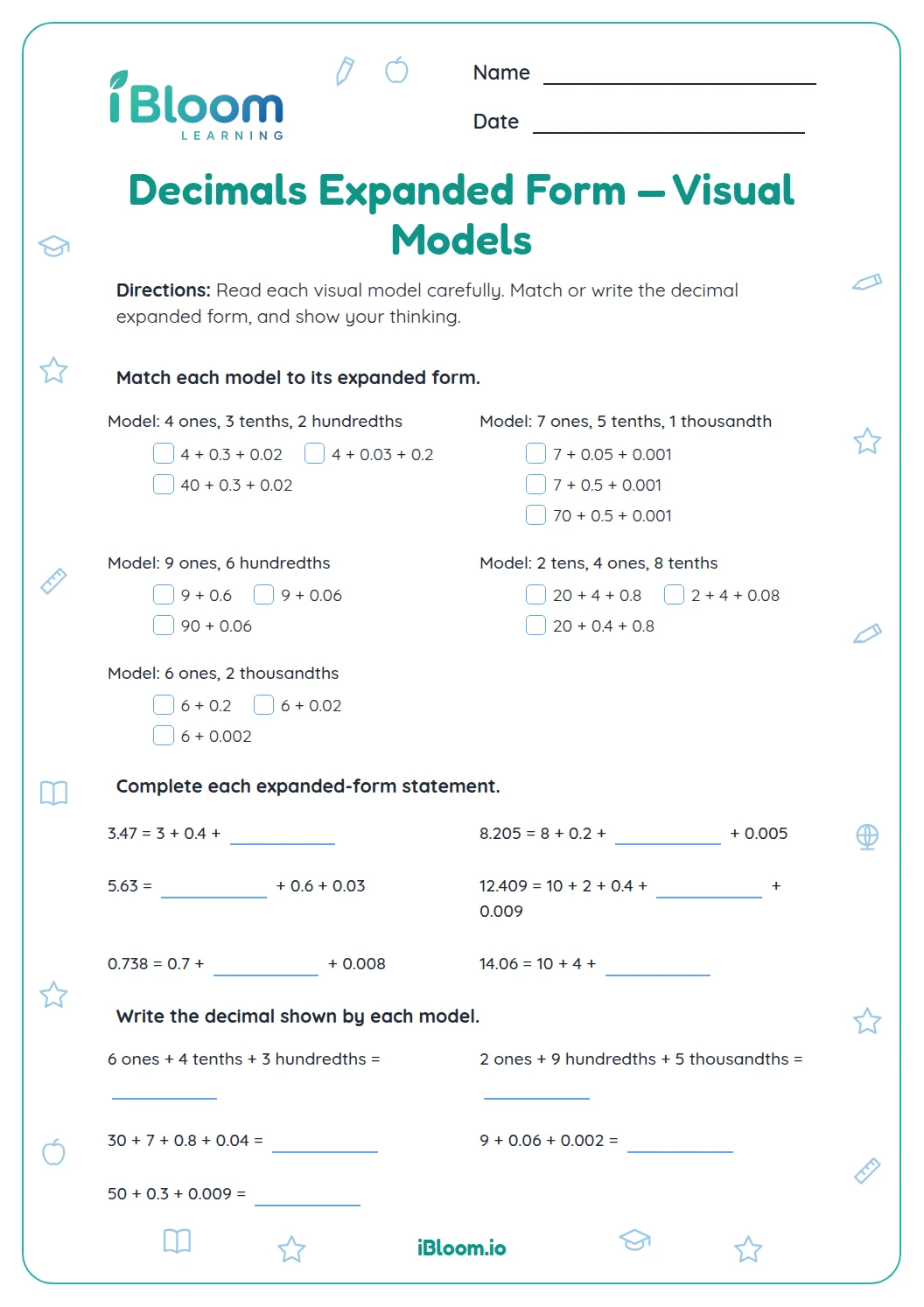
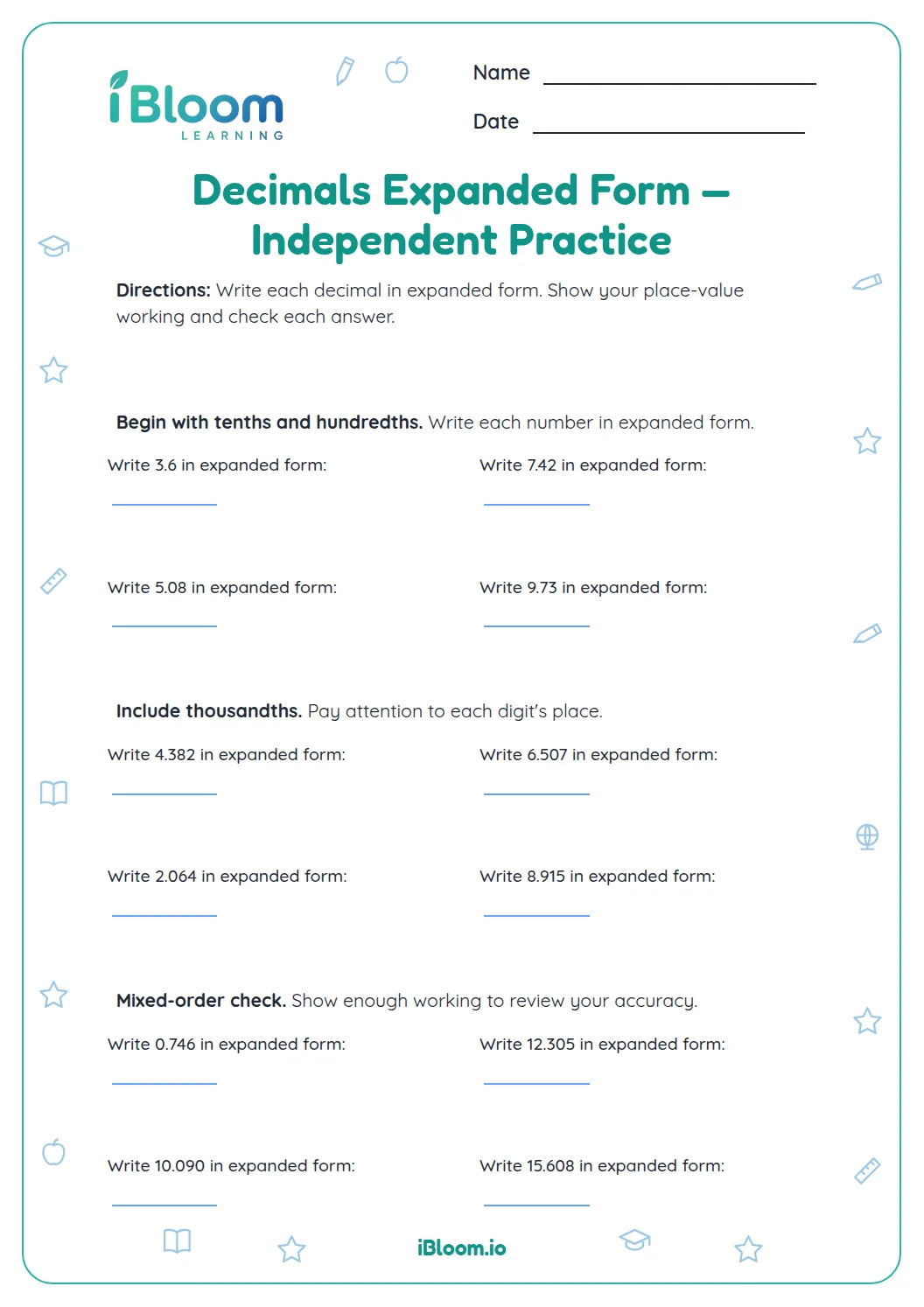
How do you expand a decimal?
Name the value of each digit after the decimal point. In 12.305, the 3 is three tenths and the 5 is five thousandths, so the decimal part is 0.3 + 0.005. Keep each place value distinct.
How does expanded form help solve a story problem?
First identify the number named in the situation and write its place-value parts. Then add or subtract as the question asks. Keep the unit from the story with your final answer.
How to use this worksheet
- 1Read the whole situation and find the number it names.
- 2Mark the place value of each nonzero digit.
- 3Write the expanded form as a sum.
- 4Perform the operation the story asks for.
- 5Check the size and unit of your answer.
Common mistakes and quick fixes
The mistake
Giving a digit its face value instead of its place value
The fix
Name the place first; a 3 in the thousands place contributes 3,000.
The mistake
Confusing tenths and hundredths
The fix
Count the decimal places from the decimal point before writing each value.
The mistake
Leaving out a step in the story problem
The fix
Write the expanded form first, then use the requested operation and check the total.
Common Core alignment
These standards describe the skills practiced in the questions below.
Use the value of each digit to write whole numbers and decimals in expanded form.
On this sheet: The questions break whole numbers and decimals into place-value parts before solving contextual problems.
Show the official wordingHide the official wording
Recognize that in a multi-digit number, a digit in one place represents 10 times as much as it represents in the place to its right and 1/10 of what it represents in the place to its left.
What to practice next
Make more practice
Further reading
Questions parents and teachers ask
What is expanded form?
Expanded form writes a number as the sum of the value of each digit. For example, 305,042 is 300,000 + 5,000 + 40 + 2. Each addend names a place value, and zero-value places can be left out. This makes the number’s structure easier to inspect.
How do you write decimals in expanded form?
Use the value represented by each digit to the right of the decimal point. For example, 4.276 is 4 + 0.2 + 0.07 + 0.006. Read tenths, hundredths and thousandths carefully so each digit keeps its place. The number of decimal places helps name each value.
How many questions are on this worksheet?
There are 14 questions: five multiple-choice questions, six expanded-form responses, and three real-world problems that ask for totals. The answer key gives the correct forms and calculations. Students can check the place-value sum as well as the final total.
Why do some expanded forms skip zero places?
A zero digit contributes zero to a sum, so a zero-value place can be omitted. For example, 7,040 is 7,000 + 40. Keep the zero places in the original numeral when reading it, since they show which place each other digit occupies.
What should students do in the story problems?
Each final prompt gives a real-world situation and asks for a total. Use the answer line for the sum and keep the units from the story, such as cans, visitors or meters. The key shows the expected total.