

About this worksheet
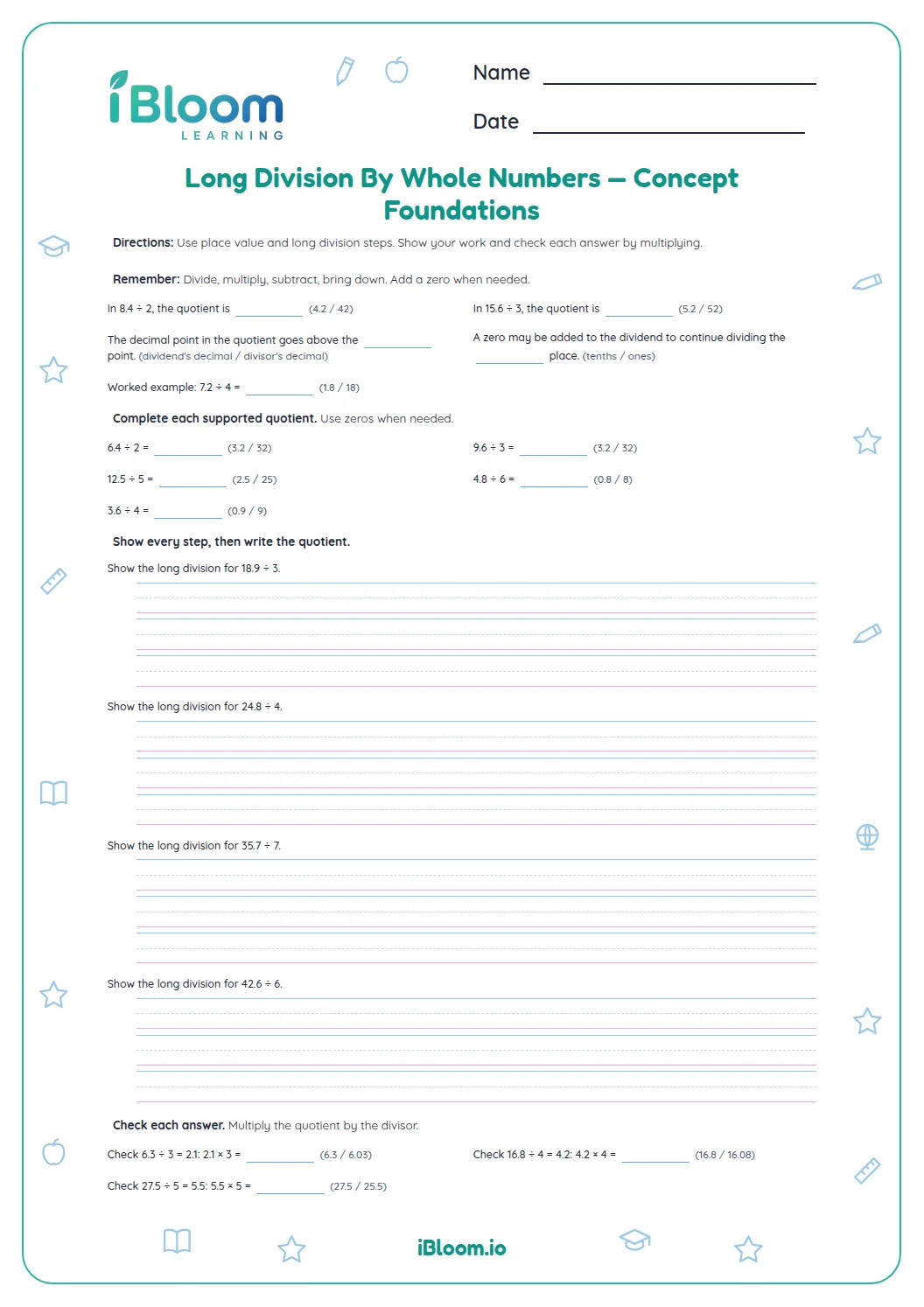
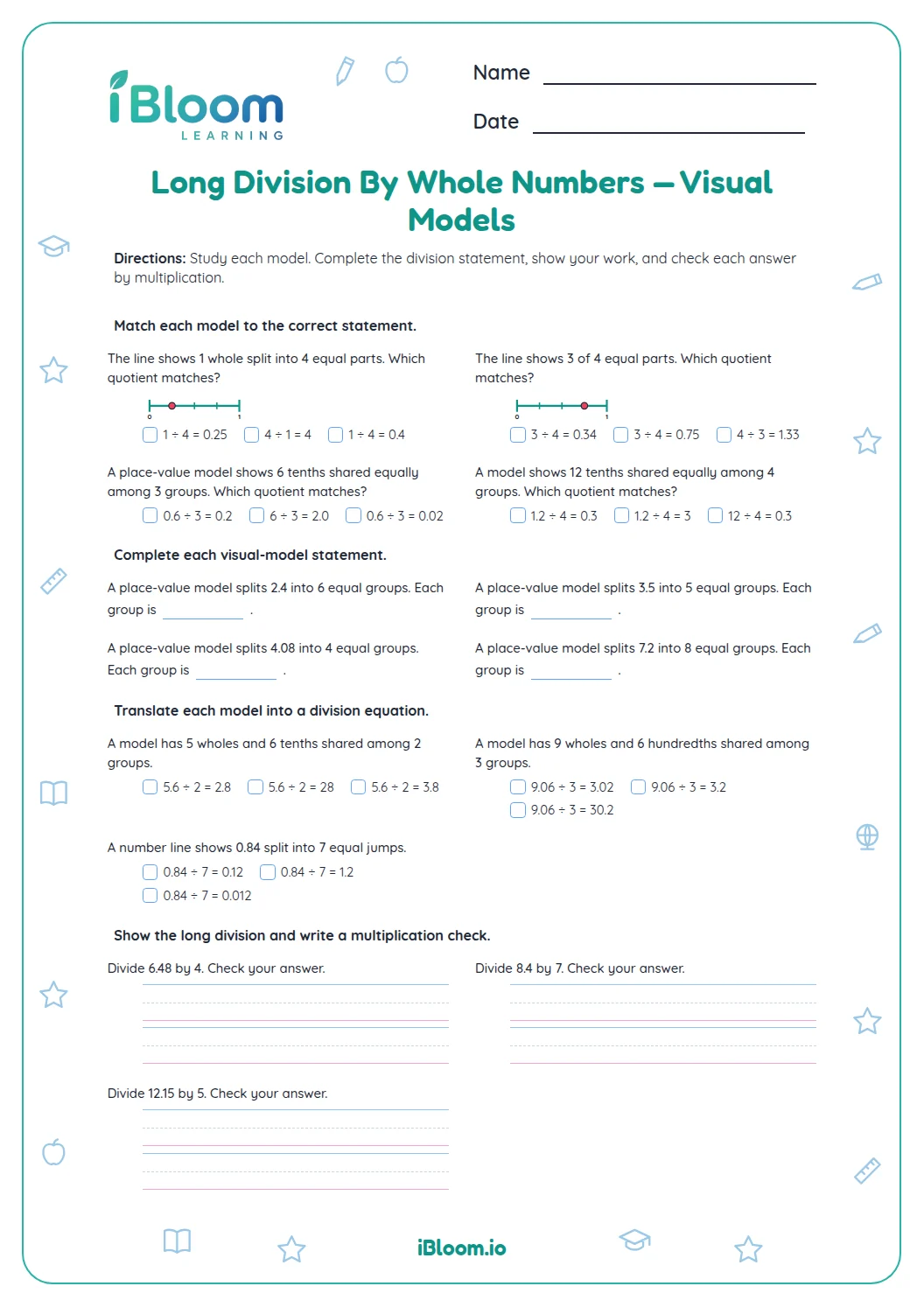
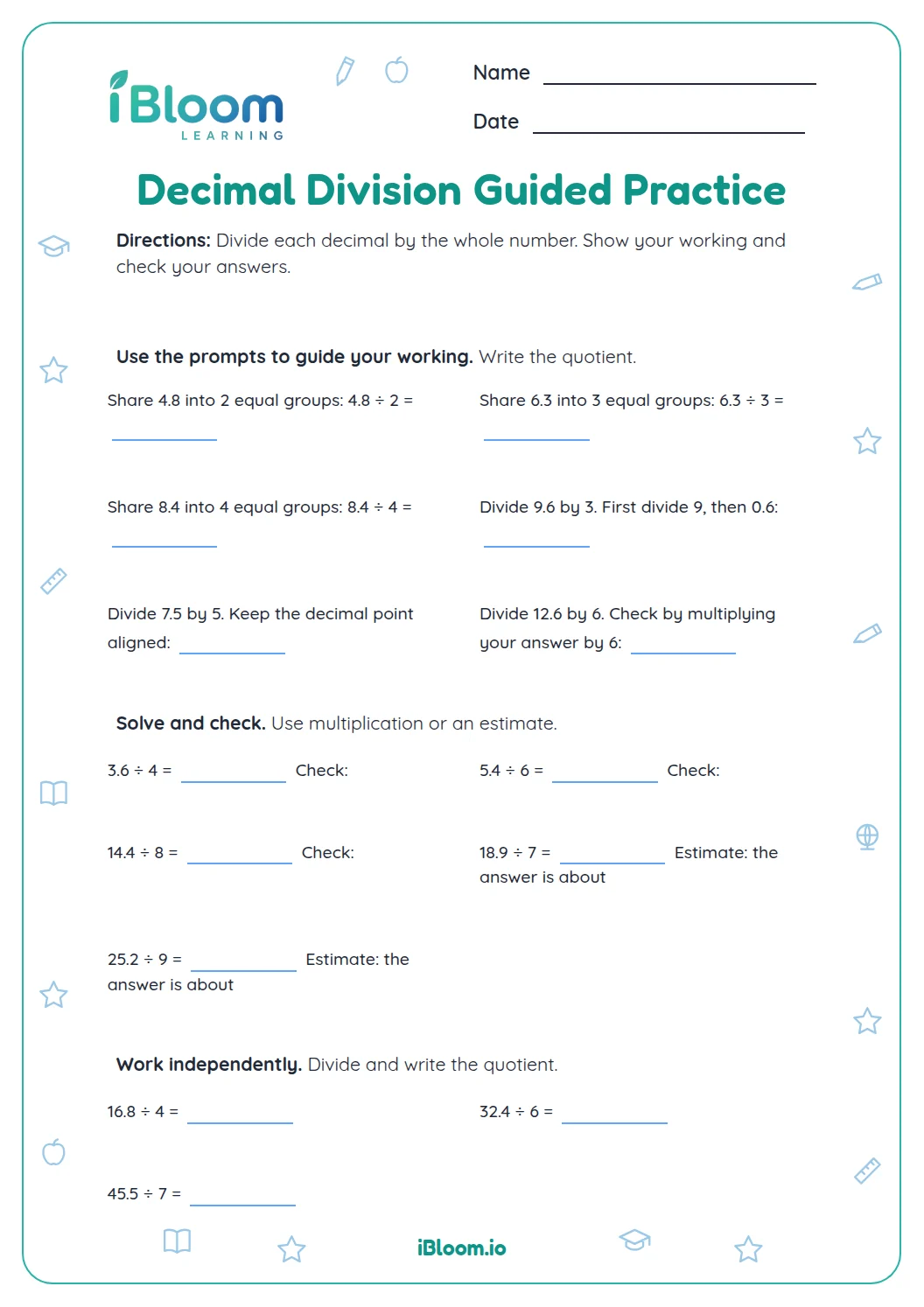
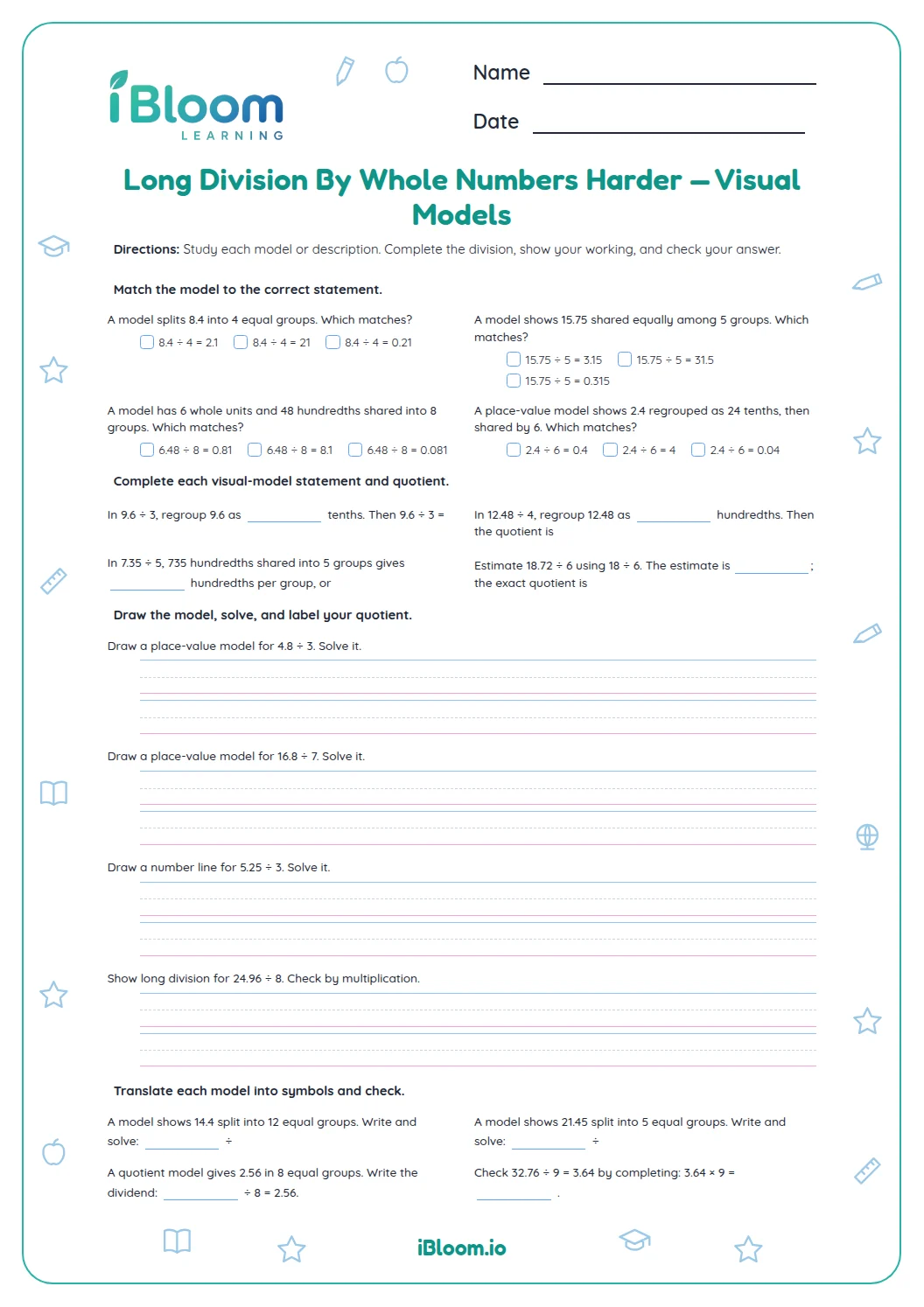
This Grade 6 reasoning challenge practices dividing decimal dividends by whole-number divisors with long division. Students calculate quotients, find missing values, diagnose a decimal-place error, estimate, and solve measurement problems. The first computation section includes room to show work, and the key supplies answers for checking with multiplication. It practices CCSS 6.NS.B.3.
Aligned to 6.NS.B.3
How should a quotient be estimated and calculated?
Estimate the size first, then divide place by place and align the quotient decimal with the dividend. The first eight questions provide space to show the computation.
How does the page ask students to reason?
The next two questions ask students to identify a decimal-place error and choose a reasonable estimate. For q9, 5.6 ÷ 4 equals 1.4, not 14.
How can a division answer be checked?
Multiply the quotient by its divisor and compare the product with the dividend. In q3, 0.84 × 8 = 6.72, which checks the quotient.
A simple way to work
- 1Estimate whether the quotient is less than or greater than 1.
- 2Divide one place at a time using the standard algorithm.
- 3Place the decimal point in the quotient above the dividend decimal.
- 4Multiply quotient by divisor to check the original dividend.
Check these common slips
The mistake
Treating a decimal dividend as a whole number and shifting the answer.
The fix
Estimate the quotient and align the decimal point.
The mistake
Dropping a zero or place while dividing.
The fix
Keep each quotient digit aligned with its place value.
The mistake
Giving a measurement answer without its unit.
The fix
Include the unit asked for in each story problem.
Curriculum alignment
The calculation, error-analysis, estimate, and context questions practice decimal division with the standard algorithm.
Fluently add, subtract, multiply, and divide multi-digit decimals using the standard algorithm.
On this sheet: The worksheet questions directly practice this standard.
Show the official wordingHide the official wording
Fluently add, subtract, multiply, and divide multi-digit decimals using the standard algorithm for each operation.
What to practice next
Make more practice
Further reading
Questions parents and teachers ask
What is on this reasoning challenge?
The 14 questions include decimal division calculations, missing dividend or divisor values, an error analysis, an estimate, and measurement stories. The first computation items provide work space, and the answer key includes quotients and story units. The questions are arranged from direct computation toward contextual reasoning.
How can a student check a decimal quotient?
Multiply the quotient by the whole-number divisor. The product should equal the decimal dividend. For example, q3 checks because 0.84 multiplied by 8 is 6.72. An estimate also helps reveal a quotient that is too large or small.
Why estimate before using long division?
An estimate gives a useful range for the answer before the exact calculation. For example, 19.2 divided by 6 should be near 3. If the written quotient is near 0.3 or 30, revisit the decimal placement. That scale check is especially useful when placing decimal digits in a quotient.
Are the word problems about decimal division?
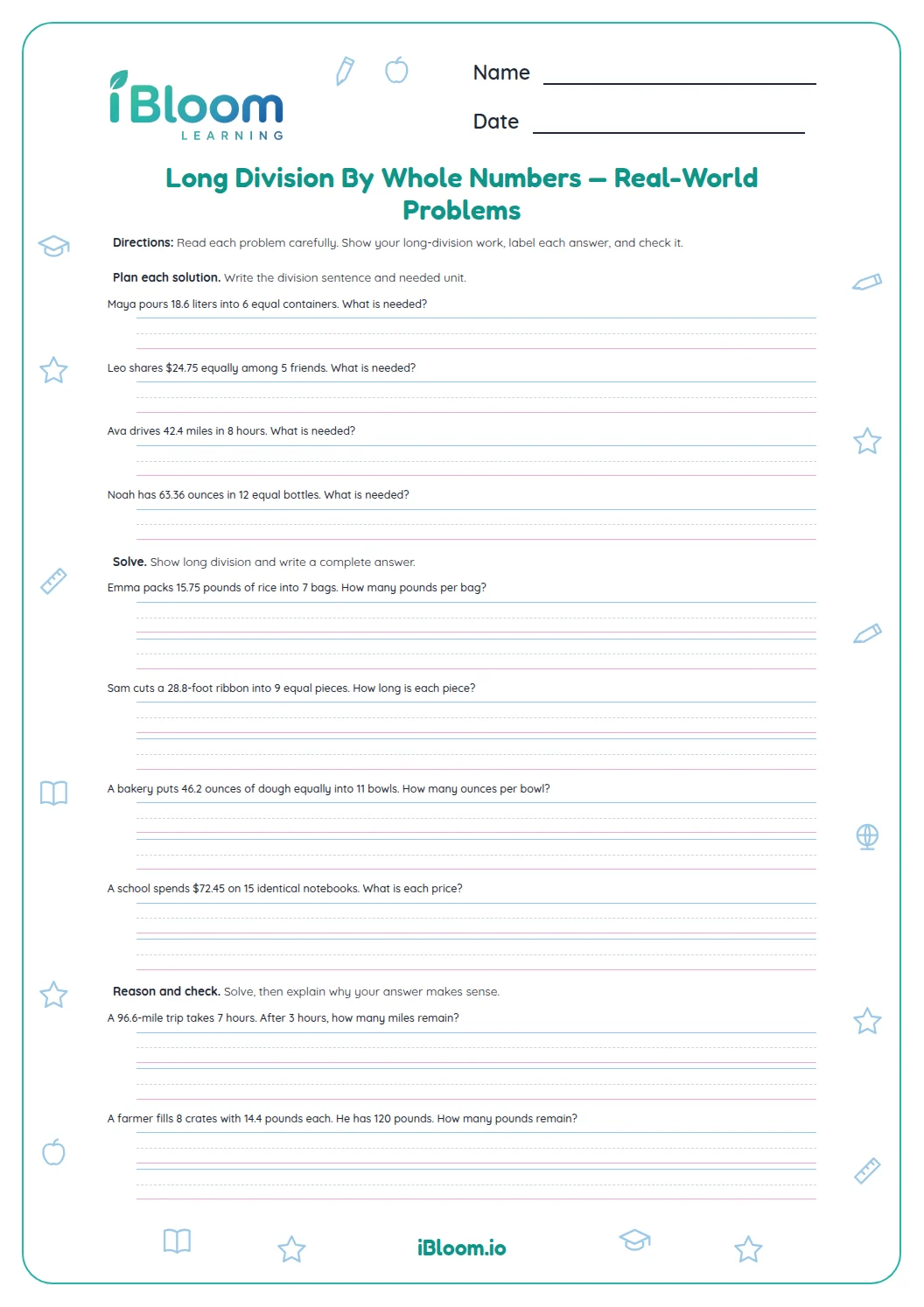
Yes. Each story divides a decimal amount into equal groups using a whole-number divisor. The answer key states the unit requested, such as liters per bottle or miles per hour, so the numerical quotient has a clear meaning.
What is the correct quotient in the place-value error question?
The correct quotient for 5.6 ÷ 4 is 1.4. A quotient of 14 is ten times too large because the decimal place was not handled correctly. Multiplying 1.4 by 4 returns 5.6 and confirms the answer. The related multiplication fact is a reliable way to confirm the decimal placement.