

About this worksheet
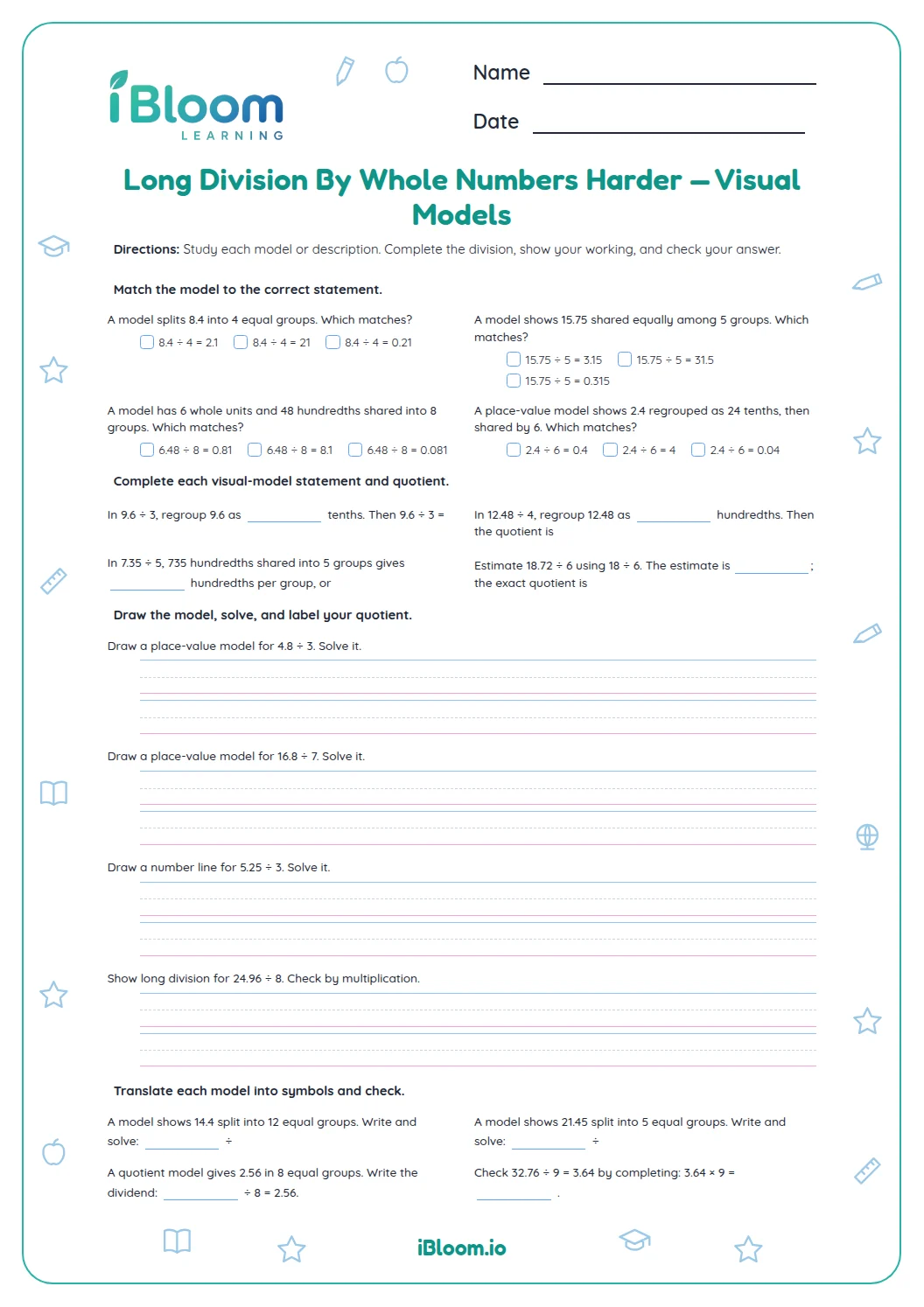
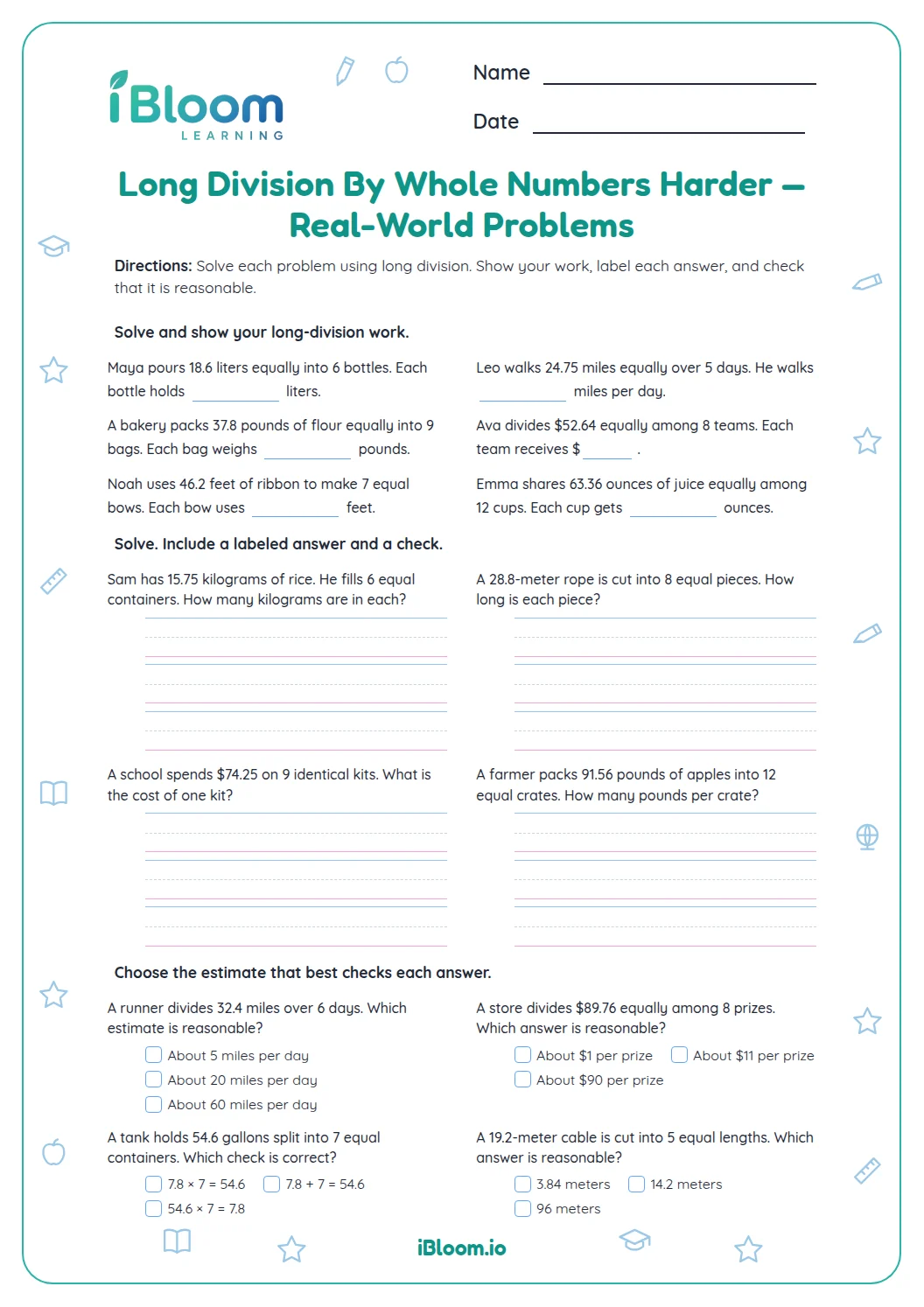
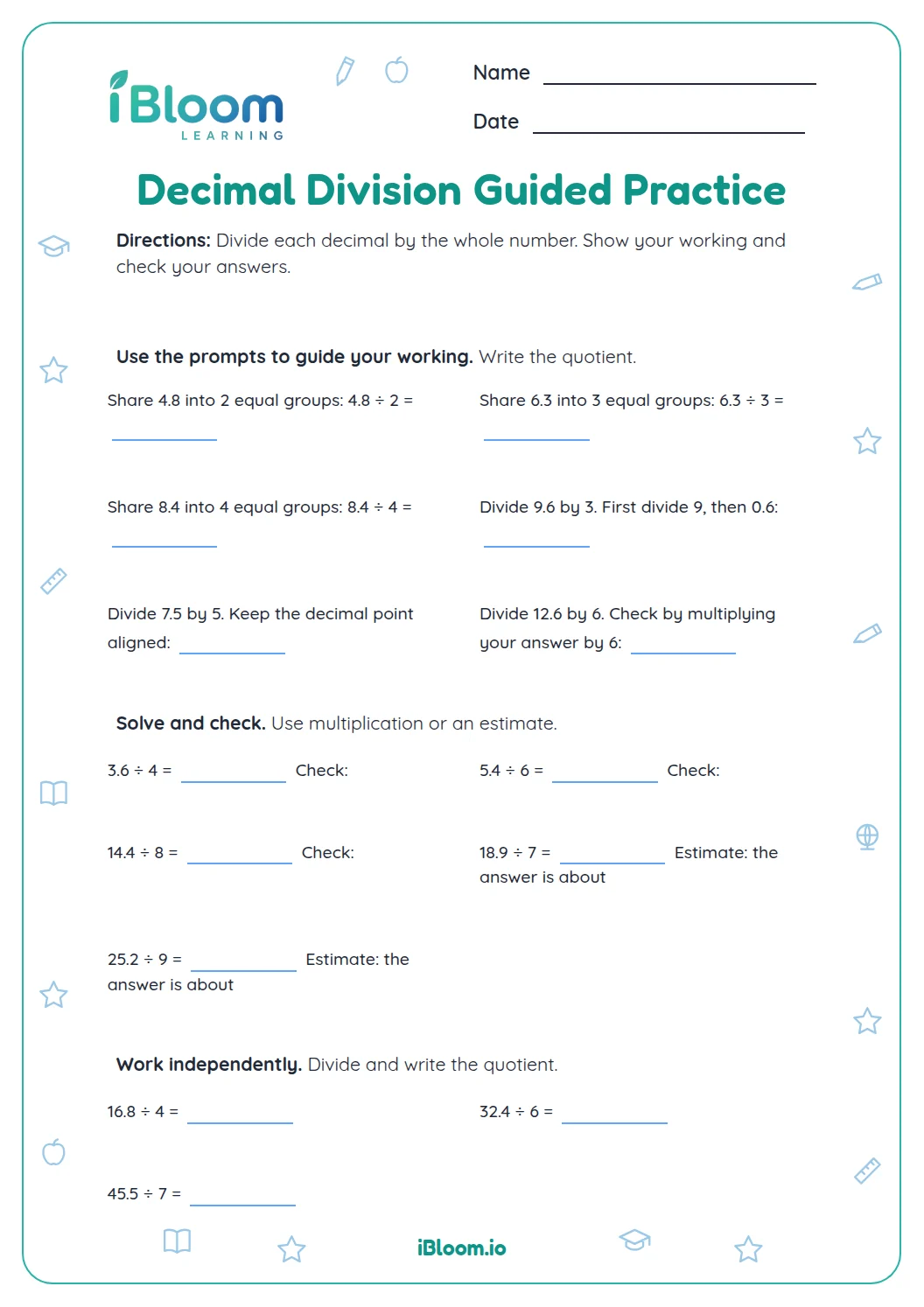
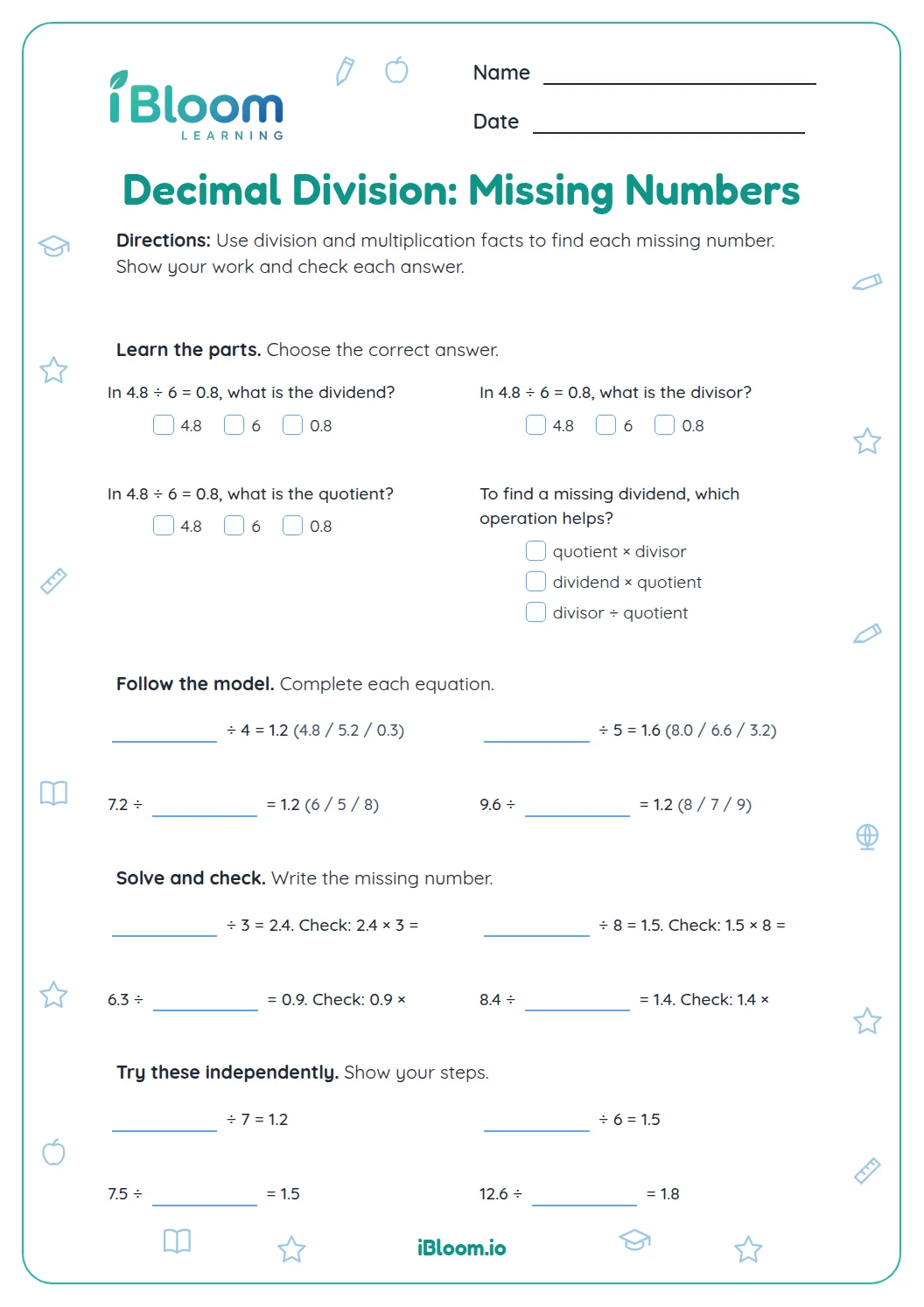
This Grade 6 printable gives students 15 problems dividing decimal dividends by whole-number divisors. The first six build fluency with shorter quotients; the next nine ask students to continue the same long-division algorithm with larger dividends and two-digit divisors. Each quotient is exact, and the directions ask students to show place-value steps and check by multiplying. The separate answer key makes it easy to review both the quotient and the calculation. The practice aligns with Common Core 6.NS.B.3.
Aligned to 6.NS.B.3
What does the warm-up practice?
Questions 1–6 divide decimal numbers by one-digit divisors. Keep the decimal point in the quotient directly above the decimal point in the dividend, then check with multiplication.
- 18.4 ÷ 2 = 4.2
- 2Check: 4.2 × 2 = 8.4
How do you divide by a two-digit number?
Questions 7–15 use the same long-division steps with larger dividends and two-digit divisors. Estimate first, divide one place at a time, and bring down each next digit while keeping place values aligned.
How can you tell if a quotient is reasonable?
Multiply the quotient by the divisor. The product should equal the dividend for every problem on this sheet. If the product is too large or too small, check the division steps and decimal placement.
- 1288.75 ÷ 25 = 11.55
- 211.55 × 25 = 288.75
How to use this worksheet
- 1Write the divisor and dividend in a long-division setup.
- 2Estimate the size of the quotient before calculating.
- 3Divide from left to right and keep the decimal point aligned.
- 4Bring down each digit and record every place-value step.
- 5Multiply the quotient by the divisor to check the dividend.
Common mistakes and quick fixes
The mistake
Placing the quotient decimal at the end of the answer.
The fix
Place it directly above the decimal in the dividend before dividing.
The mistake
Forgetting a zero in a quotient such as 16.02.
The fix
Use the multiplication check to see whether each place value is represented.
The mistake
Accepting an answer without checking it.
The fix
Multiply quotient × divisor; the product should equal the original dividend.
Common Core alignment
This worksheet practices the listed Common Core skill through its questions.
Fluently divide multi-digit decimals with the standard algorithm.
On this sheet: All 15 problems divide a decimal dividend by a whole-number divisor using long division.
Show the official wordingHide the official wording
Fluently add, subtract, multiply, and divide multi-digit decimals using the standard algorithm for each operation.
What to practice next
Make more practice
Further reading
Questions parents and teachers ask
How many problems are on this decimal division worksheet?
There are 15 problems. Questions 1–6 use shorter decimal dividends and one-digit divisors; Questions 7–15 continue with larger dividends and two-digit divisors. The answer key is two pages, like the worksheet, so each quotient can be checked after the student finishes.
What is the decimal point rule for long division?
Place the decimal point in the quotient directly above the decimal point in the dividend. Then divide as usual, keeping each digit in its place. Question 1 shows the idea: 8.4 ÷ 2 = 4.2, and multiplying 4.2 by 2 returns 8.4.
Does every problem have an exact decimal answer?
Yes. Each dividend was chosen so that dividing by its whole-number divisor produces a terminating decimal or whole-number quotient. Students can confirm each one by multiplying the quotient by the divisor and checking that the product matches the dividend.
Why does the sheet ask students to multiply after dividing?
Multiplication reverses division, so it checks whether the quotient and divisor recreate the dividend. For example, 11.55 × 25 = 288.75. If the product differs, students can revisit the place-value steps, the decimal point, and the multiplication facts used.
What standard does the worksheet practice?
The sheet practices CCSS 6.NS.B.3, which includes dividing multi-digit decimals with the standard algorithm. The problems all divide decimals by whole numbers and ask students to show long-division work. A separate answer key supports checking the final quotients.