



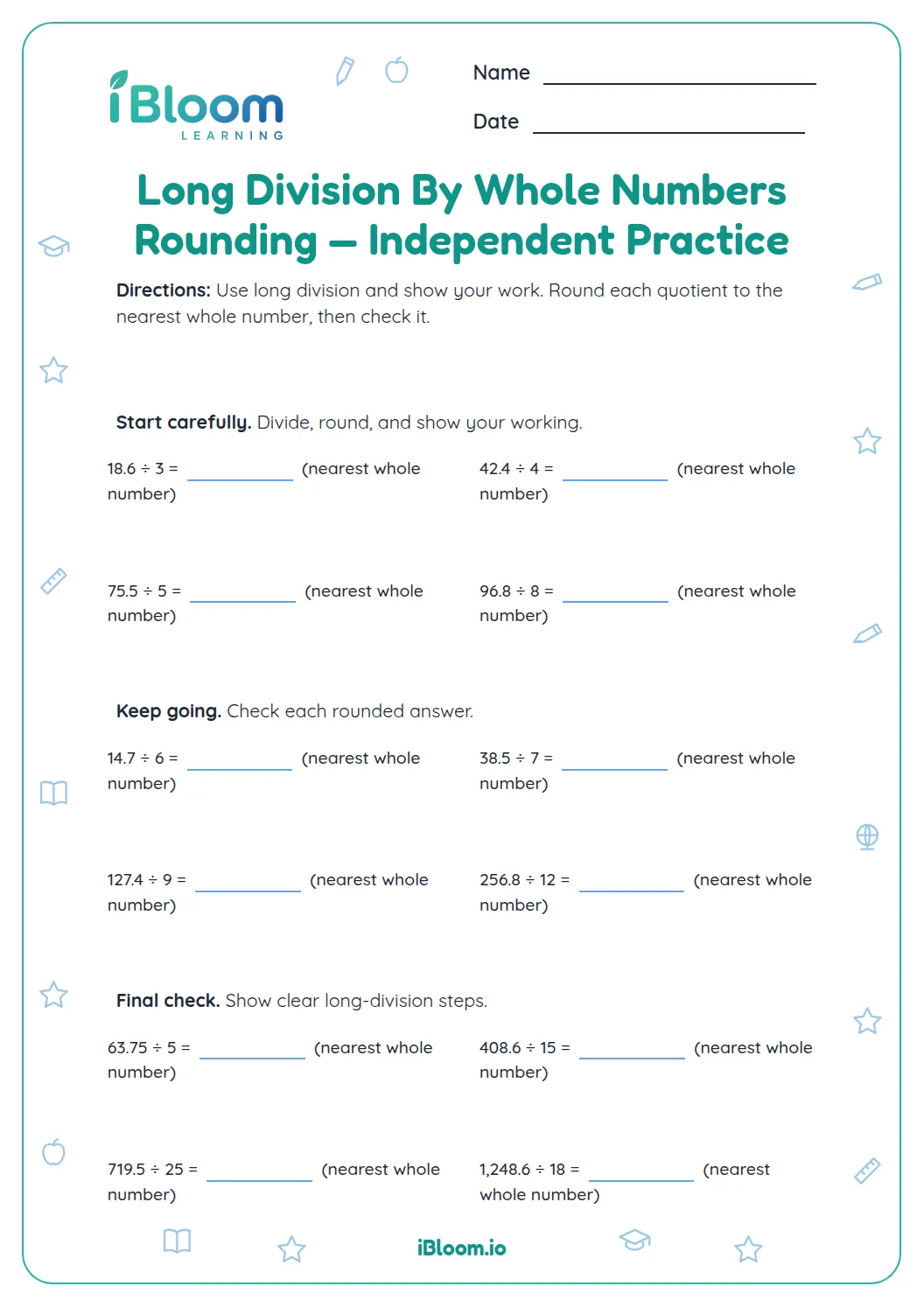
About this worksheet
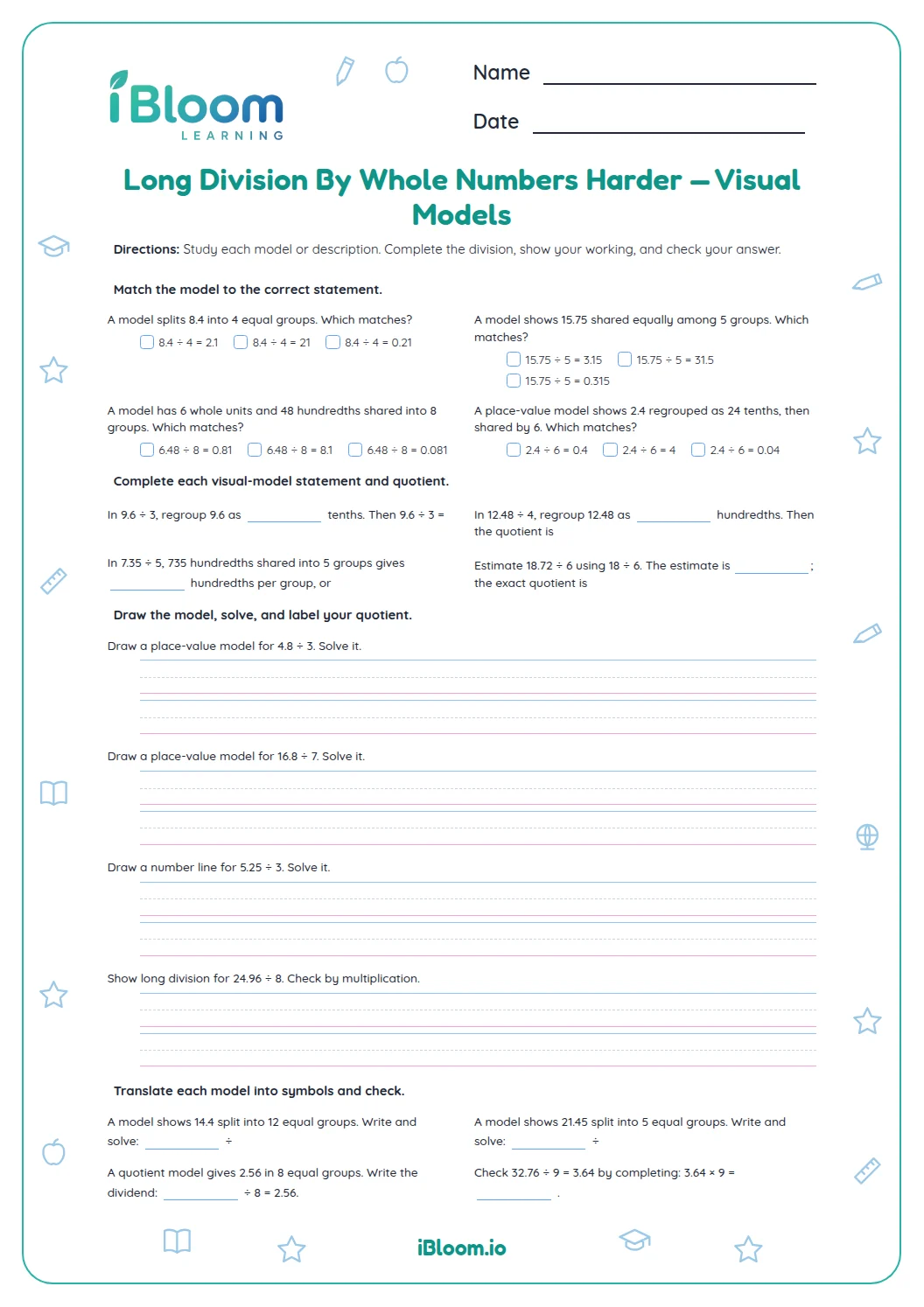
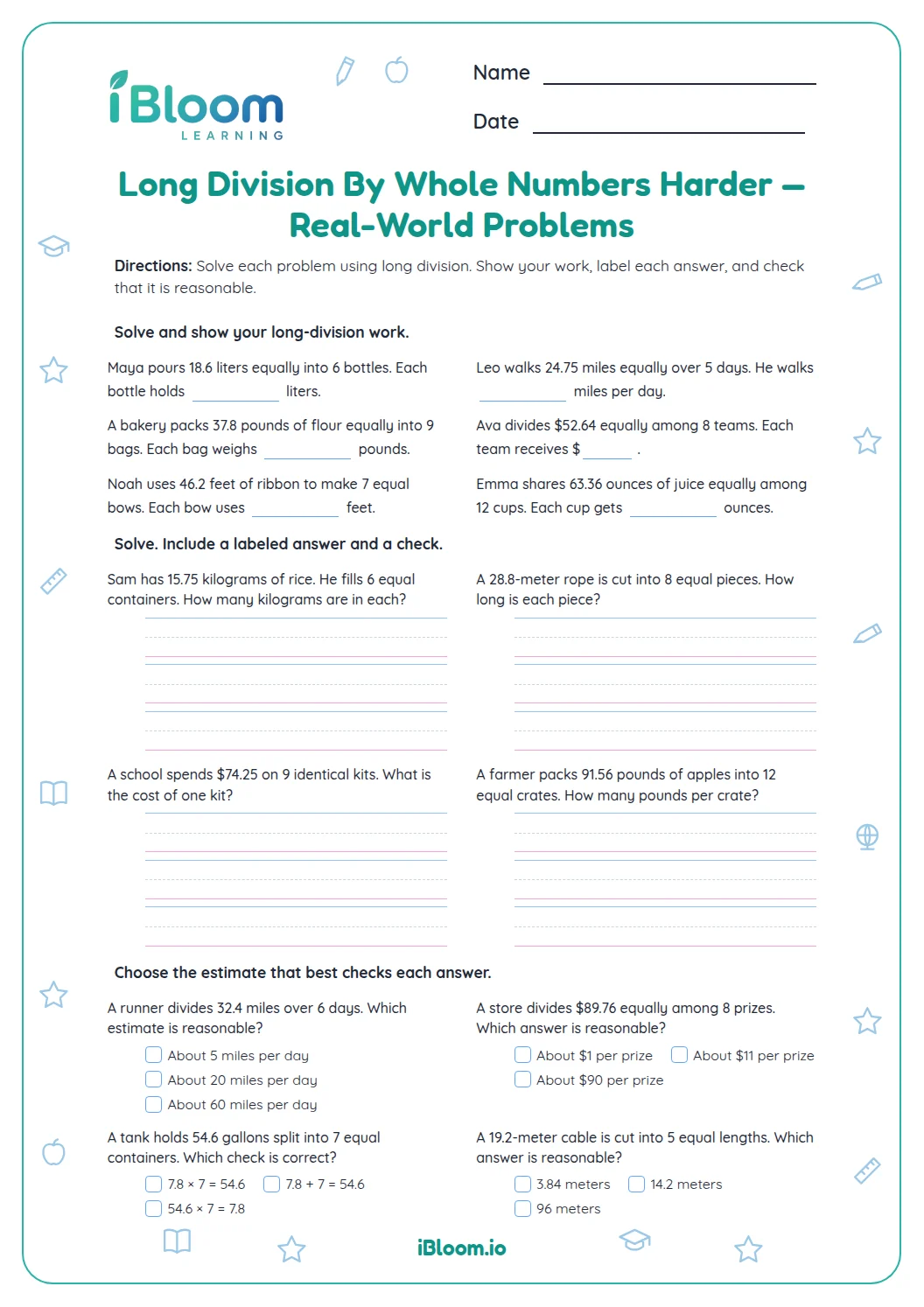
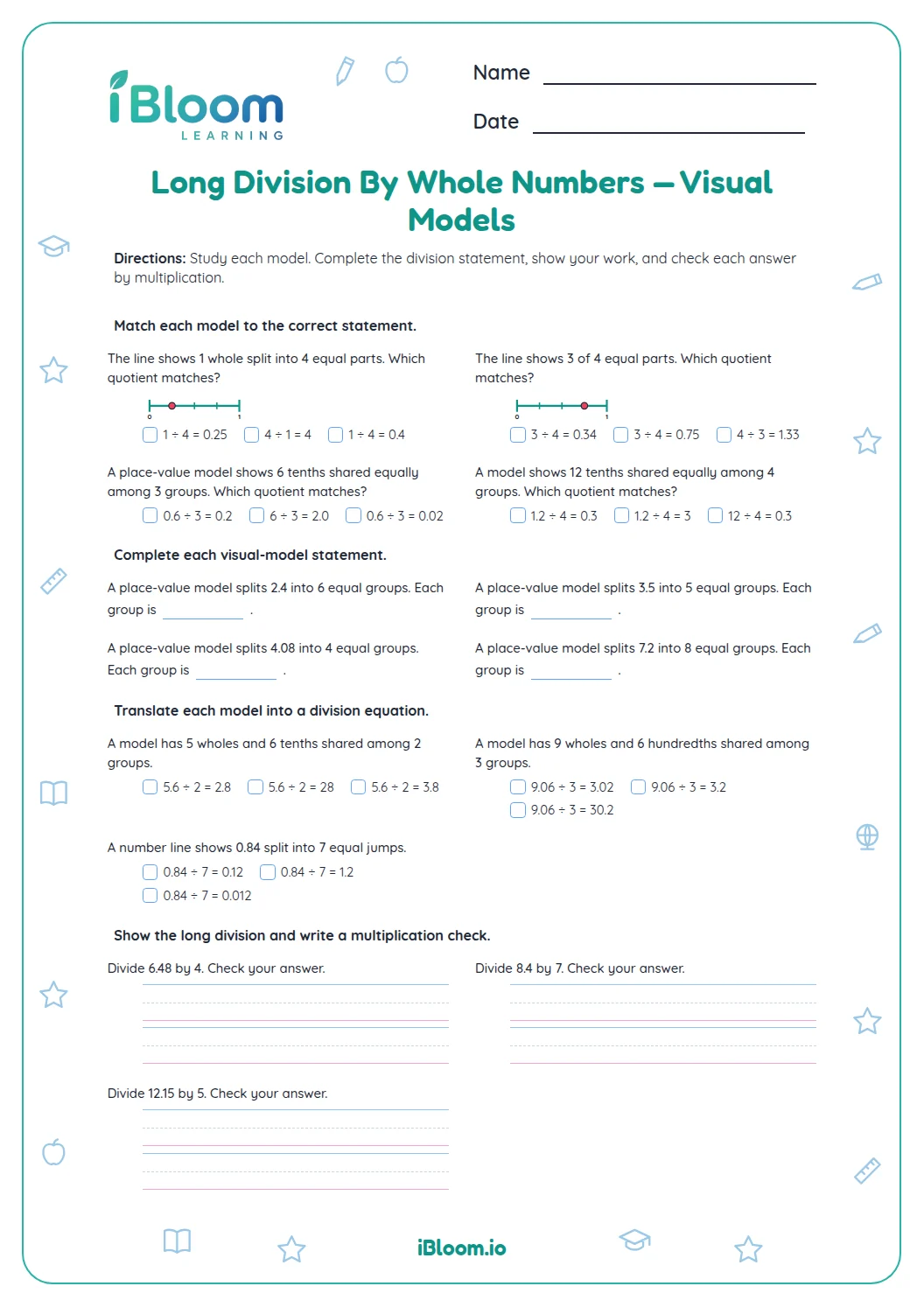
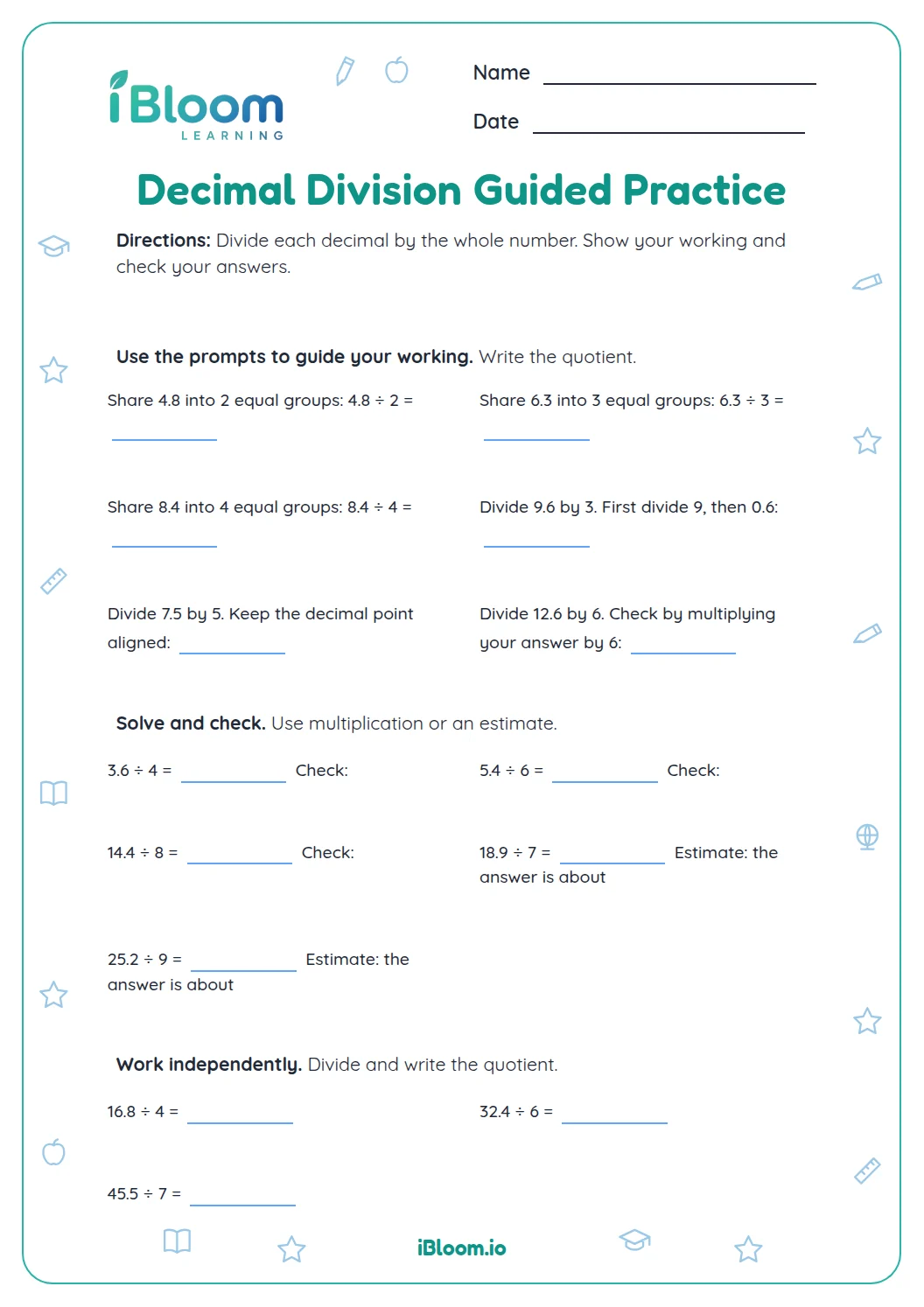
This Grade 6 worksheet replaces a generic challenge page with 16 decimal division problems that move from selecting and calculating quotients to interpreting results. Divisors are whole numbers; the quotient may be less than one or include hundredths. Four short reasoning tasks ask children to use quotient size or multiplication to check their work. The page aligns with CCSS 6.NS.B.3 and includes an answer key.
Aligned to 6.NS.B.3
What does this decimal division challenge include?
The page has four parts, from quotient selection to reasoning. Children calculate decimal dividends divided by whole numbers, solve four unit problems, and use multiplication or quotient size to examine possible errors.
The dividends range from less than 10 to 32.4, with answers including tenths and hundredths.
- Part A: choose a quotient with the right place value.
- Part B: calculate four decimal quotients.
- Part C: solve word problems and label units.
- Part D: explain or check reasoning.
Where does the decimal point go in the quotient?
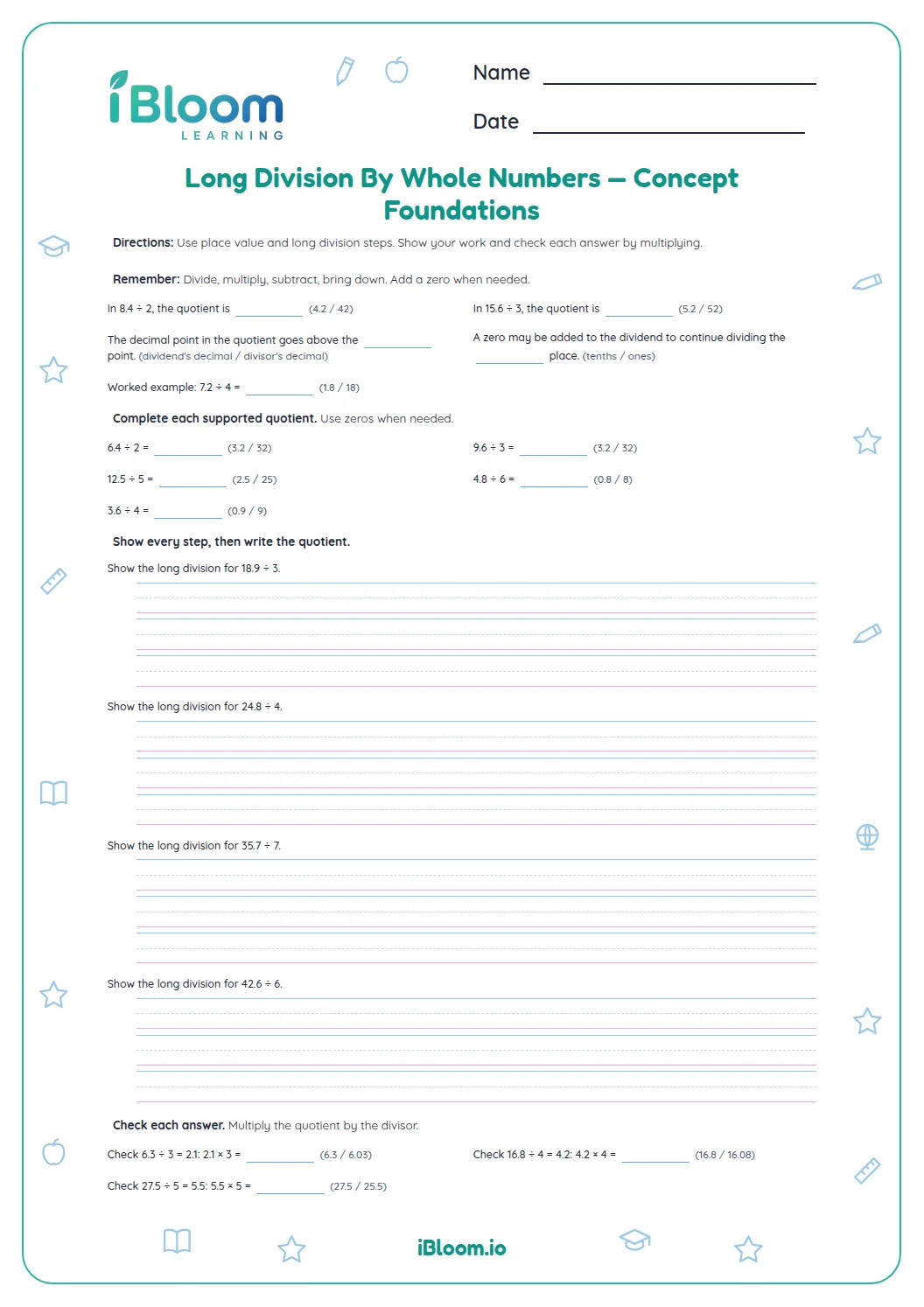
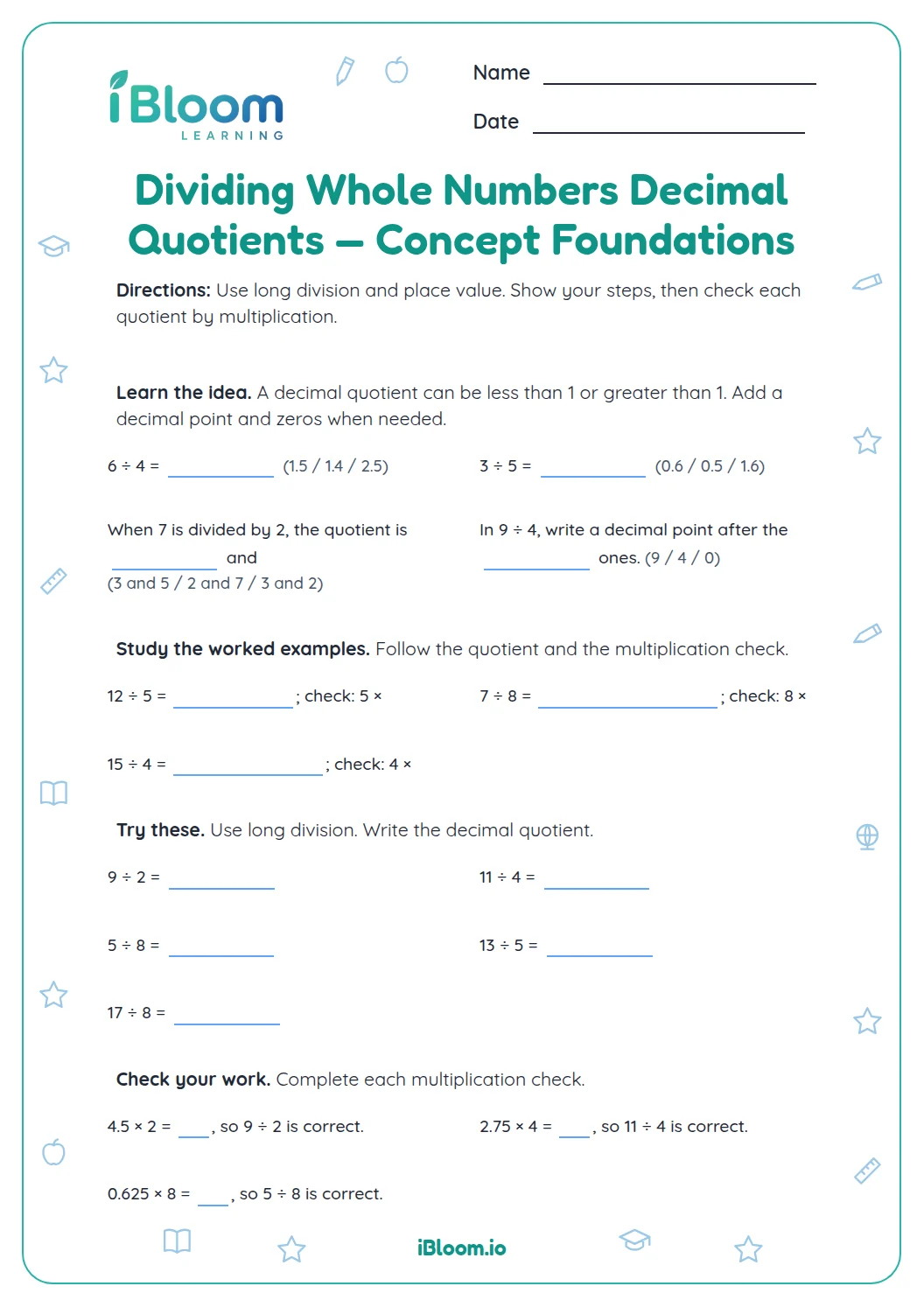
In decimal long division, place the quotient decimal point directly above the dividend decimal point, then divide digit by digit. Before calculating, estimate whether the quotient is greater or less than one; that estimate can catch a decimal-place slip.
- 121.6 ÷ 8
- 2216 tenths ÷ 8 = 27 tenths
- 327 tenths = 2.7, so 21.6 ÷ 8 = 2.7
How can multiplication check a quotient?
Multiply the quotient by the divisor. For 16.8 ÷ 7 = 2.4, calculate 2.4 × 7 = 16.8. If the product does not match the dividend, revisit the division steps and decimal placement.
How to use this worksheet
- 1Estimate whether the quotient should be above or below one.
- 2Divide using the standard algorithm and align the decimal point.
- 3For a story problem, write the quotient with the requested unit.
- 4Multiply quotient by divisor to check the dividend.
- 5Explain any error using place value or the size of the groups.
Common mistakes and quick fixes
The mistake
Placing the quotient decimal without checking its size.
The fix
Estimate first; dividing 5.4 by 6 must give an answer below 1.
The mistake
Dropping a zero needed in the quotient, such as 12.48 ÷ 6.
The fix
Check each place value as you bring down digits; 12.48 ÷ 6 = 2.08.
The mistake
Leaving units off a word-problem answer.
The fix
Name what each equal share measures, such as 2.4 pounds per container.
Common Core alignment
The questions practice decimal division and checking the standard algorithm.
Divide decimal dividends by whole-number divisors and check quotient size.
On this sheet: The computation and checking questions practice decimal division with the standard algorithm.
Show the official wordingHide the official wording
Fluently add, subtract, multiply, and divide multi-digit decimals using the standard algorithm for each operation.
What to practice next
Make more practice
Further reading
Questions parents and teachers ask
What skills does this decimal division worksheet practice?
It practices dividing decimal numbers by whole numbers, checking quotient place value, and interpreting answers in word problems. Four final questions ask children to explain a likely error, compare quotient sizes, or verify division with multiplication. The divisors are whole numbers throughout.
Why can a decimal division answer be less than one?
When the dividend is smaller than the divisor, each equal group is less than one. For example, 5.4 divided into 6 equal groups gives 0.9 per group. Estimating before dividing helps children notice whether a quotient should be below or above one.
How should students check a decimal quotient?
Multiply the quotient by the whole-number divisor and compare the product with the dividend. For example, 2.4 × 7 equals 16.8, so 2.4 is a correct quotient for 16.8 ÷ 7. Students can also estimate to catch a misplaced decimal point.
Does the worksheet include word problems?
Yes. Part C includes four division situations about equal containers, ribbon pieces, bottles, and route stages. Students write the quotient with a unit so the number answers the question being asked. For example, a ribbon length divided among equal pieces gives the length of one piece.
How many questions and pages are included?
There are 16 questions in four parts: four multiple choice, four fill-in calculations, four word problems, and four reasoning checks. The worksheet and separate answer key each span three printable pages, so learners can work through one section at a time.