

About this worksheet
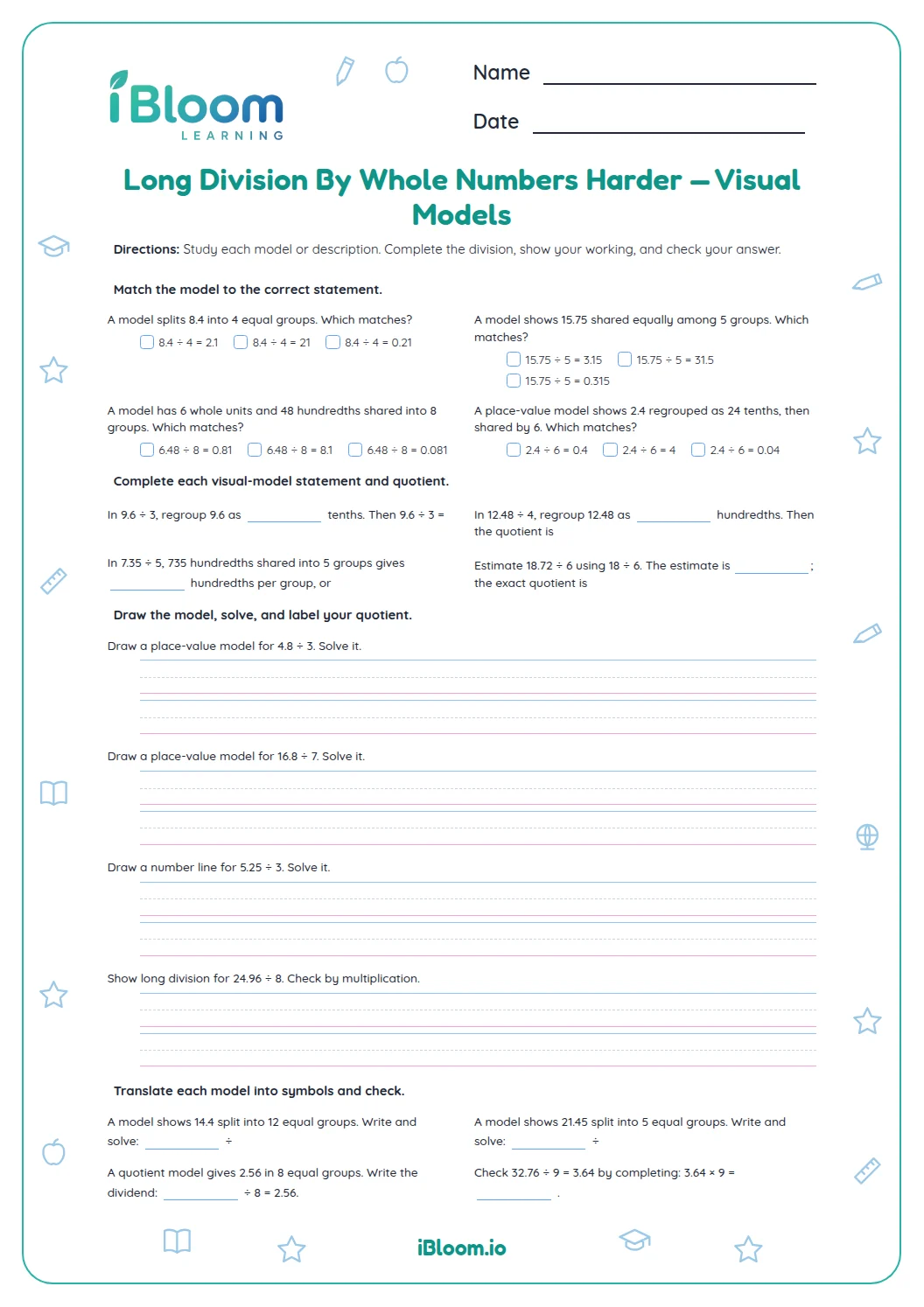
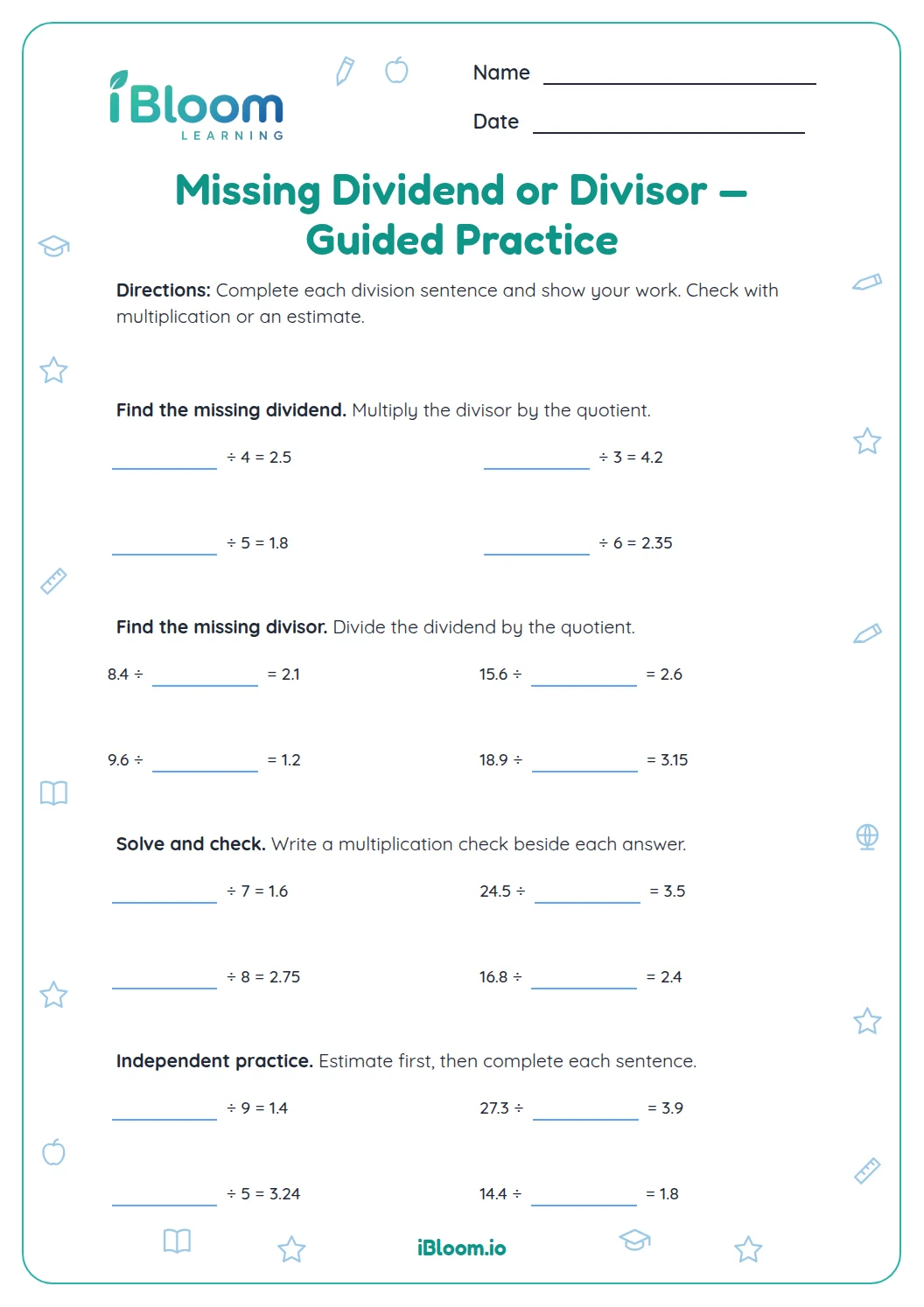
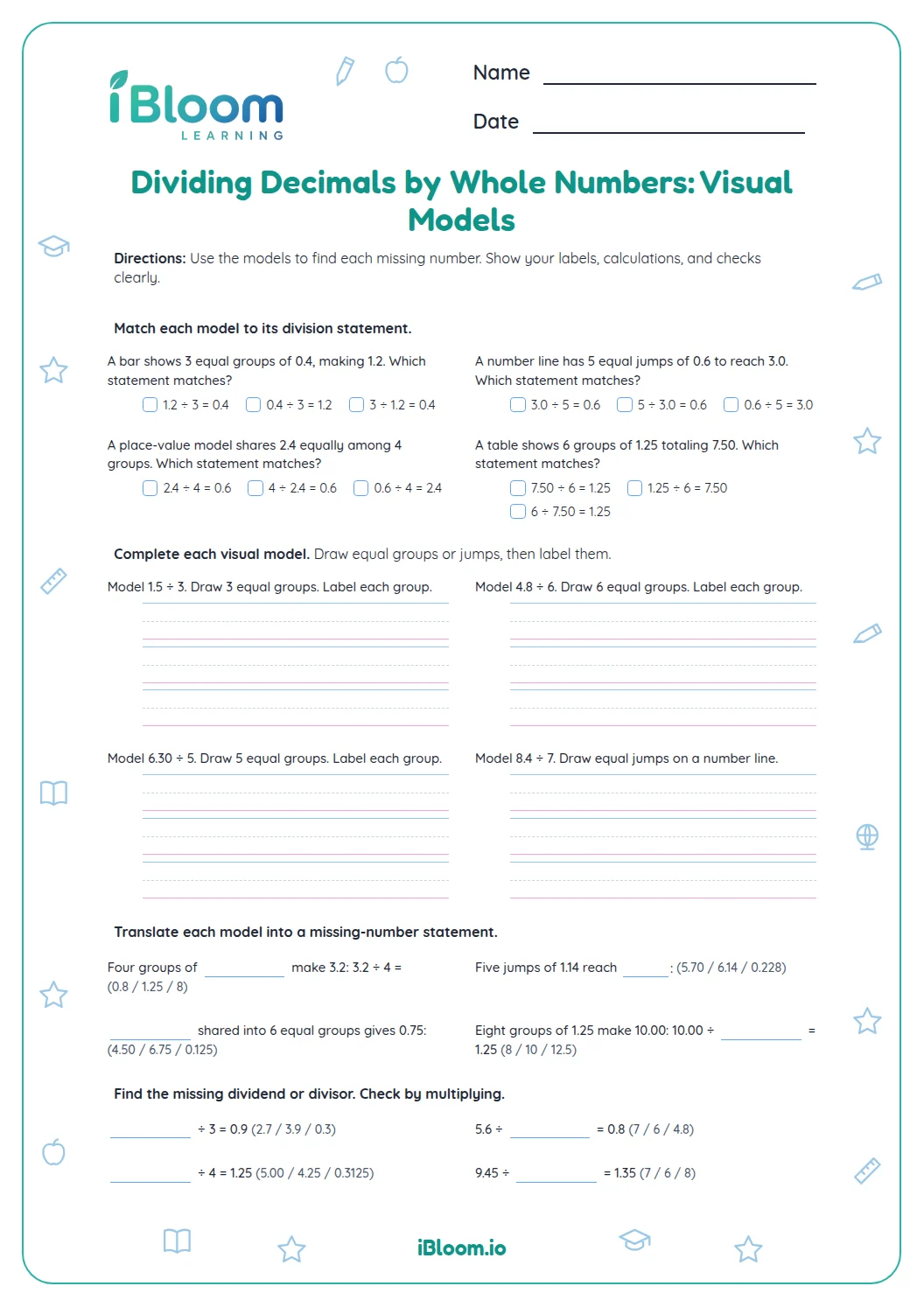
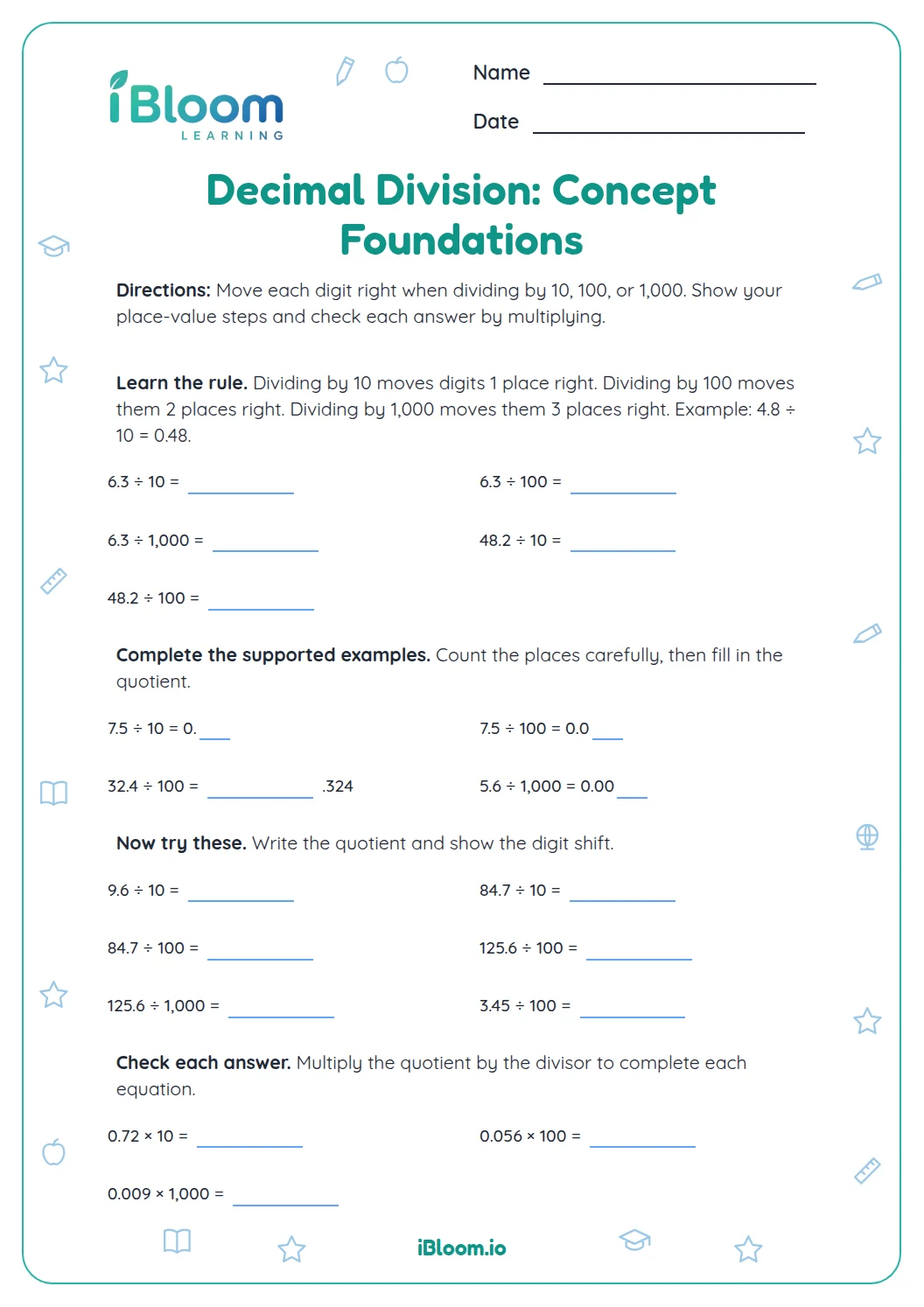
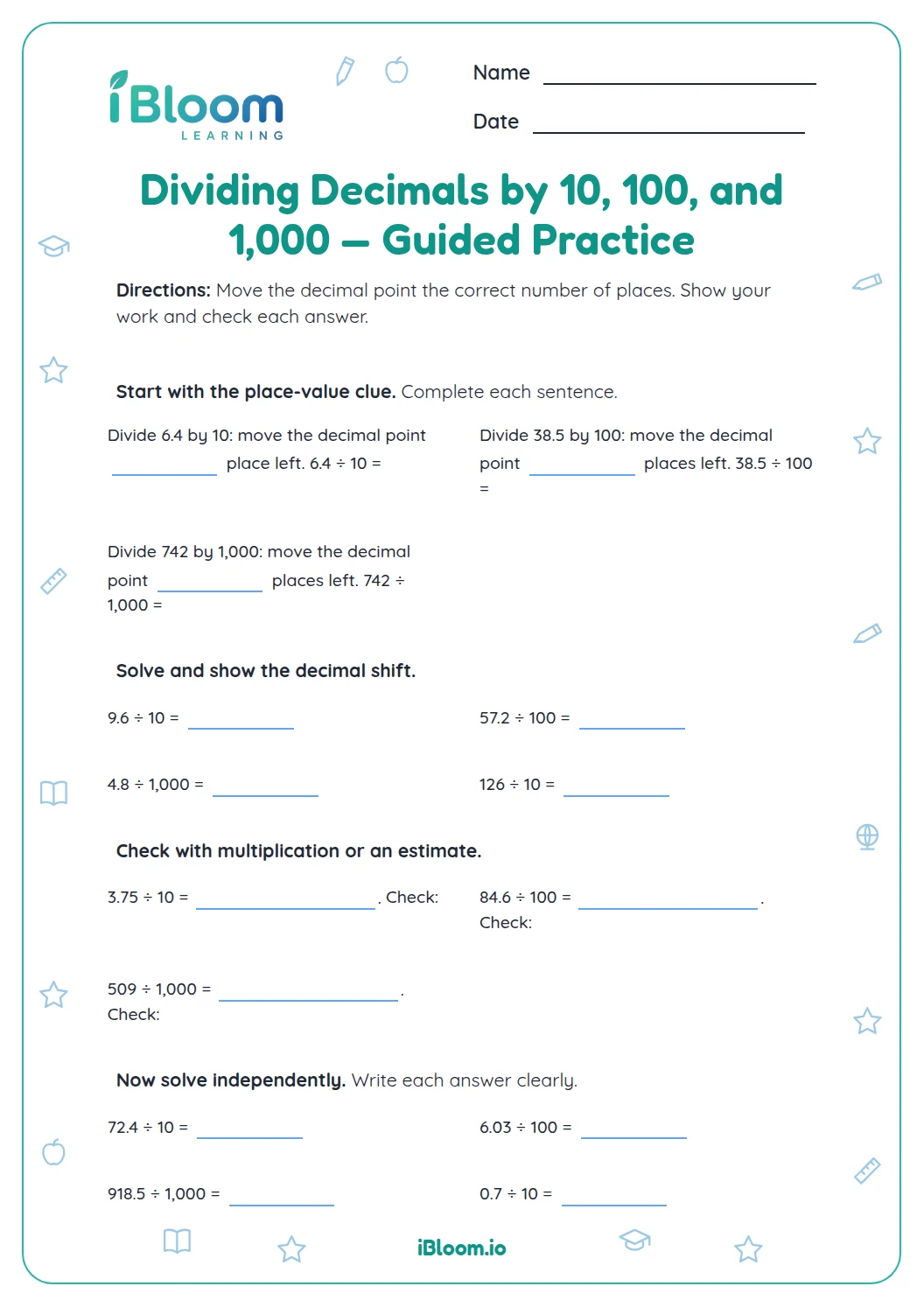
This Grade 6 worksheet practices dividing decimal dividends by whole numbers using long division. Learners estimate first, place the decimal point in the quotient, and continue with zeros when a division reaches a decimal place. The quotients terminate in tenths or hundredths, and the final questions put equal sharing into context. It aligns with CCSS 6.NS.B.3 and comes with a separate answer key.
Aligned to 6.NS.B.3
Why estimate before dividing?
An estimate gives a target for the quotient. For 18.4 ÷ 4, 20 ÷ 4 is 5, so a quotient near 5 is reasonable.
Where does the quotient decimal go?
Place the decimal point in the quotient directly above the decimal point in the dividend. Divide by place value from left to right.
What does this worksheet include?
The three parts move from estimation to computation and then equal-sharing applications.
- Part A: four whole-number estimates
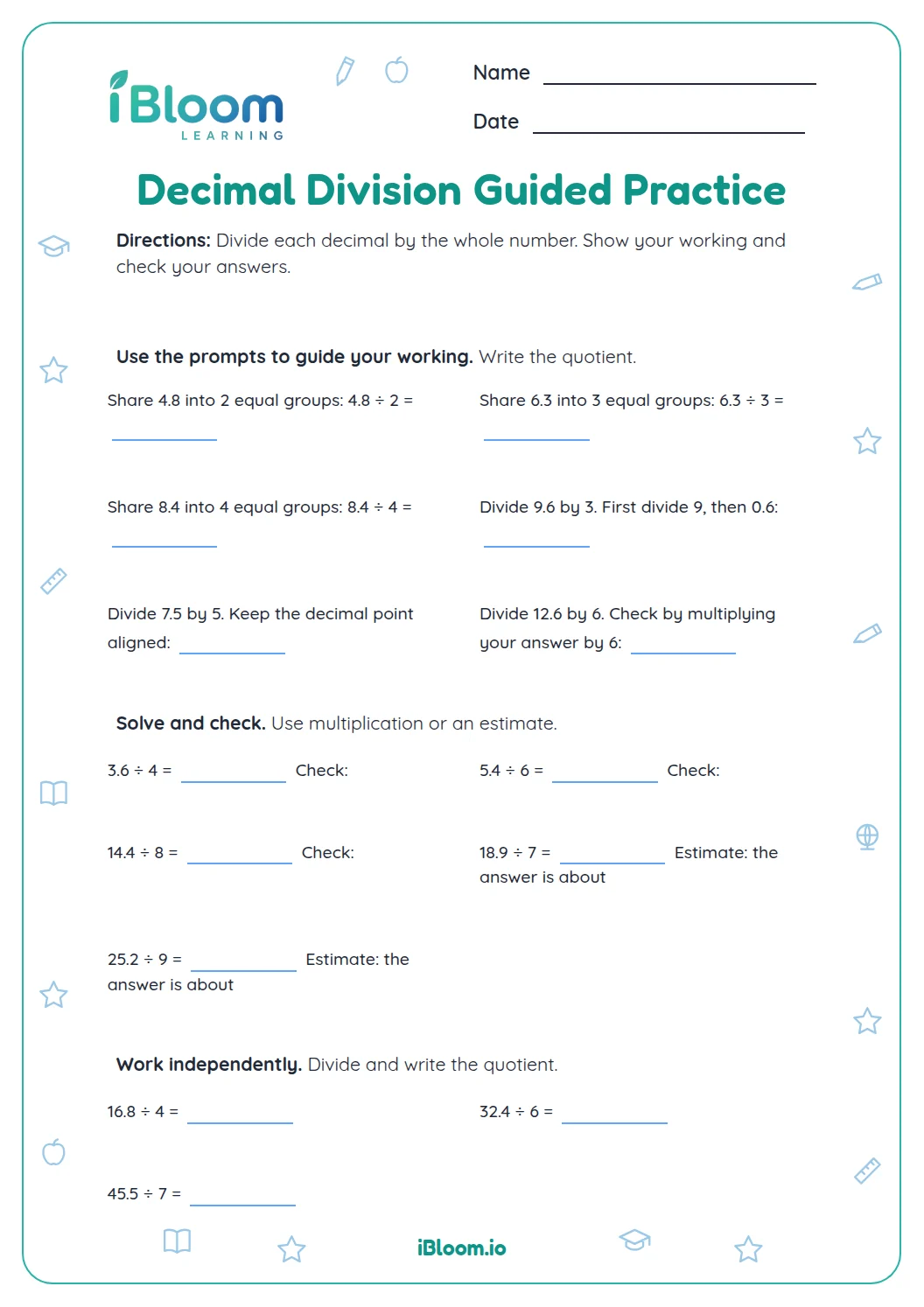
- Part B: eight decimal division calculations
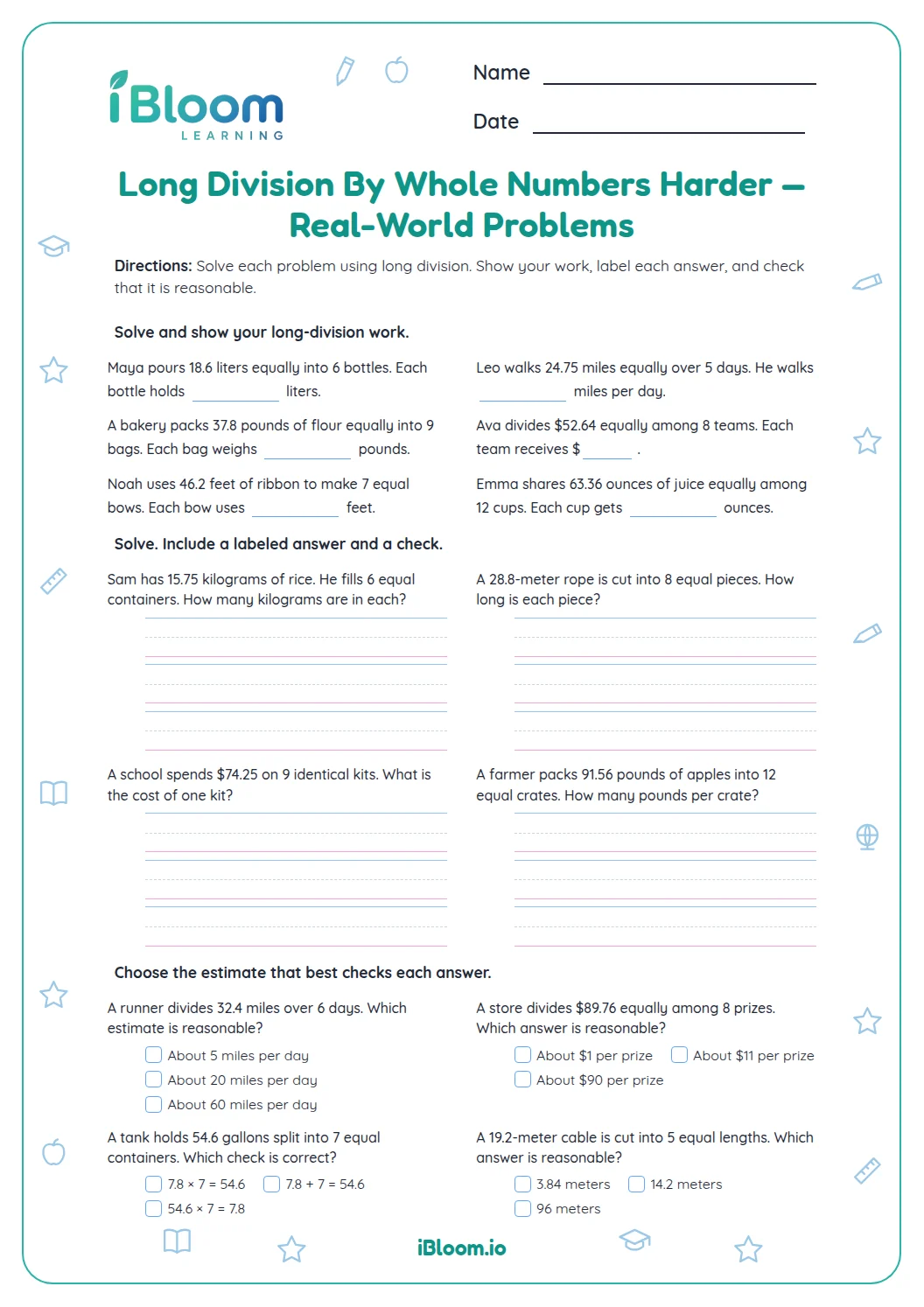
- Part C: four word problems
Steps for long division
- 1Round the dividend to a nearby friendly number and estimate.
- 2Set up the whole-number divisor outside the division bracket.
- 3Bring the dividend decimal point straight up into the quotient.
- 4Divide, multiply, subtract, and bring down each place.
- 5Add a zero to the dividend when needed and continue until the quotient ends.
- 6Multiply the quotient by the divisor to check the original dividend.
Common decimal-division slips
The mistake
Moving the quotient decimal one place by guesswork.
The fix
Place it directly above the dividend decimal before dividing.
The mistake
Stopping when a remainder remains after the tenths place.
The fix
Append a zero to the dividend and continue the same long-division steps.
The mistake
Reporting a quotient far from the estimate.
The fix
Multiply divisor by quotient to see whether the product returns to the dividend.
Common Core alignment
This worksheet focuses on division of decimals by whole numbers using place value and standard algorithms.
Fluently add, subtract, multiply, and divide multi-digit decimals.
On this sheet: The calculations divide decimal dividends by whole-number divisors and use the standard algorithm.
Show the official wordingHide the official wording
Fluently add, subtract, multiply, and divide multi-digit decimals using the standard algorithm for each operation.
What to practice next
Make more practice
Questions parents and teachers ask
Where does the decimal point go in the quotient?
Bring the decimal point straight up from the dividend into the quotient before dividing. This keeps the quotient places aligned with the dividend. Estimate first, then use the estimate to check that the final decimal is a reasonable size. That nearby value is a useful check.
When should a learner add a zero?
If all dividend digits have been brought down and a remainder remains, write a zero after the decimal digits in the dividend and continue. The added zero does not change the dividend’s value; it allows division to continue to the next place.
Are the exact quotients terminating decimals?
Yes. The calculation items are chosen to end in tenths or hundredths, so learners can find an exact quotient without rounding. The estimate section asks for a nearby whole number separately from the exact calculations, giving a reasonableness check before long division begins.
How can learners check a long-division answer?
Multiply the quotient by the whole-number divisor. The product should equal the original decimal dividend. For example, 4.6 multiplied by 4 returns 18.4, so it checks the quotient for 18.4 ÷ 4. Encourage learners to estimate first, then use multiplication to check.
Why does the worksheet begin with estimates?
An estimate gives learners a nearby target before they calculate. For example, 18.4 ÷ 4 is close to 20 ÷ 4, or 5. Comparing the exact quotient with that estimate helps catch a misplaced decimal point or a division error.