

About this worksheet
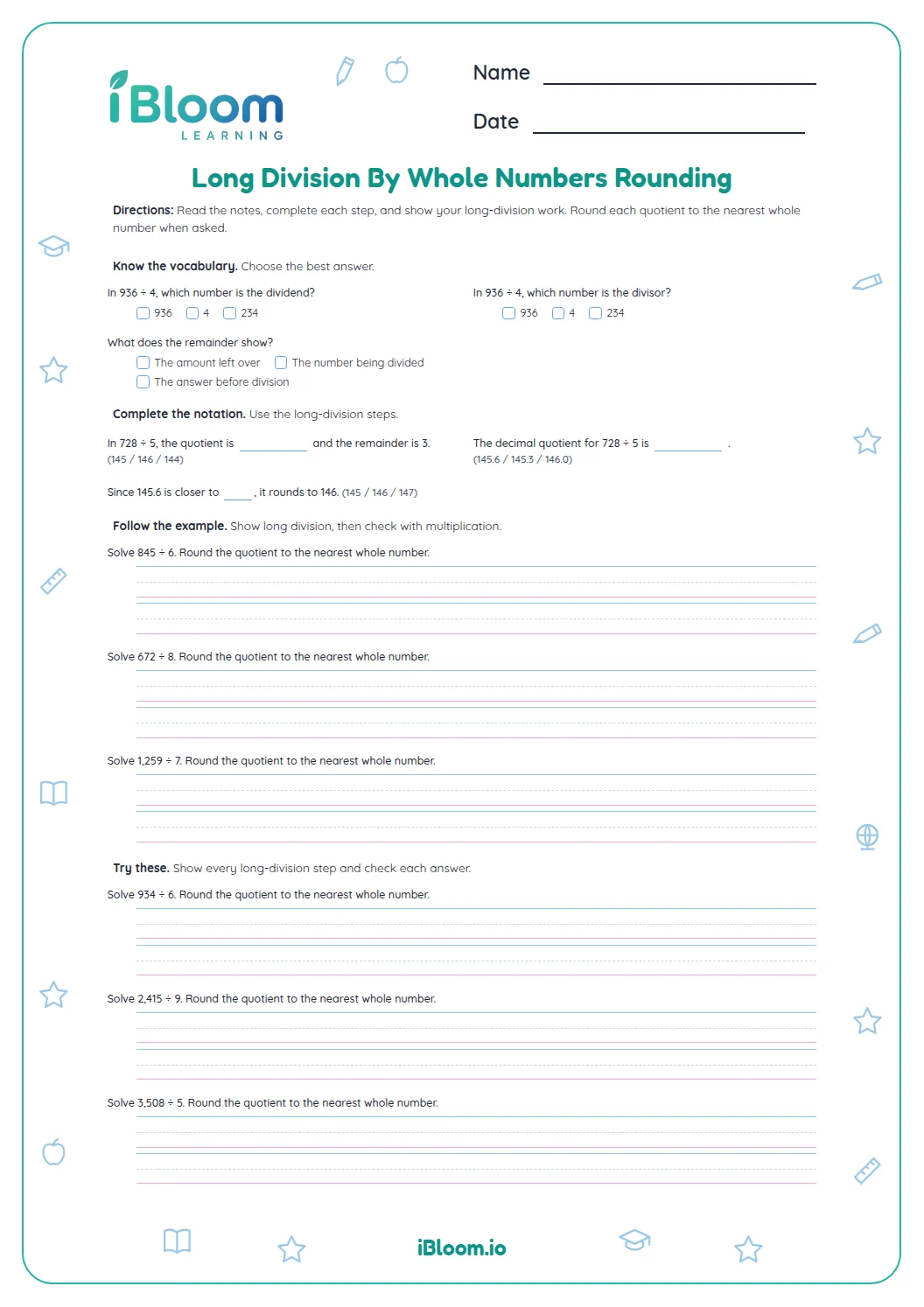
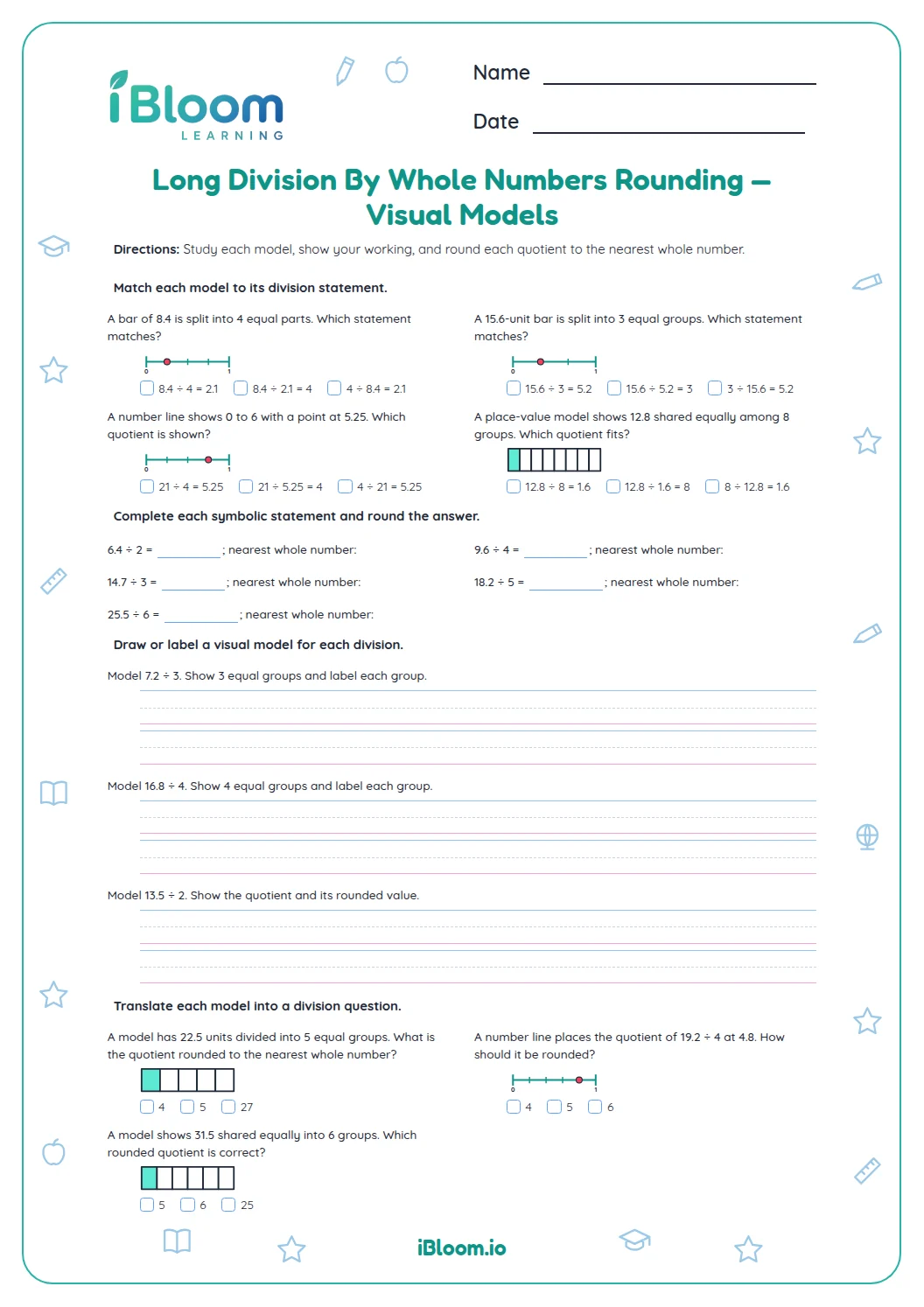
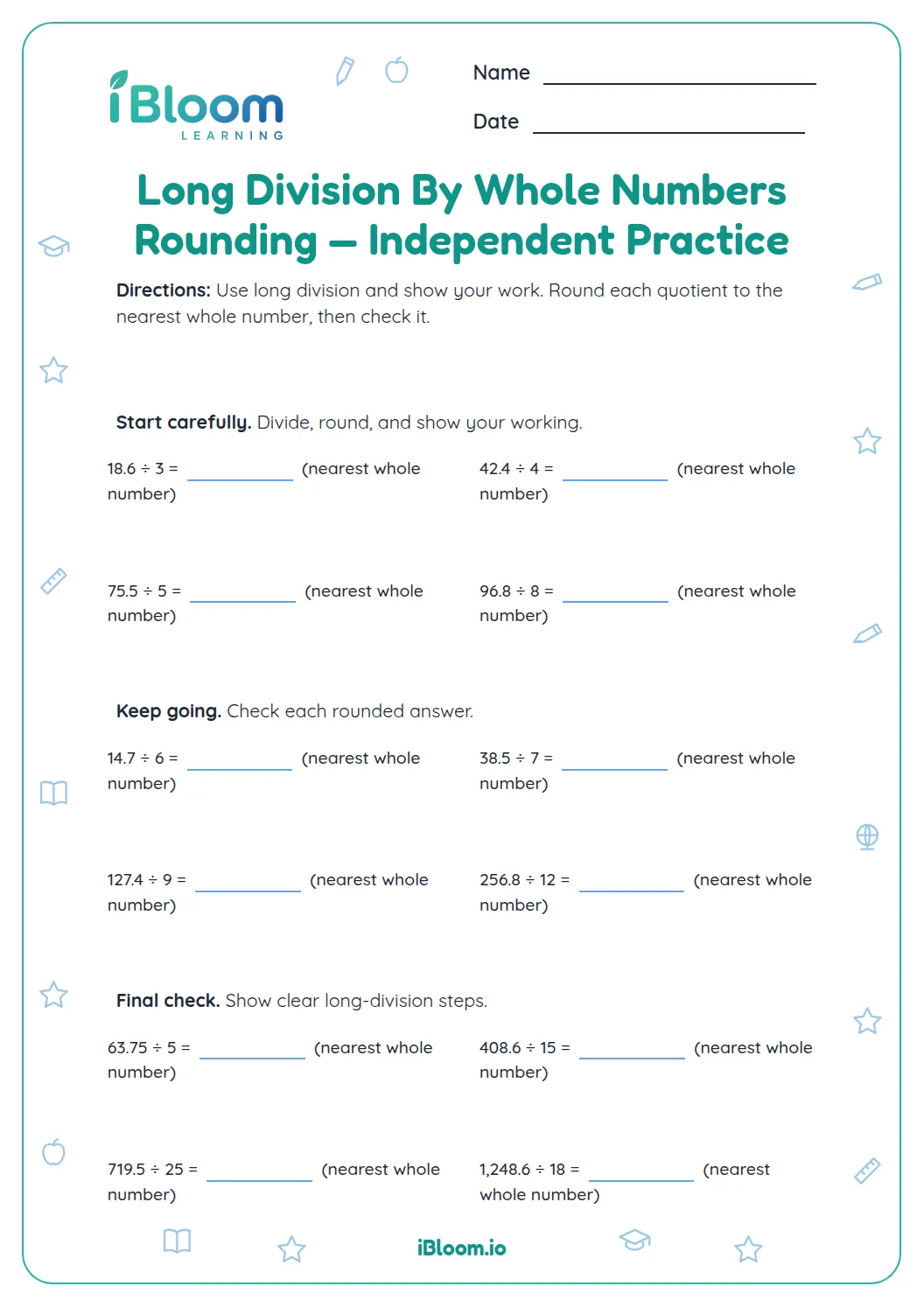
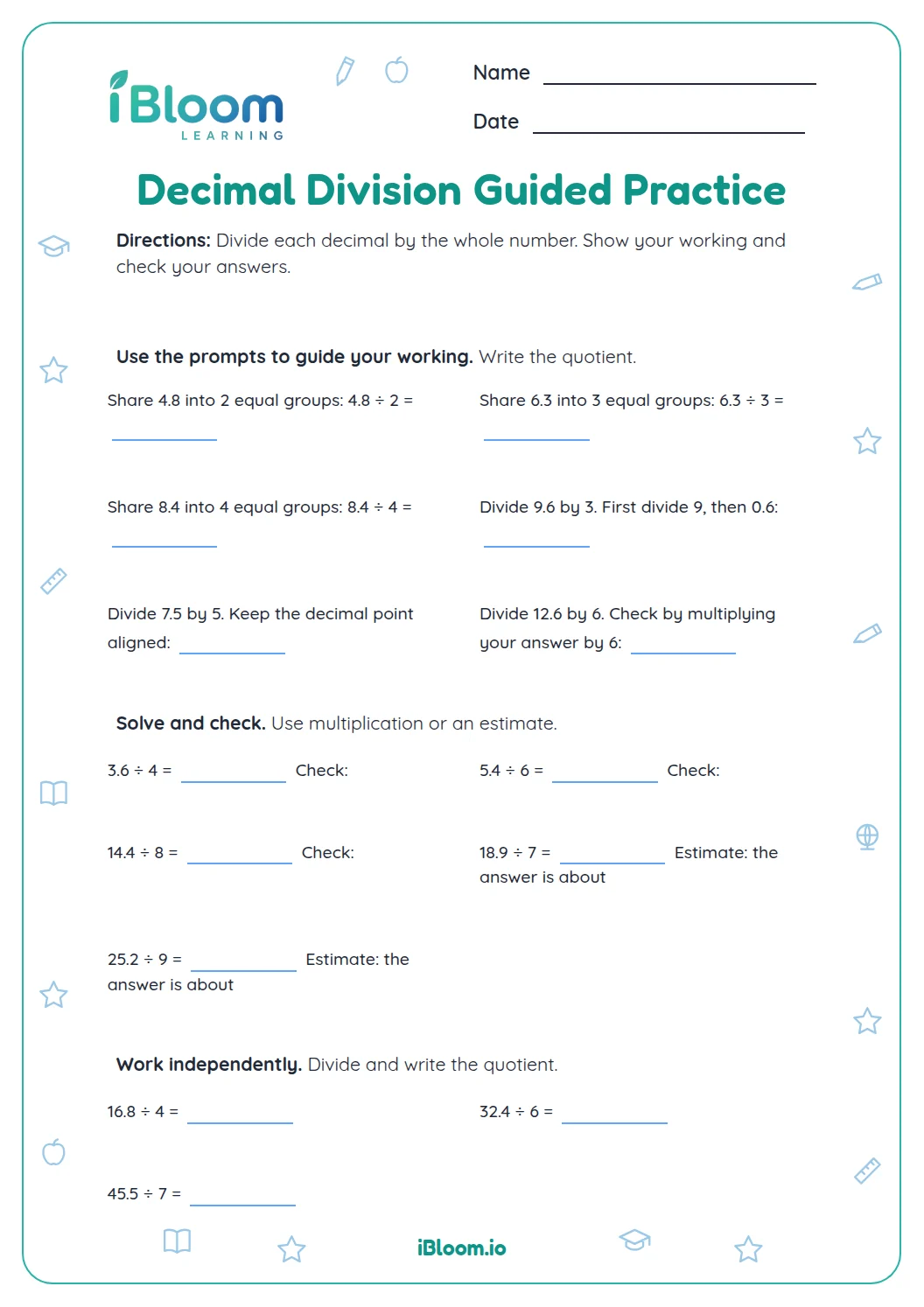
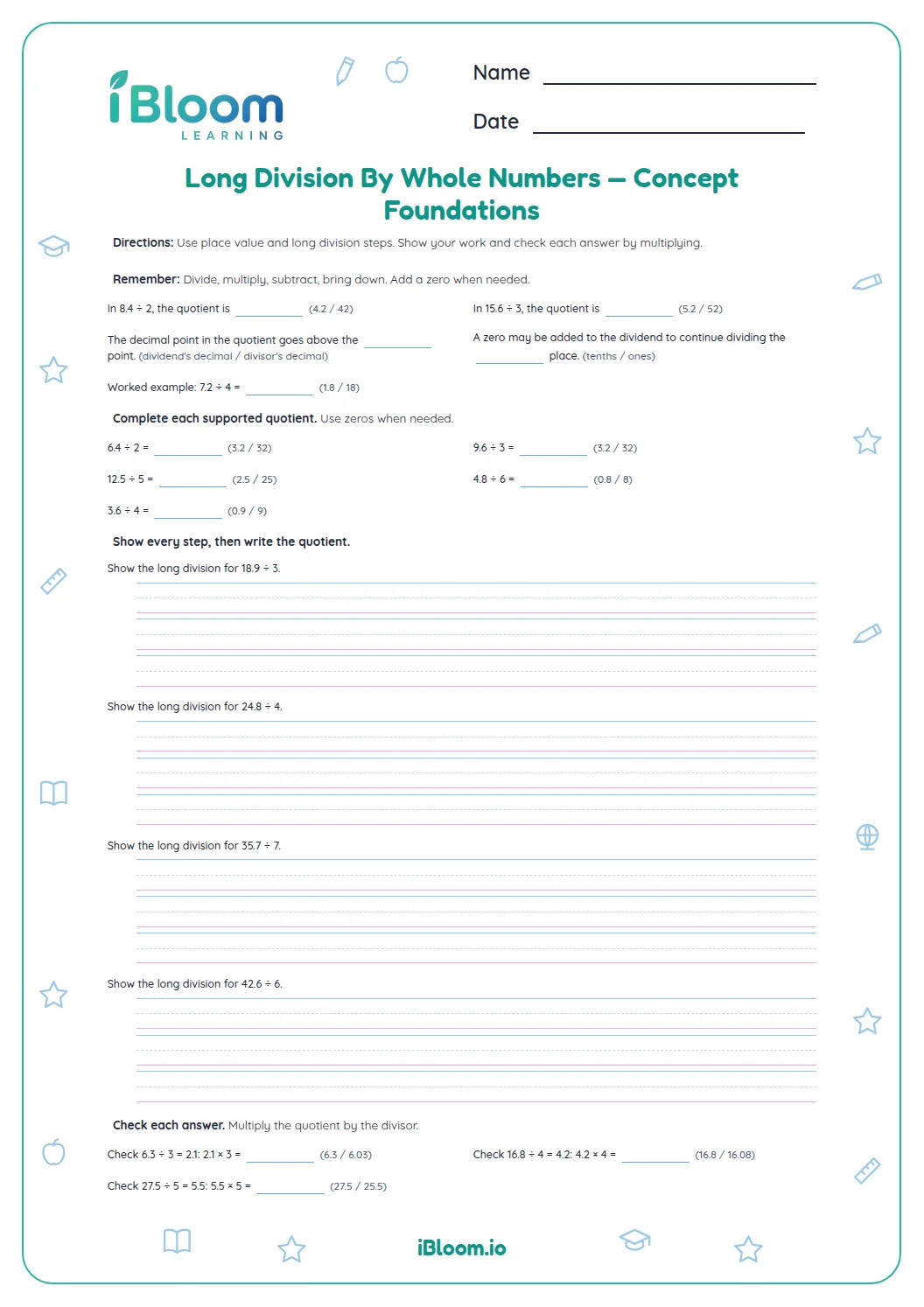
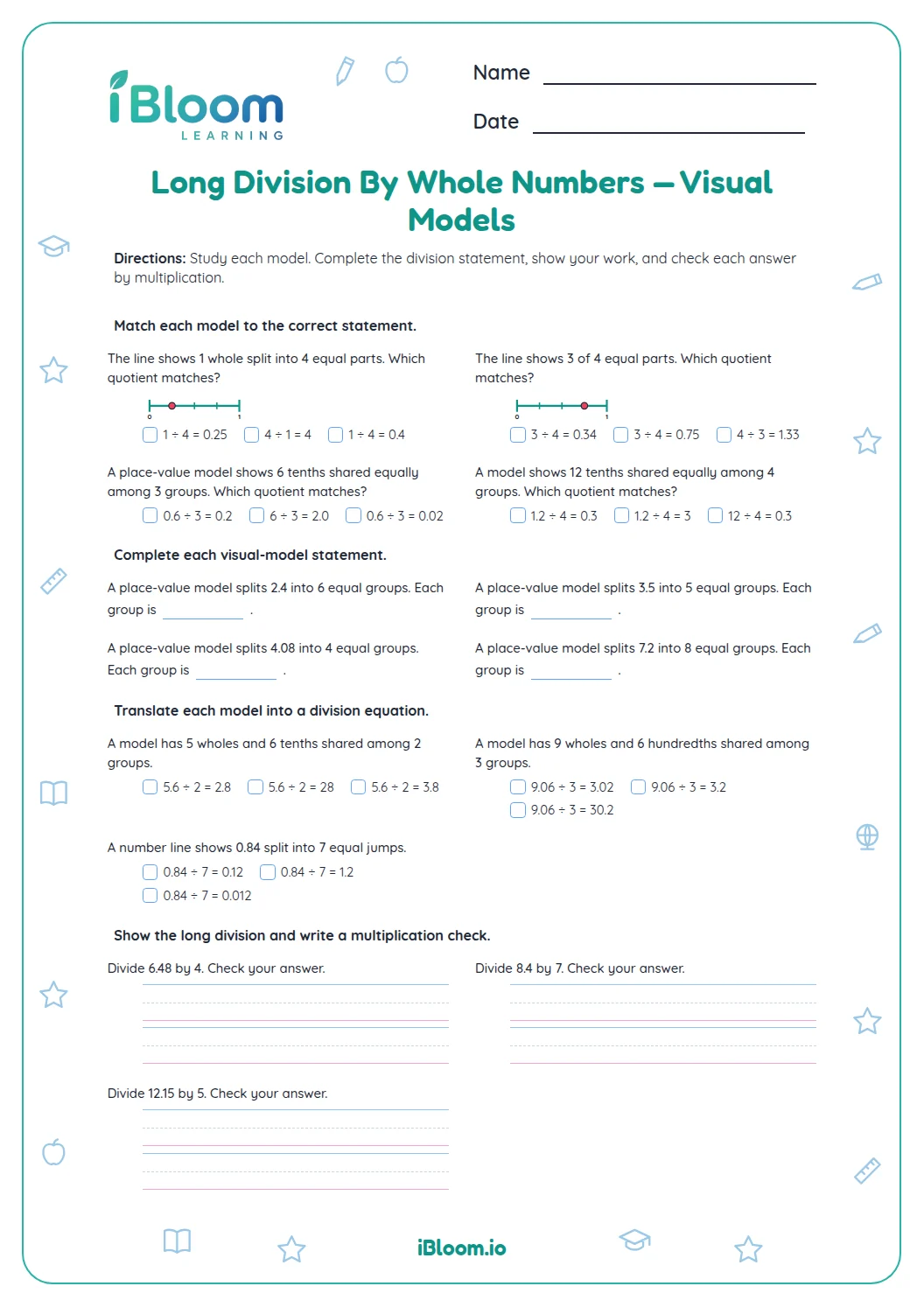
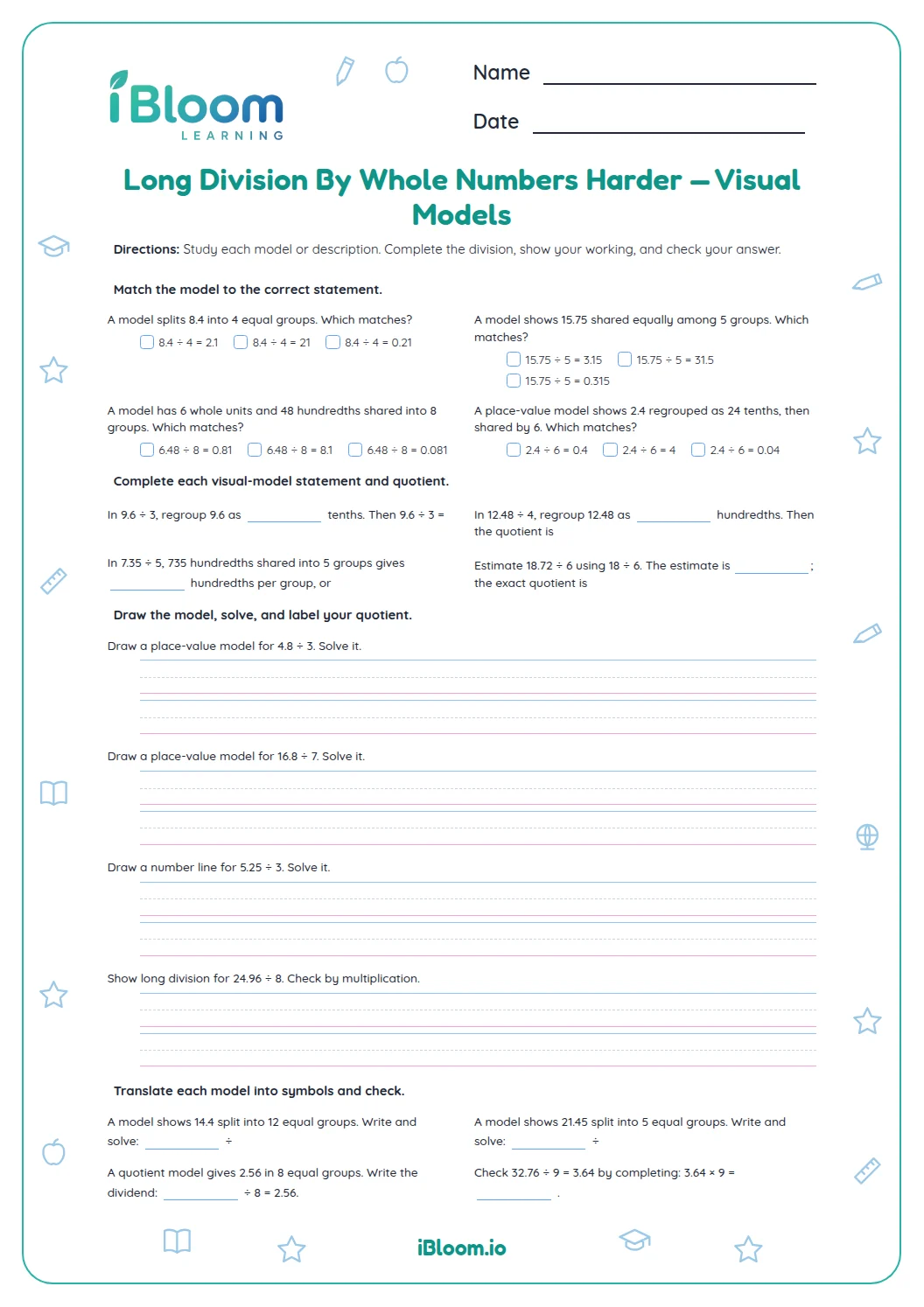
This Grade 6 worksheet gives students guided practice dividing decimal dividends by whole numbers with long division. The first six problems build exact quotients; four more ask for rounding to the nearest hundredth; four apply division to equal sharing and measurement. The page practices Common Core 6.NS.B.3 by using the standard algorithm with decimals. A worked example and answer key support checking each quotient.
Aligned to 6.NS.B.3
Where does the decimal point go in the quotient?
Bring each dividend digit down in order and place the quotient digits over the digits being divided. When the dividend’s decimal point is reached, place the quotient’s decimal point directly above it.
For question 1, 18.4 ÷ 4 = 4.6. Check by multiplying 4.6 × 4 to get 18.4.
- 118.4 ÷ 4
- 218 ÷ 4 gives 4 with a remainder; bring down the 4 tenths.
- 3The quotient is 4.6; check: 4.6 × 4 = 18.4.
How do you round a quotient to the nearest hundredth?
Find the thousandths digit after the division. If it is 5 or more, increase the hundredths digit by one; otherwise keep it. In question 7, 23.7 ÷ 4 = 5.925, which rounds to 5.93.
How can division help solve a sharing problem?
Write the total amount divided by the number of equal groups. Include the unit in the answer. For the 12.6-liter jug shared among 5 bottles, 12.6 ÷ 5 = 2.52 liters per bottle.
Estimate a reasonable quotient before calculating.
- 1Divide from left to right and bring down each digit.
- 2Place the quotient decimal directly above the dividend decimal.
- 3For rounding, keep two decimal places and inspect the thousandths digit.
- 4Check by multiplying the quotient by the divisor.
Common mistakes and quick fixes
The mistake
Placing the quotient decimal at the end of the answer.
The fix
Line it up directly above the decimal point in the dividend.
The mistake
Rounding before the division is complete.
The fix
Keep enough digits to see the thousandths place before rounding.
The mistake
Leaving off units in a story answer.
The fix
Use the same unit as the total being shared.
Common Core alignment
This practice connects to 6.NS.B.3 through the skill named on the worksheet.
Divide decimal dividends by whole-number divisors with a standard algorithm.
On this sheet: The problems divide decimal numbers using long division and ask students to round quotient values.
Show the official wordingHide the official wording
Fluently add, subtract, multiply, and divide multi-digit decimals using the standard algorithm for each operation.
What to practice next
Make more practice
Further reading
Questions parents and teachers ask
How do you divide a decimal by a whole number?
Use the standard long-division steps and bring down the dividend digits in order. When you reach the decimal point in the dividend, place the quotient decimal directly above it. Multiply the quotient by the divisor to check the result. Check that the product returns to the original dividend.
How do I round a quotient to the nearest hundredth?
Finish dividing far enough to find the thousandths digit. Keep the hundredths digit when the next digit is 0 through 4; increase it by one when the next digit is 5 through 9. For example, 23.7 divided by 4 is 5.925, or 5.93 rounded.
What kinds of problems are on this worksheet?
The page begins with exact decimal quotients, then moves to quotients that need rounding and equal-sharing situations involving liters, meters, miles, kilograms, and pounds. Students show long-division work so they can check where each quotient digit belongs. Reading each prompt carefully helps students decide what total is being shared and which unit belongs in the answer.
Can students check their work without the answer key?
Yes. Estimate first to see whether the quotient is reasonable, then multiply the quotient by the whole-number divisor. For rounded answers, the product may differ slightly from the dividend, so compare the unrounded quotient before rounding. Estimation also helps catch a decimal point that has shifted too far left or right.
Which unit should go in a sharing answer?
Use the same unit as the total in the story. For example, when 12.6 liters are shared among 5 bottles, the quotient is 2.52 liters per bottle. The answer key uses units such as liters, meters, kilograms, and miles where a measurement is given.