
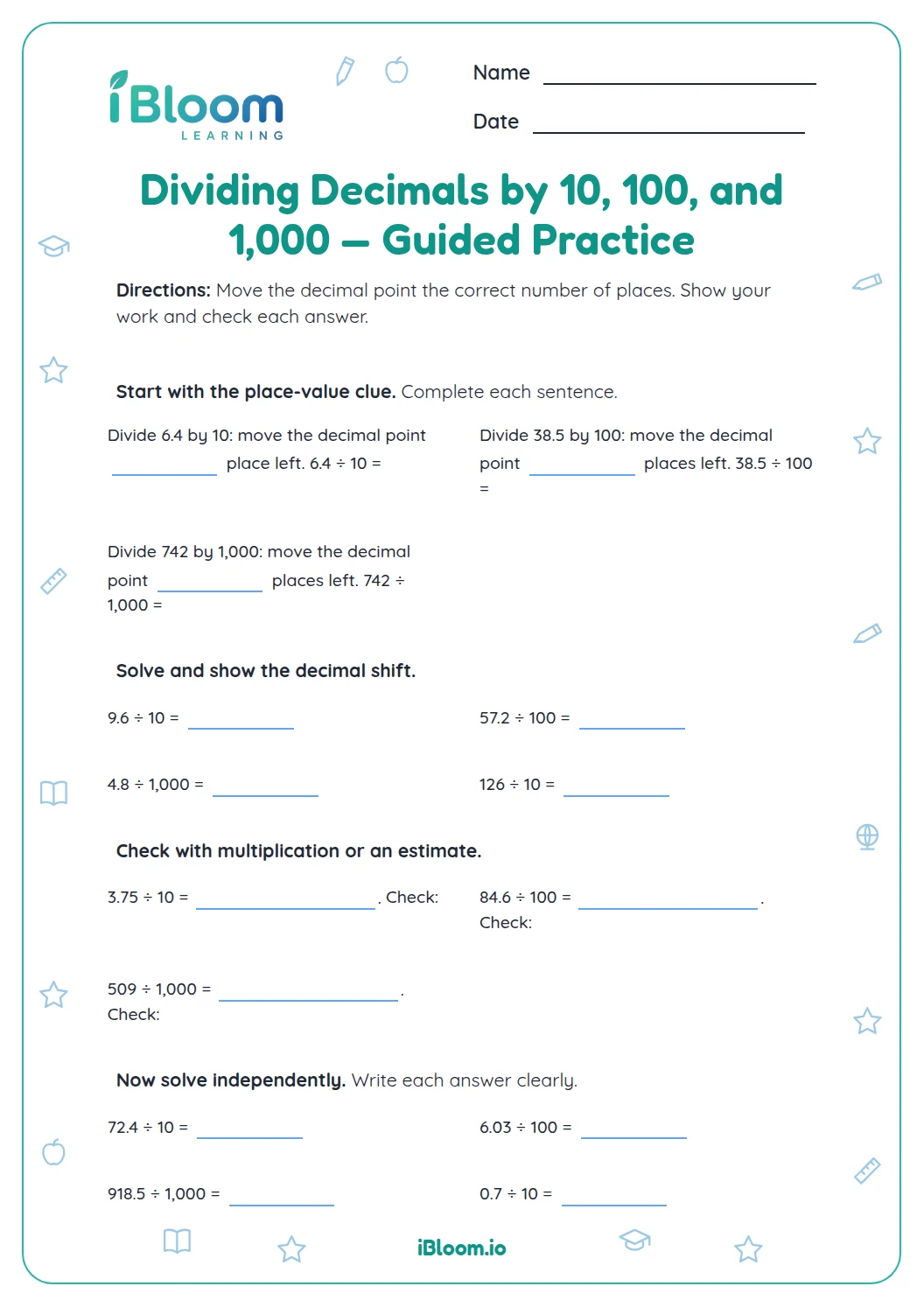
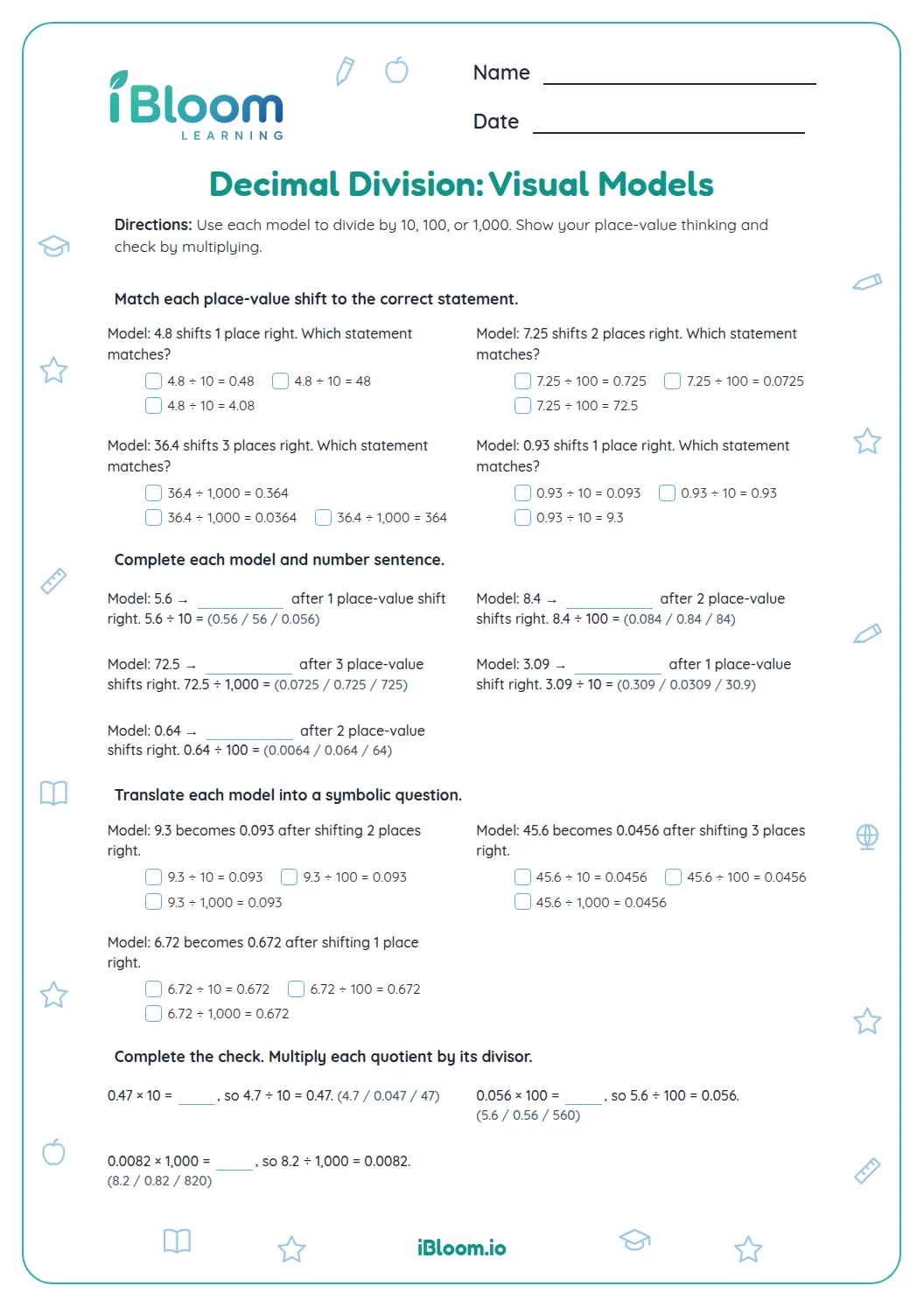
About this worksheet
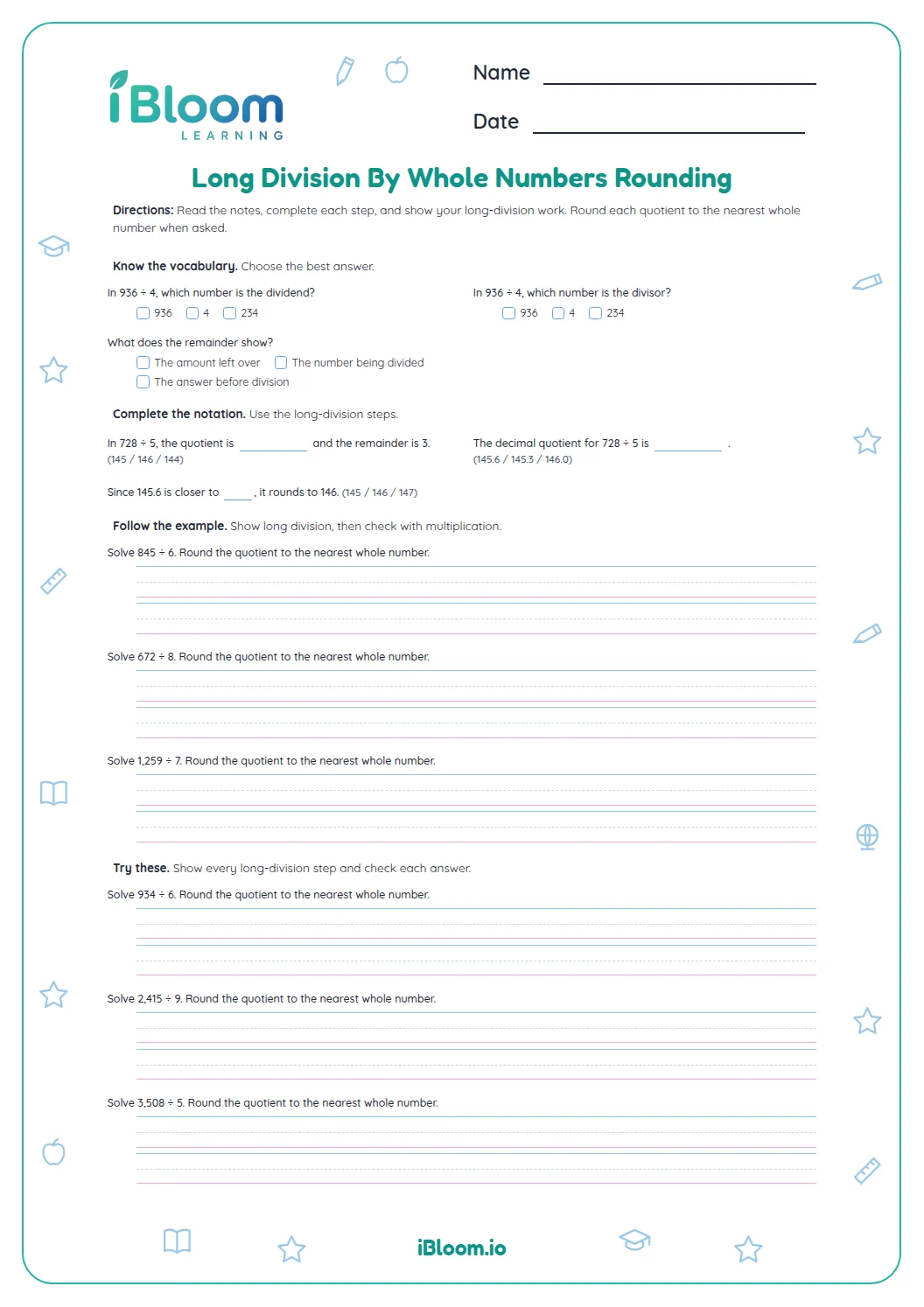
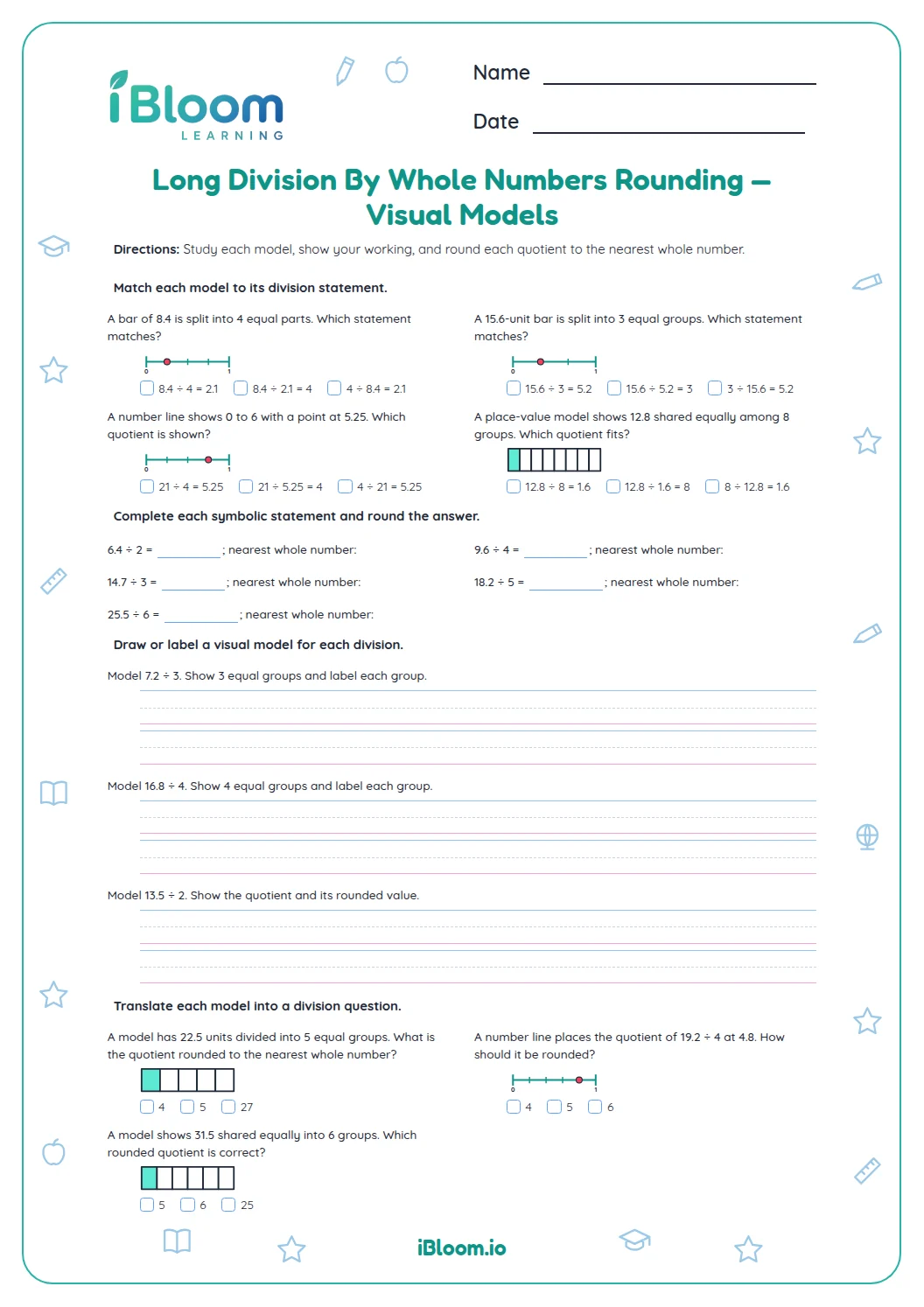
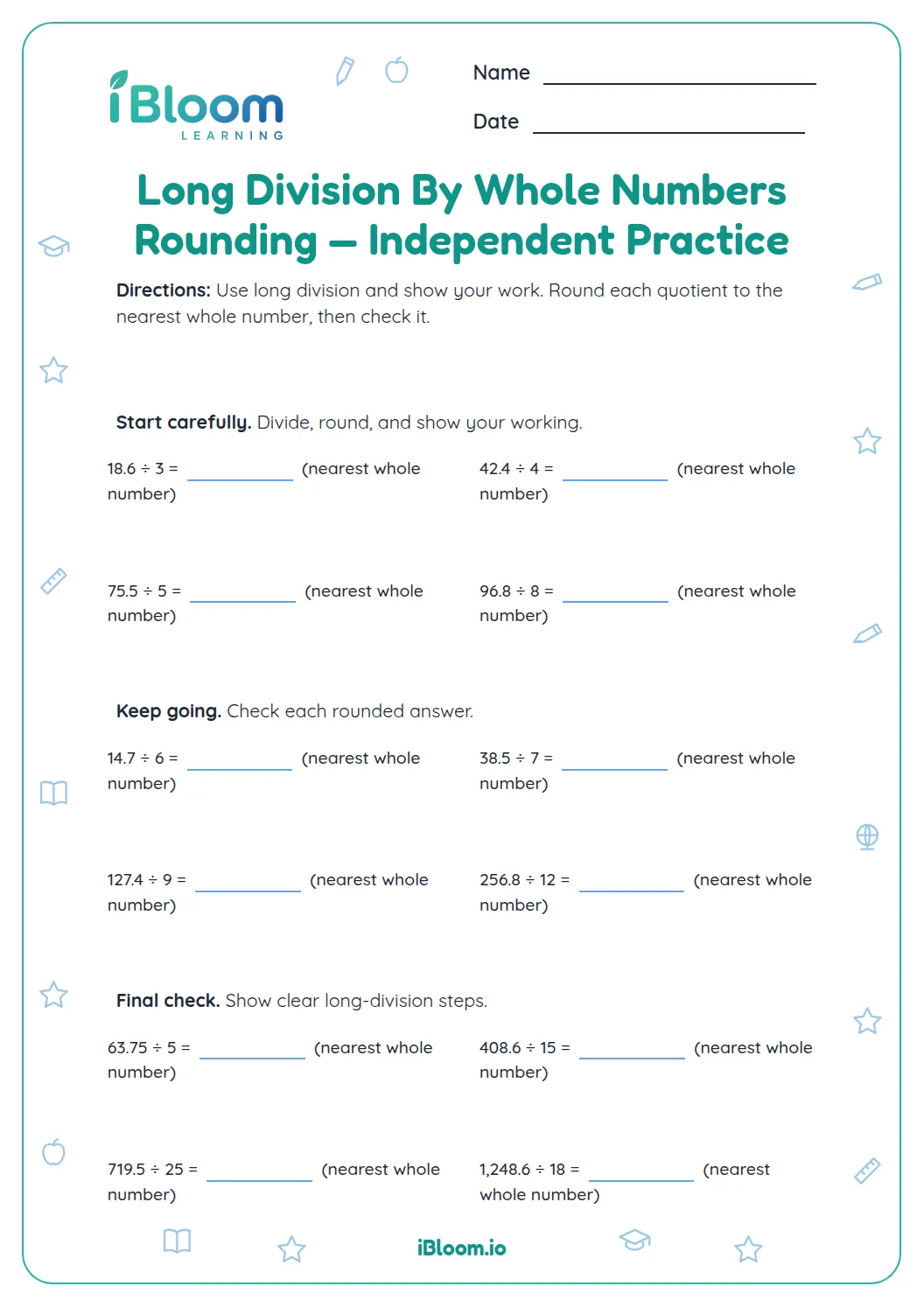
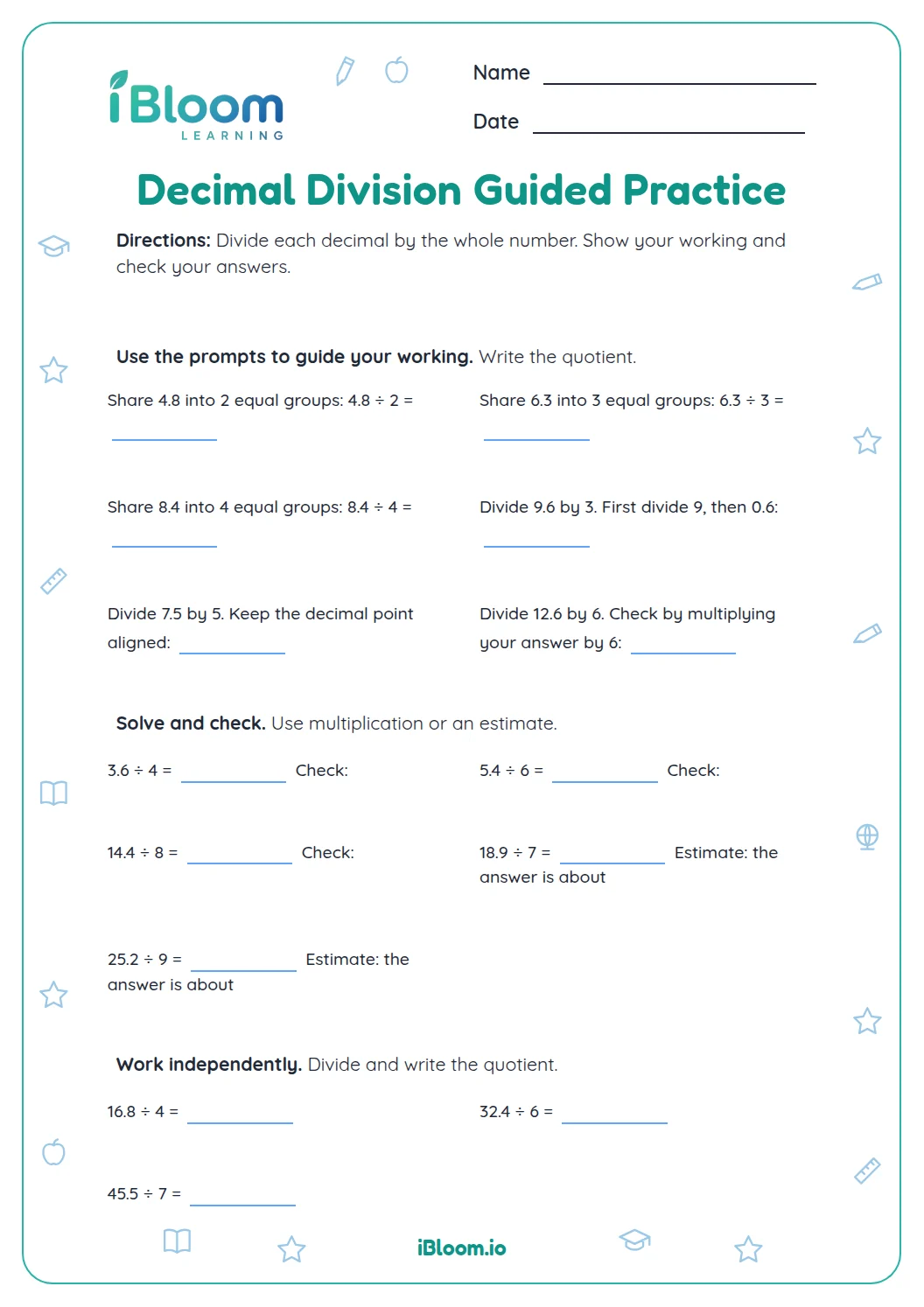
This Grade 6 printable practices long division with decimal dividends and whole-number divisors, followed by rounding quotients to the nearest whole number. Its 16 questions include exact division, error checks, strategy comparisons, missing information, and a sharing situation. The separate key shows rounded answers and reasoning.
Aligned to 6.NS.B.3
How do you divide a decimal by a whole number?
Divide as with whole numbers and place the decimal point in the quotient directly above the decimal point in the dividend. Add zeros to the dividend when needed.
- 18.64 ÷ 4
- 2Divide 8 by 4 to get 2.
- 3Bring down 6 tenths; 6 ÷ 4 gives 1 tenth, remainder 2 tenths.
- 4Bring down 4 hundredths to make 24 hundredths; 24 ÷ 4 = 6.
- 5The quotient is 2.16.
How do you round a quotient?
Find the ones digit, then inspect the tenths digit. In question 7, 5.83 ÷ 4 = 1.4575, which rounds to 1 because the tenths digit is 4.
How can an estimate check the answer?
Estimate the quotient before rounding, then compare the exact value with the proposed rounded result. For question 13, 63.7 ÷ 4 is 15.925, so rounding to 15 is incorrect; it rounds to 16.
How to use this worksheet
- 1Estimate the quotient before calculating.
- 2Divide digit by digit and keep the decimal point aligned.
- 3Add a zero to continue when the dividend has no digits left.
- 4Round only after finding the quotient.
- 5Multiply the quotient by the divisor to check.
Common mistakes and quick fixes
The mistake
Dropping the decimal point in the quotient.
The fix
Place it above the dividend decimal point before dividing.
The mistake
Rounding from the wrong digit.
The fix
Circle the requested place, then look one digit to its right.
The mistake
Stopping when a remainder remains.
The fix
Append zeros after the decimal to continue to the needed precision.
Common Core alignment
This sheet gives practice with the Common Core skill named below.
Use standard algorithms to divide multi-digit decimals.
On this sheet: The computation questions use standard decimal division; the final items ask learners to judge or apply quotients.
Show the official wordingHide the official wording
Fluently add, subtract, multiply, and divide multi-digit decimals using the standard algorithm for each operation.
What to practice next
Make more practice
Further reading
Questions parents and teachers ask
How do I round a decimal quotient to the nearest whole number?
Divide first, then look at the tenths digit. If it is 5 or more, raise the ones digit by one; otherwise keep it. In question 7, 5.83 ÷ 4 = 1.4575, so the quotient rounds to 1. The divisor and dividend still provide a useful check on the quotient’s size.
Where does the decimal point go when dividing?
Place the decimal point in the quotient directly above the decimal point in the dividend. Then divide the digits as usual and add zeros to the dividend if you need to continue. For example, 8.64 ÷ 4 equals 2.16.
How can I check an estimated or rounded quotient?
Multiply the quotient by the divisor to see whether it returns the dividend, allowing for rounding. An estimate also helps: 63.7 ÷ 4 is near 64 ÷ 4, or 16, so an answer around 16 is sensible. Estimate before rounding when possible.
What does the strategy question ask?
It asks children to compare estimates and calculations before deciding which method is efficient. They should check that the quotient makes sense, then explain how the divisor and dividend support their choice. Children should include the requested place value when recording each rounded answer.
What is included in the answer key?
The separate key gives exact or rounded quotients and sample reasoning for the explanation problems. A learner can check a division result by multiplying the quotient by its divisor and comparing the product with the dividend. The divisor times the exact quotient should reproduce the dividend.
How long might this worksheet take?
Plan for about 25 minutes, depending on how much long-division work the learner writes. The sheet moves from quotient practice to rounding and then to reasoning, comparisons, and short applications. The key provides a model for checking both the calculation and the explanation.