


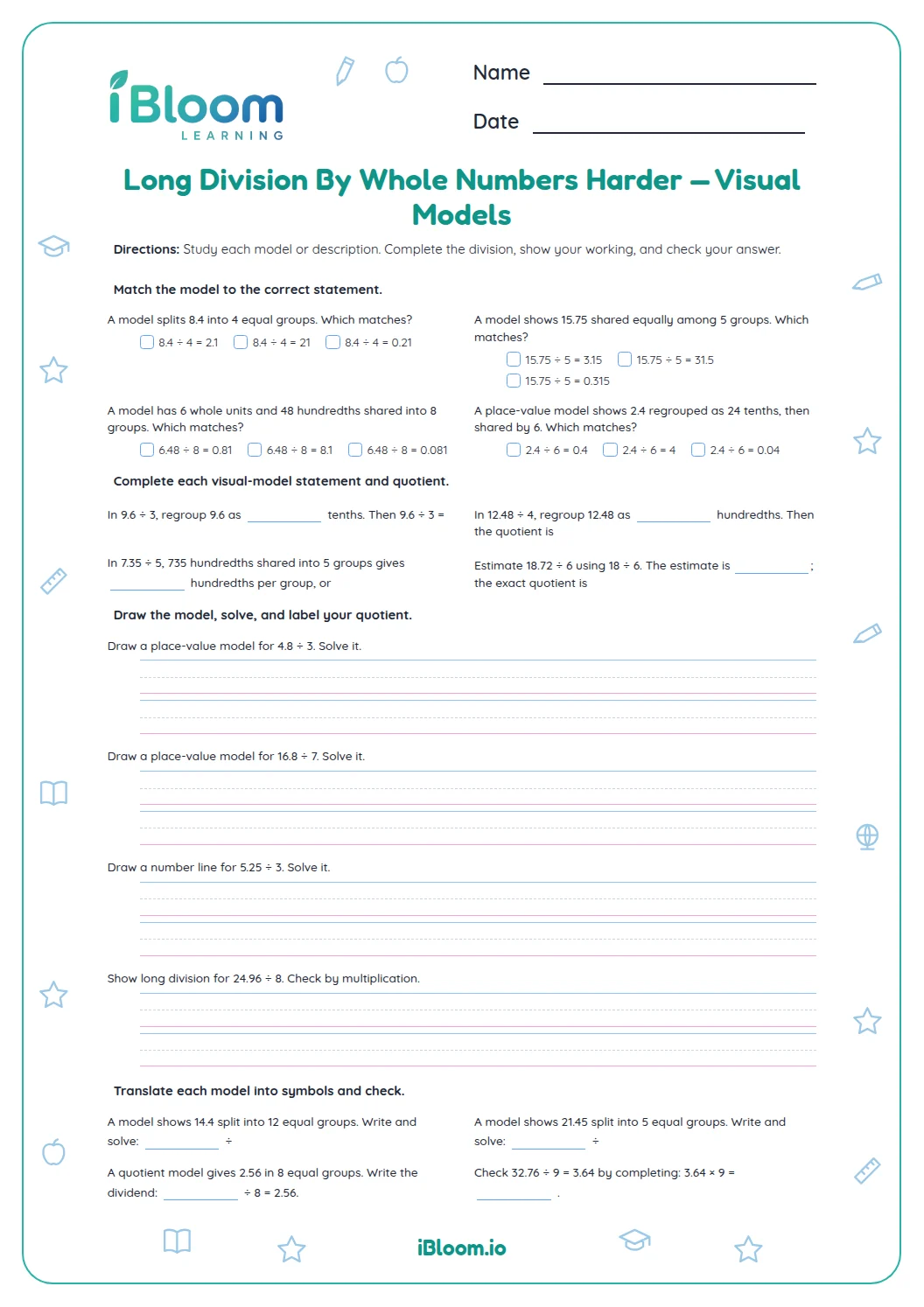
About this worksheet
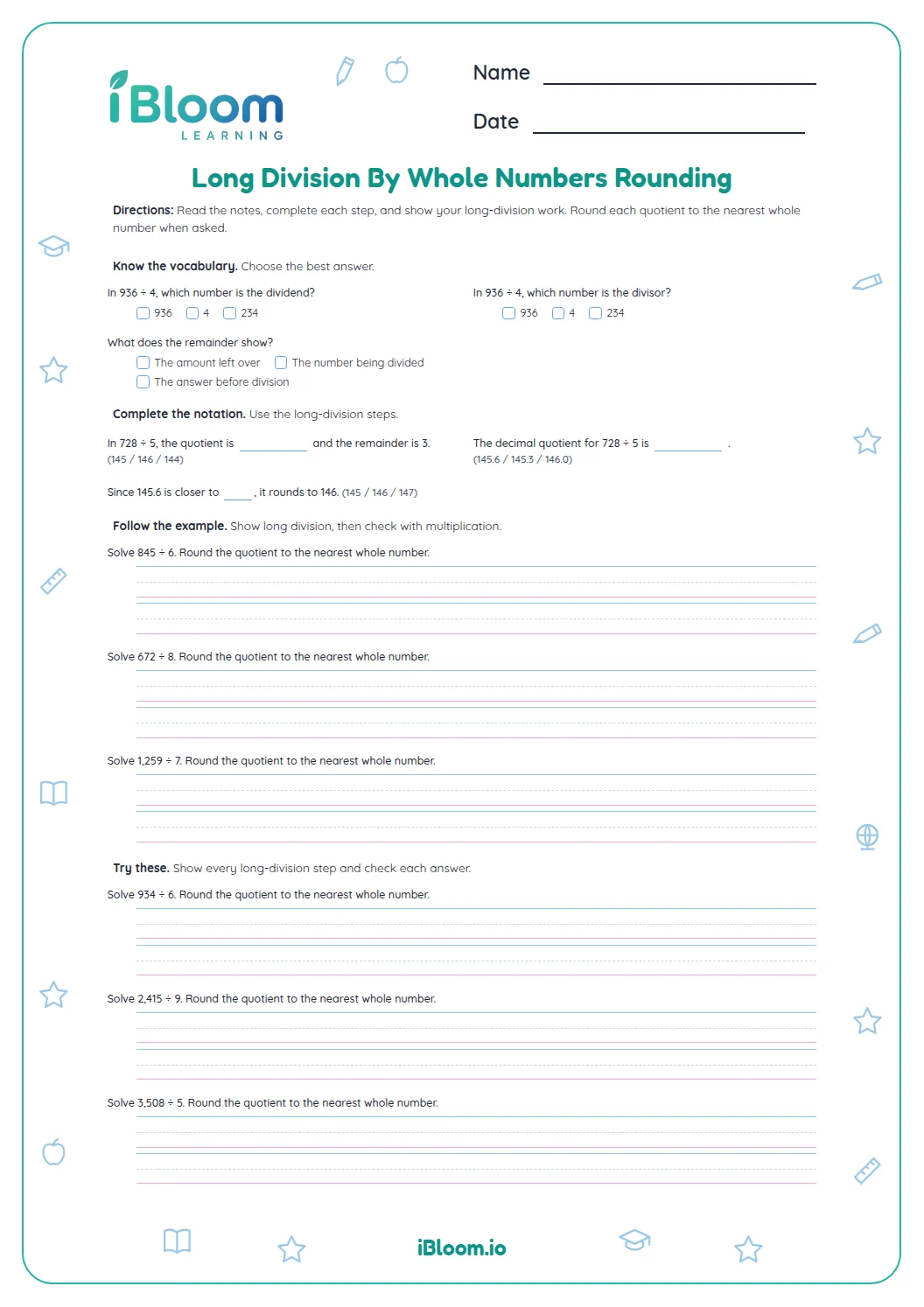
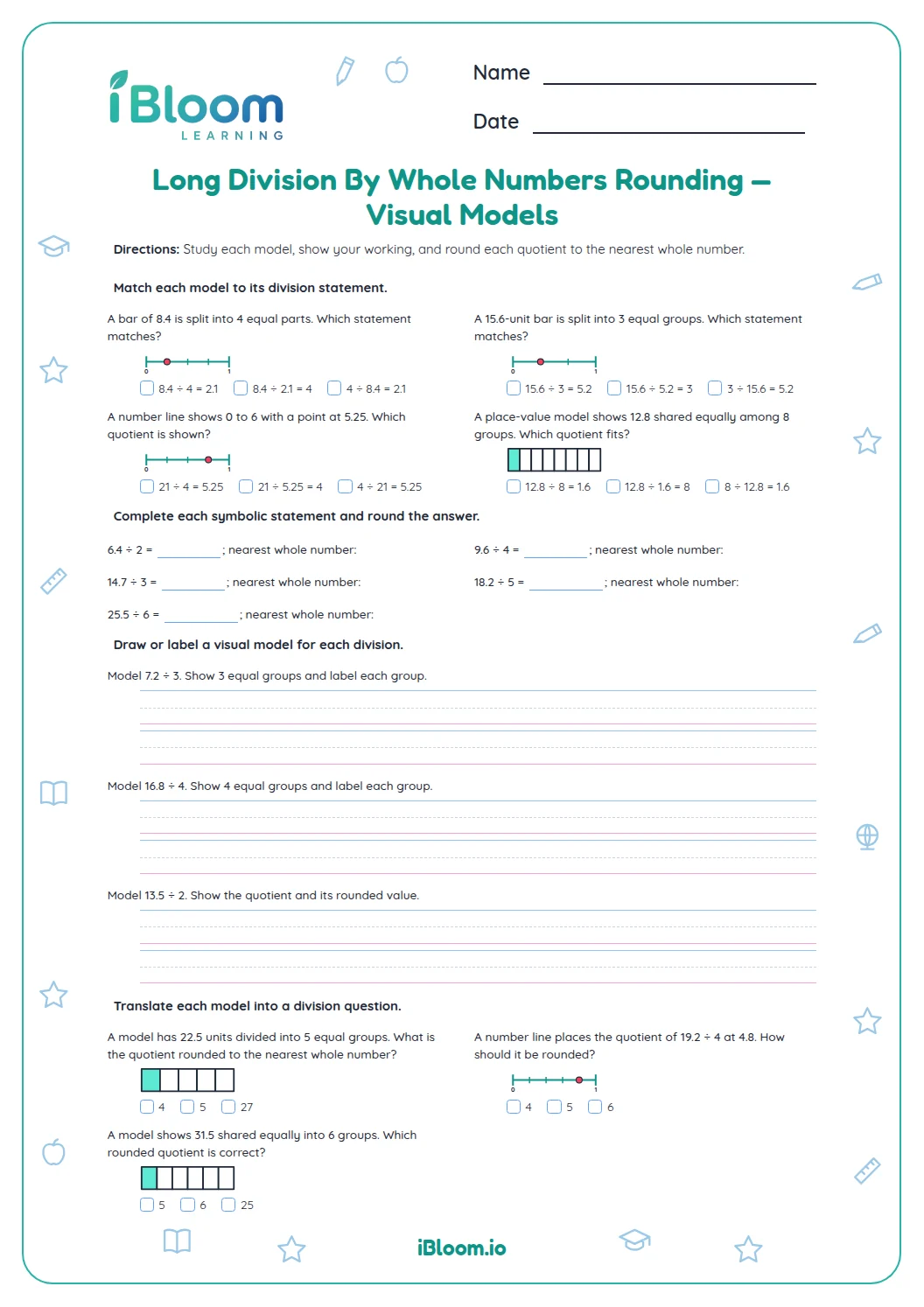
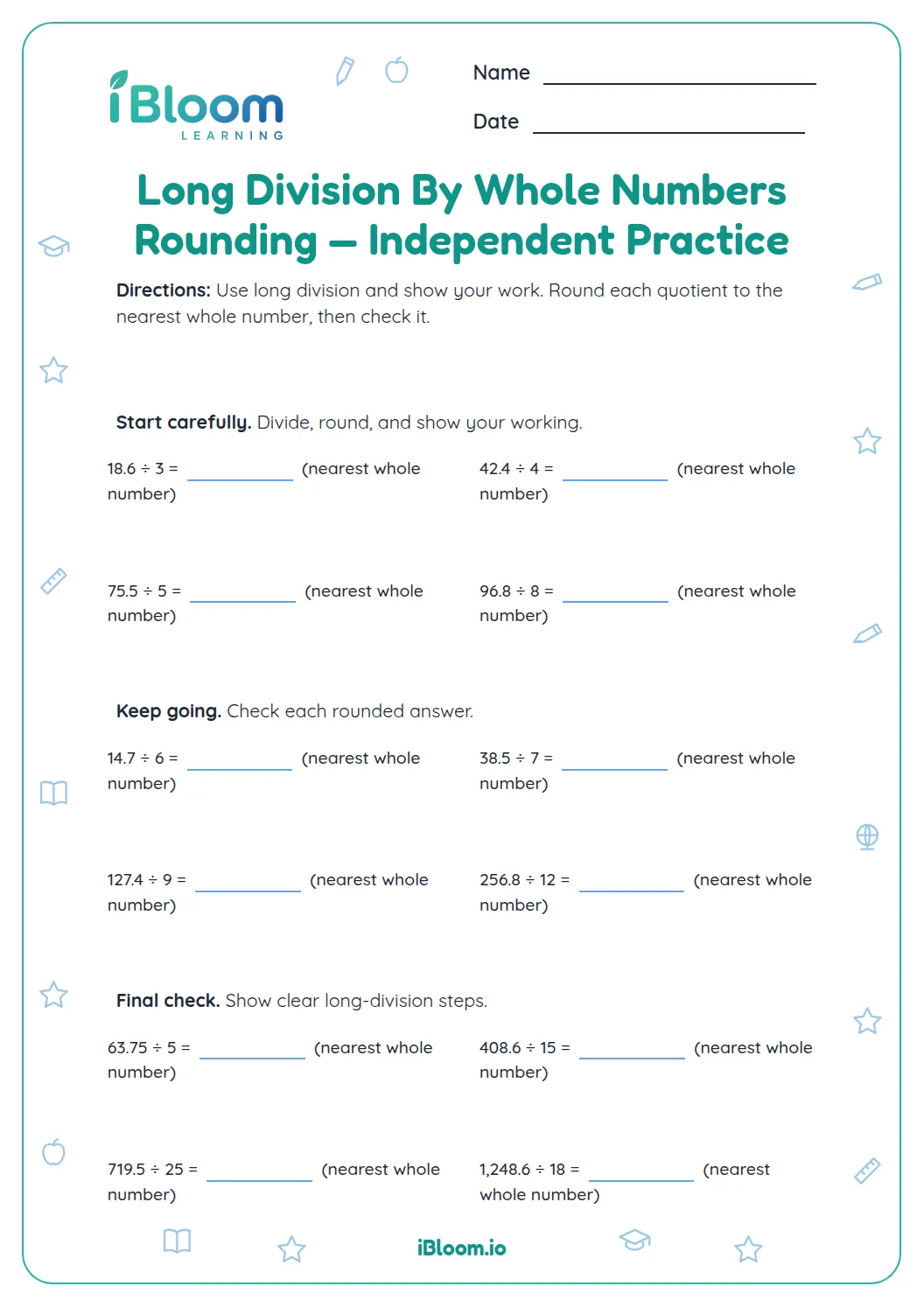
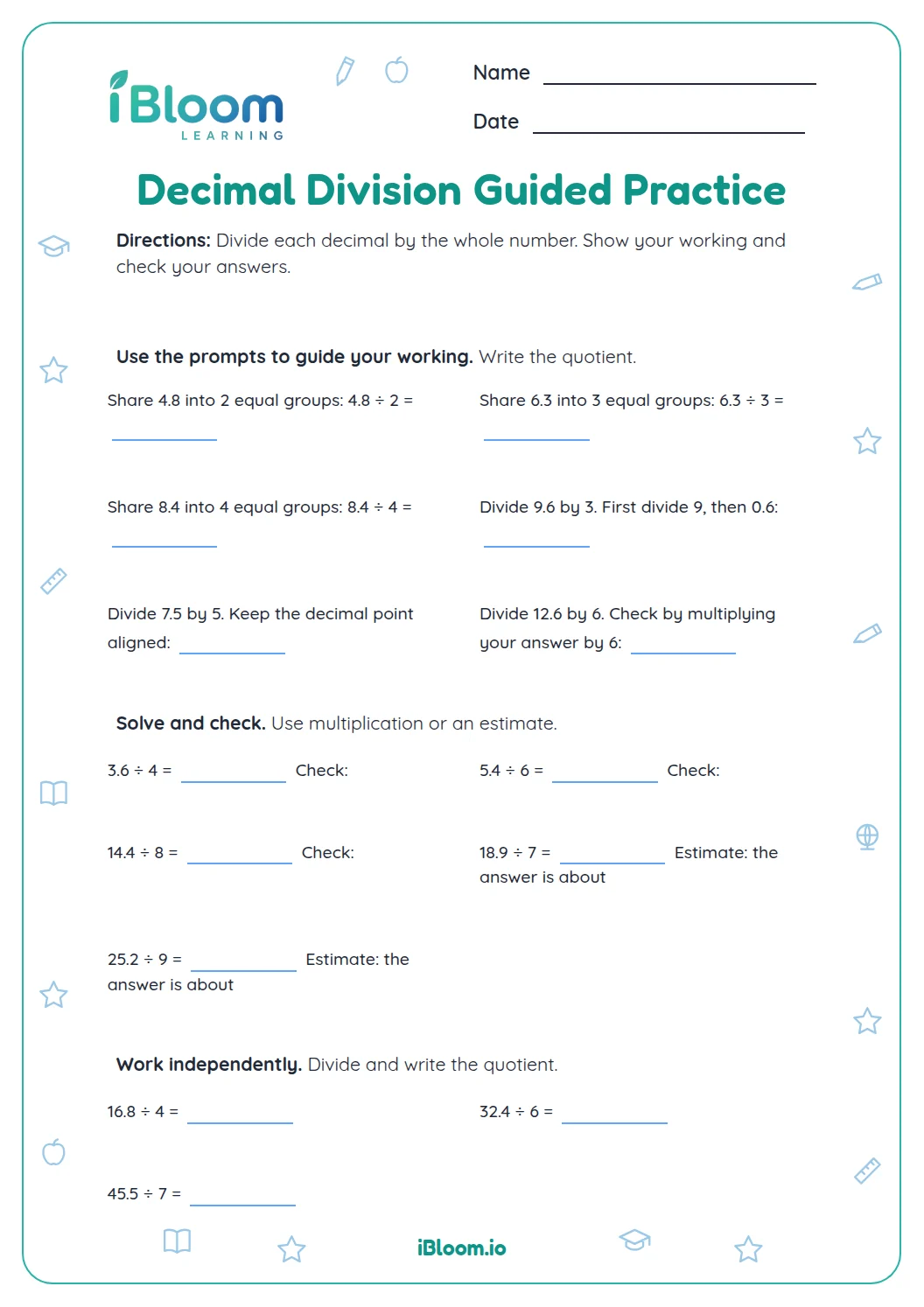
This free printable Grade 6 worksheet connects decimal long division to equal shares, lengths and unit costs. Students solve 14 short, contextual division problems with whole-number divisors, including 12 and 14. Part A rounds eight quotients to the nearest tenth; Part B rounds six to the nearest hundredth. Students can show the long-division steps on scratch paper and write each rounded quotient in the blank. The sheet practices Common Core 6.NS.B.3 through decimal division. A separate answer key gives the rounded results.
Aligned to 6.NS.B.3
How does long division work with a decimal dividend?
Part A has eight decimal quotients to round to tenths. Estimate first, divide the amount by the number of equal groups, then use the next decimal place to decide whether to round up.
A zero added to the end of a decimal does not change its value. It lets the calculation continue far enough to decide how to round.
Which digit decides whether the answer rounds up?
Part B has six quotients to round to hundredths. For money, the hundredths place gives the amount in cents. Keep the divisor as the number of equal groups, and check that the result is close to a reasonable estimate.
- 1Question 5: Five notebooks cost $18.76.
- 218.76 ÷ 5 = 3.752
- 3The hundredths digit is 5; the next digit is 2.
- 4Rounded average cost: $3.75 per notebook.
How can students check whether the answer makes sense?
Estimate before dividing: $18.76 for five notebooks is a little less than $20 for five, so the average cost should be a little less than $4. A result of $37.52 would fail that check.
A rounded quotient is an approximation. Multiplying $3.75 by 5 gives $18.75, one cent short of the total because of rounding. The question supplies the unit; write the rounded number in its answer box and say what the quantity measures.
How to use this worksheet
- 1Read the part heading to identify the requested rounding place.
- 2Identify the total and number of equal groups, then write a division expression.
- 3Estimate a nearby quotient to check its size.
- 4Use long division through at least one digit beyond the requested place.
- 5Round once and compare the result with your estimate. State the unit aloud, then write the number in the answer box.
- 6Use the key to check the rounded result; review the written division if it differs.
Mistakes to discuss and fix
The mistake
Stopping at 2.91 and writing 2.91 for a nearest-tenth answer.
The fix
Part A requires one decimal place. The hundredths digit decides the tenth: 2.9.
The mistake
Rounding 28.4 before dividing by 8.
The fix
Keep the original dividend. Divide first to get 3.55, then round to 3.6 liters.
The mistake
Moving the decimal point because the divisor has two digits.
The fix
A whole-number divisor needs no decimal shift. Keep the quotient’s point above the dividend’s point.
Common Core alignment
Use long division to divide decimal quantities by whole numbers in word problems.
On this sheet: All 14 contextual division problems use decimal division followed by rounding to tenths or hundredths.
Show the official wordingHide the official wording
Fluently add, subtract, multiply, and divide multi-digit decimals using the standard algorithm for each operation.
What to practice next
Make more practice
Further reading
Questions parents and teachers ask
Which answers should be rounded to tenths?
Round questions 1 through 4 in Part A to the nearest tenth. Continue the division through the hundredths digit so you can decide what happens to the tenths digit. For example, question 2 gives 28.4 ÷ 8 = 3.55, which rounds to 3.6 liters.
How many decimal places should money answers have?
Write the money answers in Part B with two decimal places, because they are rounded to the nearest hundredth of a dollar. Question 5 has a quotient of 3.752 and an answer of $3.75. Question 6 uses the same rounding place for the average marker cost.
Why does multiplying a rounded answer give a slightly different total?
Rounding changes an exact quotient to a nearby value, so multiplication may return a nearby total. In question 5, five times $3.75 is $18.75, while the given total is $18.76. The one-cent difference comes from rounding the average cost per notebook to the nearest cent.
Should students use long division or a calculator?
Students should use long division in the working space for these questions. The practice is designed around the decimal division algorithm in 6.NS.B.3. Afterward, an adult may use a calculator to check an unrounded quotient and discuss which digit determined the rounded answer on the key.
What makes Part B more demanding?
Part B requires hundredths, including quotients below one and divisors of 12 and 14. Continue to the thousandths digit, adding zeros to the dividend if needed, then round. In question 7, 4.25 liters shared among nine servings is less than one liter per serving, so the answer begins with zero.