
About this worksheet
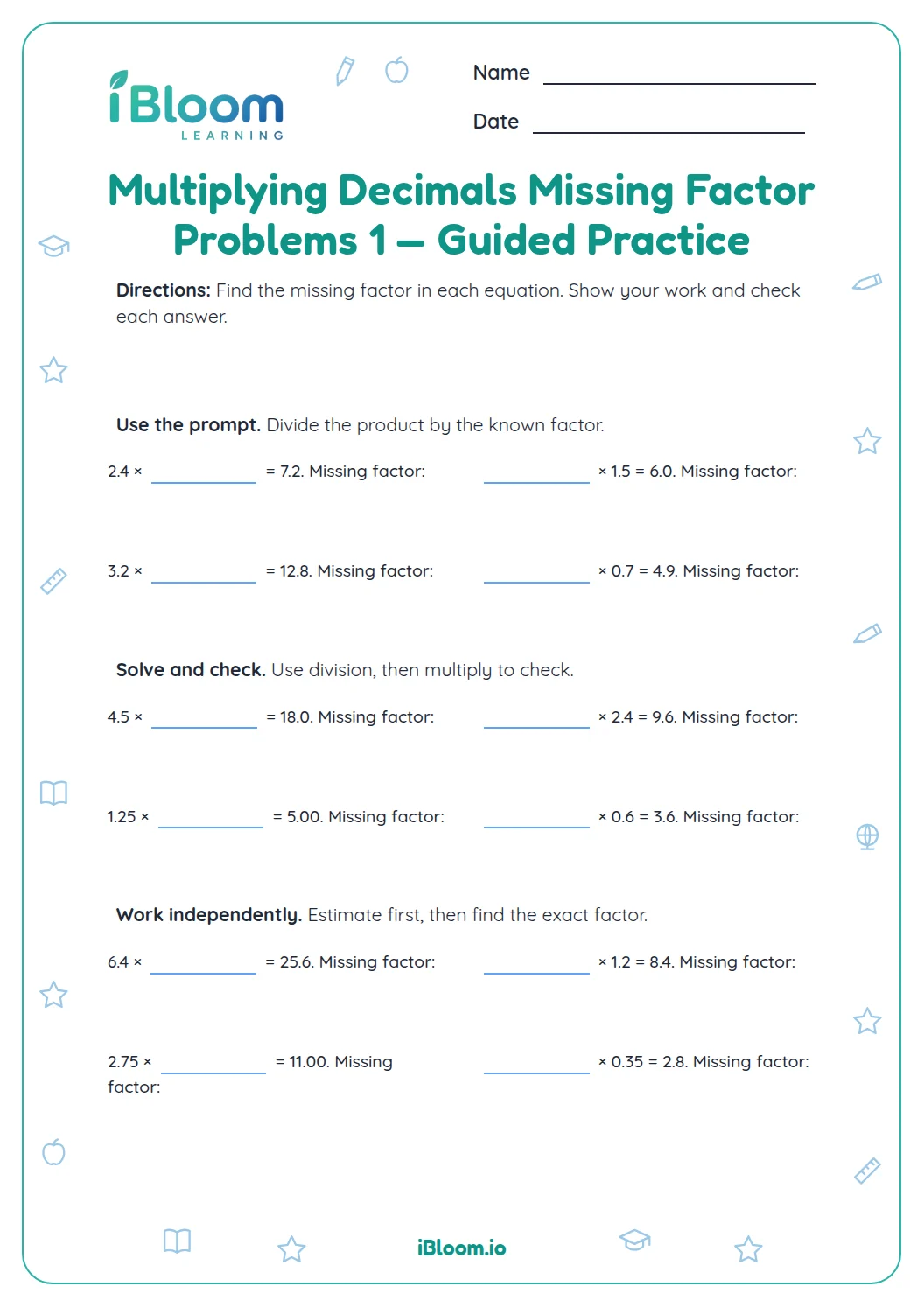
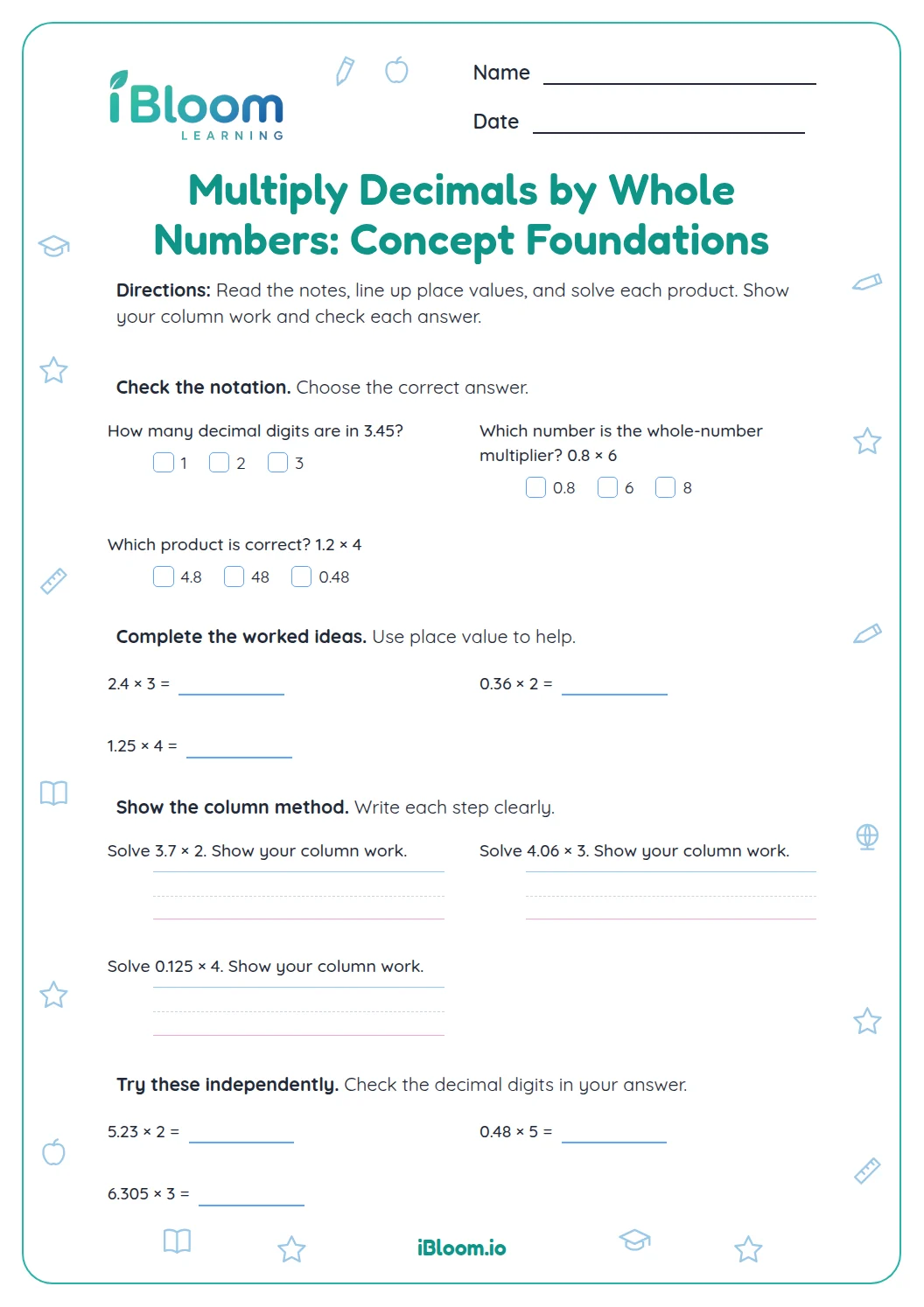
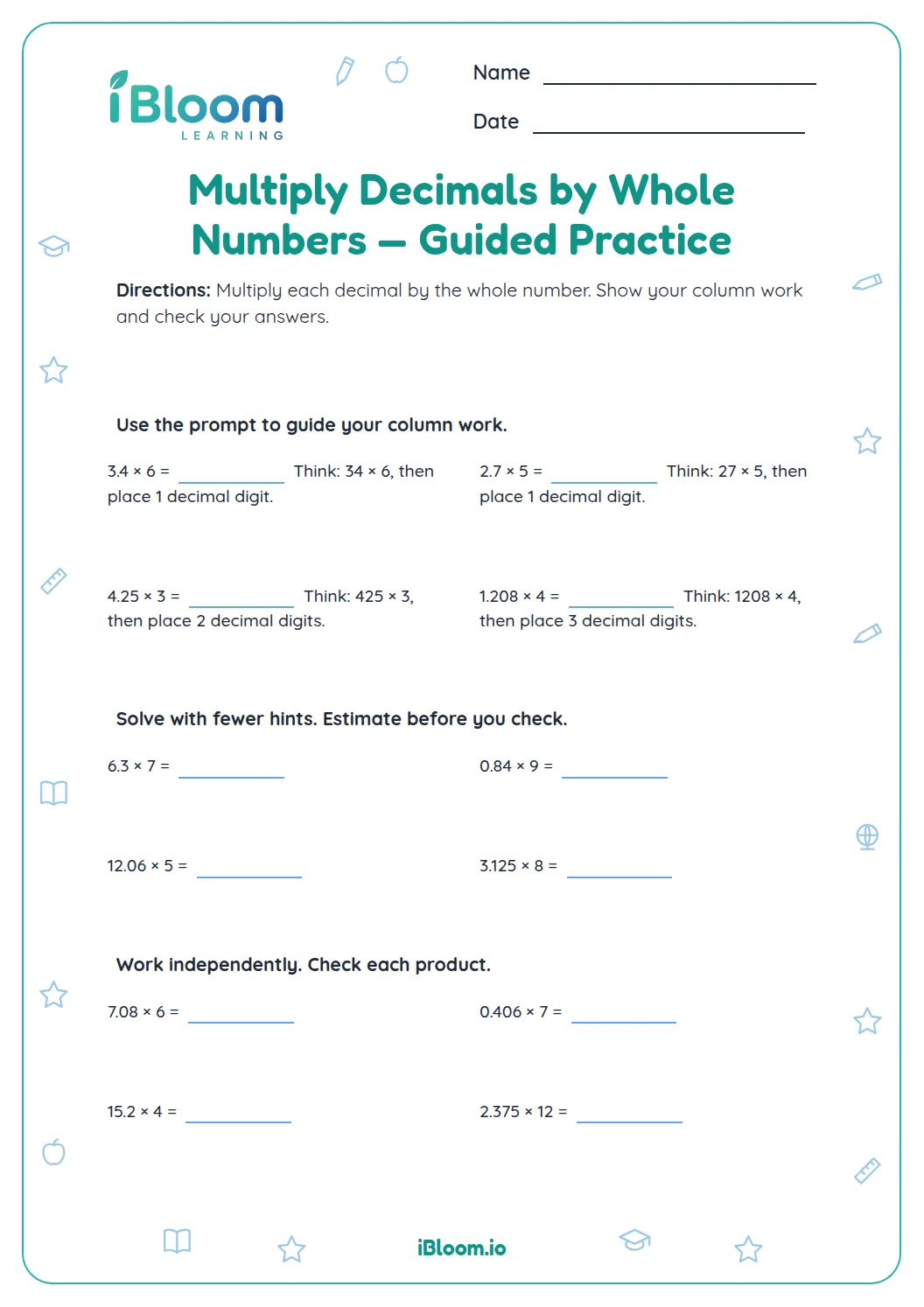
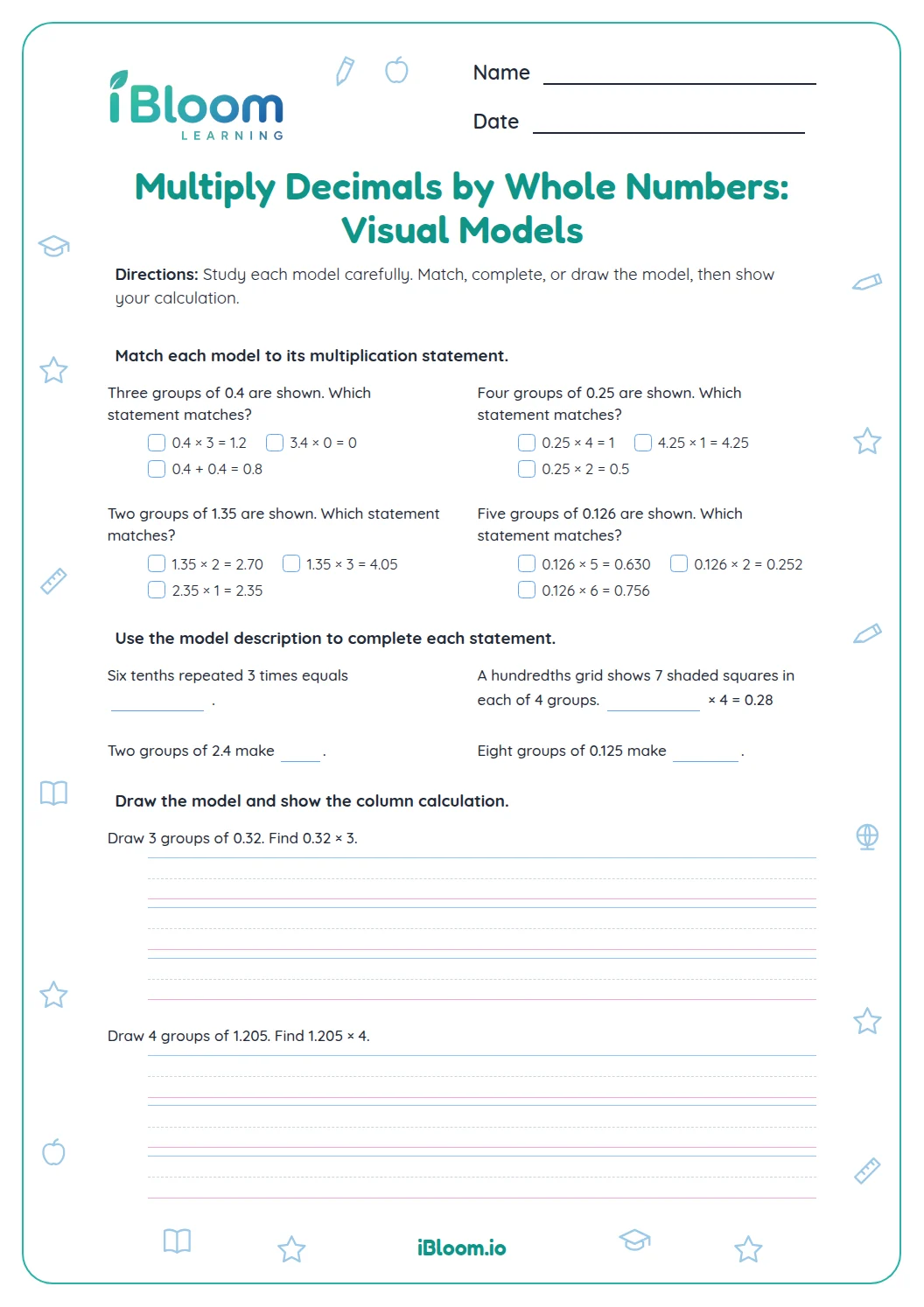
This free Grade 6 worksheet practices decimal multiplication through missing-factor word problems. Children find unit prices, equal distances, liquid amounts, and other group sizes by dividing a total, then use multiplication to check. The sixteen questions move from selected answers to written equations and reasonableness checks. The page practices CCSS 6.NS.B.3, which includes fluently computing with multi-digit decimals using the standard algorithm. A separate answer key includes units and check products.
Aligned to 6.NS.B.3
How does division find the missing factor?
When a total is split into equal groups, divide by the number of groups. In question 1, four notebooks cost $18.00 altogether, so $18.00 ÷ 4 = $4.50 per notebook.
Multiplication checks the result: 4 × $4.50 = $18.00. Keep the unit attached to the quotient so the answer says what one group contains.
How can an estimate catch a misplaced decimal?
Estimate before calculating. The price in question 1 should be a little less than $5 because four times $5 is $20. This makes $4.50 sensible and rules out answers such as $0.45.
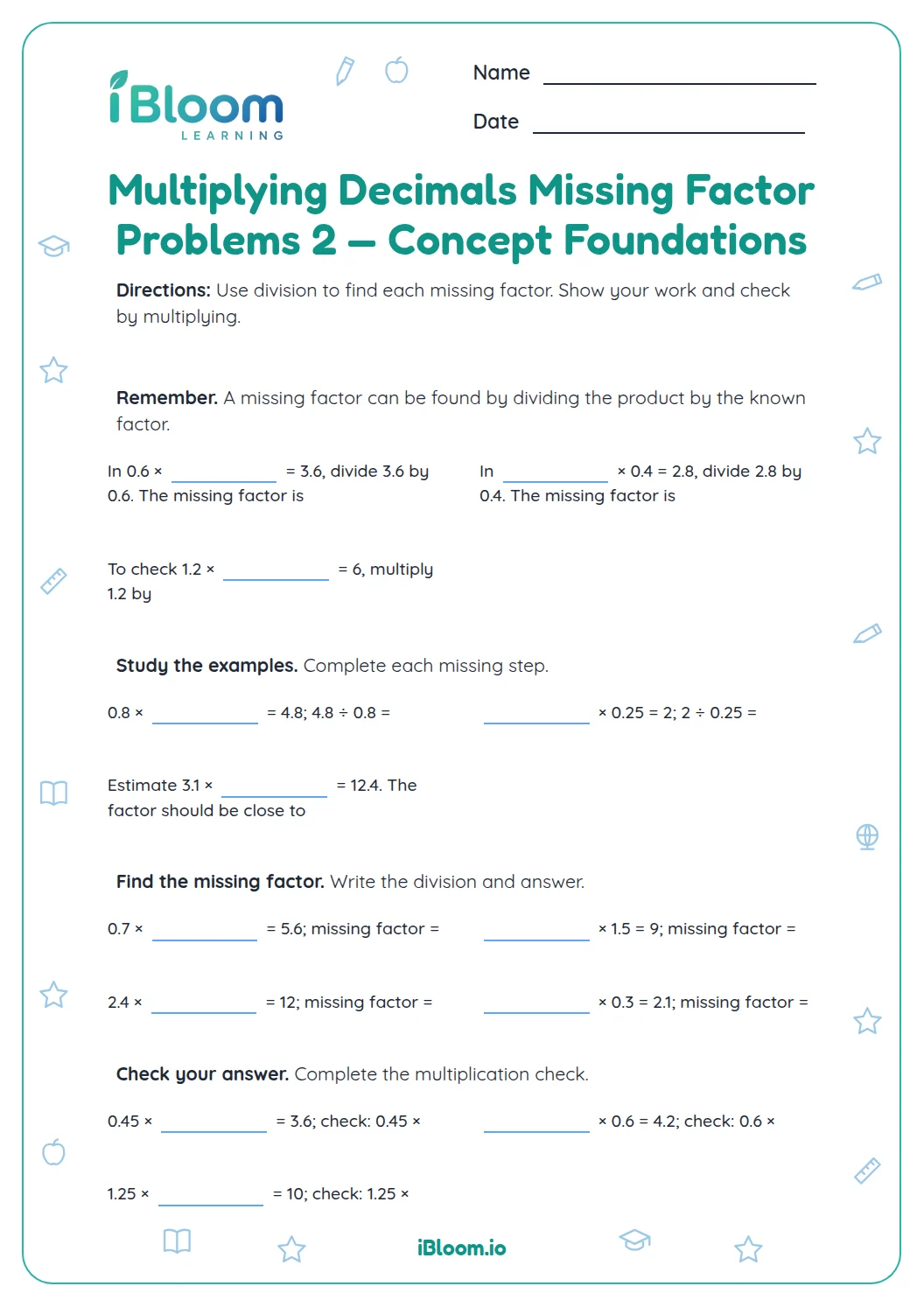
The final part asks children to complete multiplication checks. Match the product to the given total, then include its unit where the prompt requests one.
What practice is included?
Sixteen questions move from choosing a quotient to solving equal-group problems and checking factors. The stories use different quantities and units so the same division idea appears in varied settings.
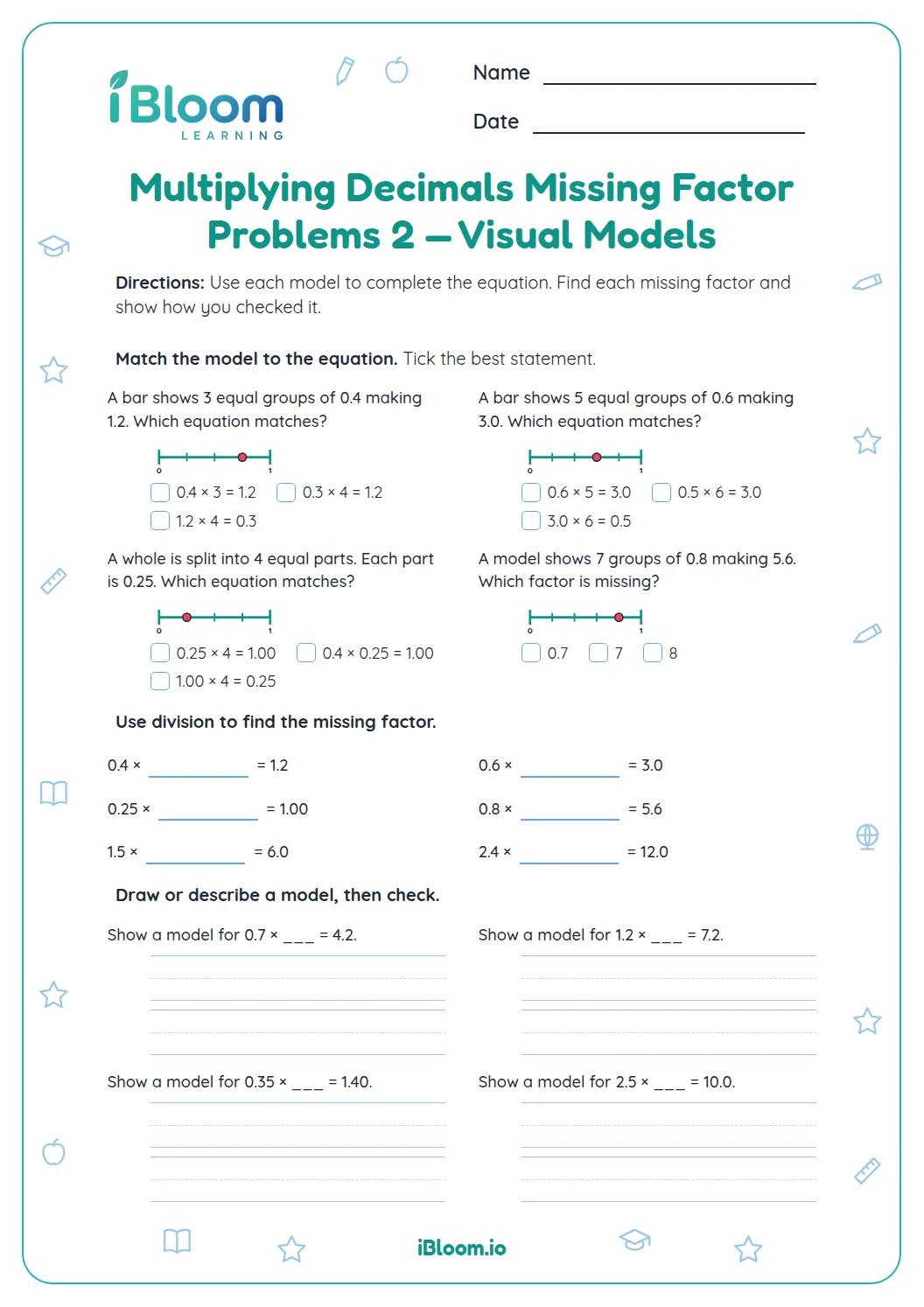
- Part A: four multiple-choice situations
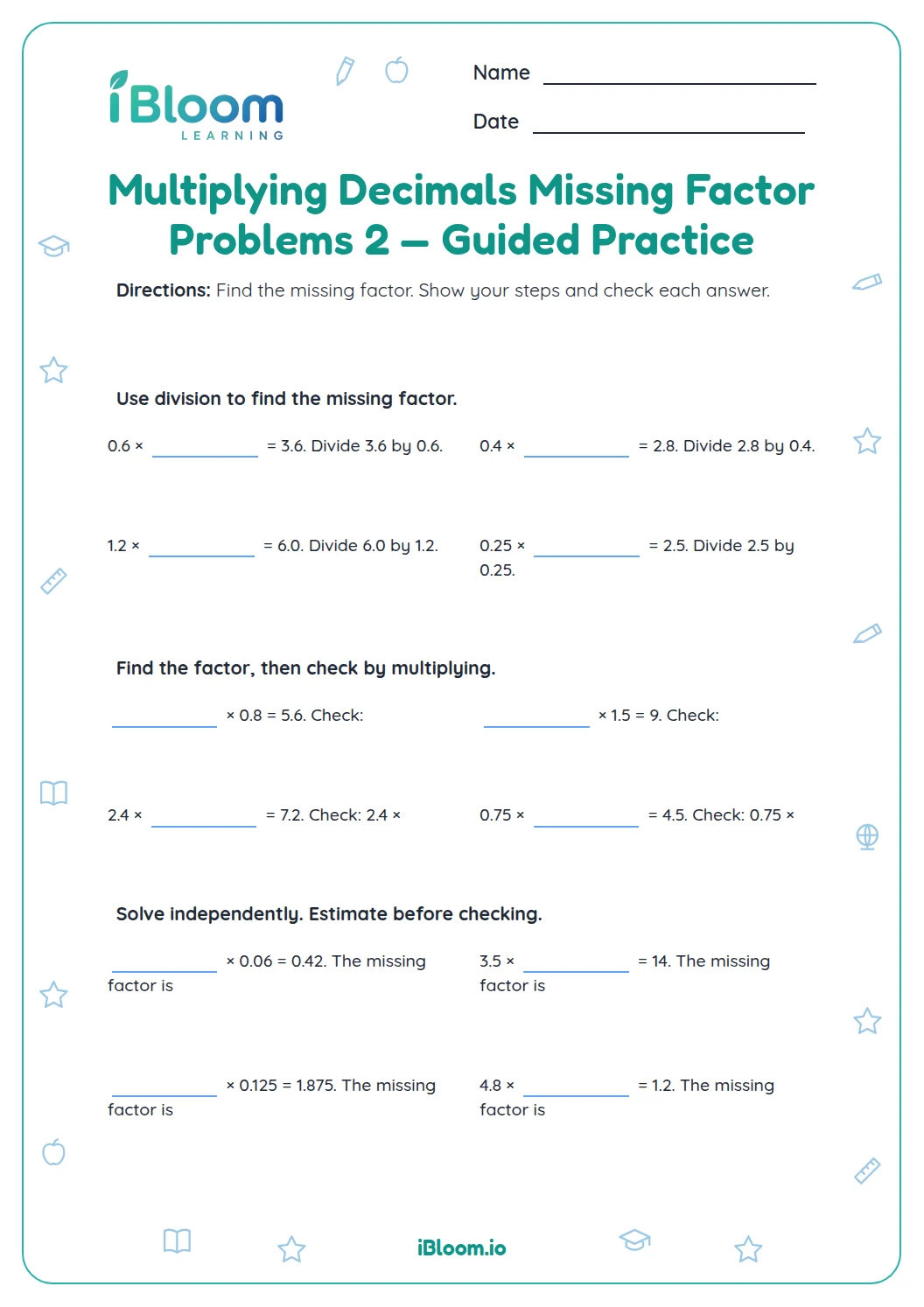
- Part B: four missing-factor word problems
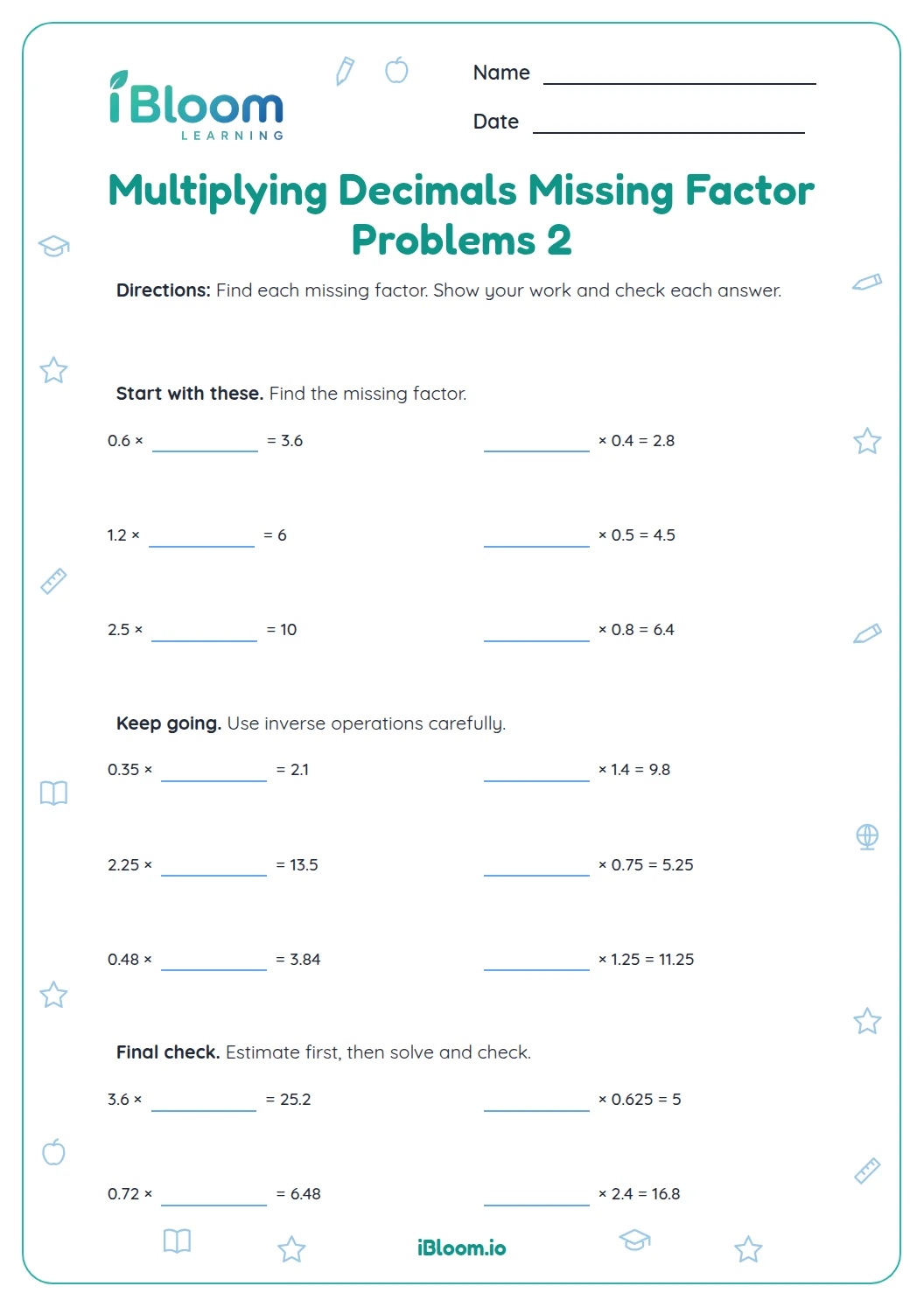
- Part C: four word problems with working space
- Part D: four multiplication checks
- Four worksheet pages and a separate four-page key
How to use this worksheet
- 1Read the situation and identify the total and number of equal groups.
- 2Estimate the size of one group before dividing.
- 3Write total ÷ groups = one group for the equation items.
- 4Keep the unit from the story in the answer.
- 5Multiply the quotient by the number of groups to check.
Common decimal division slips
The mistake
Moving the decimal in the quotient without estimating.
The fix
Estimate the size of one group first and check that the quotient is plausible.
The mistake
Dividing the number of groups by the total.
The fix
Use total ÷ number of groups to find the amount in one group.
The mistake
Leaving off the unit in a story problem.
The fix
Copy the unit that describes one group, such as dollars per ticket or liters per jar.
Common Core alignment
The problems connect decimal computation to equal groups and real quantities.
Compute with decimals and use quotients to solve these equal-group problems.
On this sheet: The problems require decimal division and multiplication checks in context.
Show the official wordingHide the official wording
Fluently add, subtract, multiply, and divide multi-digit decimals using the standard algorithm for each operation.
What to practice next
Make more practice
Further reading
Questions parents and teachers ask
How do you find a missing factor in a decimal situation?
Divide the total by the number of equal groups. For example, $18.00 shared among 4 notebooks gives $4.50 per notebook because $18.00 ÷ 4 = $4.50; multiply back to check that the product returns the original total. The same divide-then-multiply strategy works for money, lengths, and measures of capacity.
What kinds of situations are on the worksheet?
Problems use equal prices, distances, amounts of liquid, flour, soil, and ribbon. Each gives a total and number of equal groups, then asks children to find the amount in one group. Later items check a proposed factor by multiplication. Children can write the division sentence before choosing or recording a quotient.
How can a child check a quotient?
Multiply the quotient by the number of equal groups. If 8.4 miles split into 6 equal laps gives 1.4 miles per lap, then 6 × 1.4 returns the original total of 8.4 miles. Keep the unit with the answer. This reverse operation confirms both the decimal placement and the equal-group relationship.
Why does decimal placement matter?
The quotient must fit the size of the total. If $18 is shared among 4 notebooks, each price is greater than $4 and less than $5; $0.45 is too small and $45 is too large. Estimation catches misplaced decimal points. Comparing with a nearby whole-number estimate also helps judge whether a quotient is sensible.
Is an answer key included?
Yes. The separate answer key lists each missing factor with its unit and shows products for the check items. Encourage children to include a division equation and a multiplication check whenever the prompt asks for working. Answers are grouped by worksheet page. The key keeps units in the written answers and shows the product for each check.