
About this worksheet
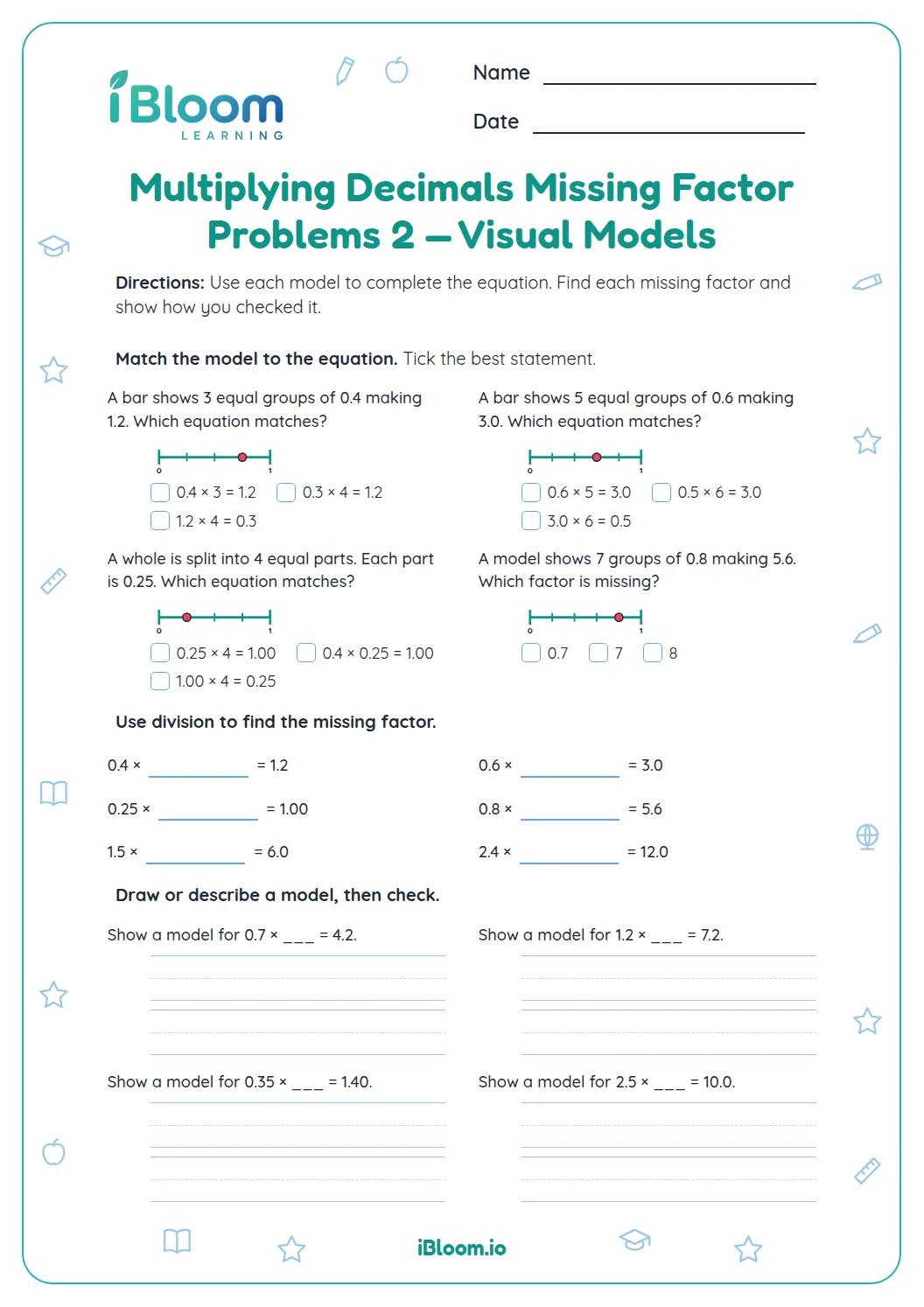
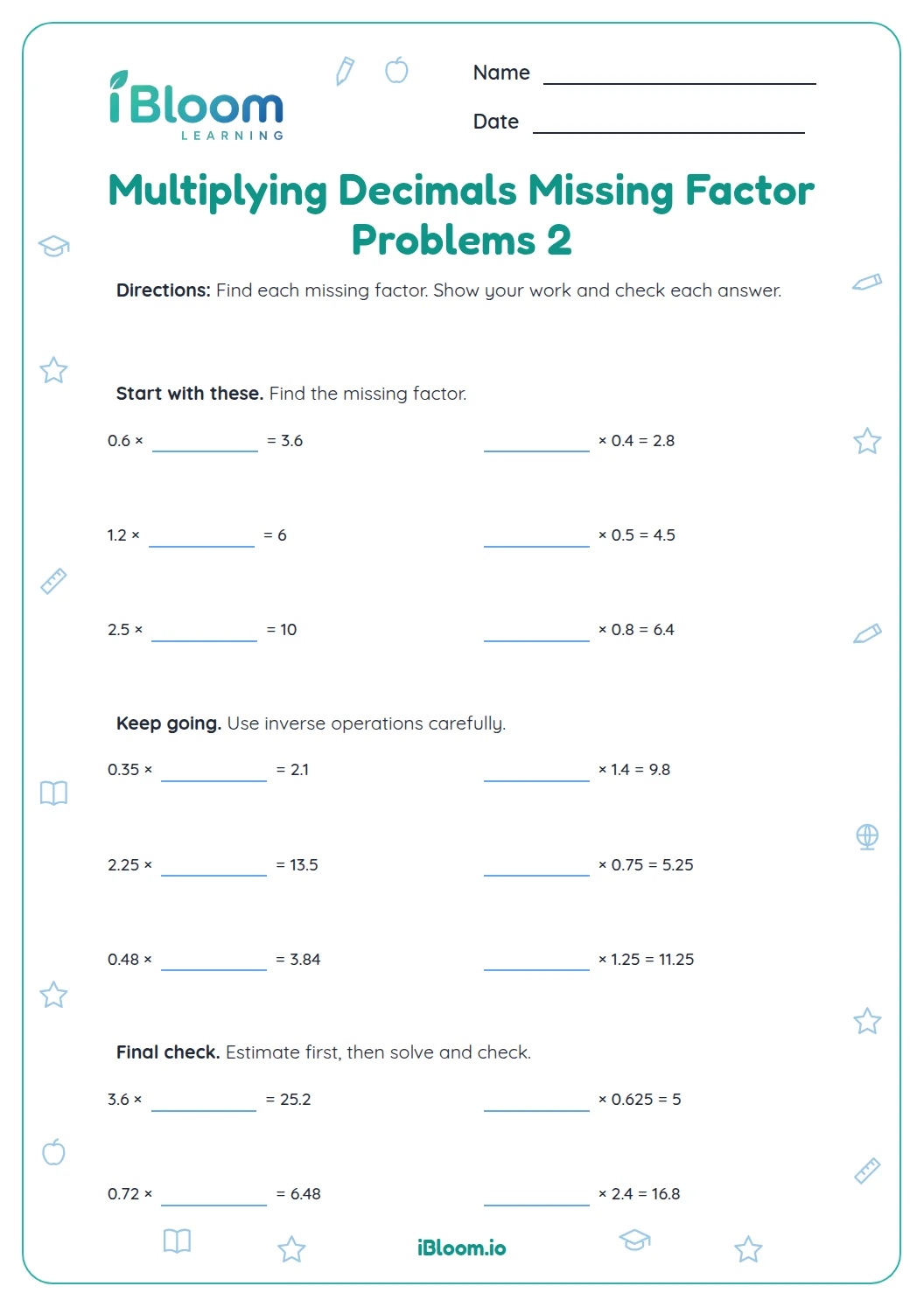
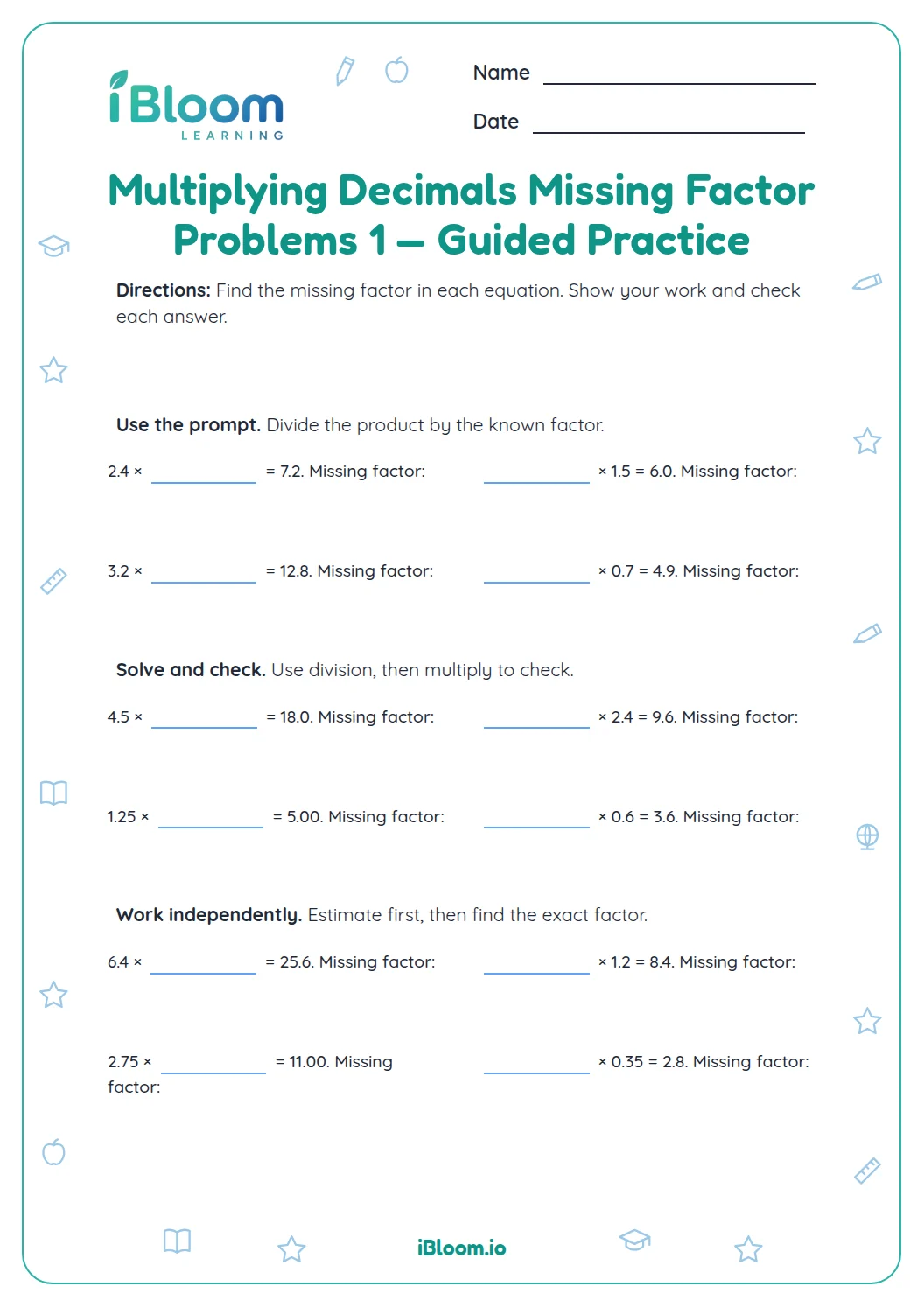
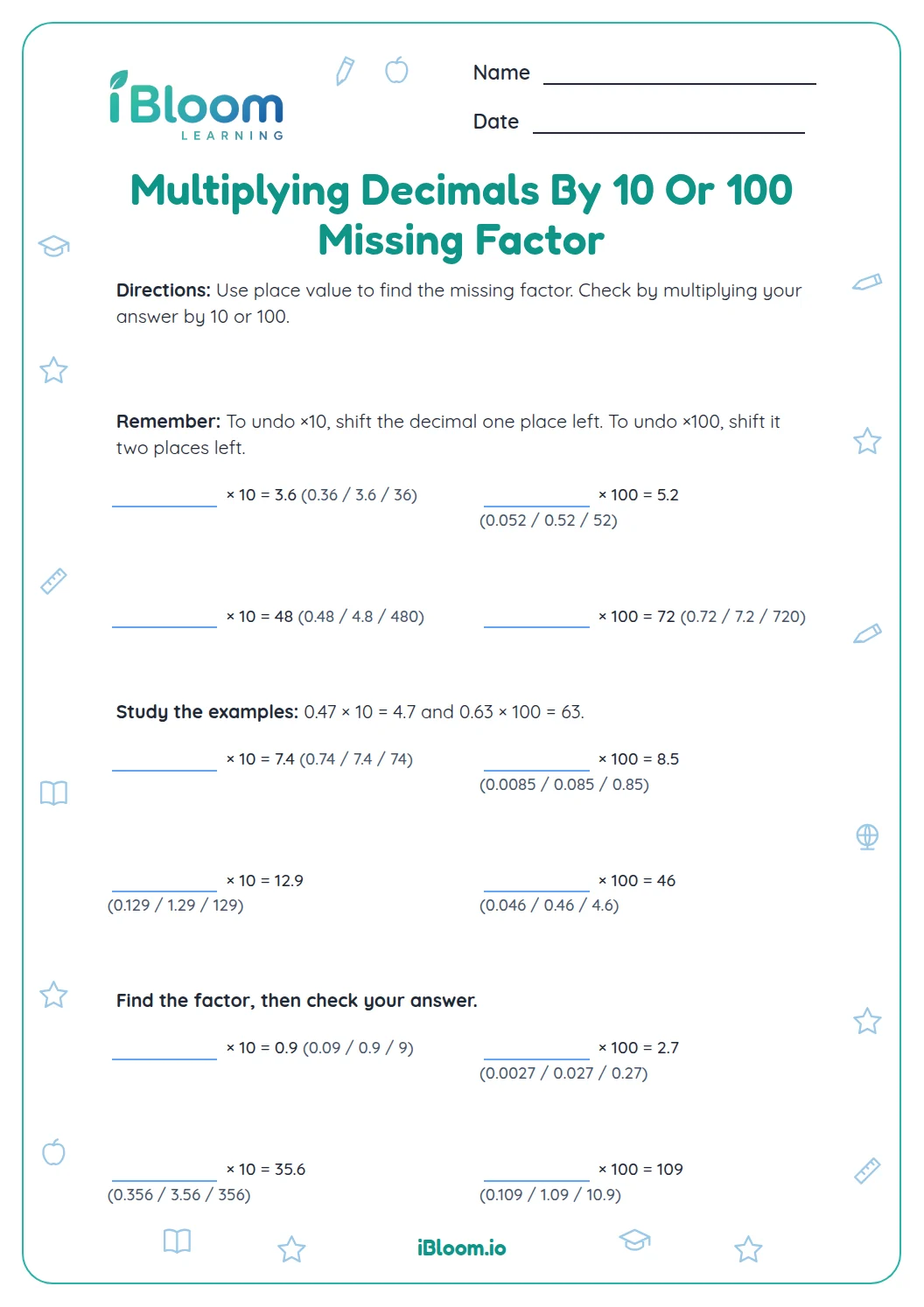
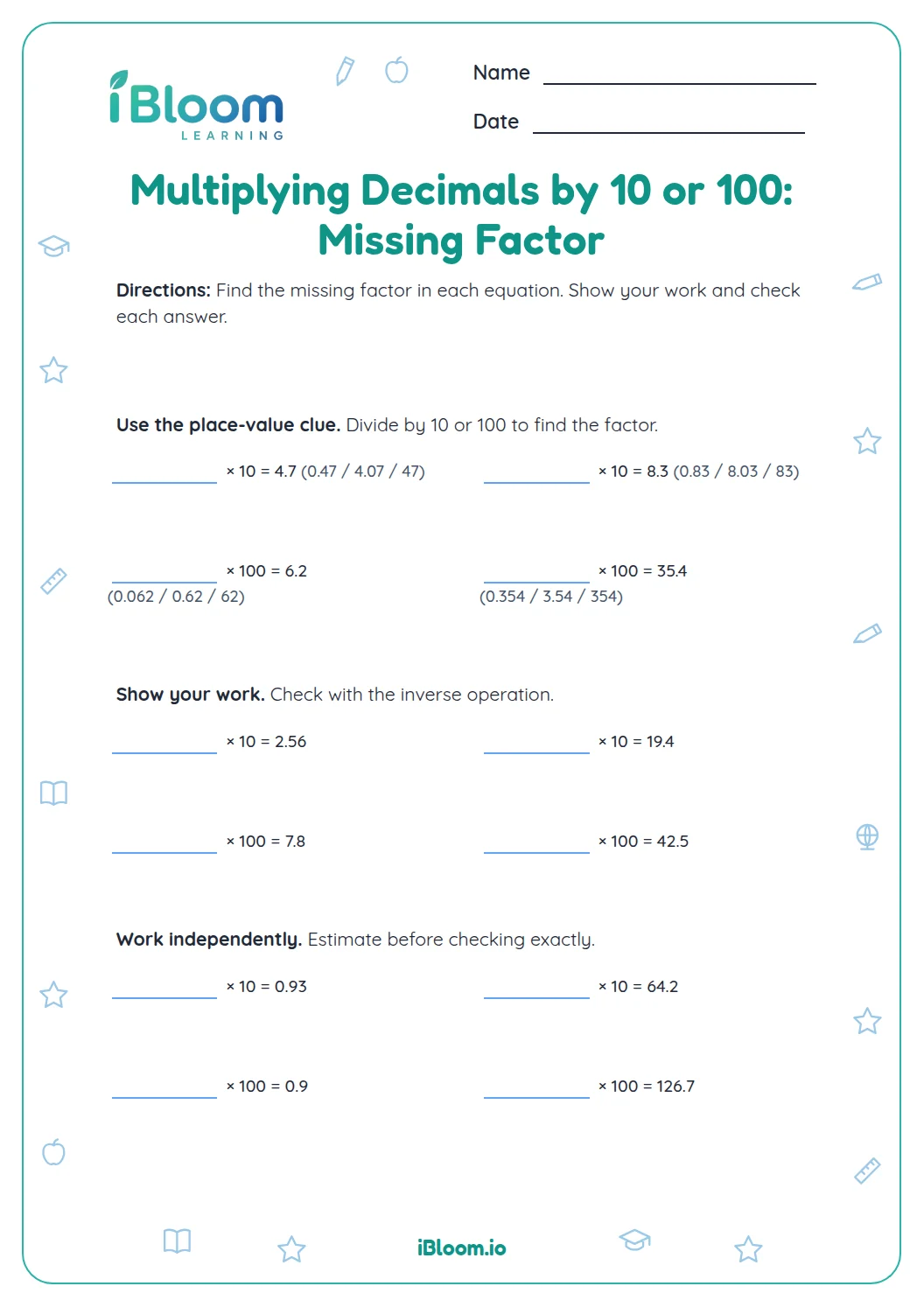
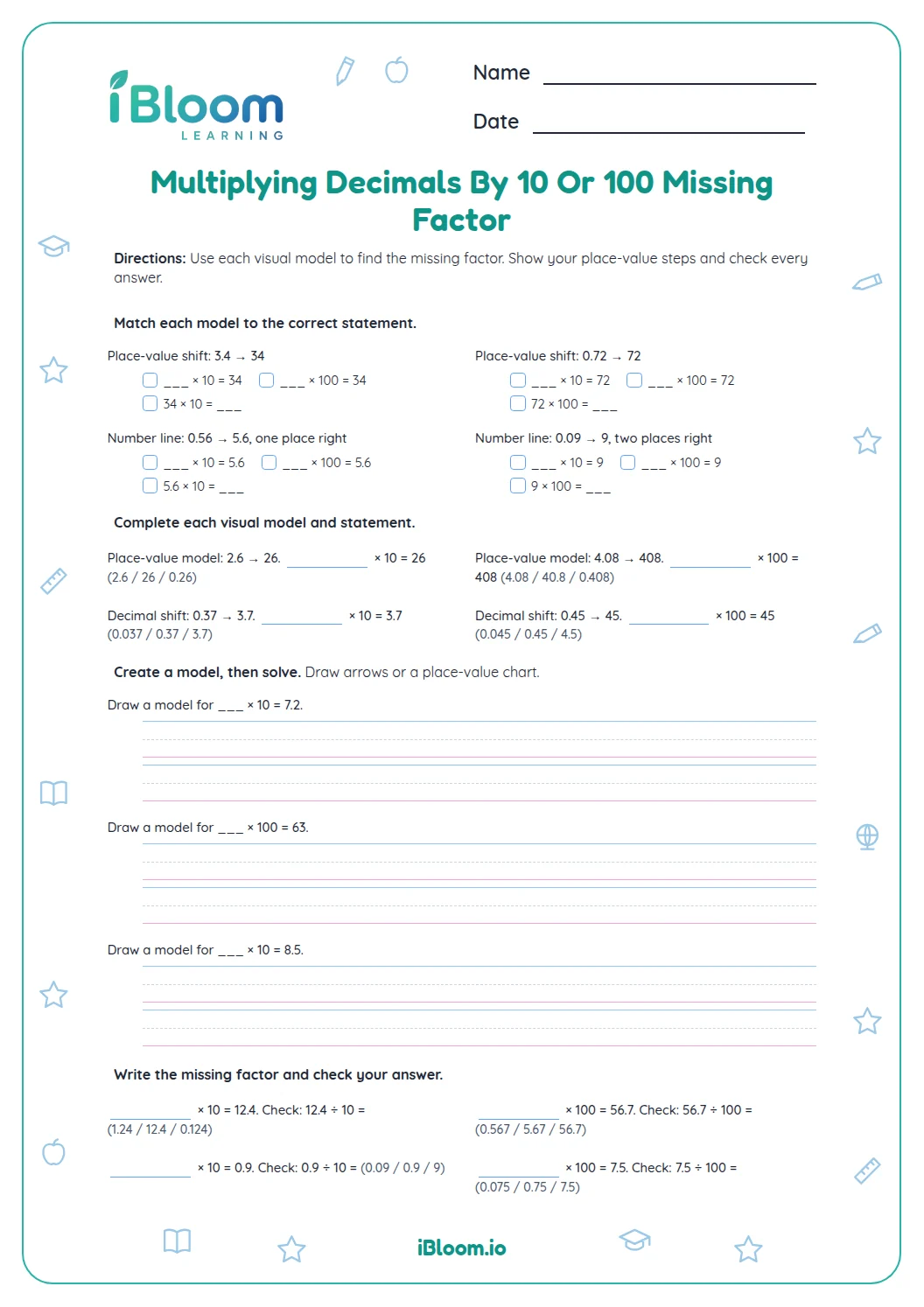
This Grade 6 printable focuses on finding a missing factor in multiplication equations with decimal factors. Twelve equations build practice, followed by an error check and three applications. Learners use division to work backward, estimate the factor’s size, and multiply to verify each result. A separate answer key is included.
Aligned to 6.NS.B.3
How can division reveal the missing factor?
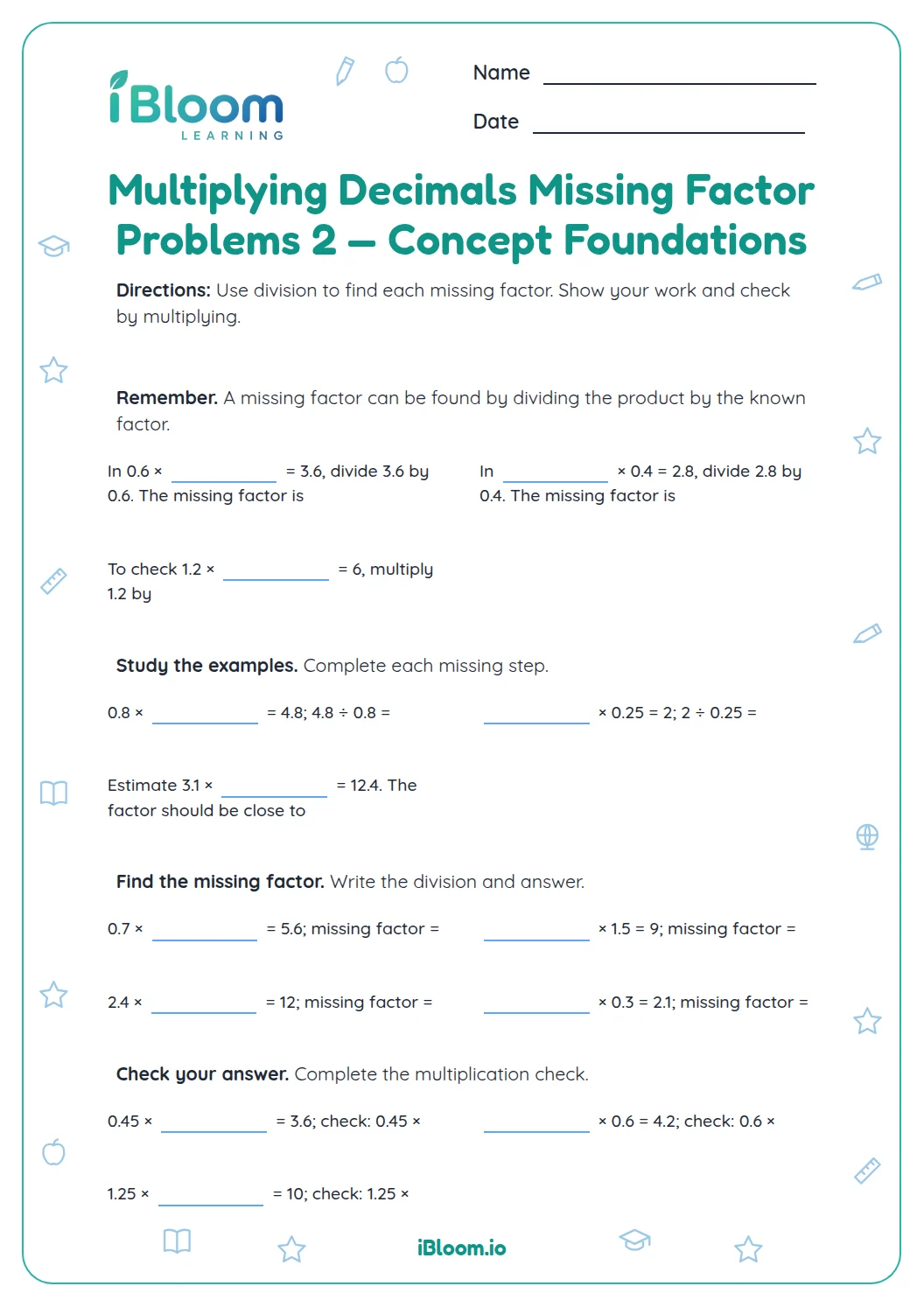
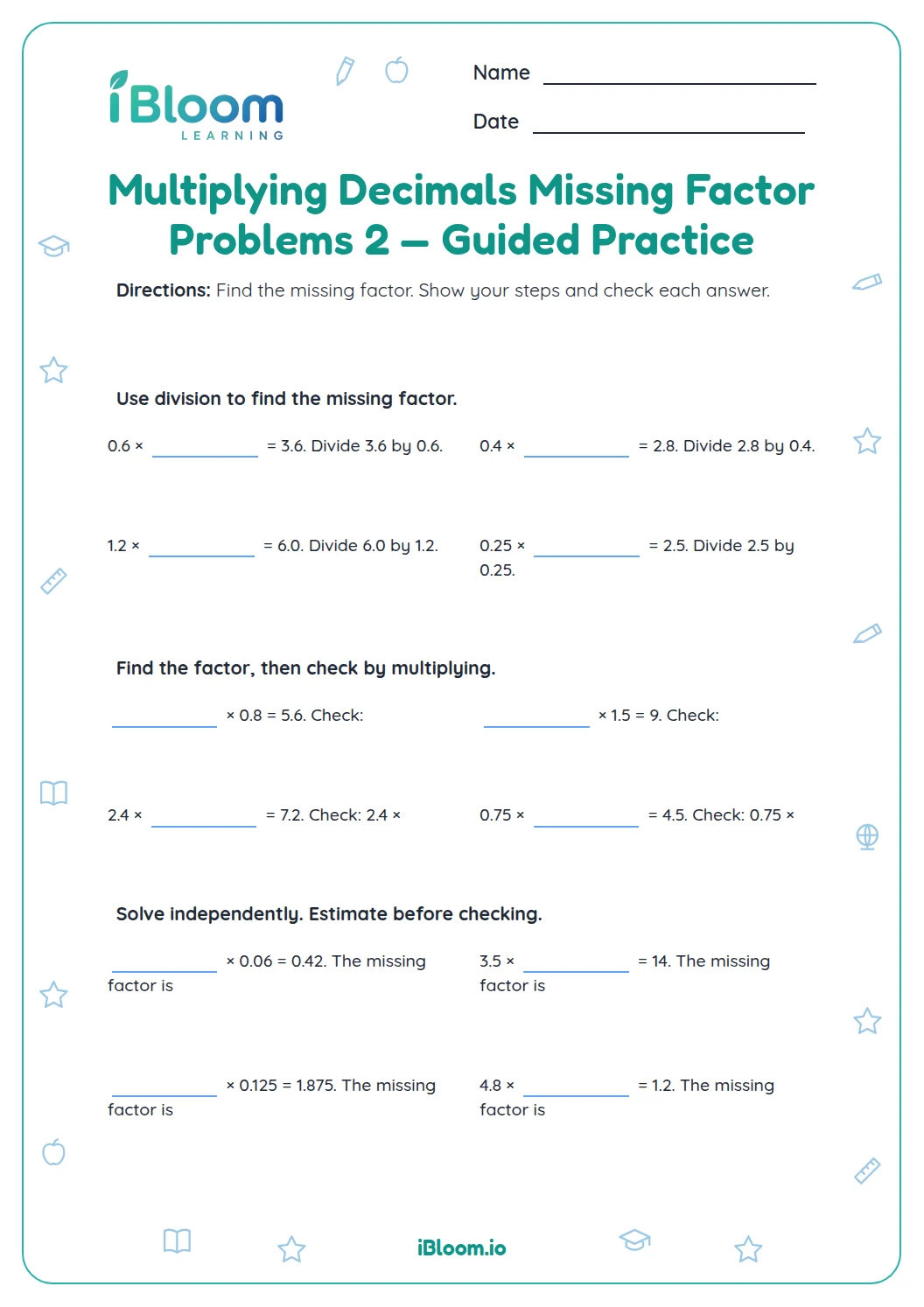
Multiplication and division undo one another. In question 1, the missing factor in ___ × 0.6 = 4.8 is 4.8 ÷ 0.6, or 8. Check: 8 × 0.6 = 4.8.
How can place value guide a decimal answer?
Estimate first. If a product is 0.96 and one factor is 3.2, the missing factor should be less than 1. Dividing 0.96 by 3.2 gives 0.3.
How do you check the factor?
Substitute the proposed value into the original equation and multiply. In question 13, 0.4 × 0.8 = 0.32, so 0.8 cannot make a product of 2.
How to use this worksheet
- 1Read the known factor and product.
- 2Estimate whether the unknown should be large or small.
- 3Divide the product by the known factor.
- 4Write the missing factor in the blank.
- 5Multiply to check the equation.
Common mistakes and quick fixes
The mistake
Moving the decimal point without a reason.
The fix
Use division by the known factor and check with multiplication.
The mistake
Choosing a factor smaller than expected.
The fix
Estimate: multiplying by a factor below 1 makes a positive number smaller.
The mistake
Using the known factor as the answer.
The fix
Substitute it and verify that the product matches.
Common Core alignment
This sheet gives practice with the Common Core skill named below.
Use standard algorithms to multiply multi-digit decimals.
On this sheet: Learners multiply decimal factors to verify products and use division to find unknown factors.
Show the official wordingHide the official wording
Fluently add, subtract, multiply, and divide multi-digit decimals using the standard algorithm for each operation.
What to practice next
Make more practice
Further reading
Questions parents and teachers ask
What operation finds a missing factor?
Divide the product by the factor you know. In question 1, the missing factor in ___ × 0.6 = 4.8 is 4.8 ÷ 0.6, or 8. Multiplication checks the result: 8 × 0.6 = 4.8. This inverse operation works whether the missing factor is greater or less than 1.
How can I check a missing factor?
Substitute the proposed factor into the original multiplication equation. Multiply the two factors and see whether their product matches the number on the other side of the equals sign. Replacing the blank in the original equation makes the check easy to see.
Why estimate before calculating?
An estimate helps predict whether the unknown factor should be greater or less than 1. For example, if a product is smaller than the known factor, the missing positive factor may be less than 1. This can catch decimal-place errors.
What does the error-check question ask?
Question 13 tests the claim that 0.4 multiplied by an unknown factor gives 2, with 0.8 suggested as the factor. Since 0.4 × 0.8 = 0.32, divide 2 by 0.4 to find the correct factor, 5. This shows why the suggested value is too small.
What situations appear in the application questions?
The last items use a price per yard, a machine’s liters per cycle, and a product equation. Each asks learners to find how many equal units or groups make the stated total. The final items use the same divide-then-check strategy in context.
Is a key included?
Yes. A separate key lists the missing factors and application answers. Learners can verify the results by multiplying each proposed factor by its known factor and checking the product. Use the product and known factor to decide which division equation to write.